

You've scrubbed the shower wall twice, the white haze has come back, and now the balcony edge is doing the same thing after the last wet spell. That's the point where many waste time on another cleaner and the wrong brush, when the true job is to find where the water's getting in. Efflorescence treatment in Melbourne only works when you treat the salts as a symptom of moisture movement, not as a stain that can be rubbed off and forgotten.
Table of Contents
- What Efflorescence Treatment Really Means in Melbourne Homes
- Why Efflorescence Forms and What the Salts Tell You
- Diagnosing the Moisture Source Before You Touch the Surface
- Removing the White Deposits from Tiles, Grout, Masonry, and Stone
- Choosing the Right Cleaner and Tool for Each Job
- Preventing Efflorescence from Coming Back
- When the Job Becomes a Renovation and You Need a Registered Builder
What Efflorescence Treatment Really Means in Melbourne Homes
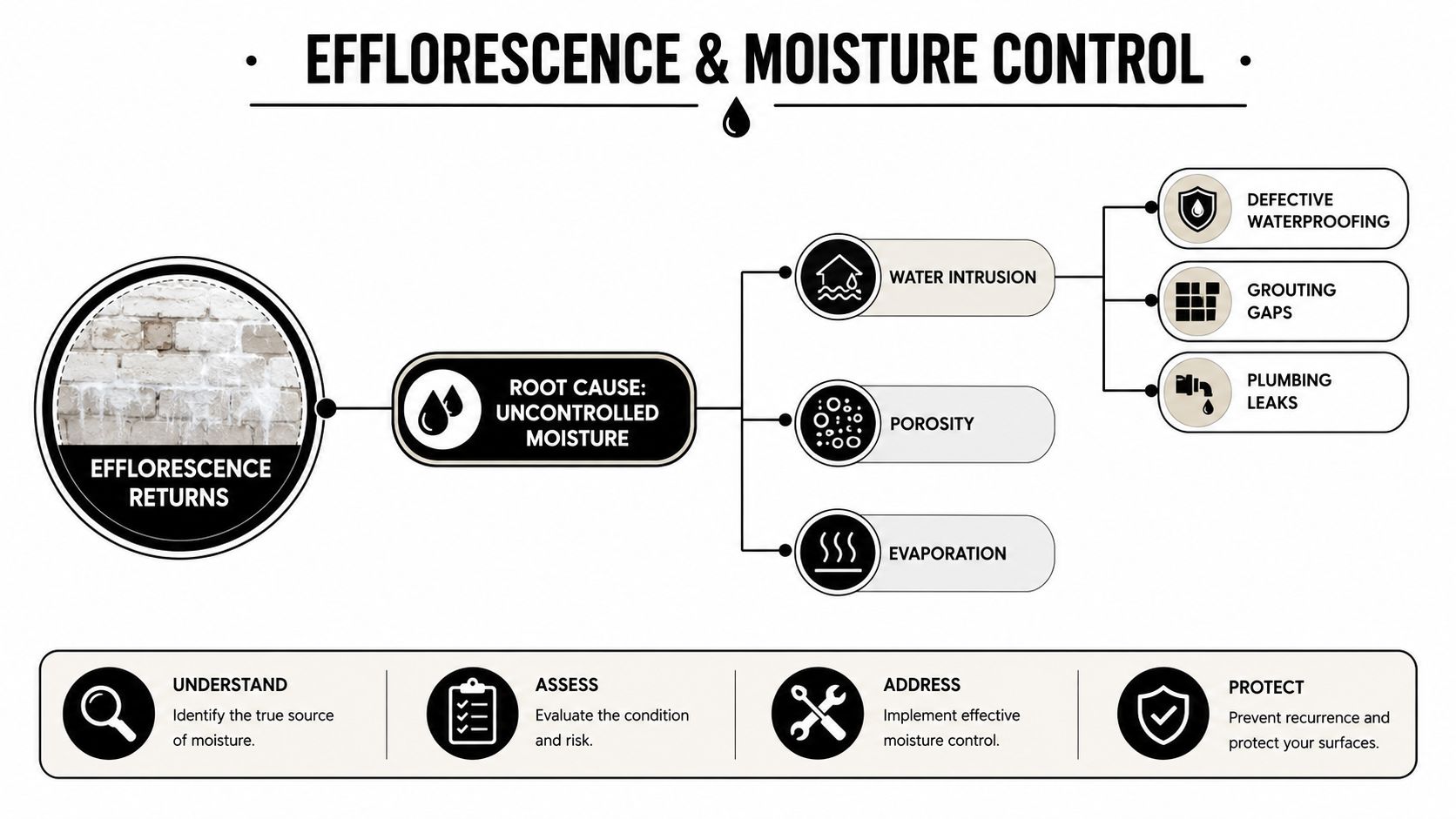
A common Melbourne call-out goes like this. A homeowner cleans a new shower wall, the tile looks fine for a week or two, then the white bloom returns along the grout line and around a niche. That points to moisture still moving through the wall, bed, or substrate and carrying salts back to the surface, so the job is not finished by cleaning alone.
Read the surface, then read the building
Efflorescence usually shows up as a white, powdery, or crystalline deposit on grout, brick, render, concrete, or stone. It can look harmless, but it usually marks the end point of water entering a porous material, dissolving soluble salts, then drying at the surface. That is why the bloom often appears near showers, balconies, external brickwork, and other wet or weather-exposed areas.
Sealing over the haze rarely fixes the issue for long. If the water pathway is still active, salts keep migrating from behind the finish and the bloom comes back. The practical rule is simple, stop the moisture first, then remove the deposits.
Practical rule: if the salt keeps returning, you're not dealing with a surface problem anymore. You're dealing with a building-envelope problem.
In Australian practice, that distinction matters because moisture control sits inside the code and the standards, not just the cleaning cupboard. The National Construction Code 2022 requires external moisture management and compliant waterproofing in wet areas, and the standards commonly used in practice include AS 3740:2021 for domestic wet areas and AS 4654.2:2012 for external above-ground waterproofing. The standards guidance above sets out the same basic point, if water control is not right, surface treatment will not hold.
A decent test is to ask whether the bloom behaves like a one-off cosmetic haze or a recurring moisture signal. One-off weathering on an exposed wall is very different from a damp patch inside a shower that keeps reappearing after cleaning. The second one almost never belongs in the “just scrub it” category.
In Melbourne homes, that distinction also affects who needs to get involved next. A tiler can clean and assess the visible salts, but a leaking shower base, failed balcony waterproofing, or recurring wet-area bloom often needs a waterproofer, plumber, or registered builder to fix the source. If the bathroom work is moving from maintenance into renovation territory, the VBA rules and the $10,000 threshold come into play, and that is where the paperwork and the trades have to line up properly.
Why Efflorescence Forms and What the Salts Tell You
Efflorescence starts when soluble salts, water movement, and a porous substrate line up in the same wall, bed, or joint. Remove one part of that chain and the bloom usually stops. Leave all three in place and the white residue keeps coming back, no matter how often the surface gets cleaned.
The chemistry behind the bloom
A new brick fence can haze over after a wet winter because rain draws salts through porous masonry, then the face dries between showers. A balcony tile bed can crust up if moisture is still trapped in the build-up while the screed cures. A rendered wall that takes wind-driven rain on its exposed face can powder in the same way. The surface changes, but the mechanism stays the same.
The older split between primary and secondary efflorescence still has practical value. Primary efflorescence comes from salts already present in the masonry, grout, or concrete. Secondary efflorescence means salts are being carried in later by groundwater, irrigation, plumbing leaks, or ongoing moisture ingress. That second type is the one that keeps trades on the job, because cleaning the face does not fix the source.
What the timing tells you
Timing and location often tell you more than the cleaner label. A bloom that shows up near a shower niche, along a balcony edge, or below a leaking pipe points in a different direction from a dry haze on an exposed north-facing wall after rain. One points to active water movement. The other may be weathering and drying.
A recurring damp patch usually beats the cleaner to the finish line. If the moisture is still there, the salts will keep returning with it.
That is why the salts are worth reading. They do not just show that a stain exists. They show that the building is moving water somewhere it should not. The masonry guidance cited earlier, including the standards and the NRC masonry review, points to the same practical order of work. Deal with the moisture path first, then clean what is left on the surface. If the wall is feeding the bloom, the wall needs attention.
Diagnosing the Moisture Source Before You Touch the Surface
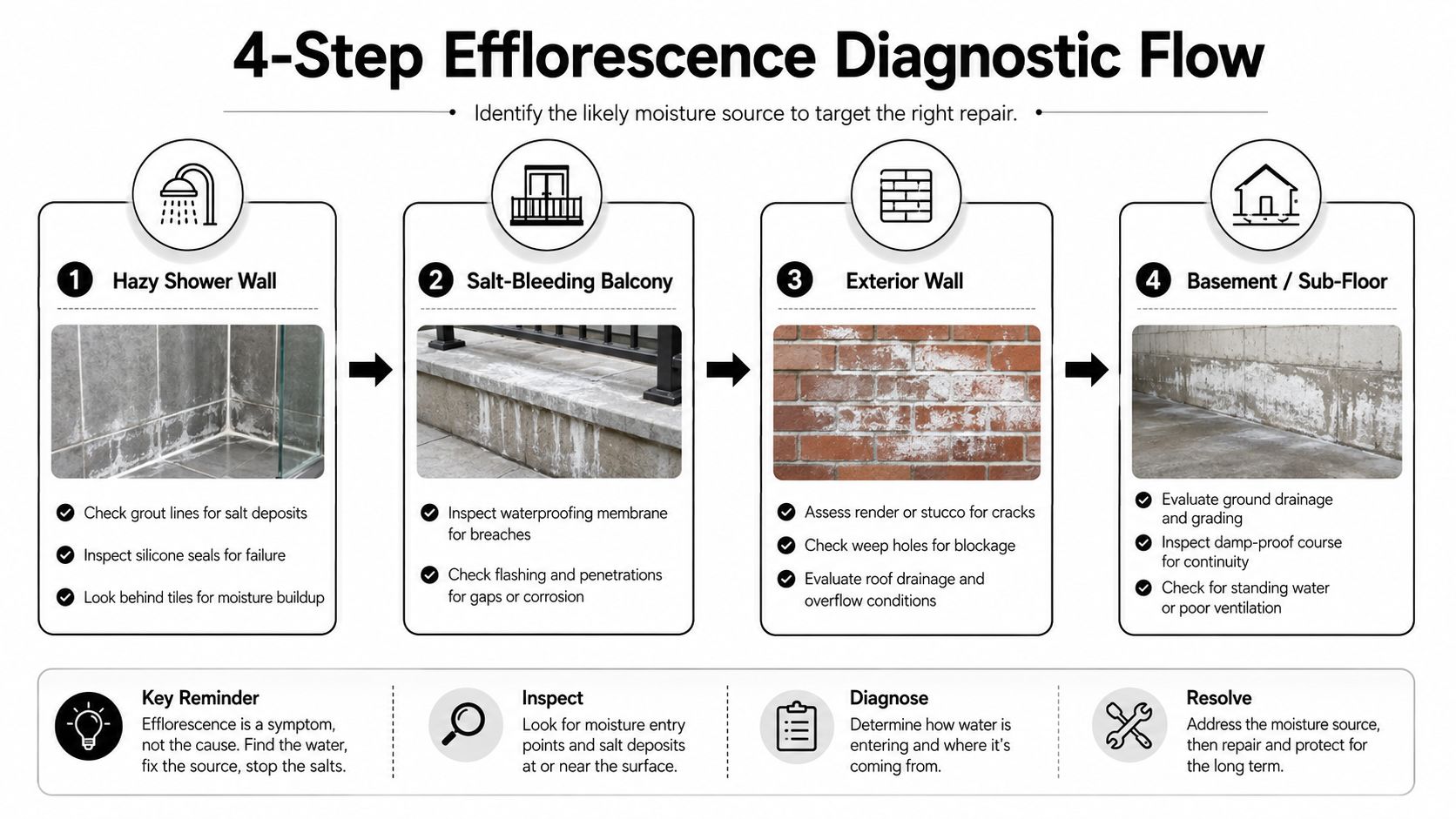
Start with location, not chemicals. A shower wall, balcony, external brick wall, and sub-floor column each fail in different ways, so the bloom has to be mapped against penetrations, drainage, waterproofing details, and recent weather. I've seen people chase the white powder for weeks when a cracked silicone joint or leaky mixer tap was doing all the work.
Start with the obvious wet zones
On a hazy shower wall, inspect grout lines, silicone seals, shower screens, and the perimeter around niches. On a salt-bleeding balcony, look at the membrane, flashing, fall to waste, and movement joints. On an exterior wall, check render cracks, weep holes, roof run-off, and garden irrigation spray. On a basement or sub-floor column, look for ground drainage problems and damp-proofing issues.
Homeowners can run a simple moisture check with plastic tape and a square of plastic sheet over the bloom for a day. If moisture shows up under the plastic, there's an active source behind the surface. A thin blade can also help you judge whether grout is sound or starting to break down, and balcony soffits can reveal hidden salt trails on the underside.
Know when to stop DIY
The hard cutoff is straightforward. If you see active dripping, mould, staining on adjacent ceilings, or a bloom that comes back within days of cleaning, stop and call a licensed waterproofer or registered builder. At that point you're not dealing with residue, you're dealing with water entry.
For deeper leak tracing, this local resource is worth keeping handy, leak detection in Melbourne. It's the right mindset for stubborn bathroom and balcony failures, because diagnosis always comes before removal.
When the bloom sits beside a shower, it also pays to think about ventilation, especially in bathrooms and laundries where internal moisture can stay trapped. That's part of the source, not an afterthought. Sherwin-Williams specifically points to vents or exhaust fans when moisture is originating inside, especially in kitchens, bathrooms, and laundry areas (efflorescence and moisture guidance).
Removing the White Deposits from Tiles, Grout, Masonry, and Stone
The first mistake usually starts with the surface, not the cleaner. I see people reach for acid on the wrong material, pressure-wash grout that is already weak, or scrub so hard they drive salts deeper into the pores. That does not solve the moisture problem, and it can turn a clean-up job into a repair job.
Match the method to the surface
Ceramic and porcelain tiles usually handle a gentle approach well, so start dry, then rinse, then use a pH-neutral cleaner if residue is still sitting on the surface. Cement-based grout needs more restraint, because harsh scrubbing can open the joints and give salts an easier path back to the face of the tile. Clay brick and concrete block can sometimes take a carefully diluted acid wash, but only after you know the substrate can tolerate it. Natural stone is where you slow down and check twice.
Never acid-wash polished marble, limestone, or any acid-sensitive stone. Once the surface is etched, you've traded a white deposit for permanent damage.
For stubborn deposits on stone, use a pH-neutral cleaner or a poultice instead of forcing the issue with acid. That matters most on limestone, marble, and softer sandstone, where even a small mistake can change the colour and sheen. If you're dealing with marble bathroom tiles, keep the chemistry conservative and the brushing light, this marble cleaning guide shows how quickly a cleaning mistake becomes a surface repair.
Use acid only where the substrate can take it
Historical masonry guidance still sets the safe end of the scale. If acid is used at all, it should be diluted muriatic acid, with older practice limiting it to about 1 part acid to 12 parts water, and other guidance warning not to exceed 10% acid because stronger mixes can etch masonry and alter colour and texture. That same caution is echoed in the masonry guidance above. Rinse thoroughly with clean water, ventilate the area well, and wear PPE.
A sensible sequence on masonry is straightforward.
- Dry brush first to remove loose salts.
- Rinse lightly so you don't drive dust back into the pores.
- Treat only if needed with the mildest suitable cleaner.
- Rinse again until no residue remains.
- Dry fully before deciding whether the moisture source is fixed.
That sequence works because it respects the substrate. It does not pretend every white stain needs the same chemical.
Choosing the Right Cleaner and Tool for Each Job
The right cleaner depends on the surface, not the frustration level. A good outcome usually comes from the least aggressive method that still removes the deposit. A bad outcome usually starts with bulk-store acid, a stiff hand, and no plan for the rinse water.
A quick comparison
| Method | Best For | Avoid On | Strength |
|---|---|---|---|
| Plain water and stiff nylon brush | Fresh, loose surface bloom on tiles and masonry | Delicate stone if over-scrubbed | Mild |
| Dilute acid wash | Acid-tolerant brick, block, and some masonry | Polished marble, limestone, acid-sensitive stone, failing grout | Moderate |
| Commercial efflorescence remover | Mixed surfaces where the label suits the substrate | Anything the manufacturer excludes | Moderate to strong |
| Poultice | Ingrained deposits on stone and sensitive finishes | Surfaces that can't tolerate dwell time or moisture | Targeted |
Build a simple toolkit
A stiff nylon or natural-bristle brush handles loose salt better than a wire brush, which can scar the finish. A plastic paint scraper helps lift crust without gouging. A pump sprayer applies cleaner evenly, and pH strips let you keep an eye on the rinse. A wet-dry vac saves a lot of residue on floors and balconies, especially where run-off would otherwise sit in the joints.
Cheap hydrochloric acid from a bulk hardware shelf is the trap. It can etch grout, dull stone, and leave a bigger job than the one you started with. The label doesn't care how angry you are at the wall.
If a second clean produces the same amount of salt, stop escalating the chemistry. The moisture source is still active, and the next step is diagnosis, not a stronger bottle. That's the difference between maintenance and denial.
Preventing Efflorescence from Coming Back
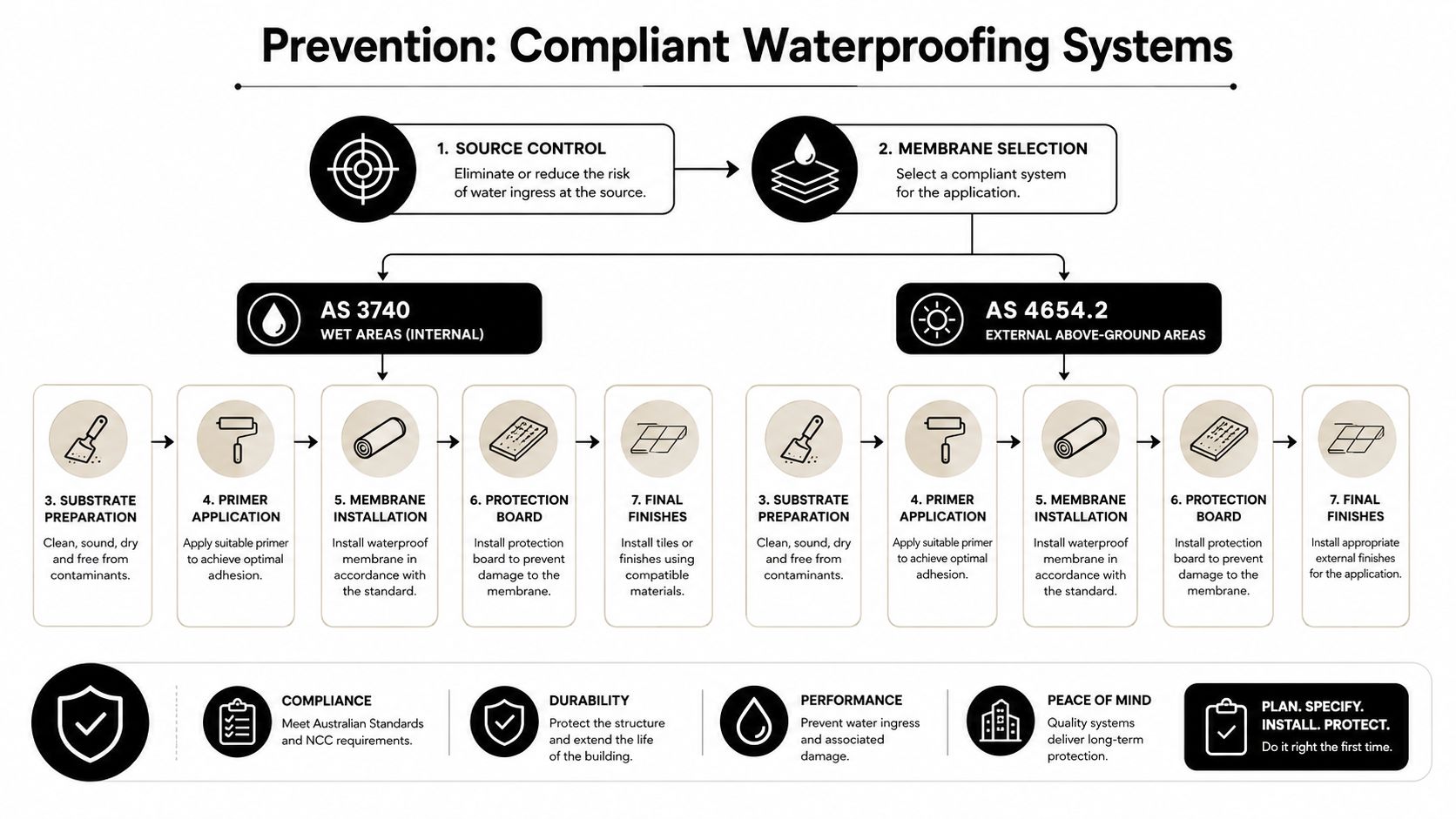
A clean face can look like the job is done while problem is still moving through the wall, floor, or balcony edge. Long-term prevention starts with the building envelope, then the finish. If the membrane, falls, drainage, or ventilation are wrong, salts will keep migrating and the white bloom will return.
What stops the salt cycle
In wet areas, compliant membranes matter because the surface finish only stays stable if the substrate is kept dry enough. That is why AS 3740:2021 sits at the centre of domestic wet-area waterproofing practice, and AS 4654.2:2012 matters for external above-ground membranes, as noted earlier in the NCC and Australian Standards guidance. The trade logic is simple. Water has to be managed before the salts stop moving.
The practical package is unglamorous, but it works. Correct falls to waste, capped penetrations, properly primed substrates, sound grout, quality silicone, and movement joints on balconies all do a job. Miss one of those details and the bloom often comes back after a few wet cycles.
Moisture management is part of the fix
Rain exposure, irrigation overspray, leaking taps, and poor ventilation all feed the problem. Bathrooms and laundries need mechanical extraction that moves damp air out, not just a decorative vent cover. That matters when the bloom keeps showing up after showers, winter rain, or a stretch of humid weather.
If the wall keeps getting wet, it keeps salting up. The coating on top will not outwork the leak behind it.
Seasonal grout inspection is worth doing, and natural stone needs resealing on a sensible maintenance cycle. When a new bloom appears after heavy rain, treat it as a signal. For membrane and waterproofing work in Melbourne, this waterproofing overview shows how the trade approaches the problem from the substrate out.
When the Job Becomes a Renovation and You Need a Registered Builder
Once efflorescence points to shower failure, balcony membrane breakdown, or a larger bathroom strip-out, the job stops being a cleaning task. In Victoria, that matters legally as well as practically. The Victorian Building Authority says a domestic building contract is required for work over $10,000, and domestic building work includes renovations to bathrooms and laundries, with major work generally requiring a registered builder (VBA guidance as referenced in the verified data).
Know where the line is
A single faint haze on one wall may be a DIY cleaning candidate. A shower that keeps salting up, a balcony that bleeds through the edge, or a larger scope involving waterproofing, screeding, tiling, and plumbing is a different project altogether. At that point you need coordination, compliance, and a proper scope, not just a bucket of cleaner.
That's why registered builders matter on bathroom renovations. The visible finish can look clean while the membrane underneath is already failing. If the waterproofing is wrong, the salts will come back no matter how good the tile face looks on day one.
Use a simple decision tree
- Locate the bloom. Shower, balcony, exterior wall, or sub-floor.
- Test for moisture. Plastic sheet, stain mapping, and visible damp clues.
- Identify the substrate. Tile, grout, brick, render, stone, or concrete.
- Choose the mildest suitable treatment. Brush, rinse, pH-neutral cleaner, or carefully diluted acid where appropriate.
- Fix the source. Membrane, leak, drainage, ventilation, or plumbing.
- Decide the scope. DIY cleaning for a small cosmetic patch, registered-builder work for renovation-scale repairs.
The warning signs are hard to miss. Persistent return after cleaning, mould, soft or lifting tiles, water staining on adjoining surfaces, and any sign of a structural leak are all clear indicators. If you're seeing those, you're not buying a cleaner, you're buying a building-envelope repair.
For Melbourne homeowners, that's usually the cheapest way to think about it anyway. The cheap-looking fix is often the most expensive one once the salt keeps coming back.
If you're dealing with efflorescence that won't stay gone, Melbourne Tiling Services P/L can assess whether you've got a surface stain or a waterproofing failure hiding underneath it. They handle bathroom renovations, leak rectification, waterproofing, and tiling with the kind of scope control this problem usually needs, so visit Melbourne Tiling Services P/L to organise a quote and a proper plan before the white bloom comes back again.
Write a Comment