
There's no universal expiry date for waterproofing: a well-installed internal wet-area membrane is assessed around a 25-year service life, a protected balcony membrane about 15–25 years, and an exposed coating often 5–10 years. These are performance expectations, not replacement deadlines.
The popular advice to replace waterproofing because it has reached a certain birthday misses the bigger issue. A membrane can fail early at a poorly sealed pipe, while an older system can continue protecting the building because its drainage, junctions and substrate remain sound.
For Melbourne homeowners asking how long does waterproofing last, the useful answer starts with the location, the installation details and the evidence kept before tiling. A warranty matters, but it doesn't tell you how long the complete system will keep water where it belongs.
Table of Contents
- Typical Waterproofing Lifespans by Location
- Why Waterproofing Has No Fixed Expiry
- Factors That Shorten Waterproofing Life
- Warning Signs Waterproofing Is Failing
- Bathroom Renovations and Balcony Leak Examples
- When to Inspect Repair or Call a Registered Builder
Typical Waterproofing Lifespans by Location
A bathroom membrane and an exposed balcony coating face different conditions, so their expected service lives differ too. The CSIRO Appraisals serviceability paper reports reliability analysis supporting a 25-year membrane service life at a 95% confidence limit for the assessed acrylic membrane systems. That is an estimate for those systems, not a guarantee for every installation.
Protected balcony membranes are commonly expected to last about 15–25 years, while exposed systems may need recoating or renewal after about 5–10 years. These are general expectations, not fixed replacement dates. The table compares typical ranges and the conditions that can affect performance.
Expected waterproofing service life by area
| Location | Typical service life | Governing standard | What most affects it |
|---|---|---|---|
| Internal bathroom, ensuite or laundry membrane | About 25 years for assessed acrylic membrane systems | NCC wet areas and AS 3740 | Substrate preparation, thickness, curing, junctions and penetrations |
| Shower enclosure within that bathroom | Same membrane life; shower walls waterproof to at least 1,800 mm | NCC and AS 3740 | Hob or step-down, wall-floor junction and pipe penetrations |
| Protected balcony membrane under tiles or pavers | About 15–25 years | AS 4654.1 and AS 4654.2 | Falls, outlets, movement joints and later fixings |
| Exposed external membrane or coating | About 5–10 years before recoat or renewal | AS 4654.1 and AS 4654.2 | UV exposure, thermal cycling, rainfall and physical damage |
The shower-wall height is a construction requirement, not a separate lifespan rating. A shower membrane forms part of the bathroom system, but concentrated water makes its junctions and pipe openings more exposed to faults.
Read the range as an expectation, not a promise
Tiles and pavers shield a balcony membrane from direct sun and wear. They do not correct poor falls or blocked drainage, and movement can still stress joints. An exposed coating faces sunlight, temperature changes, rain and physical wear directly, so it may need attention sooner.
Inside a bathroom, a leak soon after installation does not necessarily mean the membrane material has worn out. Water can escape through a poorly bonded area, an untreated corner or an unsealed pipe opening while other parts remain intact.
Practical rule: Match the expected service life to the installed system, not to the appearance of the tiles above it.
For a renovation, ask for the membrane product information and confirm it suits the substrate and wet-area application. Keep the waterproofing certificate, installation photographs and product details together.
For an existing room, check available records before judging the system by its age or style. A recently retiled shower may still have an older membrane, while an older-looking bathroom may have a documented installation.
Why Waterproofing Has No Fixed Expiry
Say you buy a Melbourne home with a bathroom that looks tidy but has no renovation records. The grout is clean, the shower drains and there's no visible staining. None of those observations establishes the condition of the hidden membrane.
Waterproofing is more like roof flashing than a decorative coat of paint. Its performance relies on continuity at edges, junctions and openings, including places you can't inspect once the finishes are installed.
The installation-to-inspection sequence explains why there's no simple expiry stamp.
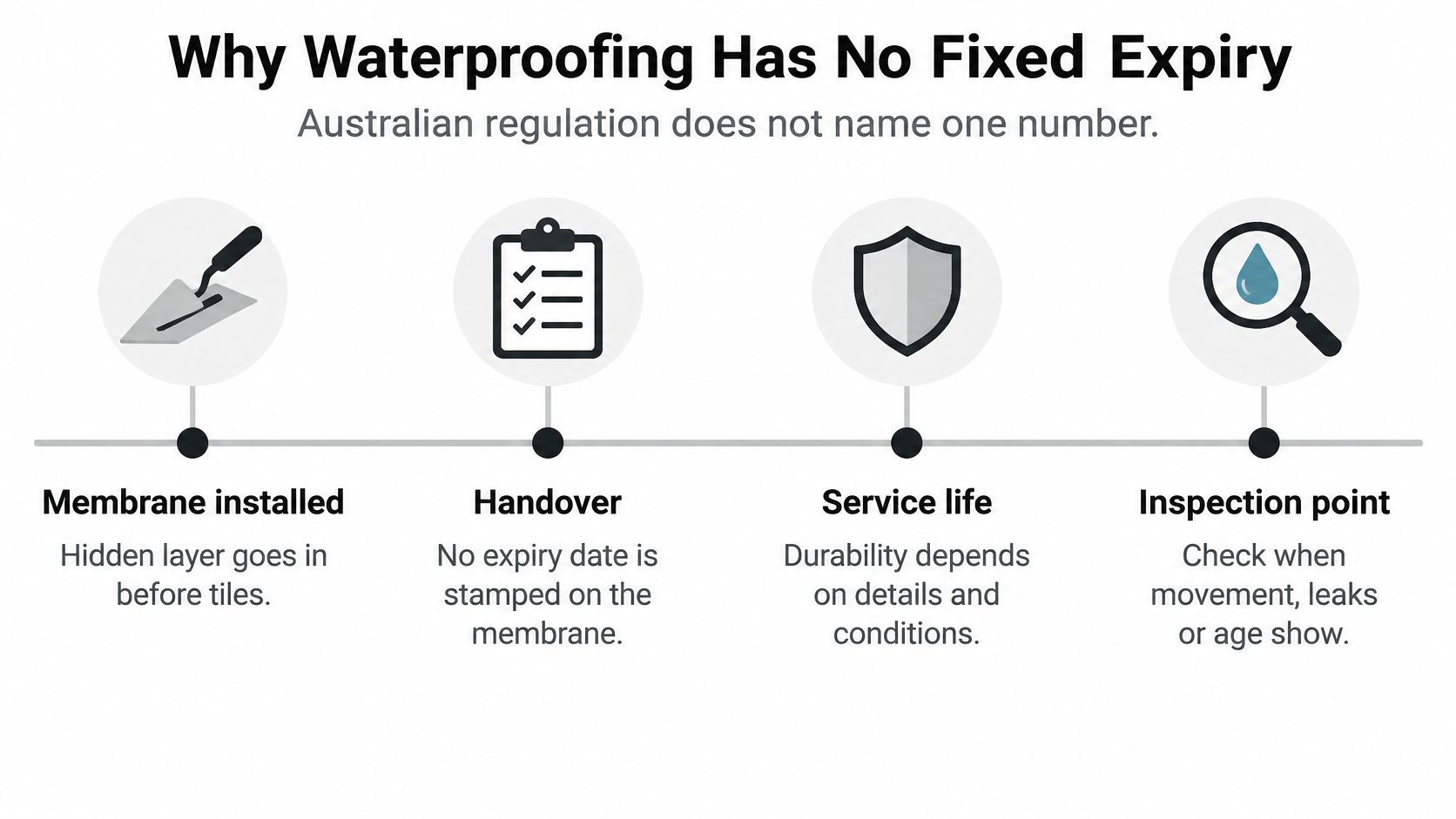
The rules describe protection, not a countdown
The Australian Building Codes Board's waterproofing history explains that NCC Volume Two included wet-area construction details in 1996, practitioners generally relied on AS 3740 for those details from 2012 to 2019, and NCC 2022 reinstated construction details while allowing an alternative using AS 3740:2021. The framework also requires shower-wall waterproofing to at least 1,800 mm above the floor substrate.
The underlying purpose is to prevent dampness and water flow from creating health risks, dangerous conditions or damage to building elements. Australian regulation doesn't nominate a universal membrane replacement age.
For homeowners, this means the installation date matters because it helps identify the applicable requirements. It doesn't establish that every bathroom built before a particular code change is defective.
Waterproof and water-resistant aren't interchangeable
For houses under NCC 2022, the NCC Navigator's compliance explanation identifies two pathways: using Housing Provisions Part 10.2 in full, or combining specified Housing Provisions clauses with AS 3740:2021. The NCC determines which building elements need to be waterproof or water-resistant, while the installation provisions establish how that protection is achieved.
Water-resistant materials tolerate moisture under the specified conditions. Waterproof construction must prevent water passing through the relevant building element.
A renovation therefore isn't proven compliant by a photograph showing coloured liquid rolled across the floor. The evidence needs to establish:
- Coverage: The required surfaces and junctions received the appropriate treatment.
- Compatibility: The membrane suited the substrate and connected materials.
- Continuity: Corners, wastes and service openings formed a connected waterproof barrier.
For the homebuyer with no records, the sensible next step is a condition assessment, not automatic demolition. For someone renovating, the opportunity is to document those concealed details before they disappear.
Factors That Shorten Waterproofing Life
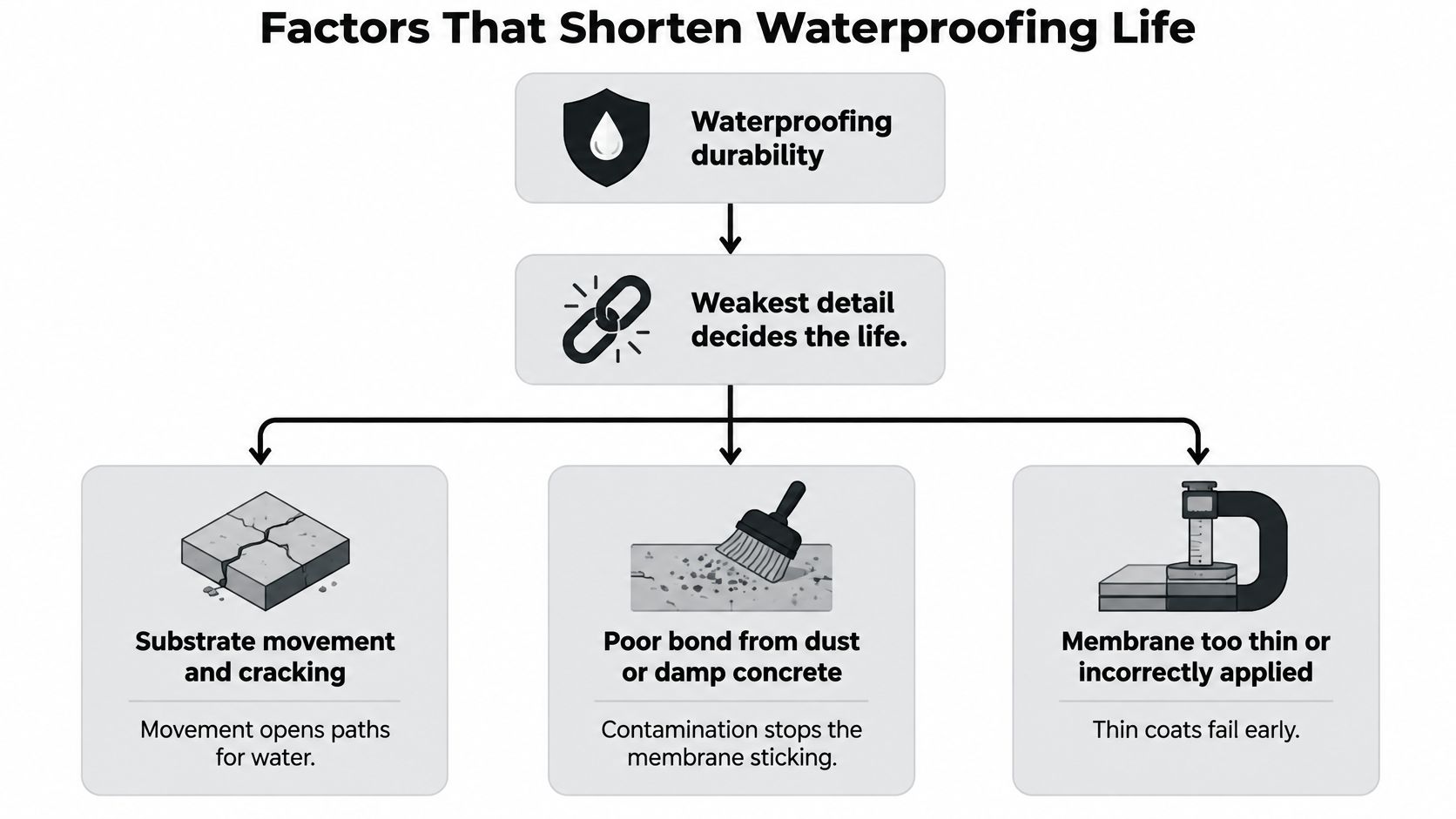
A waterproofing system lasts only as well as its weakest detail performs. A continuous film across the middle of a floor won't prevent leakage through an untreated doorway edge or an opening around a pipe.
The Victorian Building and Plumbing Commission's moisture-dispute findings found water-related issues accounted for nearly 31% of individual residential-building dispute items, with an absent waterstop the most frequently recorded bathroom problem. The same guidance distinguishes Victoria's statutory protection for waterproofing defects, generally up to 10 years from completion, from the membrane's working life.
That legal period is not a replacement instruction or a promise that every defect claim will succeed. Contractual warranties, statutory rights and actual system durability answer different questions.
The main installation risks begin beneath the visible finish.
Movement, adhesion and application
A membrane needs a stable, prepared base. Loose particles, unsuitable moisture conditions or incompatible materials can prevent adhesion, while substrate movement can strain corners and joints.
Liquid-applied membranes also need the specified finished thickness and curing conditions. Installers can use a wet-film thickness gauge during application rather than judging coverage by colour alone.
More coats don't automatically mean a better system. The product's application method, coverage and drying requirements need to work together.
Detailing, drainage and later damage
Waterstops help contain water at boundaries such as doorways and shower openings. Pipe penetrations, wall-floor junctions and waste connections need deliberate detailing rather than a quick brush around the visible edges.
Under the NCC Housing Provisions wet-area requirements, where a floor waste drains a bathroom or laundry floor, the floor, floor-to-wall junction and relevant penetrations must be waterproof. Falls, meaning the floor's slope towards the waste, therefore belong in the waterproofing discussion, not just the tiling discussion.
Later trades can damage a completed membrane with dropped tools, screws or fixtures. A shower-screen fixing or bathroom accessory mustn't create an unplanned opening through the barrier.
Clearing a drain can reduce water exposure. It can't restore a membrane that never bonded to its substrate.
For current or planned bathroom renovations, use this short check:
- Preparation: Who checked the substrate before application?
- Details: Who completed the corners, waterstops and penetrations?
- Evidence: Were those stages photographed before tiling?
A wet-area waterproofing assessment should address the complete assembly of substrate, membrane, screed, wastes and finishes. Looking only at the tile surface leaves the most consequential details unexamined.
Warning Signs Waterproofing Is Failing
A ceiling stain beneath a shower needs investigation, even if the bathroom upstairs looks dry. Water may travel along framing or the underside of a slab before appearing, so the visible patch isn't necessarily directly beneath the entry point.
Soft plaster, bubbling paint and a persistent musty smell can indicate moisture beyond the wet area. A growing stain, active dripping or water entering another apartment makes the situation more urgent.
Waterproofing warning signs and what to do
These are diagnostic starting points, not proof of a particular failure.
| Sign | Usual cause | Where | What to do |
|---|---|---|---|
| Stain or drip on the ceiling below | Water past the membrane at a junction, penetration or crack; plumbing can also be responsible | Bathroom over a living area | Inspect promptly; don't just repaint |
| Returning mould or musty odour | Persistent damp, poor ventilation or a concealed leak | Shower walls and corners | Check silicone and falls; investigate if it returns |
| Drummy or lifting tiles | Lost bond, movement or water under the tile bed | Shower floor or balcony | Avoid surface-only fixes; assess the membrane zone |
| Ponding water | Inadequate falls or a blocked waste or outlet | Bathroom floor or balcony | Clear the outlet; if ponding remains, review falls |
| Efflorescence or damp balcony edge | Water moving through joints, edges or the slab | External balcony | Check drainage and arrange a leak investigation |
| Cracked corner silicone only | Joint movement or deteriorated sealant | Wall-floor and fixture junctions | Replace compatible sealant and watch for stains |
Drummy tiles sound hollow when tapped because the bond beneath them is incomplete or has failed. Efflorescence is the pale mineral deposit left when moisture carries dissolved salts to a surface.
Neither sign establishes membrane age or proves that the entire waterproofing layer needs replacement. Equally, new silicone won't resolve concealed damage merely because it makes the corner look watertight.
Record the pattern before covering it
The scale of the problem warrants early attention: the Sydney Morning Herald's report on ABCB estimates states that, in 2024, Australian apartment water-ingress rectification costs were estimated at $235 million–$610 million annually. That national estimate isn't a forecast for an individual repair, but it reinforces why small wet patches shouldn't be dismissed.
Photograph the affected area and note whether it changes after showering, rain or neither. Check accessible wastes and outlets without dismantling finishes.
PostDamage's wall moisture clues for homeowners can help you describe wall symptoms clearly when arranging an inspection. For external symptoms, balcony leak detection should distinguish rain entry, drainage problems and defects around edges or fixings.
Don't drill, paint over or repeatedly regrout a suspect area before assessment. If water is near electrical fittings or a ceiling is sagging, keep people clear and arrange urgent professional assistance.
Bathroom Renovations and Balcony Leak Examples
A bathroom renovation and a leaking balcony can both involve tiles and membranes, but they need different design decisions. Treating the balcony as an outdoor bathroom can leave important structural and drainage details unresolved.
These contrasting scenarios show where the investigation should start.
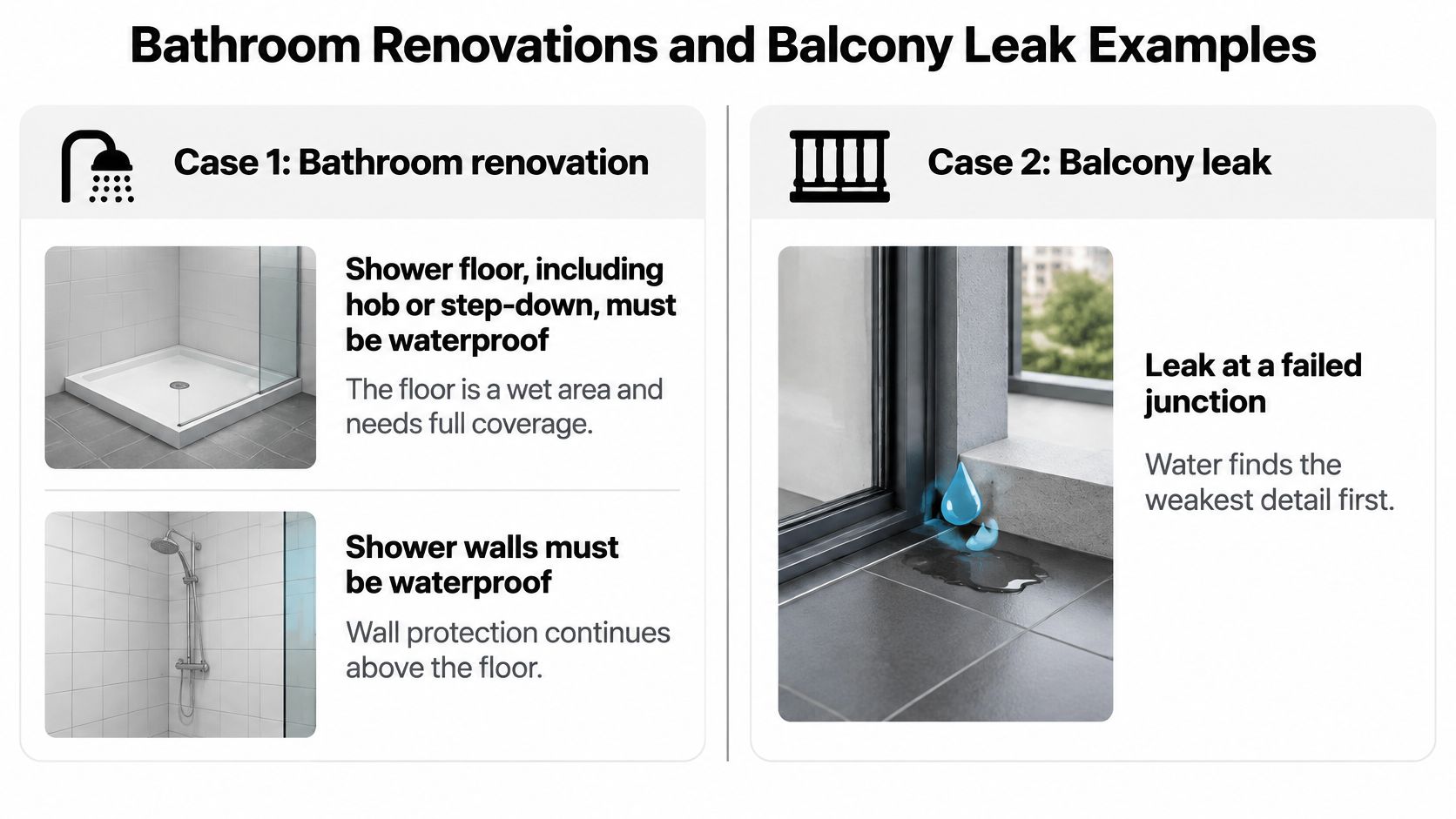
A bathroom renovation before tiling
Say a homeowner replaces an enclosed shower with a more open layout. Moving the screen changes where water can reach, so copying the previous membrane footprint isn't a sound design decision.
The NCC wet-area building-element requirements require waterproof treatment of the shower floor, including its hob or step-down, together with shower junctions and penetrations. Outside the shower, some surfaces may require water resistance rather than full waterproofing, subject to the applicable provisions and drainage arrangement.
A registered builder coordinates the carpenter, plumber, waterproofer and tiler so their work connects correctly. The plumber's waste position affects the screed, the screed affects drainage, and the membrane must connect properly to the selected waste detail.
Before tiling, the homeowner needs confirmation of the intended wet zones, finished layout and concealed details. A photograph of an empty room after demolition isn't enough; photographs should show the completed waterproofing and its critical connections.
A balcony that leaks after recoating
Now consider a balcony that still leaks beneath its doorway after a new membrane has been applied. The coating may be intact across the central area while water enters through the threshold, a balustrade fixing or a failed movement joint.
The Victorian Government's non-cladding building-defects analysis reported that about 73% of balcony defects were caused by water ingress, mainly inadequate waterproofing or poor workmanship, while 64% of affected buildings were more than 10 years old. It also explains that the concrete slab can be the primary water barrier, making slab condition, falls, drainage, toppings and tiles important to diagnosis.
The practical difference is visible in the construction process.
An external system needs external waterproofing design; an internal wet-area specification doesn't resolve balcony thresholds, weather exposure or structural movement. Applying another coating without identifying the water path can leave the original problem untouched.
A bathroom needs its waterproof zones confirmed before tiling. A leaking balcony needs its water path identified before another coating or a full strip-out is authorised.
The appropriate investigation checks outlets, edges, movement joints and penetrations, then uses controlled testing where needed. The repair scope should follow the diagnosis, not the assumption that the oldest visible material must be responsible.
When to Inspect Repair or Call a Registered Builder
Choose a local repair only when the defect is isolated and the surrounding system is sound. A blocked outlet, failed perimeter seal or accessible penetration may be repairable without removing the entire finish, but the repair must connect reliably to the existing construction.
If the membrane has lost adhesion, the floor drains incorrectly or defects extend across the tiled area, surface patching is unlikely to address the cause. A leaking balcony slab, movement joint or balustrade connection also needs an assessment of the affected construction, not an automatic instruction to recoat.
Use the condition to set the scope
| Finding | Sensible next step |
|---|---|
| Accessible blockage with no continuing leakage | Clear it and confirm drainage during normal use |
| Isolated failed seal with sound adjoining construction | Complete a compatible local repair and monitor |
| Widespread hollow tiles or suspected membrane debonding | Investigate removal and reinstatement |
| Incorrect falls or recurring water at a threshold | Resolve levels and drainage before selecting finishes |
| Uncertain leak source | Diagnose first, then price the repair scope |
A stain or hollow tile within the expected service life shouldn't be dismissed as normal ageing. It may indicate workmanship, movement, maintenance or another water source, and the cause needs evidence rather than an assumption.
For an undocumented bathroom renovation, don't assume that new tiles will preserve or improve an unknown waterproofing layer. Establish the substrate condition and design a documented waterproofing installation before concealing the work.
Keep a usable building record
Create a folder that a future owner, property manager or repair contractor can understand. Include:
- Installation evidence: Waterproofing certificate, installer details and completion records.
- Product identification: Membrane name, technical information and compatible system components.
- Stage photographs: Prepared substrate, corners, penetrations, wastes and completed coverage.
- Drainage information: A sketch showing wastes, outlets, falls and relevant thresholds.
- Maintenance history: Inspection notes, leak photographs and details of later fixtures or repairs.
Commercial warranty paperwork belongs in that folder too. Read what it covers, what maintenance it requires and what happens if water returns, rather than treating the headline warranty term as a lifespan prediction.
For ongoing care, check accessible balcony drains after leaf accumulation and heavy weather, and inspect sealant when cracking or separation appears. In bathrooms, investigate recurring smells, staining or changes in tile adhesion instead of waiting for a calendar reminder.
Coordinate the trades before closing the floor
Registered builders help coordinate responsibilities where repairs involve plumbing, substrates, waterproofing and finishes. At Melbourne Tiling Services P/L, we're Registered Unlimited Builders based in Highett and have specialised in bathroom renovations since 2003.
Our workers are qualified and certified waterproofers or tilers, and our coordinated team includes licensed carpenters, electricians, plumbers, tilers and waterproofers. Our waterproofing work comes with extended warranties, which should be considered alongside installation records and maintenance obligations, not as a substitute for them.
For a suspected shower failure, a bathroom waterproofing repair assessment is a practical starting point for deciding whether a contained repair or broader reinstatement is justified. Bring the photographs, leak history and available certificates so the decision addresses the cause.
Melbourne Tiling Services P/L offers bathroom renovations, waterproofing and shower and balcony leak repairs, with coordinated trades and extended waterproofing warranties. Visit Melbourne Tiling Services P/L to arrange a quote, discuss your leak symptoms or plan a renovation that documents the waterproofing before the tiles go down.
Write a Comment