
The most repeated advice about marble in Melbourne bathrooms is that honed is the safe choice for a floor and polished is the showy choice for a wall. It's tidy, it's easy to repeat, and it isn't evidence of anything.
A finish name describes how far a diamond-abrasive process was taken. Slip resistance belongs to the installed system: the exact slab, the surface treatment, the sealer, the grout joints, the fall to the waste, and what happens on that floor when someone drops a bottle of conditioner across it.
Get the sequence wrong and you can spend premium money on honed marble that still fails a wet-area requirement, or rule out a polished stone that would have been perfectly serviceable on a vanity splashback. The useful question isn't honed or polished. It's which finish goes where, and what document proves the performance of the thing being laid.
Table of Contents
- Honed and Polished Marble at a Glance
- Why Slip Ratings Decide Bathroom Floors
- Appearance, Upkeep and Wear Compared
- Verify the Slip Rating and Stone Before You Buy
- Waterproofing and Registration Rules to Check
- Choose the Finish for Each Bathroom Zone
Honed and Polished Marble at a Glance
Honed marble has a low, satin sheen that suppresses glare, while polished marble carries a reflective gloss that deepens colour and makes veining read harder, and neither finish on its own decides whether a bathroom floor is safe.
Both finishes come off the same diamond-abrasive sequence. Honing stops it early and leaves a surface that scatters light; polishing carries the stone through the finer grits until the surface throws the room back at you. That one difference drives everything in the table below, from how a scratch reads to how much of the floor can be restored on site.
| Criterion | Honed marble | Polished marble |
|---|---|---|
| Surface sheen | Low, satin finish that suppresses glare | High reflective gloss that emphasises veining |
| Wet slip starting point | Less smooth contact surface, but still needs an AS 4586 result for the exact stone | Smooth, can become hazardous when water or soap forms a continuous film |
| Visibility of scratches and etching | Disguises minor wear and abrasion | Uniform sheen makes marks and dull spots conspicuous |
| Maintenance routine | Needs proper sealing; the more open surface can absorb stains if unsealed | Sealing helps stain resistance but does not make polish a compliant wet-area floor |
| Restoration | Re-honed to the matte level and resealed, with no final polish stage | Sequential abrasive stages from about 180 to 800 grit, then a final polish |
| Best location | Floors and high-use areas once the slip classification is confirmed | Low-contact walls, vanity splashbacks and feature niches |
Read the rows in order of consequence. Best location and wet slip starting point settle most renovation decisions before appearance gets a vote, because a floor that can't take water is a floor you'll be replacing. The maintenance and restoration rows tell you what the finish costs over the next decade, not on the day you pay for it.
The slip row is a starting point, not a rating. Australian classification depends on AS 4586 testing of the exact stone, finish, sealer and installation, so a honed tile with no report proves nothing, and a polished tile with a documented wet-pendulum result can be specified with confidence.
Marble is a natural product. Hardness, texture, porosity and sealer take-up vary between blocks and even within a batch, so two tiles both sold as honed are not interchangeable. That's why the test report has to name the product, not the finish.
Restoration is where the two finishes part company hardest. Polished marble gets its gloss back through a graduated abrasive sequence, and if you want to understand how grit progression shapes a finish, EZARC Tools' walkthrough of sanding discs covers disc selection and step-ups in practical terms. Honed stone is re-honed and resealed.
Why Slip Ratings Decide Bathroom Floors
A finish name cannot establish slip safety. Australian testing under AS 4586 classifies new pedestrian surfaces, while AS 4663 assesses existing ones. The wet-pendulum scale runs from P0 to P5: higher classes indicate greater slip resistance, as explained in the Australian guide to understanding slip resistance.
The classification belongs to the tested surface, not the word on a sample tag.
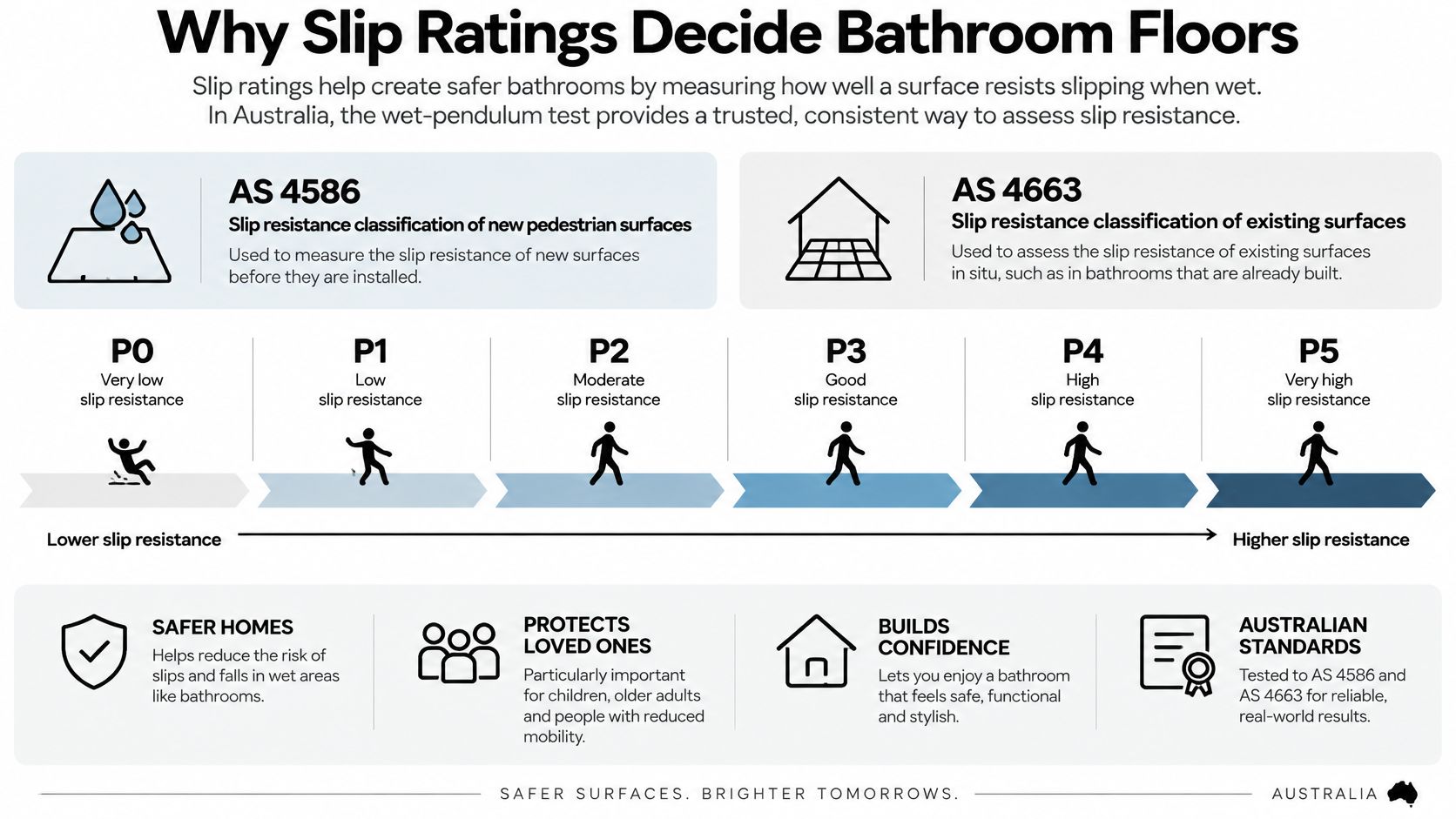
| Rating | Typical location | Relevance to a bathroom |
|---|---|---|
| P1 | Dry locations | Rarely suitable for bathroom floors |
| P2 | Transitional areas such as hotel bathrooms and laundries | Possible for dry-entry laundry floors |
| P3 | Wet public entries and bathroom environments | A possible reference point for domestic bathroom floors, subject to the project requirements |
| P4 | Continuously wet external areas and communal shower rooms | Relevant to shower recesses and wet zones |
| P5 | Most demanding locations, including pool ramps and stairs | Rarely needed in homes; may be relevant to stair or ramp treads |
Published test reports show that honed marble can receive different classifications. A result for one stone does not establish the rating of another, or even of the same stone with a different finish, sealer or surface condition. Honed describes the finish; it is not a slip certificate.
Polished marble can be slippery when wet or contaminated with soap. Honing removes the gloss and may provide a less smooth contact surface, but it does not guarantee a suitable result. For each bathroom zone, specify the required classification and check that the tested surface matches the tile, finish and treatment being installed.
Several details affect how closely a test result represents the finished floor:
- Stone and finish: Marble varies, and the honing process changes the surface.
- Sealer: Confirm the tested sample had the same sealer as the installed tile.
- Layout and slope: Tile size, grout joints and fall toward the waste shape how water sits and moves.
- Cleaning: Residue from unsuitable products can leave a film underfoot.
Ask for the AS 4586 report for the exact product and finish, and confirm its tested condition and intended bathroom zone. For practical guidance on specifying non-slip bathroom flooring, start with the surface that will be installed. A slip and fall prevention program also depends on assessing the walking surface, rather than relying on a finish label alone.
Appearance, Upkeep and Wear Compared
Polished marble reflects light, saturates colour and pulls veining forward, which is why it suits a formal, high-contrast room. Honed marble absorbs light instead, softening the veining into something quieter and more contemporary. Neither look is the compromise; the compromise is what each one demands afterwards.
Wear behaves differently on each. Polished marble has a uniform sheen, so a scratch, an etch mark, a dull spot or a dried water ring catches the light and announces itself. Honed marble suppresses glare and disguises minor abrasion and wear patterns, which makes it the more forgiving surface for family bathrooms, laundries and high-use commercial floors, as the Laticrete care guidance for honed and textured marble explains. The trade-off is that its more open-looking surface can absorb staining if it's inadequately sealed.
Where each finish shows its age
Picture a family ensuite with a polished marble floor. Within weeks the traffic lanes show footprints, soap splash and the first dull patch where a shampoo bottle sat. The same room with a honed floor looks largely unchanged, because the marks are there but the surface no longer advertises them. That's an illustration of how the two surfaces read, not a measured result, and how fast either ages depends on traffic, cleaning routine and how well the stone was sealed.
Keep either finish alive with a short routine:
- Clean with pH-neutral products. Acidic cleaners etch calcium-based stone, and honed surfaces show the damage as a lighter patch.
- Dry standing water and soap residue. A squeegee on shower walls and a towel on the floor does more than any sealer.
- Reseal on the product's schedule. Follow the manufacturer's interval rather than a habit, and test with a water bead before extending it.
- Skip the vinegar. It's the fastest way to undo a professional finish.
Restoration is specialist work. Polished marble usually needs sequential abrasive stages, starting around 180 grit and working up to roughly 800 before the final polishing step, which is why a full-floor repair is quoted rather than improvised. Honed stone is re-honed to its matte level and resealed, a shorter sequence with no polishing compound at the end.
Practical rule: choose polish where contact is light and honed where wear is constant, then confirm the slip performance before a single box is ordered.
For day-to-day products and methods, cleaning marble bathroom tiles covers what to use on a sealed floor. Sealing, though, is a stain control. It doesn't convert a polished surface into a compliant wet-area floor.
Verify the Slip Rating and Stone Before You Buy
A finish label isn't a document, and neither is a material name. Work through the checks below in order, because each one changes what the next answer should be.
- Identify the material. Natural marble, engineered stone, porcelain and sintered stone are legally and practically different. Australia prohibited the manufacture, supply, processing and installation of engineered-stone benchtops, panels and slabs from 1 July 2024, with imports prohibited from 1 January 2025, and the ban does not cover natural stone, porcelain or sintered products, per the national engineered stone prohibition. Knowing which category your slab falls into tells you what rules apply before you compare finishes.
- Request the supplier's technical documentation for the exact slab or tile. Generic brochures describe a product family, not the batch you're buying.
- Ask for the AS 4586 wet-pendulum result for the chosen finish and the intended zone. Confirm whether the tested sample was sealed, because an unsealed honed sample doesn't represent a sealed floor.
- Confirm the grout and sealer system. We grout joints with sanitised flexible grouts from Ardex, Mapei or Davco, use colour-matched grout across walls and floors, seal corner joints, and apply a penetrating sealer over tiles and grout. The sealer is part of the tested assembly, not an accessory.
- Ask how the fabricator controls dust when cutting and polishing. A permitted material can still generate respirable silica-containing dust, so compliance depends on controlled fabrication practice rather than the stone's legal status.
- Check the drainage, tile size and joint layout before fixing. Small-format mosaics, smooth substrates, shower falls and grout line width all change how water sits and how the surface performs underfoot, as the Tilesmate marble mosaic notes point out.
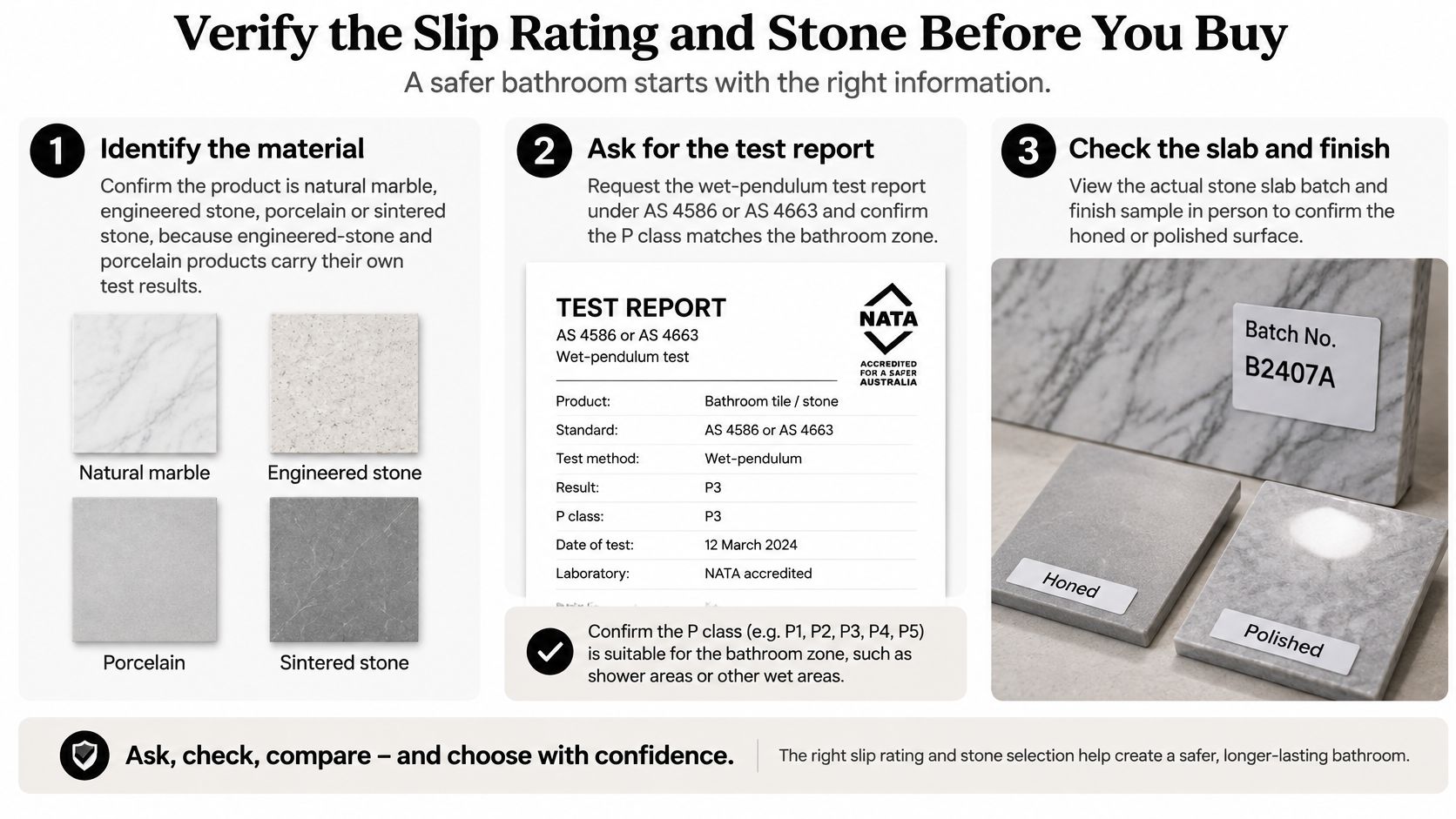
Neither answer proves anything alone. A permitted natural stone still needs dust-controlled fabrication, and a honed finish still needs its own test report for the zone it's going into. A polished finish on a vanity wall is a design decision; the same finish on a shower floor is an unverified gamble.
If the documents are missing, don't accept a finish label as proof of slip performance. Ask again, or choose a product that comes with the report.
Waterproofing and Registration Rules to Check
Marble finish cannot compensate for a shower floor that fails to drain. The NCC 2022 Housing Provisions, clause 10.2.2(a), sets out waterproofing requirements for shower floors. Separately, the Victorian Building and Plumbing Commission's wet-area guidance explains that an unenclosed shower extends to a 1,500 mm horizontal radius from the shower rose connection. Its floor needs a waste and a fall between 1:80 and 1:50, equivalent to 12.5 mm to 20 mm over one metre. A shower over a bath without a screen is treated as unenclosed, so the wet area can extend beyond the bath.
These are compliance requirements, not finish preferences. An incorrect fall can leave water standing on a carefully selected honed floor.
Registration also depends on the renovation's scope. The Building and Plumbing Commission's explanation of domestic building work describes the Domestic Builder (limited to bathroom, kitchen, and laundry renovation) class, including work in domestic wet areas within a home's existing external walls, floor and ceiling. The listed experience includes selecting and applying appropriate waterproofing systems. Confirm that a contractor's registration covers the work they are undertaking.
For work valued above $10,000, builders and tradespeople generally need to be registered with the Building and Plumbing Commission. However, Consumer Affairs Victoria's guide to builders, tradespeople and other practitioners lists exceptions for certain single trades, including wall and floor tiling. A renovation involving several trades should be assessed by its full scope, rather than treated as tiling alone.
Before work starts, ask:
- Does your registration class cover the full scope?
- Who applies the waterproofing, and who signs it off?
- Will the fall to the waste be checked before tiling begins?
Melbourne Tiling Services offers bathroom renovations, tiling, waterproofing, caulking, Kerlite and shower screens. Ventilation is another part of managing bathroom moisture; choosing the right bathroom ventilation fan can help inform decisions about the ceiling and wiring. Keep the waterproofing paperwork with the renovation records, including a Victorian waterproofing compliance certificate.
Choose the Finish for Each Bathroom Zone
Location decides the finish. Start with where the water goes, then work backwards to the stone, and treat the marble type as the last variable rather than the first.
| Zone | Suited finish | Condition to confirm |
|---|---|---|
| Shower floors and recesses | Neither finish without a test | AS 4586 result for the exact product, targeting P4 or P5 |
| Family bathroom floor | Honed | Confirmed P3 or higher, sealed, colour-matched grout |
| Laundry or high-traffic commercial floor | Honed | Tested for the wet-traffic class before ordering |
| Vanity splashbacks and feature niches | Polished | Water splashes rather than pools |
| Powder room and low-moisture feature walls | Polished | Low moisture exposure confirmed |
| Shower walls within spray | Honed low, polished high | Sealed corner joints |
| Balconies and external areas | Honed generally | External-rated AS 4586 result |
The pattern in that table is consistent: the wetter and more trafficked the zone, the more the decision depends on a test result rather than on appearance. Wall tiling in porcelain, marble and Kerlite is where polish earns its place, because splash wipes off a vertical surface and nobody walks on it. Floors are the opposite.
Practical next steps, in order:
- Get the wet-pendulum report for the exact product. Not the range, not the finish, the slab or tile being supplied.
- Fix the sealer and grout system before the quote is finalised. Colour-matched grout on walls and floors, a penetrating sealer over tiles and grout, and corner joints sealed with acetic or neutral cure sealant such as Maxisil, Mapei or Sika.
- Compare quotes from registered builders who can show the whole scope. Tiling, screeding, waterproofing and shower screens belong in one contract, not three.
The scale of that coordination isn't theoretical. We've completed eight marble bathrooms and shower screens in penthouse apartments on Beach Rd, Port Melbourne, and 225 bathrooms tiled and sealed at the Tune Hotel, and in both the finish decision followed the zone plan rather than the other way around. Free quotes and 3D drawings make it easier to see how a honed floor and polished splashback read together before anything is ordered.
If you take one action first, take this one: ask for the AS 4586 result before any stone is ordered. If the supplier can't produce it for the exact product and the zone you intend, the finish name isn't an answer.
Melbourne Tiling Services P/L supplies, delivers, installs and maintains marble and stone across Melbourne and greater Victoria, and we handle the waterproofing, screeding, sealing and shower screens that determine whether a marble bathroom performs. We're Registered Unlimited Builders based in Highett, so the slip documentation, the fall to the waste and the finish selection all sit with one team. Call 1300 661 658 or visit Melbourne Tiling Services P/L for a free quote and a 3D drawing of your bathroom.
Write a Comment