
You've probably started with the exciting parts of the renovation. Tiles, tapware, vanity, layout, lighting. Then someone mentions a waterproofing compliance certificate and the whole bathroom project suddenly feels more technical than expected.
That reaction is normal. Most Melbourne homeowners don't think about the membrane hidden under the tiles until a builder, surveyor, buyer, or insurer asks for paperwork. By then, the wrong answer can turn a straightforward bathroom renovation into a dispute about leaks, liability, and whether the work was even signed off properly.
A waterproofing compliance certificate victoria issue usually isn't about paperwork for paperwork's sake. It's about proving that the wet area was built to the required standard, by the right practitioner, with traceable accountability if something goes wrong later. In practical terms, that certificate can matter when the bathroom is being built, when the home is sold, and when water damage shows up where it shouldn't.
The biggest trap in Victoria is the gap between smaller jobs and larger renovations. Some works sit in a grey area where homeowners assume they're covered because the bathroom looks finished and the invoice has been paid. That assumption can be expensive.
Table of Contents
- Your Bathroom Renovation and the Certificate You Can't Ignore
- What Is a Waterproofing Compliance Certificate?
- When a Waterproofing Certificate Is Legally Required in Victoria
- Who Can Legally Issue a Waterproofing Certificate
- Your Roadmap to Obtaining a Compliance Certificate
- Common Pitfalls and the True Cost of Non-Compliance
- How Melbourne Tiling Services Ensures Your Peace of Mind
Your Bathroom Renovation and the Certificate You Can't Ignore
A bathroom renovation looks simple from the outside. Demolition starts. Plumbing gets roughed in. The room takes shape. Then the part that matters most gets covered up. That's why the certificate matters. It records that the unseen waterproofing work wasn't guessed, rushed, or left to an unqualified trade.
For homeowners, this document protects more than the shower recess. It helps protect adjoining walls, floors, skirtings, ceilings below, and the long-term value of the home. If water gets past the membrane, the damage often stays hidden until mould, swelling, staining, or movement appears somewhere else.
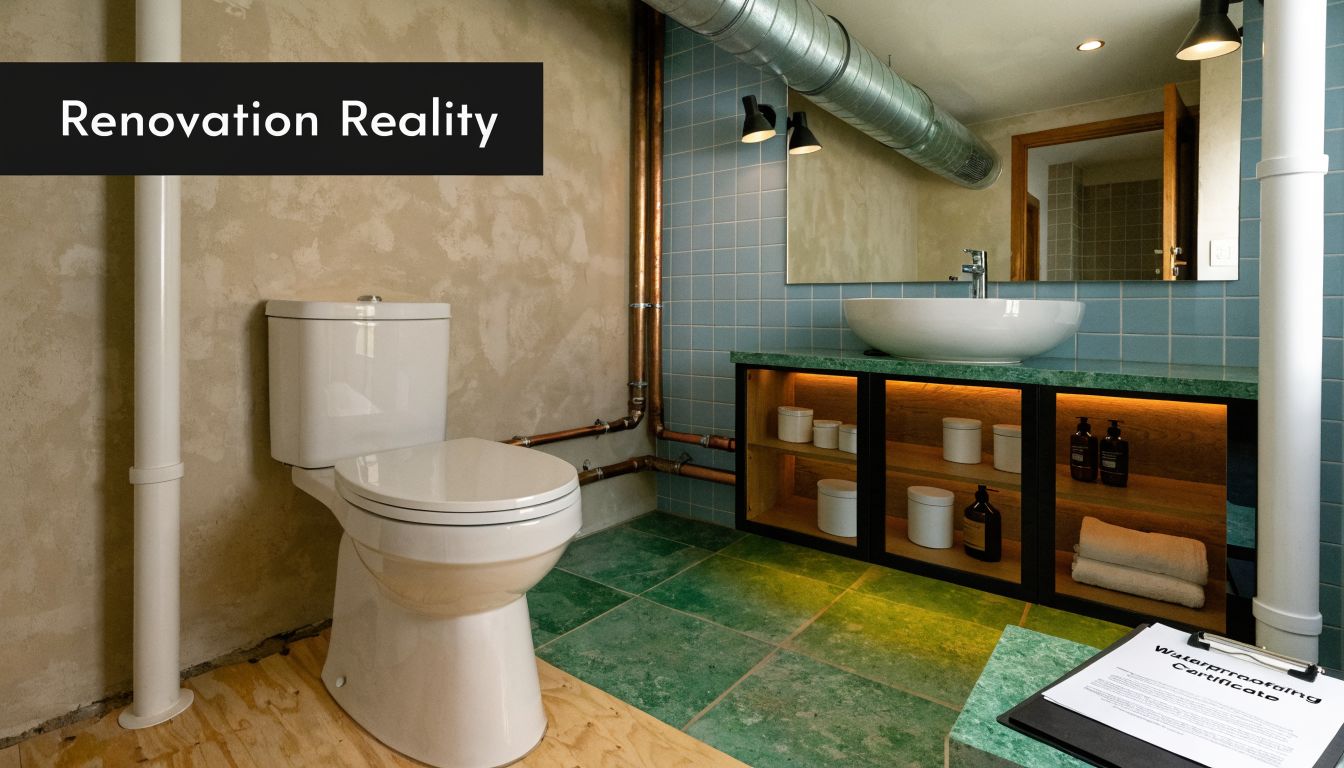
If your project involves a full bathroom renovation in Melbourne, the waterproofing stage is one of the few moments where compliance has to be taken seriously before finishes go on. Once tiles, grout, screens, and joinery are installed, inspecting the membrane becomes much harder and any repair usually means demolition.
Practical rule: If a contractor treats waterproofing like a minor step between screeding and tiling, that's a warning sign. In a wet area, it's one of the core structural protection tasks in the whole job.
The certificate also changes the conversation from trust to proof. A homeowner shouldn't have to rely on “we always do it this way” or “it'll be fine.” You want a traceable record that the work met the required standard and that somebody with the right registration stands behind it.
What Is a Waterproofing Compliance Certificate?
A homeowner usually sees the problem too late. The bathroom looks finished, the silicone is neat, the tiles are straight, and six months later paint starts lifting on the wall outside the shower or a ceiling stain appears below. By that point, the membrane is buried under the finished work and proving what was done becomes much harder.
A waterproofing compliance certificate is the document that ties that hidden work to a clear standard and a legally accountable party. In practical terms, it records that the wet area waterproofing was carried out in accordance with the relevant building requirements and by someone permitted to stand behind that work.
In Victoria, that means the waterproofing behind a bathroom renovation must meet the requirements of AS 3740 and the NCC Volume 2. The certificate matters because waterproofing is one of the few parts of a bathroom you cannot properly judge once tiling is complete. If the membrane is missing, poorly bonded, interrupted at a corner, or badly detailed around a waste or tap penetration, the room can still look first-class at handover.
What the certificate is actually confirming
A proper certificate is evidence that the waterproofing system was installed over a suitable substrate, with the right preparation, set-out, bond breakers where required, and continuity through the areas most likely to fail.
That includes details such as:
- Internal corners and wall-to-floor junctions that move slightly over time
- Shower areas and adjacent splash zones where water exposure is repeated
- Pipe penetrations and tap bodies where small gaps become leak paths
- Doorways, hobs, and floor transitions where water can escape the wet area
- Falls and drainage points that affect how long water sits on the surface
Those are the details that separate a bathroom that lasts from one that starts causing damage behind the scenes.
For homeowners, the core issue is not paperwork for its own sake. It is proof. On a smaller job under the common minor works threshold, people often assume the compliance risk is low because the renovation scope feels modest. In reality, the waterproofing risk is the same whether you are rebuilding the whole bathroom or just replacing the shower area. Water does not care what the contract value was.
Why this matters more than many owners expect
The gap between minor works and larger renovations catches a lot of people out in Victoria. A homeowner may hire someone for a bathroom refresh, assume the waterproofing side is routine, and only later find there is no clear certification trail and no registered builder taking responsibility for the full wet area package.
That is where the trade-off sits. A lower upfront price can also mean weaker documentation, blurred responsibility between trades, and a much harder path if defects show up later.
A certificate helps establish who carried out the work, what standard it was expected to meet, and who is exposed if it fails. That can become important if:
- A leak appears after handover and responsibility is disputed
- An insurer asks for renovation records
- A future buyer or conveyancer wants evidence of compliant work
- Parts of the bathroom need to be opened up and the original workmanship is questioned
From a builder's point of view, this is why registered oversight matters. Waterproofing sits between carpentry, plumbing, screeding, and tiling. If those stages are not coordinated properly, the membrane is often where the failure shows up first, even when the underlying cause started earlier. A registered builder closes that gap by taking responsibility for the sequence, the substrate, the detailing, and the documentation, not just the final tile finish.
A finished bathroom can hide a lot. A compliance certificate gives the homeowner something far more useful than a verbal assurance. It gives them a document that connects the hidden waterproofing work to a recognised standard and a party who can be held to it.
When a Waterproofing Certificate Is Legally Required in Victoria
Many bathroom renovations become complicated at this stage. Homeowners learn that waterproofing must adhere to the standard, but they also find that not every minor project is certified through the same process. Both concepts can be accurate, and the space between them is where people often encounter issues.
Victoria's regulatory framework changed significantly in 2018. The key thresholds often discussed in practice are these: work by unregistered tradespersons can be carried out up to $10,000 without requiring a compliance certificate, while projects valued over $16,000 require VBA registration and formal certification, according to the Victorian waterproofing regulatory changes summary.
The practical threshold problem
Most homeowners don't think in regulatory bands. They think in renovation scope. Replace the shower. Retile the room. Move the vanity. Rebuild the ensuite. The trouble is that the legal and compliance consequences can change depending on who is doing the work, the value of the work, and how the contract is structured.
That creates a real trade-off.
A smaller bathroom job may appear cheaper or simpler if someone says it can be done without the same formal sign-off. But the lower the paperwork, the more important it becomes to check who is responsible if moisture damage appears later. Once a bathroom is stripped, re-sheeted, waterproofed, tiled, and fitted off, it behaves like major building work even if the owner originally saw it as a cosmetic upgrade.
Victorian Waterproofing Certificate Requirements 2026
| Project Value | Practitioner | Certificate Required? |
|---|---|---|
| Up to $10,000 | Unregistered tradesperson | Not required under the threshold described in the 2018 Victorian framework |
| Between $10,000 and $16,000 | This is where homeowners often face uncertainty | The framework highlights a practical compliance gap, so verification matters |
| Over $16,000 | VBA-registered practitioner | Formal certification required |
That middle band is the problem area in real bathroom renovations. It's where homeowners can assume the project is “too big to be casual” but still not receive the clear compliance pathway they expected.
What works and what doesn't
What works is treating wet area waterproofing as regulated building work from the start, regardless of whether the quote lands just under a threshold. That means checking registration early, clarifying who is responsible for sign-off, and making the certificate part of the contract discussion before demolition begins.
What doesn't work is trying to split a larger bathroom renovation into smaller parts to make it feel like a minor job. On site, the water doesn't care how the invoices were separated. If the room fails, the entire assembly gets judged by the outcome.
A practical homeowner question is simple: who is taking legal responsibility for the waterproofing and what document proves it? If nobody can answer that clearly, stop there.
Who Can Legally Issue a Waterproofing Certificate
This is one of the most confusing parts of waterproofing compliance in Victoria, and homeowners aren't imagining the confusion. Different websites, trades, and even industry conversations often give different answers.
According to this overview of common waterproofing issues in Victoria, there is significant homeowner confusion because sources conflict on whether the certificate comes from a VBA-registered waterproofing contractor, a licensed plumber, or a builder, with thresholds discussed from $5,000 to $16,000. The practical takeaway is clear. Verify the practitioner's VBA registration before work starts.
Why homeowners get mixed answers
Part of the confusion comes from the fact that bathroom renovations involve several trades whose responsibilities overlap physically but not legally.
A plumber handles plumbing work. A waterproofer applies the membrane system. A tiler installs the finish. A builder may manage the whole renovation, coordinate sequencing, and carry the broader responsibility for compliant delivery. On site, those roles interact closely. On paper, they aren't interchangeable.
That's why the answer to “can my tiler issue the certificate?” is usually the wrong question. The better question is: what registration does that person hold, and are they authorised to certify this exact work?
Here's the practical split homeowners should keep in mind:
- Tilers: A tiler can be excellent at finishes and still not be the person who can lawfully issue a waterproofing compliance certificate.
- Plumbers: A plumber can certify plumbing work within their own scope, but that doesn't automatically resolve waterproofing certification.
- Waterproofing contractors: They may perform the membrane application, but homeowners still need to confirm the registration status and whether the issued documentation is valid for the project.
- Registered builders: On full bathroom renovations, a registered builder often provides the clearest line of accountability because the wet area work sits within the broader building scope.
The safest way to approach sign-off
From a homeowner's point of view, the least risky setup is the one with a single accountable party overseeing the renovation and using correctly licensed specialists where needed. That avoids the common site problem where each trade says the next one is responsible.
If three different trades are pointing at each other when you ask about certification, you don't have compliance. You have a future argument.
In practice, registered builders are often the most reliable option on bathroom renovations because they can coordinate the sequence properly. Waterproofing only works when the substrate, plumbing penetrations, falls, sheet linings, membrane system, and tiling are all aligned. That's difficult to manage when the owner hires separate trades and assumes certification will sort itself out at the end.
What doesn't work is relying on verbal assurances. Ask for registration details. Check them. Ask who issues the final compliance document. Get that answer before any membrane is applied.
Your Roadmap to Obtaining a Compliance Certificate
A common Melbourne bathroom scenario goes like this. The room is half-demolished, the plumber has finished rough-in, the tiler is booked, and only then does the owner ask who will handle the waterproofing certificate. By that point, the risk is already on site.
The better approach is to set up certification before work starts, especially in the grey area between minor works under $10,000 and larger bathroom renovations. Smaller jobs often get treated casually, even though the same leak can still damage framing, swell skirtings, stain ceilings below, and trigger an insurance dispute. A registered builder closes that gap by taking responsibility for the whole sequence, not just one trade task.
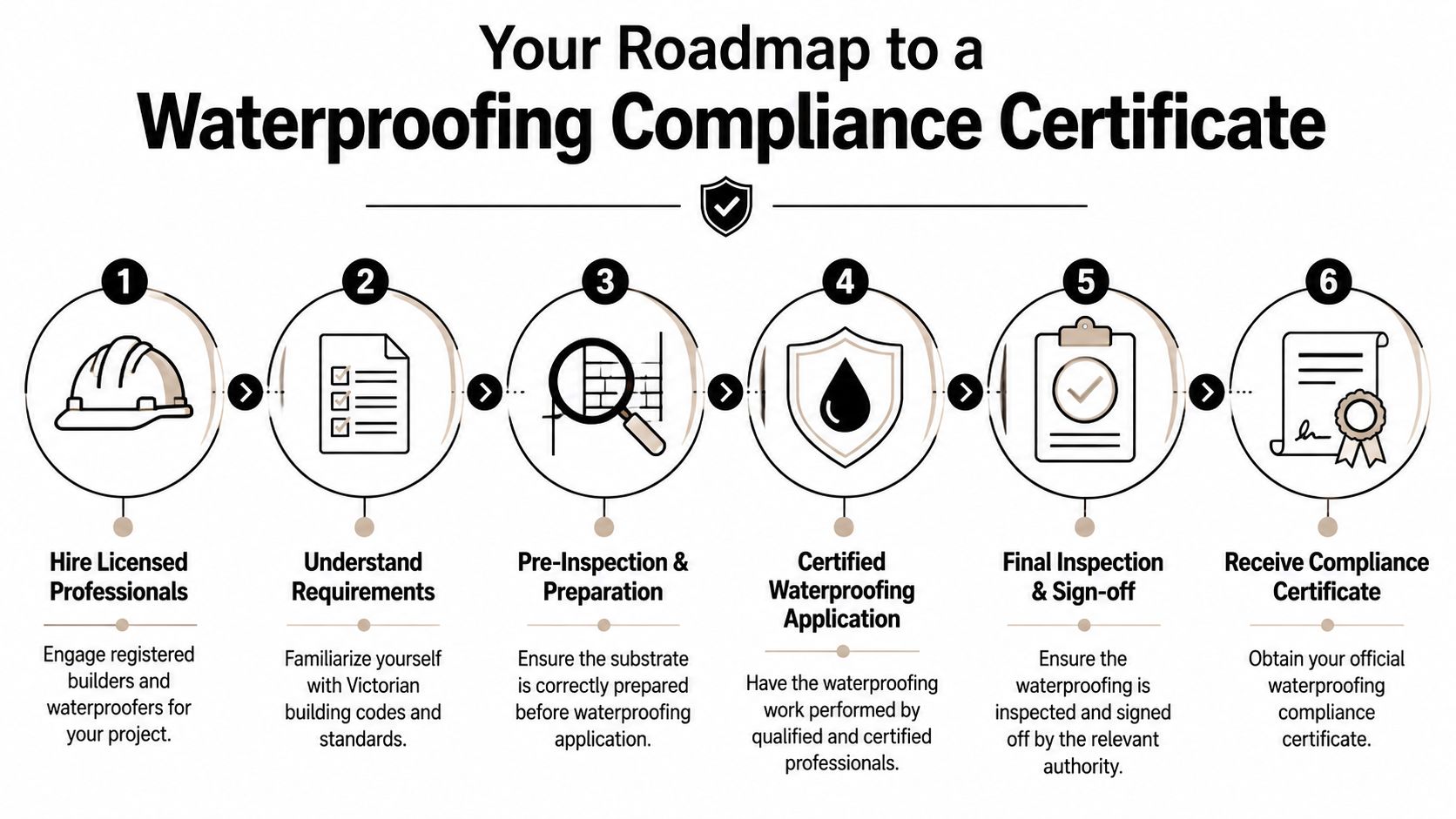
Homeowners should also discuss the actual membrane build-up early. The certificate only has value if the underlying work is suitable for the room, the substrate, and the fixtures being installed. Our guide to waterproofing systems used in bathroom renovations helps explain what should be decided before the first coat goes down.
Before work starts
Start by locking in responsibility. Ask three direct questions. Who is carrying out the waterproofing work, who is supervising it, and who will issue the compliance paperwork at the end?
If those answers are vague during quoting, they usually stay vague during construction.
This matters most on projects that sit between a simple refresh and a full structural renovation. Homeowners often split these jobs across separate trades to save money. Sometimes that works. Often it creates a gap where no one owns the compliance side properly. A registered builder usually gives a clearer path because the waterproofing, substrate preparation, plumbing penetrations, sheet lining, falls, and tiling all need to line up.
Before signing off on the job, confirm:
Who is responsible for certification
Get the name of the practitioner or builder who will stand behind the wet area work.What the bathroom scope includes Confirm whether the room is being stripped to framing, back to substrate, or partly retained. The certificate process depends on what is being altered.
Which wet areas are included
The quote should identify shower areas, bathroom floors, wall returns, niches, hobs, and any other sections being waterproofed.Which products will be used
Ask for the membrane system, primer, bond breaker, sealant, and accessories. Mixed systems cause problems if components are not compatible.
During the waterproofing stage
Good certification starts with disciplined site work. By the time waterproofing begins, the surfaces should be stable, clean, and ready for the membrane system being used. If the substrate is dusty, moving, cracked, or still too wet, the final paperwork will not save a failed installation.
On site, I look for a few things straight away. Floor to wall junctions need proper treatment. Penetrations at wastes, taps, and mixers need to be sealed with components that suit the system. Corners, hobs, niches, and transitions need careful detailing because those are the places that usually fail first.
Photo records matter here. Once tiling starts, the evidence disappears.
A practical site checklist includes:
- Substrate readiness with no loose material, contamination, or movement
- Correct junction treatment at wall and floor changes
- Compatible detailing around wastes, flanges, tap bodies, and penetrations
- Clear photos taken after membrane application and before tiling
- Sequencing control so no trade damages the waterproofing before covering works proceed
Homeowners do not need to become waterproofing inspectors, but they should ask to see the membrane before it is covered. That single step solves a lot of disputes later.
What you should receive at handover
At handover, the paperwork should match the work on site. If the bathroom has been rebuilt properly, there should be a clear record of who did the waterproofing, what system was used, and what evidence supports the sign-off.
For owners, the practical handover pack should include:
- The compliance certificate
- The responsible practitioner or business details
- The waterproofing product details
- Photos of the membrane before tiling
- Any written warranty documents that apply to the job
Do not leave this until weeks after completion. If final payment is made and everyone has moved on to the next project, missing documents become much harder to chase.
That is the fundamental difference between a patched-together bathroom job and one run properly. On a larger renovation, responsibility is usually clearer. On smaller or mid-range jobs, it often is not. Hiring a registered builder helps close that liability gap before it turns into a leak claim, a resale issue, or an argument about who was supposed to certify what.
Common Pitfalls and the True Cost of Non-Compliance
Most failed bathrooms don't start with a dramatic event. They start with a shortcut that seemed harmless at the time. A rushed membrane. No photo record. A trade working outside their actual registration. A homeowner being told that a certificate isn't necessary because the room is “only a small reno”.

The broad compliance culture in Victoria is not casual. Between July 2024 and June 2025, Victorian water corporations commenced 3,670 investigations into alleged breaches of the Water Act 1989, according to Victoria's water compliance report for 2024 to 2025. That report relates to water regulation, not bathroom certificates directly, but it shows the wider regulatory environment takes water compliance seriously.
Where bathroom renovations go wrong
The first pitfall is assuming waterproofing is just part of tiling. It isn't. Tiling is the surface finish. Waterproofing is the protective system underneath. Good tilers understand this distinction. Cheap operators often blur it.
The second pitfall is trying to save money by treating a substantial bathroom renovation like a minor patch-up. Homeowners sometimes break work into smaller pieces or use separate cash jobs across demolition, waterproofing, and tiling. That can leave nobody clearly accountable for the finished wet area.
The third pitfall is failing to inspect the hidden stage. Once the membrane is covered, your influence drops. If there are no photos, no checklist, and no proper certificate, proving what happened later becomes much harder.
Common warning signs include:
- Vague answers about certification
- No registration details provided upfront
- Pressure to move quickly through curing and tiling
- No mention of pre-tiling photos
- A contractor saying the certificate “isn't really needed”
Why shortcuts fail later
The actual cost of non-compliance usually appears after the bathroom looks finished. Water tracks into framing, adjoining rooms, or the ceiling below. Mould develops where you can't clean it. Timber swells. Paint bubbles. Tiles debond. Then the owner learns that fixing the membrane means removing the new bathroom to get back to the failed layer.
This video gives a useful visual sense of how hidden defects can turn into expensive rectification work.
A bathroom leak rarely stays in the bathroom. It spreads into the parts of the home that cost the most to open up and repair.
What works is slower, more disciplined, and less glamorous. Proper preparation. The right practitioner. Clear sign-off. A documented chain from substrate to finished tile. Homeowners remember the stone and the fittings. The house remembers whether the waterproofing was done properly.
How Melbourne Tiling Services Ensures Your Peace of Mind
For homeowners, the biggest relief is having one accountable team manage the bathroom renovation properly from start to finish. That matters because waterproofing compliance only works when the builder, waterproofer, plumber, and tiler are all working in sequence, with the same scope and the same standard in mind.
Melbourne Tiling Services P/L operates as Registered Unlimited Builders, which is exactly the kind of structure that helps close the risk gap between minor works assumptions and major renovation realities. Instead of leaving the owner to coordinate separate trades and chase paperwork afterwards, the process can be managed as one compliant building scope with proper trade supervision and documentation.
That's especially valuable on bathroom renovations where the waterproofing layer disappears behind finishes very quickly. A registered builder-led process means the critical checks happen before the room is closed up. It also means the homeowner has a clear point of accountability rather than a chain of subcontractors passing responsibility around.
If you need a team that handles wet area compliance as part of the build, not as an afterthought, see Melbourne waterproofing services for the practical side of how that work is delivered on site.
If you're planning a bathroom renovation and want the waterproofing compliance handled properly from the start, Melbourne Tiling Services P/L can help you build it once, document it properly, and avoid the grey areas that catch so many homeowners later.
Write a Comment