
You've measured the bathroom, multiplied the floor area by a rate you found online, and arrived at a figure that feels reassuring. Then a builder asks whether the plumbing is moving, the walls are square, the floor needs levelling, and the shower requires a new waterproofing system. Suddenly, the simple renovation cost per square metre calculation no longer resembles the quote.
That's normal. Floor area is only one part of the price. Scope complexity, fixed trade costs, materials, access, compliance and coordination often matter more, particularly in Melbourne bathrooms and ensuites. A small room can cost more per square metre than a larger one because the same demolition, plumbing, waterproofing and certification tasks are concentrated into fewer square metres.
Table of Contents
- Understanding Bathroom Renovation Costs in Melbourne
- How Scope Determines Your Price per Square Metre
- Key Cost Drivers That Escalate Your Budget
- Calculating Renovation Cost per Square Metre
- Real-World Examples for Melbourne Bathrooms
- Important Rules for Registered Builders
- Using Free Quotes and Calculators to Plan
Understanding Bathroom Renovation Costs in Melbourne
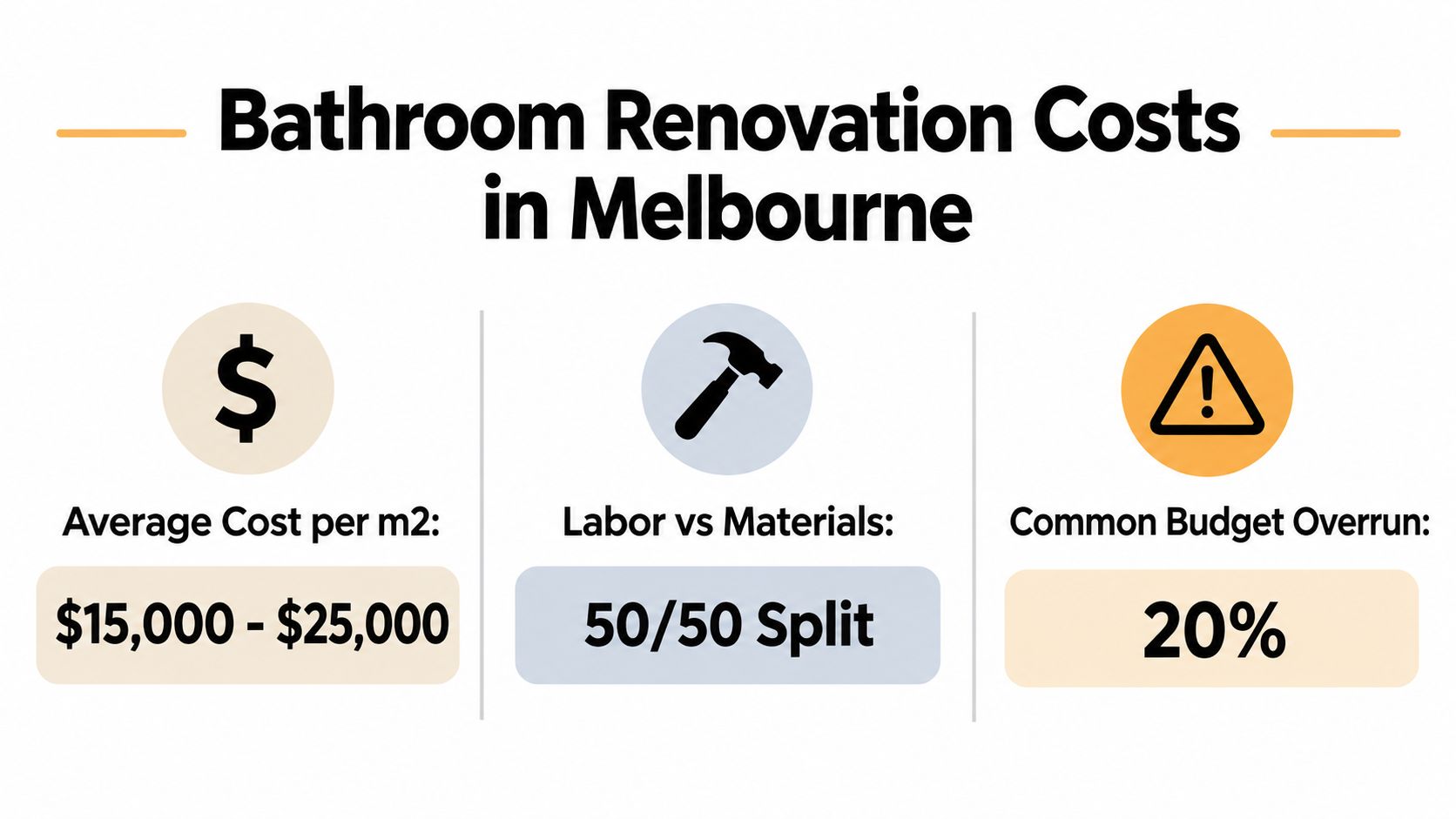
A homeowner might start with a calculator, see a national renovation range, and assume the result will translate directly to a Melbourne bathroom. A commonly cited Australian benchmark for a standard home renovation is A$1,600 to A$3,700 per square metre, with the figure attributed to SOHO in a 2025 Canstar summary, as outlined by this Victorian bathroom renovation pricing guide. That's useful as a first filter, but it isn't an itemised bathroom quote.
The calculation becomes unreliable when the scope changes. Replacing fittings in their existing positions is very different from demolishing the room, relocating a toilet, correcting a sloping substrate, installing a tiled niche and rebuilding the shower with compliant waterproofing. Both projects may occupy the same floor area, yet they demand different trades, sequencing and inspection requirements.
Melbourne conditions also affect how a project is priced. Labour availability, site access, waste removal, older housing stock and the need to coordinate licensed trades can all influence the final figure. A bathroom in a compact terrace with difficult access may require more handling and protection than a larger room on a clear ground-floor site.
The rate is a starting point, not a promise
I treat a per-square-metre figure as a sense-check. It helps identify whether a proposed budget is obviously too low for the stated finish, but it doesn't replace a scope of work and an itemised quotation. The scope should identify what's being demolished, retained, relocated, supplied, installed, tested and finished.
Builder's rule: If a quote gives you only a rate and no defined scope, you still don't know what you're buying.
For Melbourne and greater Victoria, the most useful early comparison is between a cosmetic refresh and a full wet-area rebuild. The first may preserve services and limit demolition. The second can involve waterproofing, plumbing, electrical work, substrate preparation, tiling and compliance documentation. Homeowners comparing contractors can also review the Melbourne bathroom renovation cost guide to understand which parts of the work need to be separated before comparing prices.
How Scope Determines Your Price per Square Metre
The phrase “renovation cost per square metre” hides several different project types. A cosmetic refresh may involve new paint, fittings, accessories and selected surface work while keeping the layout intact. A full renovation removes more of the existing room and rebuilds the wet areas, services and finishes.
A 2026 Australian renovation guide places metropolitan cosmetic projects at roughly A$2,000 to A$2,500 per square metre, mid-range full renovations at about A$2,800 to A$4,500 per square metre, and premium architect-designed work at more than A$6,000 per square metre, according to Canstar's Australian renovation cost guide. These bands help with planning, but a bathroom shouldn't be classified by appearance alone.
Cosmetic work
Cosmetic work works best when the existing layout is serviceable and the concealed building elements are sound. Keeping the toilet, vanity, shower waste and major plumbing in place can reduce disruption. It doesn't eliminate the need to check the substrate, falls and waterproofing, especially if the shower is being altered.
This approach stops working when the room has leaks, movement, damaged flooring or services that no longer suit the layout. Covering a defect with new tiles isn't a renovation strategy. It's postponing the cost and potentially making the eventual repair more disruptive.
Mid-range full renovation
A mid-range full renovation usually includes demolition, replacement fixtures, new wall and floor finishes, electrical and plumbing coordination, waterproofing and surface preparation. The cost rises because the trades work in sequence, and each stage affects the next. The tiler can't produce a durable finish if the substrate is uneven, the waterproofing is incomplete or the waste falls aren't correct.
The most useful document is a detailed scope of work, often called an SOW. For readers who manage properties or maintenance programmes, this SOW definition for facility managers explains why clear inclusions and exclusions make contractor comparisons more meaningful.
Premium and structural work
Premium work can include natural stone, complex patterns, custom joinery, concealed systems, architectural details and extensive substrate correction. A higher finish level also increases handling, protection and quality-control requirements. Large-format products may reduce grout lines, but they demand accurate walls, careful transport and experienced installation.
Structural changes add another layer. Removing walls, changing openings or altering floor levels can require design input, engineering or additional approvals. The floor area hasn't changed, but the scope has, which is why a single rate can mislead.
Practical test: Compare two quotes by matching the scope line by line, not by choosing the lowest rate per square metre.
Key Cost Drivers That Escalate Your Budget
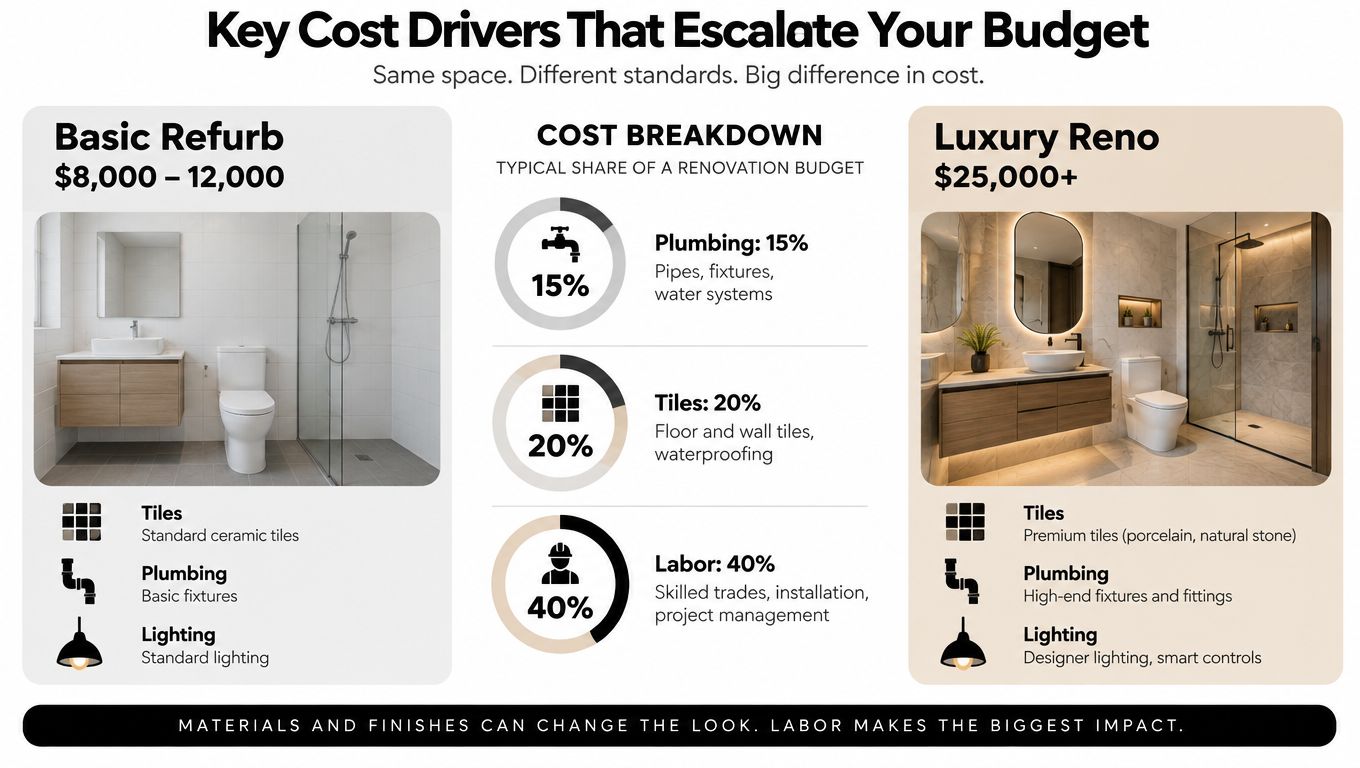
Two bathrooms with the same floor area can have very different prices. One may need straightforward ceramic tiling over a sound substrate. The other may require demolition, re-levelling, plumbing relocation, premium porcelain, a recessed niche and a complete waterproofing system.
Australian trade pricing illustrates the spread. Tiler labour is commonly quoted at A$30 to A$170 per square metre, waterproofing at A$35 to A$200 per square metre, standard tile supply at A$30 to A$120 per square metre, premium stone at A$80 to A$130 or more per square metre, and tile removal at A$45 to A$60 per square metre, based on the Australian bathroom renovation cost breakdown from Service.com.au.
Tiles and substrate
Standard ceramic can be practical for a controlled budget, particularly where the format is manageable and the walls are reasonably true. Large-format porcelain and natural stone create a different installation environment. The sheets are heavier, handling is more demanding, and the substrate must be flatter to avoid lippage and stress.
Screeding, self-levelling and re-levelling aren't decorative extras. They prepare the surface for the finish and help establish correct falls. Skipping that preparation may produce a cheaper initial quote, but it can create visible defects, poor drainage and premature failures.
Waterproofing and wet-area work
Waterproofing is one of the least visible parts of the job and one of the worst places to cut corners. A bathroom renovation needs coordinated preparation, compatible products, correctly treated junctions and adequate curing time. The tiler's finish can look excellent while a failure behind the tiles creates expensive remedial work.
Plumbing relocation also carries more impact than the visible fixture cost. Moving a shower or toilet can affect pipe routes, penetrations, floor preparation and sequencing. A layout change may improve the room, but it shouldn't be priced as if it were a simple fitting replacement.
Labour and coordination
Trade labour includes more than time spent laying tiles. It can include protection, demolition, rubbish handling, preparation, set-out, cutting, cleaning, testing and return visits. A builder coordinating plumbers, electricians, waterproofers, carpenters and tilers also carries responsibility for sequence and access.
The most reliable savings come from reducing unnecessary scope, not from removing essential preparation. Choose a simpler tile pattern, retain sound services where practical and finalise fixtures before work begins. Don't save money by omitting waterproofing checks or substrate correction.
Calculating Renovation Cost per Square Metre
Start with the floor area, but don't stop there. Measure the length and width of the room, calculate the floor area, then record the wall areas that will be tiled separately. The floor figure helps with broad comparison, while the wall and wet-area details reveal the actual tiling and preparation workload.
For full Australian bathroom renovations, commonly quoted benchmark pricing sits around A$2,300 to A$4,600 per square metre, with smaller bathrooms often landing at the higher end because demolition, waterproofing, plumbing relocations and compliance work are spread across fewer square metres, according to Homes to Love's bathroom renovation cost guidance.
A useful calculation method
-
Measure the room: Calculate the floor area and note ceiling height, wall lengths, openings and any areas that won't receive tiles.
-
Define the scope: Write down whether the project is a refresh, a full strip-out, a layout change or a structural alteration. Include demolition, disposal, plumbing, electrical work, waterproofing, screeding, tiling, fixtures and finishing.
-
Choose a finish band: Use a lower band only when the scope is strictly cosmetic. A full wet-area rebuild belongs in a different planning category from a surface refresh.
-
Separate fixed costs: Allow for site setup, demolition, waste, trade mobilisation, compliance work and coordination. These costs don't shrink in proportion to floor area.
-
Request an itemised quote: Ask each contractor to identify labour, materials, exclusions, provisional items and assumptions. A per-square-metre price is useful only when the inclusions match.
The inverse relationship is straightforward. A compact ensuite still needs demolition, a plumber, an electrician, waterproofing, tiling, fixtures and cleaning. Those fixed tasks are divided by fewer square metres, so the unit rate rises. A larger bathroom may require more tiles, but the same service and setup costs are distributed across a broader area.
The same measurement principle applies in adjacent trades. If you're comparing area-based pricing outside the Australian bathroom market, this guide to price per square foot for painters in shows why unit measurements need to be read alongside preparation and scope. For local tiling assumptions, the Melbourne tiling cost per square metre guide can help separate tile supply from installation and preparation.
Real-World Examples for Melbourne Bathrooms
A compact ensuite can produce a surprisingly high cost per square metre. Consider a 4.5 m² ensuite at the upper end of the full-renovation benchmark. The floor-area calculation gives roughly A$10,000 to A$21,000 before any plumbing relocation is priced, based on the benchmark from Hipages' bathroom renovation cost article. The calculation provides a starting point, not a final quote. Access, materials, layout changes and concealed damage determine where the project lands.
A compact ensuite
Small rooms carry most of the same trade requirements as larger bathrooms. A complete strip-out may involve demolition, waste removal, plumbing, electrical work, waterproofing, wall and floor tiling, fixture installation and final cleaning. Those fixed tasks are divided across fewer square metres, which raises the unit rate.
The plumber still needs to isolate and reconnect services. Waterproofing must cover the required wet-area surfaces, and the tiler must work around wastes, niches, corners and fittings. Premium tiles, restricted access or substrate repairs can increase labour even when the tiled area is limited.
A price based only on floor area can therefore understate the work. Price the ensuite as a defined package first, then use the square-metre rate as a sense-check.
A larger family bathroom
A larger family bathroom usually contains more floor and wall surface, fixtures, storage, screens and finishing work. Some setup and service costs are spread across a wider area, so the rate per square metre may fall. Keeping the vanity, toilet and shower in their existing positions can reduce plumbing labour further.
The total project can still be substantial. Australian consumer guidance places bathroom renovation costs around $10,000 to $30,000 or more, depending on design, materials and labour, according to Service.com.au's bathroom renovation cost breakdown. The final scope matters more than floor area alone.
What a quote should reveal
Check whether the quote includes demolition, disposal, waterproofing certification, substrate preparation, tile trims, silicone, fixtures, screens, painting and final cleaning. Ask the contractor to identify exclusions, provisional items and assumptions as well.
A reliable comparison starts with matching work packages. A cheaper quote may omit preparation, waste removal or finishing, leaving those costs to appear later as variations. Compare the inclusions before comparing the price.
Important Rules for Registered Builders
In Victoria, domestic building work valued at more than $10,000 must be carried out by a registered builder or registered building company, and the project must use a major domestic building contract. Consumer Affairs Victoria says the requirement applies to renovations, extensions and repairs. Some single-trade jobs, including tiling, painting or plumbing, can be exempt when that is the only work being performed, as explained by Consumer Affairs Victoria's guidance on builders and tradespeople.

Check who holds responsibility
A bathroom renovation often combines several trades. If one contractor is managing demolition, carpentry, plumbing, electrical work, waterproofing and tiling, confirm whether the contracting entity is registered for the work and whether the required contract is being used. Don't assume that a trade licence automatically makes the person a registered builder.
Ask for the registration details, written scope, contract terms, insurance information and a clear payment schedule. Verify the practitioner through the Victorian practitioner search rather than relying only on a business card or online profile.
The registration rule protects more than paperwork. It helps establish who is responsible for coordinating the work, addressing defects and complying with the applicable domestic building requirements. A cheap quote can become expensive if nobody accepts responsibility for the complete sequence.
Compliance check: Before signing, confirm the contractor's registration status and make sure the contract describes the entire renovation, not just the visible tiling.
The following video provides a useful visual introduction to the role of construction builders and contract administration:
Single-trade exemptions don't remove the need for competent workmanship or correct coordination. If several trades are involved, treat the project as a managed renovation rather than a collection of unrelated tasks.
Using Free Quotes and Calculators to Plan
A calculator is most useful before you speak to contractors. Enter the room measurements, identify whether the layout changes, select a finish level and list the work that must be included. Then use the result to prepare questions, not to demand that every contractor match one headline figure.
The Melbourne bathroom renovation calculator can help organise an early budget around scope. Pair it with at least one detailed, site-based quote and ask each contractor to identify exclusions, provisional items, substrate assumptions, waterproofing requirements and fixture responsibilities.
Before accepting a price, ask:
- What demolition and disposal are included?
- Are plumbing and electrical relocations included?
- Who supplies tiles, fixtures, screens and accessories?
- What preparation is allowed for floors and walls?
- Is waterproofing documented and certified?
- Who coordinates the registered builder and specialist trades?
A clear scope makes the renovation cost per square metre meaningful. Without it, you're comparing incomplete promises.
Melbourne Tiling Services P/L provides start-to-finish bathroom and ensuite renovations, waterproofing, screeding, self-levelling, ceramic, porcelain, marble and large-format Kerlite tiling across Melbourne and greater Victoria. Visit Melbourne Tiling Services P/L to request a free quote, discuss your scope and use practical planning tools before work begins.
Write a Comment