
You're standing in a Melbourne tile showroom with three samples in your hand. One is a glossy marble-look ceramic subway tile, one is a large Carrara-style porcelain slab, and the third is real marble with veining no printer can fully reproduce. You want the classic look without the sealing, weight and maintenance, but you also know a bathroom renovation can expose weaknesses that a showroom never will.
The right choice isn't decided by the prettiest sample. Water absorption, slip resistance, dimensional tolerance, grout design and compliant waterproofing determine whether marble look ceramic subway tile belongs on your shower wall, splashback, feature wall or floor. This guide gives you the practical Melbourne answer, including installation under AS 3958:2023, wet-area requirements under the NCC, grout maintenance, sourcing risks, Victorian permits and the role of registered builders.
Table of Contents
- The Marble Look Trend in a Melbourne Bathroom
- Ceramic Subway Versus Natural Marble and Porcelain
- Where Marble Look Subway Works and Where It Doesn't
- Installation Standards That Protect Your Renovation
- Grout Choices That Make or Break the Look
- Living With the Tile Day to Day
- Melbourne Sourcing, Permits and Registered Builders
- Putting It All Together for Your Project
The Marble Look Trend in a Melbourne Bathroom
A Melbourne bathroom can look expensive in the showroom and disappoint once the shower is running. Marble look ceramic subway tile offers the familiar narrow format, printed Carrara or Calacatta-style veining and less routine maintenance than natural marble. It is a practical design choice, provided the product and installation suit the wet area.
The construction is straightforward: a fired ceramic body, a printed glazed surface carrying the marble pattern and a clear protective finish. The pattern creates the stone effect, while the ceramic body provides the tile's shape and base. A convincing print still cannot reproduce the variation of quarried marble.
The practical distinction: “Marble look” describes the finish, not the material.
A subway tile is usually rectangular, with a length roughly twice or three times its width. Running bond is the familiar layout, while stacked, vertical and restrained herringbone arrangements produce a different feel. The format creates more joints and alignment decisions than a large panel. On a Melbourne renovation, accurate setting-out and consistent joints matter as much as the printed design.
Australia's supply chain affects availability, replacement matching and delivery times. Australia imported 40,120,185 square metres of ceramic tiles in 2019, down 12.1% from 45,577,062 square metres in 2018, with China supplying 70.6% of import volume, according to Australian ceramic-tile import analysis. Overseas manufacturing and freight can affect what remains available after installation.
Record the product code, calibre and shade before work begins. Confirm batch availability before demolition, then keep spare tiles for future repairs. A close replacement may still differ visibly in tone, size or veining.
What the showroom label doesn't tell you
Soft grey veining can look calm on a sample board and become busy across a full shower. High-contrast patterns may resemble luxury stone under bright showroom lighting but dominate a compact ensuite. Recent Australian bathroom design coverage favours softer, subtler marble veining over dramatic patterns, as discussed in current ceramic-tile design coverage.
The pattern also says nothing about floor suitability. Check the declared water absorption classification under AS 13006 and ISO 13006, the slip classification under AS 4586, and the manufacturer's dimensional-tolerance information. A marble-look tile can match the colour brief and still be unsuitable for a hobless shower floor.
Treat the glossy marketing as the starting point, not the specification. For walls, it can deliver the look efficiently. For floors, choose based on tested performance, compliant wet-area detailing and grout maintenance, not appearance alone.
Ceramic Subway Versus Natural Marble and Porcelain
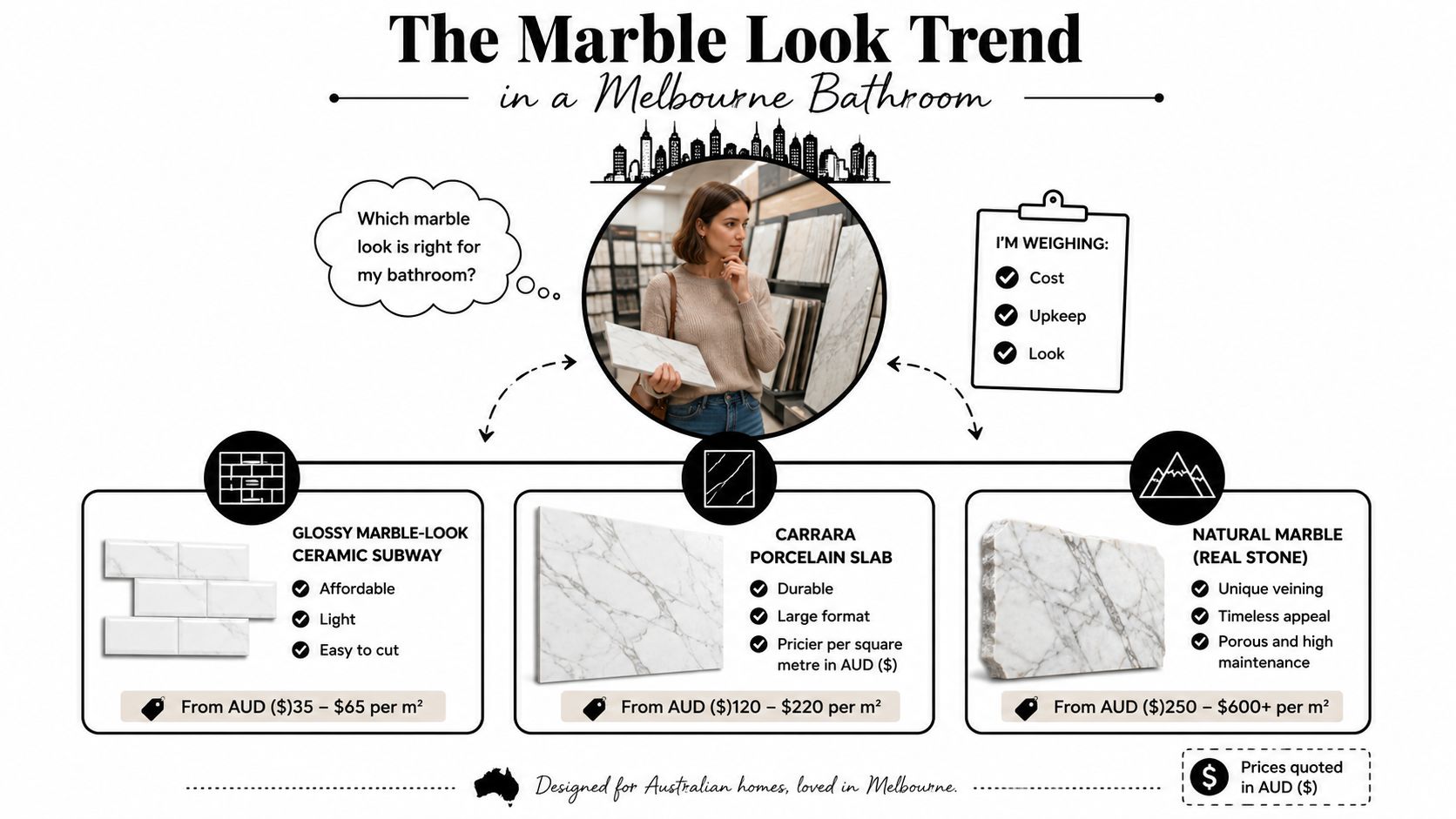
Marble-look ceramic subway tile sits between natural marble and porcelain in both appearance and practical performance. Natural marble offers authentic variation and a surface that develops character, but it's porous, heavier and more demanding to maintain. Porcelain delivers density and large-format drama, yet it can be less forgiving to cut and doesn't give you the same narrow, hand-laid rhythm.
Australian ceramic demand provides useful context. Industry market data estimated 2024 ceramic-tile consumption and imports at approximately 43 million square metres, with import volume increasing 7% year on year and import value reaching about A$416 million, according to Australian bathroom-tile market data. Marble-look subway tile sits within this mainstream imported ceramic category, not a niche decorative market.
| Material | Typical Cost (per m² installed) | Weight and Thickness | Sealing Needed | Best Fit in a Melbourne Bathroom |
|---|---|---|---|---|
| Marble-look ceramic subway | Obtain a project-specific quote | Generally lighter and easier to handle than slabs | The tile face generally doesn't require stone sealing, but grout still needs care | Shower walls, splashbacks and feature walls when the product is correctly specified |
| Marble-look porcelain slab | Obtain a project-specific quote | Larger, denser panels that require careful handling | Usually no stone sealing, subject to the product system | Large-format walls and high-impact contemporary bathrooms |
| Natural marble | Obtain a project-specific quote | Heavy stone with unique variation | Ongoing sealing and maintenance are normally part of ownership | Carefully detailed feature areas where authentic stone is the priority |
The ceramic option is the sensible choice when you want the subway format, a lighter installation and a controlled visual pattern. It's also easier to replace if you've documented the batch and stored spares. Natural marble is the choice for people who value genuine stone more than convenience. Porcelain wins when uninterrupted surfaces and density matter more than individual small tiles.
For a more detailed material comparison before you select a product, review porcelain versus ceramic tiles. The important point is that material choice must follow the room zone, not the other way around.
Where Marble Look Subway Works and Where It Doesn't
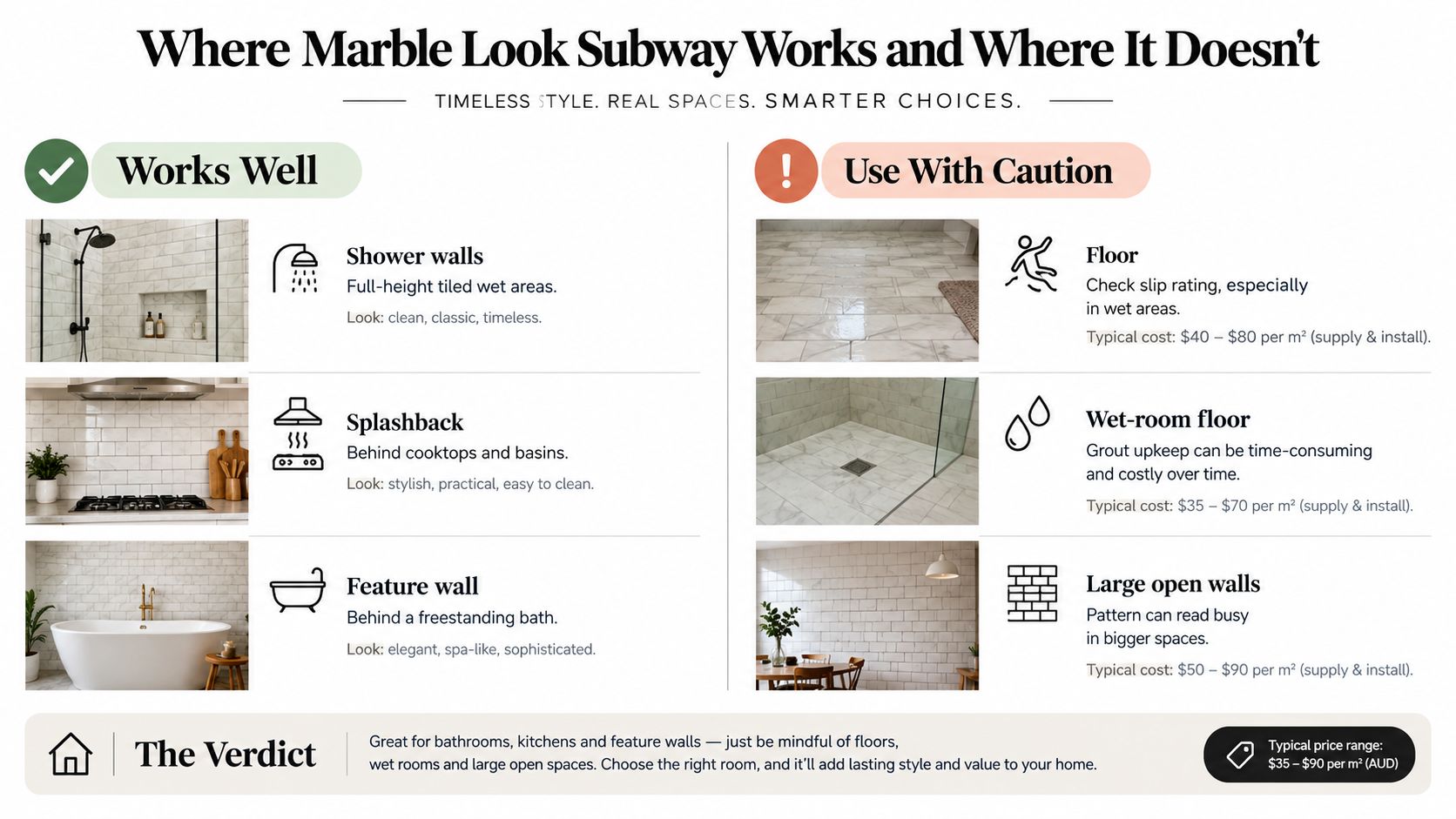
Use marble-look ceramic subway tile on vertical surfaces first. Shower walls, vanity splashbacks, kitchen splashbacks and feature walls behind a freestanding bath are where the format performs best visually and practically. A full-height shower wall can carry the veining without exposing the tile to the direct wear and barefoot grip demands of a floor.
Laundry splashbacks are another strong application. They benefit from a wipeable glazed face and a classic pattern that works with cabinetry, troughs and utility fittings. A restrained running bond usually suits a busy laundry better than a complicated layout.
The shower-floor trap
A glossy marble-look subway tile may be marketed for bathrooms, but that doesn't make it suitable for a shower floor. Slip resistance must be verified under AS 4586, and wet barefoot areas may require P4 or P5 performance, according to Australian tile safety guidance. Glazed ceramic can become substantially more slippery when wet.
Grout joints don't automatically make a surface safe. Small tiles may create more joints, but joint quantity alone doesn't establish compliance. The exact tile, finish, grout, slope and cleaning regime need to work together.
Decision rule: If the supplier can't provide the product's documented AS 4586 classification for the intended zone, don't use it there.
For a hobless shower, choose a floor-rated product with documented wet barefoot performance. Keep the marble-look subway tile on the walls unless the manufacturer specifically supports the floor application and the classification suits the design.
Installation Standards That Protect Your Renovation
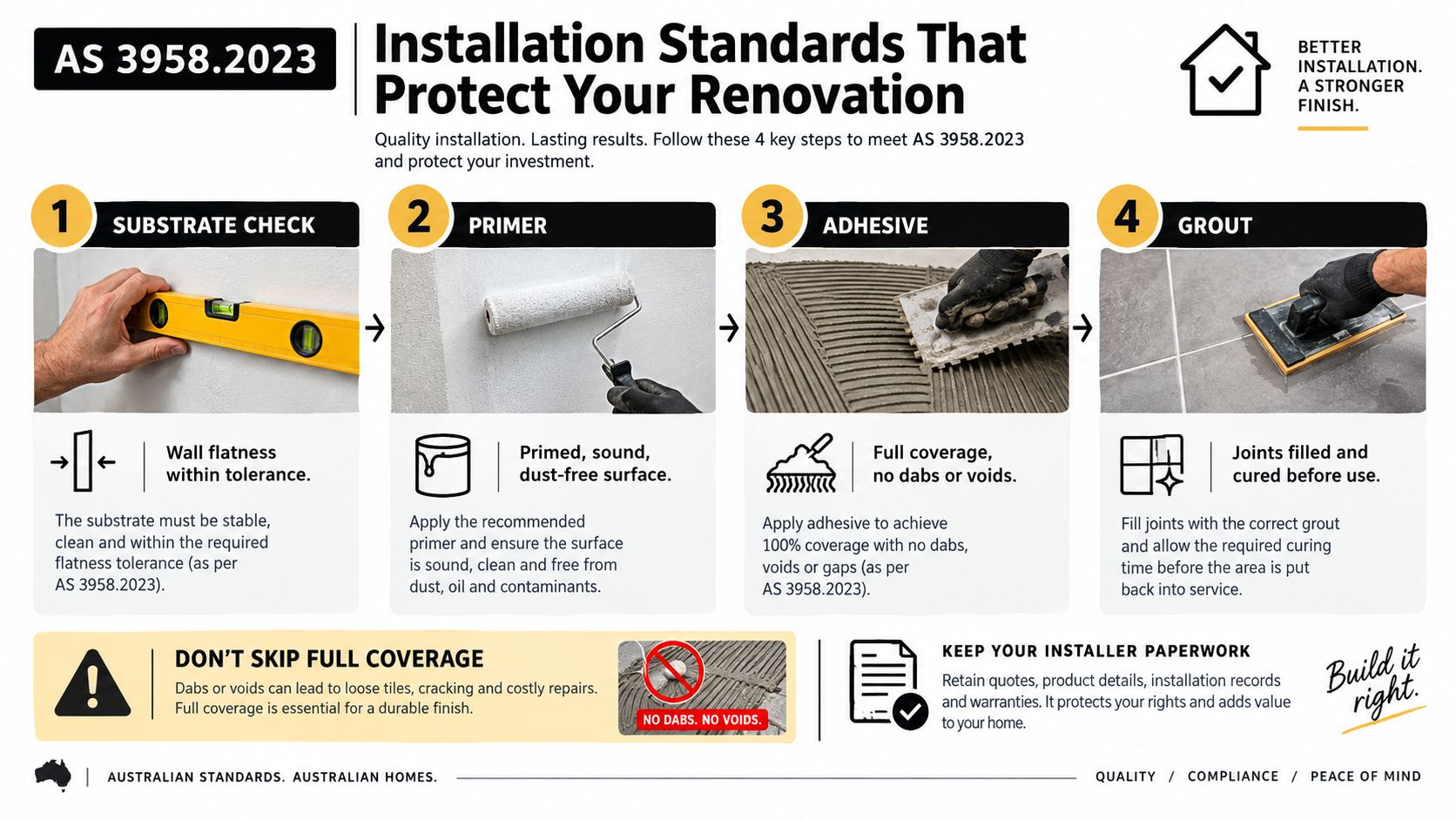
AS 3958:2023 sounds technical, but its homeowner implications are straightforward. The wall must be sound, clean, dry, sufficiently flat and dimensionally stable before the installer begins. A glossy, low-absorption tile won't hide a crooked substrate. It will highlight lippage, inconsistent joints and awkward cuts around niches and fittings.
The installer should prime compatible surfaces, use the correct notched trowel and achieve full adhesive coverage. Dabs and voids behind small-format tiles create weak spots and can leave areas vulnerable to impact or moisture-related problems. Ask for the adhesive product name and retain the installation paperwork.
For wall tiles with water absorption below 3%, the cited Australian guidance calls for at least a C2 cementitious adhesive or an R1 reaction-resin adhesive. Don't let anyone choose a basic adhesive by habit. Confirm the tile's declared absorption classification first, then match the adhesive to the product and substrate.
Waterproofing sits behind the look
The tile isn't the waterproofing system. Under the NCC, shower walls must be waterproof to at least 1,800 mm above the floor substrate, while the shower floor, including any hob or step-down, must be waterproof. Wall junctions and joints inside the shower area also require waterproofing, as set out in the NCC waterproofing requirements for houses.
The membrane may sit above or below the tile bed or screed, depending on the compliant construction method. Corners, changes of plane, penetrations and junctions need proper detailing within that system. A flexible movement joint at a change of plane is a quality-control measure, not an optional decorative detail.
Before work starts, ask for a written specification covering the membrane system, substrate preparation, adhesive, grout, movement joints and curing requirements. The Australian bathroom waterproofing standards guide is a useful reference for the questions your installer should answer.
Grout Choices That Make or Break the Look
Grout sets the visual rhythm of a marble-look subway wall. A coordinated mid-tone grout keeps the printed veining calm and refined. Bright white joints create a sharper grid and can make the pattern look busier than intended.
For soft grey veining in a Melbourne ensuite, choose warm white, pale grey or a grout matched closely to the tile. Light grout supports the classic marble effect, but shows soap residue and discolouration sooner. Mid-tone grout hides everyday marks better in a busy household, particularly where ventilation is inconsistent.
Choose the joint before the tile is fixed
A narrow, even joint suits the clean lines of a pressed subway tile. Your installer should follow the manufacturer's tolerance and recommended joint width, rather than forcing tiles into an excessively tight grid. Confirm the layout dry, including corners, niches, windows and plumbing penetrations. These details reveal poor planning before adhesive is applied.
For wet zones, compare cementitious and epoxy grout by cleaning requirements, colour stability and installer experience. The practical differences are covered in this guide to epoxy grout versus cement grout. Epoxy can suit demanding areas, but application must be handled properly. Cementitious grout may be simpler to repair or replace, depending on the product and installation.
A useful test: View the tile and grout sample together under bathroom lighting, not only under showroom lights.
Quieter marble veining gives you more freedom with grout colour than a high-drama print, but the choice still needs to be deliberate. Set perimeter joints at corners and changes of plane with a flexible sealant compatible with the wet-area system. Do not pack those movement points rigidly with cementitious grout, because the joint must accommodate movement without cracking or breaking the finish.
Living With the Tile Day to Day
Marble-look ceramic is easier to live with than natural marble, but small-format subway tile creates more grout joints. The tile face may resist ordinary bathroom staining, while the joints collect soap residue, body oils and cleaning residue. Calling the wall “low maintenance” without discussing grout is incomplete.
Use a simple routine:
- After showering: Squeegee excess water from the walls and rinse away residue.
- Each week: Clean with warm water and a mild, pH-neutral cleaner.
- During cleaning: Use a soft cloth or non-abrasive pad, then rinse and dry the surface.
- For grout: Follow the grout manufacturer's maintenance instructions rather than applying stronger chemicals by default.
Australian product guidance recommends regular removal of grit and mild, pH-neutral cleaning, while warning that abrasive chemicals can damage tile surfaces. Acidic descalers can also attack grout and leave the installation looking patchy.
Keep a neutral cleaner, soft cloths, a soft brush for grout and a squeegee in the bathroom. Leave abrasive powders, harsh scouring pads and aggressive acidic products on the shelf. If the shower screen is contributing to the hard-water appearance, use this practical shower screen cleaning guide alongside your tile-care routine.
Ventilation matters as much as the product selection. Run the exhaust fan during and after showers, keep the room aired and deal with discolouration early. The goal isn't to make the wall maintenance-free. It's to make the maintenance predictable enough that the marble effect still looks deliberate years after installation.
Melbourne Sourcing, Permits and Registered Builders
A marble-look ceramic subway tile can be the smallest part of a Melbourne bathroom renovation. Demolition, carpentry, plumbing, electrical work, waterproofing, screeding, glazing and tiling all need to happen in the right order. Before choosing the tile, establish who controls sequencing, permits, inspections, documentation and defect rectification.
A building permit is written approval from a registered building surveyor confirming that the approved plans and specifications meet building regulations. Check permit requirements before work starts, especially if the renovation changes walls, plumbing layouts, structural elements or the building envelope. A registered private or municipal building surveyor can advise on the project.
Know the Victorian thresholds
Consumer Affairs Victoria states that renovation work worth more than $10,000 generally requires registration with the Building and Plumbing Commission, although some single-trade categories, including wall and floor tiling, are exceptions. Structural building work requires registration regardless of project value, and structural work also requires a building permit. Work above the general renovation threshold requires a major domestic building contract, according to Victorian guidance on builders and tradespeople.
Owner-builders have a separate requirement. A Certificate of Consent from the Building and Plumbing Commission is required before carrying out works over $16,000, as explained in the Victorian owner-builder checklist. This threshold is separate from the general $10,000 builder-registration and contract threshold.
For a multi-trade renovation, a Registered Unlimited Builder is usually the clearest choice. One accountable party can coordinate the programme, trade interfaces and compliance questions, rather than leaving each contractor responsible for only one part of the bathroom.
Source tiles before demolition
Ask the supplier for the product code, shade, calibre, absorption classification, slip data and current batch availability. Order enough tiles from one batch for the planned work, then retain spares for future repairs. Imported ceramic products can become difficult to match when a production run changes.
A tile specification should also sit beside the builder's paperwork. Record the selected product, intended location, grout requirements and installation responsibilities before demolition begins. If you are assessing how a trades business presents its capability online, Kultiva Marketing Agency services for trades offers relevant context. For your renovation, require the builder to provide the scope, responsibilities, product selections and completion records in writing.
Putting It All Together for Your Project
Give your builder a written specification, not a Pinterest photograph. Name the marble-look ceramic subway tile, product code, shade, calibre, absorption classification, dimensional tolerance and AS 4586 slip data. Assign it to walls, splashbacks or feature areas only when the product documentation supports that location.
Lock in the construction system before demolition:
- Confirm the wet-area design. Mark the shower floor, shower walls, junctions, penetrations and membrane position under the selected compliant method.
- Approve the substrate and adhesive. Require a sound, prepared wall and the correct C2 cementitious or R1 resin adhesive when tile absorption is below 3%.
- Set the visual controls. Approve the running bond or stacked layout, grout colour, joint width, trim and movement-joint details.
- Protect future repairs. Record batch information and store spare tiles in a dry, labelled location.
- Clarify the contract. Confirm which registered builder coordinates trades, permits, inspections, waterproofing records and completion documents.
Budgeting must be clear. Request a written scope, free quote, 3D drawings and a renovation calculator that separates demolition, plumbing, electrical work, waterproofing, tiling, glazing, fixtures and allowances. This exposes changes before they become costly variations.
If you act as an owner-builder, keep the $16,000 Certificate of Consent threshold separate from the $10,000 threshold that generally triggers builder registration and a major domestic building contract. These requirements are set out in Victorian owner-builder guidance published by Consumer Affairs Victoria. A tile selection does not determine the permit position. The building work and delivery model do.
Marble-look ceramic subway tile suits a Melbourne bathroom when it stays on the right surface, uses a compliant wet-area system and has a grout plan suited to daily cleaning. Choose it for the appearance, then approve it for performance.
Melbourne Tiling Services P/L offers start-to-finish bathroom and ensuite renovations, waterproofing, compliant tiling and coordinated trade management across Melbourne and greater Victoria. Visit Melbourne Tiling Services P/L to request a free quote, review 3D design options and plan your marble-look tile renovation with a Registered Unlimited Builder.
Write a Comment