

Get three quotes and pick the middle one. That advice is everywhere, and it's useless if the three documents don't price the same job. A Melbourne bathroom quote that hides waterproofing, demolition or permits isn't cheaper, it's incomplete, and you'll pay for the missing lines later as variations.
Learning how to quote a bathroom renovation properly means treating the quote as a scope-and-compliance document, not a headline price. I would start by forcing every bidder onto the same lines, with the same assumptions, before you compare a single dollar figure.
Table of Contents
- Scope Lines Every Compliant Quote Must Show
- How to Price Each Line Without Guesswork
- Building a Contingency You Can Justify
- Comparing Two Quotes Line by Line
- Contract Terms, Milestones and Variations
- Confirm the Quote Before You Sign
Scope Lines Every Compliant Quote Must Show
Start with the room, not the finishes. A usable quote records site dimensions, room layout, substrate condition, access for materials and waste, fixture locations, ventilation, electrical changes, plumbing relocations, tile format, grout, trims and shower screen requirements. Without those notes, the estimator is pricing a generic bathroom, not yours.
Bathroom design should be settled at this stage too. We include sketches, plans and discussions in bathroom design, and modifications are agreed before work commences, so the quote prices a layout you've approved.
The Lines That Must Appear
Every scope item gets its own line, marked included, excluded or provisional. Lump sums are where cost hides.
| Scope line | What it should cover | Check before accepting |
|---|---|---|
| Demolition and disposal | Appliances, fittings, shower screens, wall and floor tiles, substrate sheeting, skip bin | Skip size and disposal fees named |
| Carpentry and substrate | Shower base substrate, stud walls, outlet moves, soap niche | Framing allowance stated per item |
| Plumbing | Relocations, new outlets, fixture connections | Licensed plumber named |
| Electrical | Rewiring, new circuits, exhaust fan | Licensed electrician named |
| Waterproofing | Membrane system, falls, penetrations, corners, puddle flanges, waterstops | Inspection hold points listed |
| Screeding and levelling | Floor levelling and shower base falls | Area and depth stated |
| Tiling | Wall and floor tile areas, trims, grout, large-format handling | Waste allowance stated |
| Fixtures and fittings | Vanity, toilet, mixer, shower screen, mirror | Supplied by builder or client named |
| Permits and certification | Building permit, surveyor fees, certificate of final inspection | Included, excluded or provisional |
| Contingency | Held as a separate line, outside the base scope | Percentage and release process stated |
That separation matters because an approval value and a quote value aren't the same thing. The Australian Bureau of Statistics building approvals methodology explains that reported building-work values generally include site-preparation costs but exclude land, demolition and landscaping, and that an approved estimate can differ materially from the final completed cost. So ask directly whether demolition sits inside the headline figure or outside it.
The same methodology defines a building approval as the official authorisation that allows construction to begin, called a building permit in Victoria, and notes that planning approval alone doesn't authorise construction. Your quote should state permit and inspection costs as included, excluded or provisional, not leave them silent.
Waterproofing Gets Its Own Detail
Never accept waterproofing buried inside a tiling allowance. Require the quote to name the membrane system, substrate preparation, falls, penetrations, corners, puddle flanges, waterstops, curing time and inspection hold points, referenced to the NCC and AS 3740. An unenclosed shower generally needs waterproofing across the area within 1,500 mm of the shower rose, and the quote should show that coverage, not just say "waterproof shower".
The evidence for this rigour is blunt. A Western Australian government inspection of 86 shower areas found only 60% overall compliance across 1,360 waterproofing inspection points, with waterstop defects accounting for 111 of 539 unsatisfactory items, and a Victorian government analysis reported missing or insufficient waterproofing in 33% of the relevant non-cladding defect cases. Price the hold points and remedial substrate work explicitly, and check what documentation you'll receive through the waterproofing compliance certificate process in Victoria.
Practical rule: If waterproofing has no named membrane, no waterstops and no inspection stage, it hasn't been priced. It's been assumed.
Registration and Assumptions
For bathroom renovations involving coordinated trades, the quote should name the registered builder responsible and separate licensed plumbing and electrical work from general trade allowances. Registration is required for work above the Victorian threshold, for combined skills such as plastering and painting, and for structural work regardless of cost, so a quote that moves walls or coordinates multiple trades should identify who's registered for what. Among registered builders, ask who coordinates the sequence day to day. We deliver bathroom renovations with in-house carpenters, plumbers, waterproofers and tilers, which removes the gaps where one trade waits on another.
Close the scope with written assumptions. State that pricing assumes no concealed structural damage, no asbestos and existing services being reusable, then list variation rates for unexpected framing, rotten flooring, plumbing relocation and levelling. You'll rarely use all of them, but agreeing the rates now, while you can still walk away, is far cheaper than negotiating them mid-demolition.
How to Price Each Line Without Guesswork
A bathroom quote can look precise and still leave major costs undefined. Price it by measurable scope, then expose the allowances and risks that could change the final bill.
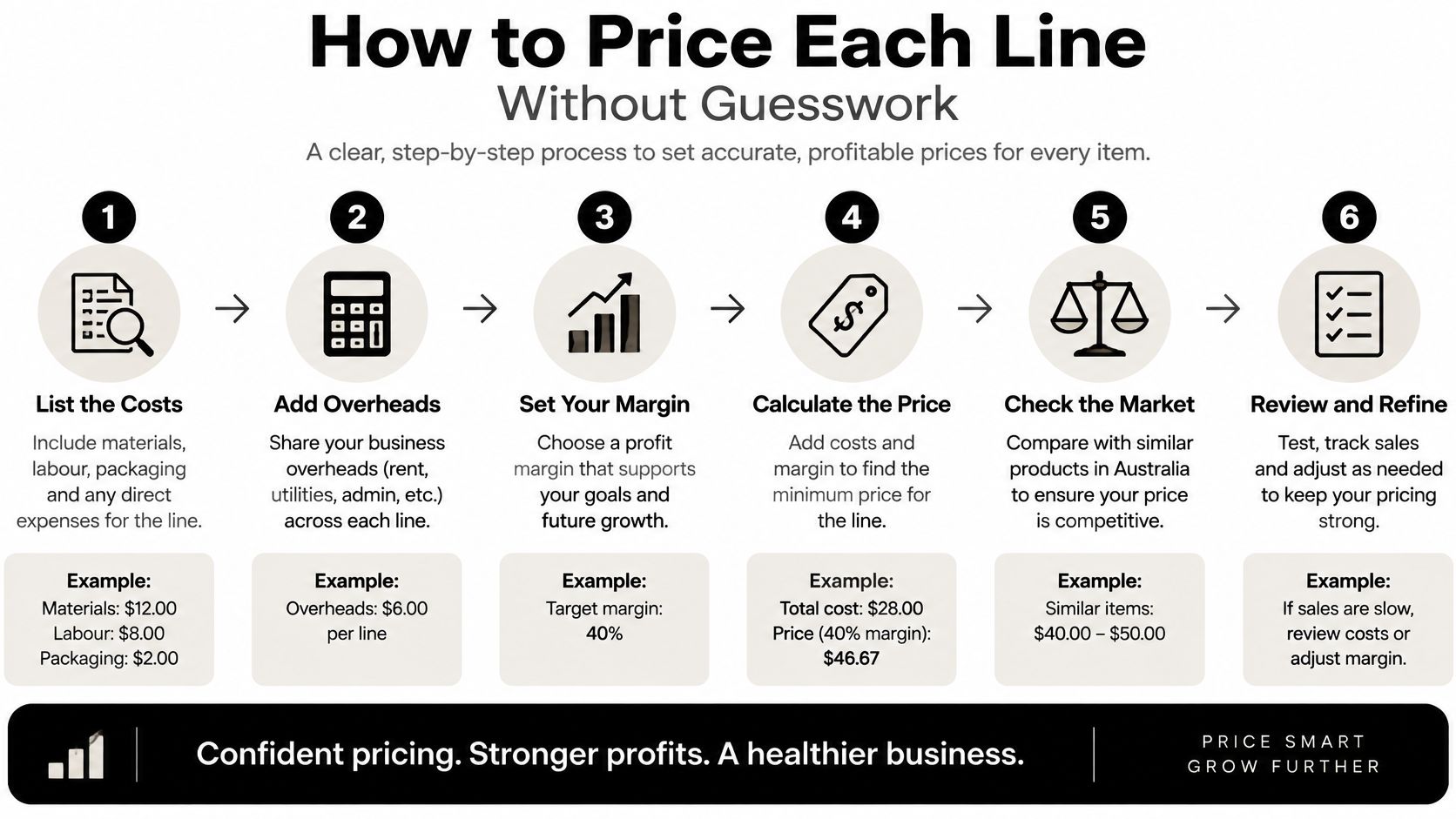
- Measure the base scope: Record wall and floor areas separately, and note the substrate condition. Walls and floors involve different tile sizes, cuts and labour, so combining them into one area can conceal an unrealistic rate.
- Allow for waste and handling: Set tile waste according to the layout and pattern; diagonal layouts generally require more. Price large-format panels or stone for handling, cutting, levelling and access as well as area. A difficult carry or cut can add labour that a square-metre rate misses.
- Confirm fixture specifications: Identify the models before pricing framing and waterproofing. A wall-hung toilet, in-wall cistern, linear waste, niche, frameless screen or recessed mixer can affect framing depth, membrane detailing and trade coordination. Missing specifications leave room for extra cost and delays.
- Price labour by trade: Show the labour and coordination required for plumbing, electrical work, waterproofing and tiling, along with the compliance documents included. The NSW government research on serious defects in residential apartments found serious defects in 39% of surveyed strata buildings and waterproofing issues in 23% of all buildings. Clear trade interfaces belong in the price, not in a handshake.
- Set provisional sums with unit rates: Use provisional sums for uncertain work, such as levelling or plumbing relocation, and attach a rate per square metre, point or hour. Without a rate and a way to measure the work, an allowance can become an open-ended cost.
- Separate margin from risk allowances: Show the margin and identify contingency separately from the priced base scope. Builders managing several jobs use the same separation in cost planning for project-based businesses, keeping base costs, allowances and risk money visible.
This walkthrough shows how those pricing decisions apply to a bathroom layout before a contract is signed.
Each priced line should state a quantity, unit and rate. Compare the total with the bathroom renovation calculator, then ask the builder to explain any gap line by line. Rectifying a failed bathroom can cost far more than building it correctly the first time. Proper falls, compatible systems, inspection photographs and commissioning are small costs beside preventable rework.
Building a Contingency You Can Justify
Published ranges are a reference point, not a budget. One 2026 Australian renovation cost guide places a standard in-place metropolitan bathroom refresh around $15,000–$22,000 and premium work at $25,000–$40,000 or more, while noting that fixed-price contracts may embed an 8–15% contingency and cost-plus arrangements can transfer overrun risk to the homeowner. That trade-off is the part most quotes don't explain.
A risk-adjusted quote shows three figures instead of one. First, the confirmed contract scope for work that can be measured today. Second, realistic provisional allowances for work that's likely but unmeasurable until demolition. Third, a homeowner-held contingency that only you can release. If a builder folds all three into one number, you can't tell what you're committed to and what you're merely allowing for.
Triggers Worth Pricing in Advance
| Trigger | Usual cause | Allowance and approval |
|---|---|---|
| Rotten or water-damaged subfloor | Past leaks or failed waterproofing | Provisional sum per square metre of replacement, approved in writing before work |
| Uneven or out-of-level floor | Old screed or timber subfloor | Screeding priced by area and depth, client signs off levels |
| Suspected asbestos | Older sheeting, vinyl or adhesives | Testing and removal provisional, work stops until the report is received |
| Hidden plumbing relocation | Pipes concealed in walls or floors | Provisional sum per fitting point, variation form signed |
| Obsolete wiring | Old circuits that do not meet current requirements | Rewire provisional, licensed electrician report required |
Melbourne's older housing stock makes these triggers common rather than exceptional. Concealed water damage, uneven substrates, obsolete plumbing and apartment body-corporate requirements can all move the final cost, so the allowance should name the trigger, the evidence and the approver before work starts.
A suspected leak or failed waterproofing makes a cheap cosmetic quote the wrong product. Get the wet area assessed first, then price finishes on a sound substrate.
Close with a release rule you both sign up to. Contingency money moves only after photographs of the concealed condition, a written variation with a price, and your sign-off before the extra work begins. Decide in advance what event justifies spending it, and the contingency stops feeling like a slush fund and starts working as insurance you've already priced.
Comparing Two Quotes Line by Line
Say two builders quote the same 2.4 m by 2.2 m Melbourne bathroom, one at $18,000 and one at $17,200. These figures are illustrative, but the method is exactly what you should run on real quotes. The cheaper headline wins only until you normalise the scope.
Step 1, demolition: Quote A includes demolition, skip hire and disposal in its base. Quote B excludes them, so add $2,100 to Quote B before comparing anything else.
Step 2, waterproofing: Quote A names the membrane system and inspection hold points. Quote B prices waterproofing inside its tiling allowance, so price it as its own line at $1,400 and ask B to confirm the detailing in writing.
Step 3, permits: Quote A marks permit and surveyor fees provisional at $900. Quote B says nothing, so add the same $900 provisional sum to B, with a unit basis for how it's reconciled.
Step 4, contingency: Quote A holds a 10 per cent contingency of $1,800 outside the base, released only on approved variations. Quote B holds none, which doesn't remove the risk, it just leaves it unpriced and entirely yours.
| Scope line | Quote A | Quote B normalised |
|---|---|---|
| Demolition and disposal | Included in $18,000 base | Excluded, add $2,100 |
| Waterproofing | Named membrane and hold points in base | In tiling allowance, add $1,400 |
| Permits and surveyor fees | Provisional, $900 | Not stated, add $900 |
| Contingency | 10 per cent owner-held, $1,800 | None allowed |
| Total | $18,900 before contingency | $21,600 before contingency |
The $800 headline advantage for Quote B becomes a $2,700 disadvantage once the lines match, and that's before Quote A's contingency is considered. Quote A also tells you how surprises get handled, Quote B doesn't. Run this normalisation on every quote you receive, in a spreadsheet, one row per scope line. Any cell a builder won't fill in is a cost you'll meet later.
Contract Terms, Milestones and Variations
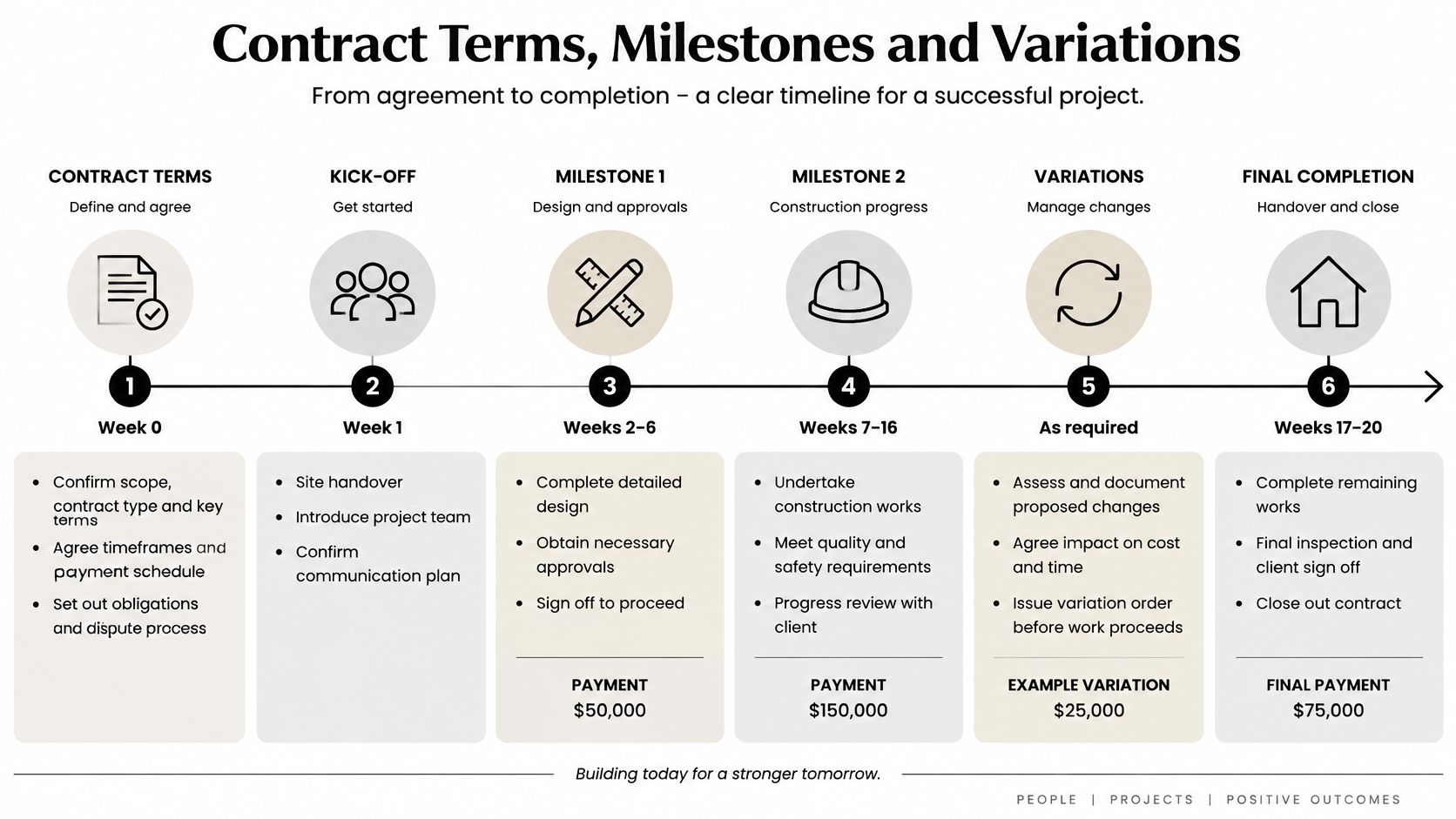
A bathroom quote is also a contract about compliance, timing and who pays when the scope changes. In Victoria, building work above a statutory value threshold requires a written domestic building contract. Work above the higher major domestic building contract threshold requires that contract with a registered builder. Splitting one job across separate agreements does not avoid the applicable requirements. The Building and Plumbing Commission's guidance on domestic building agreements and contracts explains the requirements.
The contract should identify the builder, set out the plans and specifications, and state who will obtain any required planning and building permits. Confirm the permit pathway and the completion document that applies to your project before work starts.
Milestones That Release Money
| Milestone | Trigger | Document required |
|---|---|---|
| Deposit | Contract signing | Signed contract and builder registration details |
| Progress payment | Demolition completed | Demolition completion record and disposal documentation |
| Progress payment | Waterproofing inspection passed, before tiling | Inspection record and photographs |
| Progress payment | Tiling completed | Tiling completion photographs |
| Final payment | Practical completion | Applicable completion documentation |
Tie each progress payment to work that is complete and evidence the contract specifies. The builder can price the job without financing work that has not started, while you can check the claimed milestone against the work on site. Set out the sequence and expected timing in the contract; the bathroom renovation timeline shows how trades and project stages fit together.
A variation must state the change, its price and any effect on the completion date. Get your written approval before the changed work begins. A verbal instruction can leave both the cost and the schedule disputed.
Release rule: Match each claim to its agreed milestone and supporting record. If the waterproofing inspection record is missing, resolve that gap before tiling starts or the related progress payment is released.
Confirm the Quote Before You Sign
A quote is ready to sign when its scope, exclusions and costs can be checked without filling in gaps yourself. Use this checklist with the document in front of you.
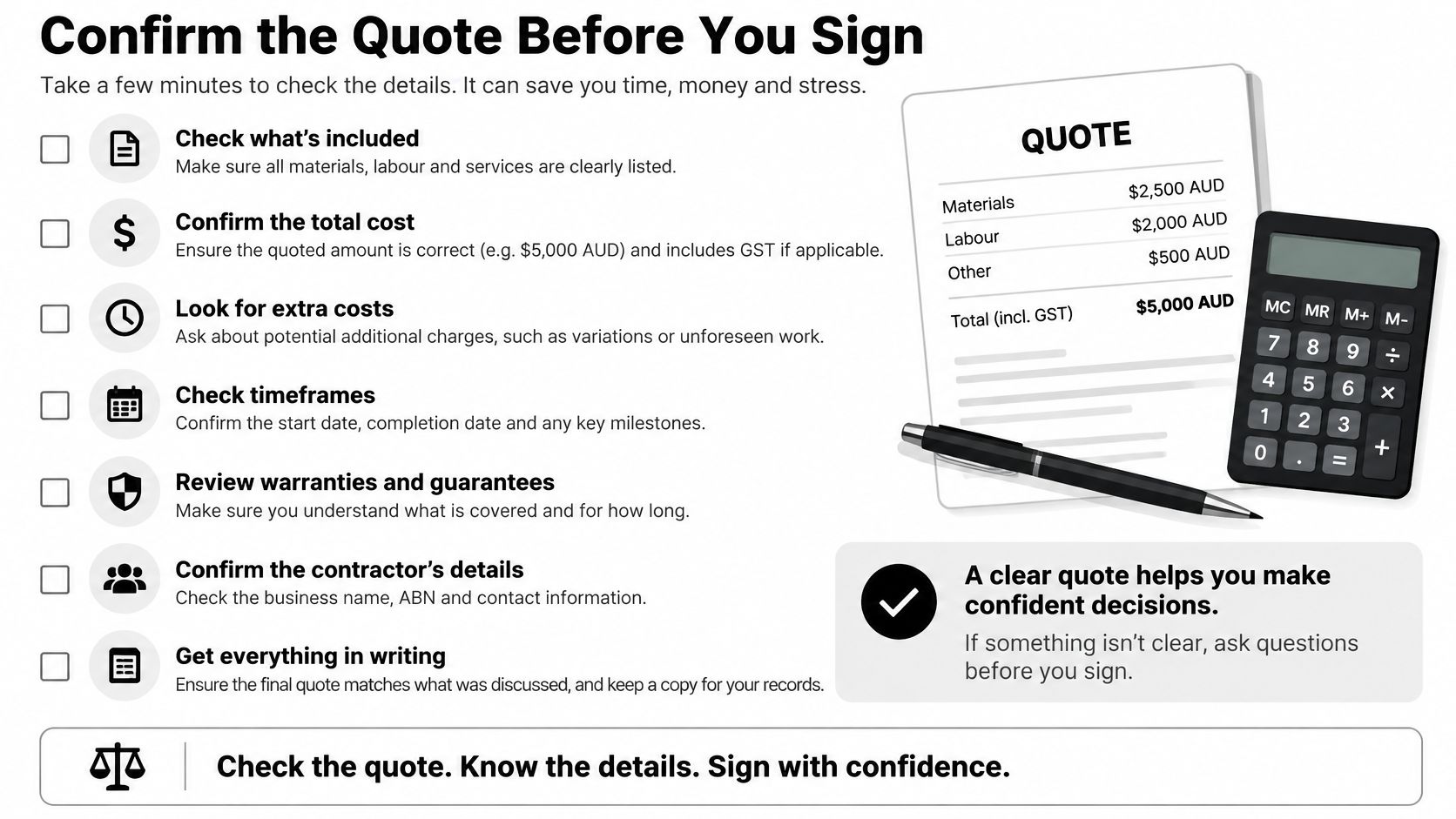
- Header details: Check the builder name, registration number, property address, quote date and validity period.
- Scope status: Confirm every line is marked included, excluded or provisional, in the same order as the comparison quote.
- Provisional sums: Check the unit rate for each allowance and list owner-supplied items, so the vanity is not ordered twice.
- Money controls: Confirm variation rates, the payment schedule, warranty and insurance details, and the contingency you are holding.
- Permit responsibility: Name who handles each permit, and mark fees as included, excluded or provisional.
Then compare the quotes line by line. Can each scope item be matched without blank cells? Are exclusions written down before demolition, rather than left to be resolved on site? If not, ask for the quote to be completed before signing. A low total can conceal costs when demolition, waterproofing, permits or contingency are omitted or treated differently.
Melbourne Tiling Services P/L offers free quotes and 3D drawings for bathroom renovations, and its website has a bathroom renovation calculator for an early budget check. The full bathroom renovation scope listed on the page is offered for a median price of $10,000. Treat that as a benchmark; the figure you sign should reflect the measured scope and agreed inclusions.
Send your room dimensions, photos and the fixtures you're considering, and we'll arrange your free quote and 3D drawing through Melbourne Tiling Services P/L, so you can compare it line by line with any other quote. For a different kind of business communication, switching to a hosted phone system is an option, but it does not replace a clear written renovation scope.
Write a Comment