
How to Quote a Bathroom Renovation: Melbourne Guide 2026

Get three quotes and pick the middle one. That advice is everywhere, and it's useless if the three documents don't price the same job. A Melbourne bathroom quote that hides waterproofing, demolition or permits isn't cheaper, it's incomplete, and you'll pay for the missing lines later as variations.

Learning how to quote a bathroom renovation properly means treating the quote as a scope-and-compliance document, not a headline price. I would start by forcing every bidder onto the same lines, with the same assumptions, before you compare a single dollar figure.

Table of Contents

Scope Lines Every Compliant Quote Must Show

Start with the room, not the finishes. A usable quote records site dimensions, room layout, substrate condition, access for materials and waste, fixture locations, ventilation, electrical changes, plumbing relocations, tile format, grout, trims and shower screen requirements. Without those notes, the estimator is pricing a generic bathroom, not yours.

Bathroom design should be settled at this stage too. We include sketches, plans and discussions in bathroom design, and modifications are agreed before work commences, so the quote prices a layout you've approved.

The Lines That Must Appear

Every scope item gets its own line, marked included, excluded or provisional. Lump sums are where cost hides.

Scope line What it should cover Check before accepting
Demolition and disposal Appliances, fittings, shower screens, wall and floor tiles, substrate sheeting, skip bin Skip size and disposal fees named
Carpentry and substrate Shower base substrate, stud walls, outlet moves, soap niche Framing allowance stated per item
Plumbing Relocations, new outlets, fixture connections Licensed plumber named
Electrical Rewiring, new circuits, exhaust fan Licensed electrician named
Waterproofing Membrane system, falls, penetrations, corners, puddle flanges, waterstops Inspection hold points listed
Screeding and levelling Floor levelling and shower base falls Area and depth stated
Tiling Wall and floor tile areas, trims, grout, large-format handling Waste allowance stated
Fixtures and fittings Vanity, toilet, mixer, shower screen, mirror Supplied by builder or client named
Permits and certification Building permit, surveyor fees, certificate of final inspection Included, excluded or provisional
Contingency Held as a separate line, outside the base scope Percentage and release process stated

That separation matters because an approval value and a quote value aren't the same thing. The Australian Bureau of Statistics building approvals methodology explains that reported building-work values generally include site-preparation costs but exclude land, demolition and landscaping, and that an approved estimate can differ materially from the final completed cost. So ask directly whether demolition sits inside the headline figure or outside it.

The same methodology defines a building approval as the official authorisation that allows construction to begin, called a building permit in Victoria, and notes that planning approval alone doesn't authorise construction. Your quote should state permit and inspection costs as included, excluded or provisional, not leave them silent.

Waterproofing Gets Its Own Detail

Never accept waterproofing buried inside a tiling allowance. Require the quote to name the membrane system, substrate preparation, falls, penetrations, corners, puddle flanges, waterstops, curing time and inspection hold points, referenced to the NCC and AS 3740. An unenclosed shower generally needs waterproofing across the area within 1,500 mm of the shower rose, and the quote should show that coverage, not just say "waterproof shower".

The evidence for this rigour is blunt. A Western Australian government inspection of 86 shower areas found only 60% overall compliance across 1,360 waterproofing inspection points, with waterstop defects accounting for 111 of 539 unsatisfactory items, and a Victorian government analysis reported missing or insufficient waterproofing in 33% of the relevant non-cladding defect cases. Price the hold points and remedial substrate work explicitly, and check what documentation you'll receive through the waterproofing compliance certificate process in Victoria.

Practical rule: If waterproofing has no named membrane, no waterstops and no inspection stage, it hasn't been priced. It's been assumed.

Registration and Assumptions

For bathroom renovations involving coordinated trades, the quote should name the registered builder responsible and separate licensed plumbing and electrical work from general trade allowances. Registration is required for work above the Victorian threshold, for combined skills such as plastering and painting, and for structural work regardless of cost, so a quote that moves walls or coordinates multiple trades should identify who's registered for what. Among registered builders, ask who coordinates the sequence day to day. We deliver bathroom renovations with in-house carpenters, plumbers, waterproofers and tilers, which removes the gaps where one trade waits on another.

Close the scope with written assumptions. State that pricing assumes no concealed structural damage, no asbestos and existing services being reusable, then list variation rates for unexpected framing, rotten flooring, plumbing relocation and levelling. You'll rarely use all of them, but agreeing the rates now, while you can still walk away, is far cheaper than negotiating them mid-demolition.

How to Price Each Line Without Guesswork

A bathroom quote can look precise and still leave major costs undefined. Price it by measurable scope, then expose the allowances and risks that could change the final bill.
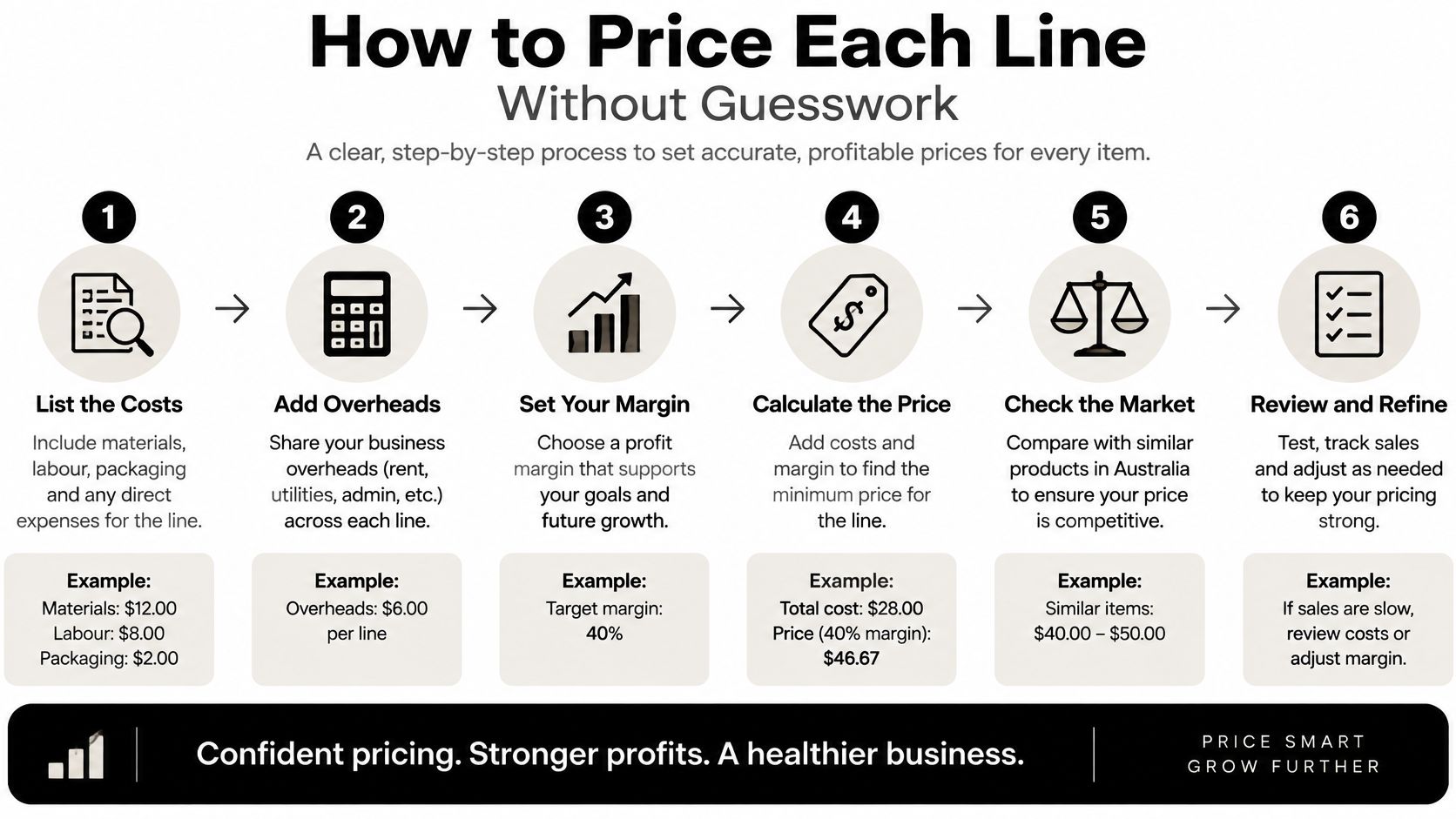
A six-step infographic illustrating a clear, logical process for determining accurate and profitable business pricing strategies.

  1. Measure the base scope: Record wall and floor areas separately, and note the substrate condition. Walls and floors involve different tile sizes, cuts and labour, so combining them into one area can conceal an unrealistic rate.
  2. Allow for waste and handling: Set tile waste according to the layout and pattern; diagonal layouts generally require more. Price large-format panels or stone for handling, cutting, levelling and access as well as area. A difficult carry or cut can add labour that a square-metre rate misses.
  3. Confirm fixture specifications: Identify the models before pricing framing and waterproofing. A wall-hung toilet, in-wall cistern, linear waste, niche, frameless screen or recessed mixer can affect framing depth, membrane detailing and trade coordination. Missing specifications leave room for extra cost and delays.
  4. Price labour by trade: Show the labour and coordination required for plumbing, electrical work, waterproofing and tiling, along with the compliance documents included. The NSW government research on serious defects in residential apartments found serious defects in 39% of surveyed strata buildings and waterproofing issues in 23% of all buildings. Clear trade interfaces belong in the price, not in a handshake.
  5. Set provisional sums with unit rates: Use provisional sums for uncertain work, such as levelling or plumbing relocation, and attach a rate per square metre, point or hour. Without a rate and a way to measure the work, an allowance can become an open-ended cost.
  6. Separate margin from risk allowances: Show the margin and identify contingency separately from the priced base scope. Builders managing several jobs use the same separation in cost planning for project-based businesses, keeping base costs, allowances and risk money visible.

This walkthrough shows how those pricing decisions apply to a bathroom layout before a contract is signed.

Each priced line should state a quantity, unit and rate. Compare the total with the bathroom renovation calculator, then ask the builder to explain any gap line by line. Rectifying a failed bathroom can cost far more than building it correctly the first time. Proper falls, compatible systems, inspection photographs and commissioning are small costs beside preventable rework.

Building a Contingency You Can Justify

Published ranges are a reference point, not a budget. One 2026 Australian renovation cost guide places a standard in-place metropolitan bathroom refresh around $15,000–$22,000 and premium work at $25,000–$40,000 or more, while noting that fixed-price contracts may embed an 8–15% contingency and cost-plus arrangements can transfer overrun risk to the homeowner. That trade-off is the part most quotes don't explain.

A risk-adjusted quote shows three figures instead of one. First, the confirmed contract scope for work that can be measured today. Second, realistic provisional allowances for work that's likely but unmeasurable until demolition. Third, a homeowner-held contingency that only you can release. If a builder folds all three into one number, you can't tell what you're committed to and what you're merely allowing for.

Triggers Worth Pricing in Advance

Trigger Usual cause Allowance and approval
Rotten or water-damaged subfloor Past leaks or failed waterproofing Provisional sum per square metre of replacement, approved in writing before work
Uneven or out-of-level floor Old screed or timber subfloor Screeding priced by area and depth, client signs off levels
Suspected asbestos Older sheeting, vinyl or adhesives Testing and removal provisional, work stops until the report is received
Hidden plumbing relocation Pipes concealed in walls or floors Provisional sum per fitting point, variation form signed
Obsolete wiring Old circuits that do not meet current requirements Rewire provisional, licensed electrician report required

Melbourne's older housing stock makes these triggers common rather than exceptional. Concealed water damage, uneven substrates, obsolete plumbing and apartment body-corporate requirements can all move the final cost, so the allowance should name the trigger, the evidence and the approver before work starts.

A suspected leak or failed waterproofing makes a cheap cosmetic quote the wrong product. Get the wet area assessed first, then price finishes on a sound substrate.

Close with a release rule you both sign up to. Contingency money moves only after photographs of the concealed condition, a written variation with a price, and your sign-off before the extra work begins. Decide in advance what event justifies spending it, and the contingency stops feeling like a slush fund and starts working as insurance you've already priced.

Comparing Two Quotes Line by Line

Say two builders quote the same 2.4 m by 2.2 m Melbourne bathroom, one at $18,000 and one at $17,200. These figures are illustrative, but the method is exactly what you should run on real quotes. The cheaper headline wins only until you normalise the scope.

Step 1, demolition: Quote A includes demolition, skip hire and disposal in its base. Quote B excludes them, so add $2,100 to Quote B before comparing anything else.

Step 2, waterproofing: Quote A names the membrane system and inspection hold points. Quote B prices waterproofing inside its tiling allowance, so price it as its own line at $1,400 and ask B to confirm the detailing in writing.

Step 3, permits: Quote A marks permit and surveyor fees provisional at $900. Quote B says nothing, so add the same $900 provisional sum to B, with a unit basis for how it's reconciled.

Step 4, contingency: Quote A holds a 10 per cent contingency of $1,800 outside the base, released only on approved variations. Quote B holds none, which doesn't remove the risk, it just leaves it unpriced and entirely yours.

Scope line Quote A Quote B normalised
Demolition and disposal Included in $18,000 base Excluded, add $2,100
Waterproofing Named membrane and hold points in base In tiling allowance, add $1,400
Permits and surveyor fees Provisional, $900 Not stated, add $900
Contingency 10 per cent owner-held, $1,800 None allowed
Total $18,900 before contingency $21,600 before contingency

The $800 headline advantage for Quote B becomes a $2,700 disadvantage once the lines match, and that's before Quote A's contingency is considered. Quote A also tells you how surprises get handled, Quote B doesn't. Run this normalisation on every quote you receive, in a spreadsheet, one row per scope line. Any cell a builder won't fill in is a cost you'll meet later.

Contract Terms, Milestones and Variations

A bathroom quote is also a contract about compliance, timing and who pays when the scope changes. In Victoria, building work above a statutory value threshold requires a written domestic building contract. Work above the higher major domestic building contract threshold requires that contract with a registered builder. Splitting one job across separate agreements does not avoid the applicable requirements. The Building and Plumbing Commission's guidance on domestic building agreements and contracts explains the requirements.

The contract should identify the builder, set out the plans and specifications, and state who will obtain any required planning and building permits. Confirm the permit pathway and the completion document that applies to your project before work starts.
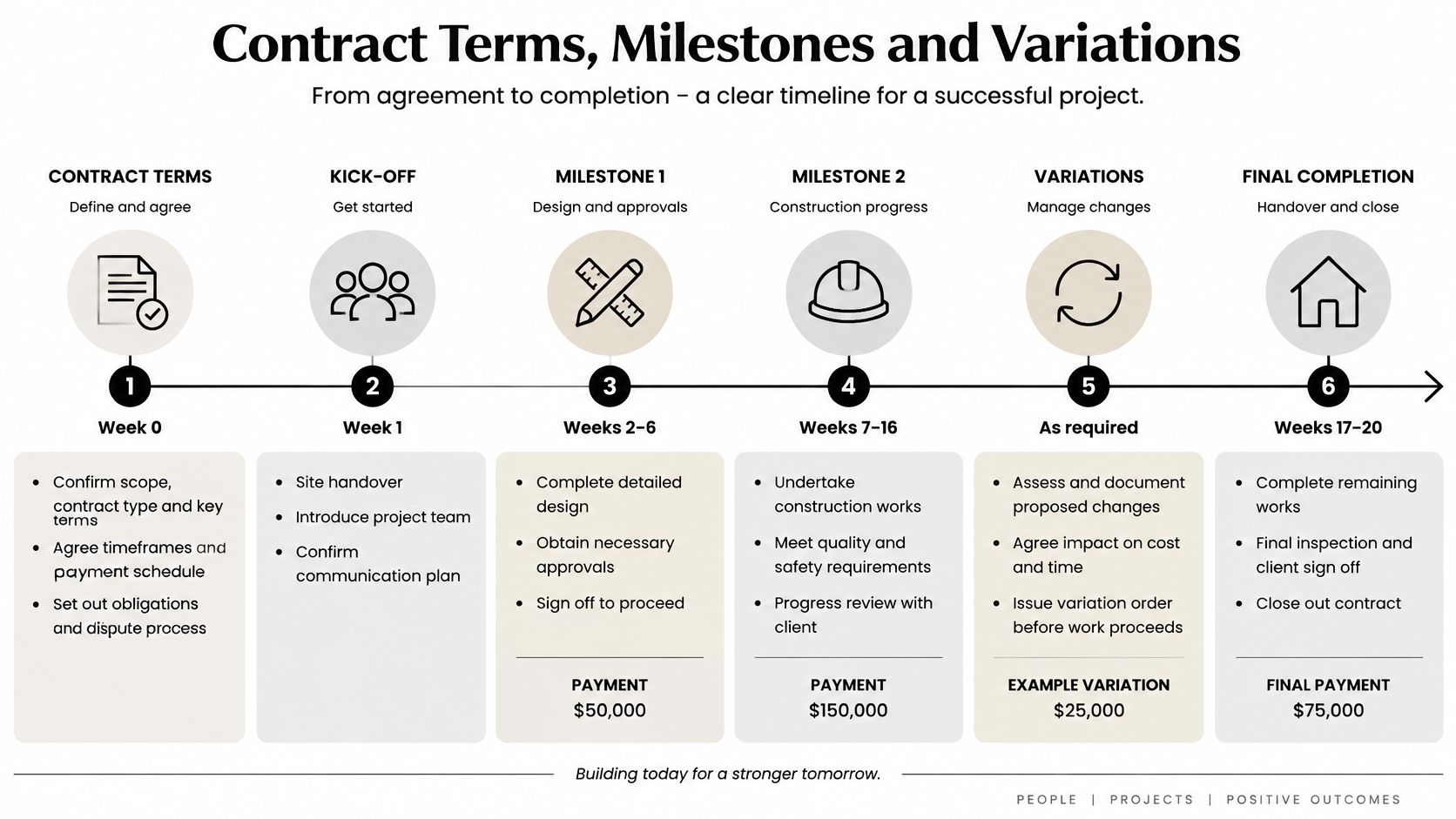
A timeline diagram showing six project phases from contract terms to final completion for construction projects.

Milestones That Release Money

Milestone Trigger Document required
Deposit Contract signing Signed contract and builder registration details
Progress payment Demolition completed Demolition completion record and disposal documentation
Progress payment Waterproofing inspection passed, before tiling Inspection record and photographs
Progress payment Tiling completed Tiling completion photographs
Final payment Practical completion Applicable completion documentation

Tie each progress payment to work that is complete and evidence the contract specifies. The builder can price the job without financing work that has not started, while you can check the claimed milestone against the work on site. Set out the sequence and expected timing in the contract; the bathroom renovation timeline shows how trades and project stages fit together.

A variation must state the change, its price and any effect on the completion date. Get your written approval before the changed work begins. A verbal instruction can leave both the cost and the schedule disputed.

Release rule: Match each claim to its agreed milestone and supporting record. If the waterproofing inspection record is missing, resolve that gap before tiling starts or the related progress payment is released.

Confirm the Quote Before You Sign

A quote is ready to sign when its scope, exclusions and costs can be checked without filling in gaps yourself. Use this checklist with the document in front of you.
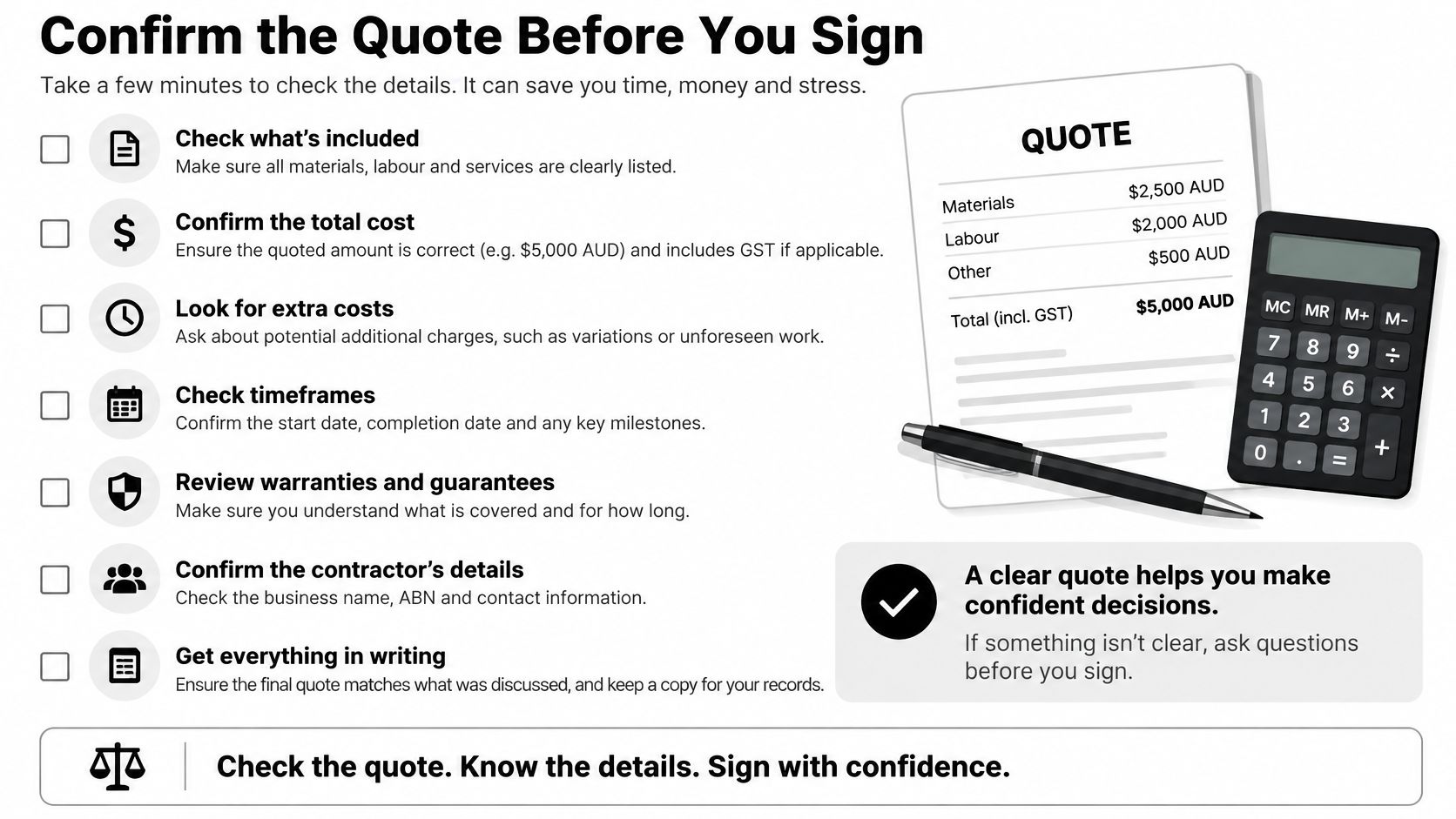
A checklist infographic titled Confirm the Quote Before You Sign, outlining essential steps for reviewing contractor quotes.

  • Header details: Check the builder name, registration number, property address, quote date and validity period.
  • Scope status: Confirm every line is marked included, excluded or provisional, in the same order as the comparison quote.
  • Provisional sums: Check the unit rate for each allowance and list owner-supplied items, so the vanity is not ordered twice.
  • Money controls: Confirm variation rates, the payment schedule, warranty and insurance details, and the contingency you are holding.
  • Permit responsibility: Name who handles each permit, and mark fees as included, excluded or provisional.

Then compare the quotes line by line. Can each scope item be matched without blank cells? Are exclusions written down before demolition, rather than left to be resolved on site? If not, ask for the quote to be completed before signing. A low total can conceal costs when demolition, waterproofing, permits or contingency are omitted or treated differently.

Melbourne Tiling Services P/L offers free quotes and 3D drawings for bathroom renovations, and its website has a bathroom renovation calculator for an early budget check. The full bathroom renovation scope listed on the page is offered for a median price of $10,000. Treat that as a benchmark; the figure you sign should reflect the measured scope and agreed inclusions.

Send your room dimensions, photos and the fixtures you're considering, and we'll arrange your free quote and 3D drawing through Melbourne Tiling Services P/L, so you can compare it line by line with any other quote. For a different kind of business communication, switching to a hosted phone system is an option, but it does not replace a clear written renovation scope.

Bathroom Renovation Quote Guide for Melbourne Homes

In Victoria, a standard full bathroom renovation typically costs AUD 15,000 to AUD 35,000, while Melbourne homeowners commonly see AUD 15,000 to AUD 22,000 for a standard full renovation. The national average is often quoted at about AUD 26,000.

You may be looking at three bathroom renovation quotes that seem to describe the same room, yet one says AUD 12,000, another AUD 21,000, and the third AUD 30,000. The gap feels alarming until you read past the totals. One builder may have included demolition, substrate repairs, waterproofing certification and licensed trades. Another may have priced only visible finishes and left several important items as allowances.

That confusion is normal. A bathroom is a small room, but a large amount of specialised labour is concentrated inside it. Moving a toilet, repairing a damaged substrate or changing the shower design can affect plumbing, electrical work, waterproofing, tiling and certification at the same time.

A useful bathroom renovation quote isn't just a price tag. It's a written story about scope, risk, materials, labour and compliance. Once you understand that story, you can compare quotes fairly, identify exclusions and decide whether a lower figure represents genuine efficiency or missing work.

Table of Contents

Introduction What a Bathroom Renovation Quote Really Tells You

The first question to ask isn't “Which quote is cheapest?” It's “What work does each quote buy?” A quote for bathroom renovations should let you trace the project from the first site inspection through demolition, rough-in services, surface preparation, waterproofing, tiling, fixture installation and final completion.

Melbourne pricing guides place a full renovation around AUD 10,500 to AUD 21,000 in one reported range, while another commonly cited Melbourne range for a standard full renovation is AUD 15,000 to AUD 22,000. These figures vary because “full renovation” can describe very different jobs, from a straightforward replacement that keeps the existing layout to a structural transformation with relocated plumbing and premium finishes. (Canstar's Australian bathroom renovation cost guide provides broader national and Victorian benchmarks.)

The same room can contain different projects

Suppose all three builders have measured the same Highett bathroom. The AUD 12,000 quote might retain the existing toilet, vanity and shower positions, use standard fixtures and assume the wall substrates are sound. The AUD 30,000 quote might include new plumbing locations, extensive demolition, upgraded stone surfaces, custom cabinetry, more complex tiling and a larger allowance for concealed damage.

Neither number tells you enough on its own. You need to know what each builder has assumed, what each trade will do and which decisions remain unresolved.

Practical rule: Treat the total as the last line of the conversation, not the first.

The quote should also show who carries responsibility for coordination. Bathroom renovations involve plumbers, electricians, carpenters, waterproofers, tilers and sometimes shower-screen installers. If separate trades aren't coordinated, a delay or mistake in one stage can affect the next stage and create a cost dispute.

Why the lowest number can mislead

A low quote can be perfectly legitimate when the scope is simple and the existing room is in good condition. It becomes risky when it omits preparation, waterproofing documentation, permits, waste removal or the work needed to correct hidden defects.

This guide gives you a practical way to read the scope, identify the main cost drivers, understand waterproofing and registered builder requirements, benchmark Melbourne and Victorian pricing, and collect comparable written quotes. The aim isn't to push you towards the highest figure. It's to help you choose a quote that is complete, lawful and clear enough to manage.

How a Bathroom Renovation Quote Is Built From Scope to Finish

Think of a quote as a house plan rather than a shopping list. A shopping list might name tiles, a vanity and tapware. A house plan explains where those items go, what must happen before installation and which people are responsible for each stage.

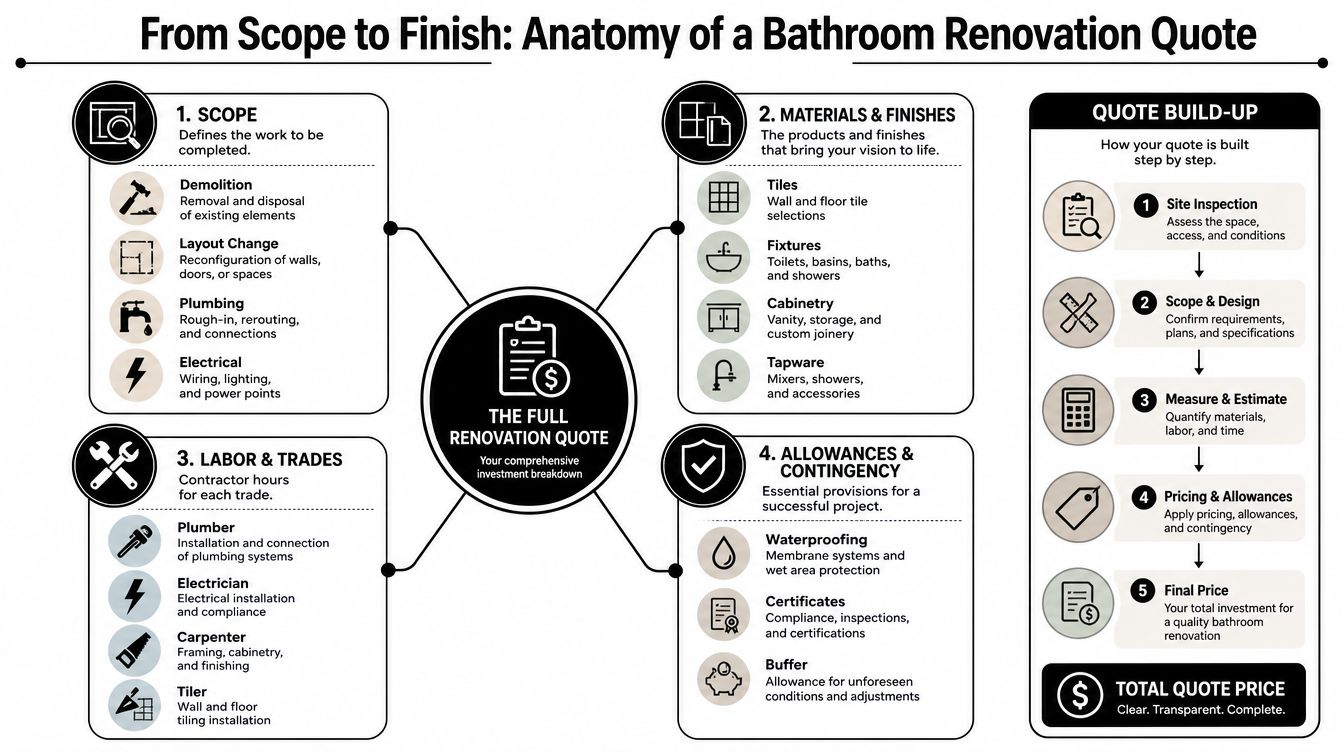
A complete quote usually brings together four connected parts:

  • Scope: Demolition, layout changes, plumbing, electrical work, carpentry and finishing tasks.
  • Materials and finishes: Tiles, fixtures, cabinetry, tapware, shower screens, adhesives, grout and paint.
  • Labour and trades: The hours and specialist work required to prepare, install, test and finish the room.
  • Allowances and contingency: Items such as waterproofing, certificates, provisional sums and allowances for conditions that can't be confirmed before strip-out.

An infographic titled From Scope to Finish detailing the key components of a bathroom renovation quote.

Read the line items as a sequence

Start with the existing room. The builder should identify access, measurements, current fixture positions, visible damage and any design constraints. Demolition then exposes the walls and floor, rough-in work prepares plumbing and electrical services, and substrate preparation creates a stable surface for waterproofing and tiles.

The quote should distinguish between a fixed scope and an allowance. A fixed scope describes a defined task and its inclusions. A prime cost item generally represents an allowance for a product you'll select, such as a toilet or tapware. A provisional sum covers work whose final extent is uncertain, such as repairs found after demolition. These aren't interchangeable, so ask what can change and how the builder will approve additional work.

Layout changes usually have a greater effect than a small finish upgrade. Keeping plumbing in place can avoid extensive service relocation, while moving a toilet or shower may require new pipe runs, different floor preparation and further coordination. A tile colour might change the materials selection, but a changed layout can alter the entire sequence of trades.

For a broader operational perspective on organising service-based work, the playbook for service businesses offers useful context around clear processes and customer communication. For homeowner-specific planning, compare the scope sequence with this bathroom renovation planning guide.

The final price should emerge from the inspection, drawings, selections and written assumptions. If the quote jumps straight from a brief phone conversation to one unexplained total, you don't yet have a reliable basis for comparison.

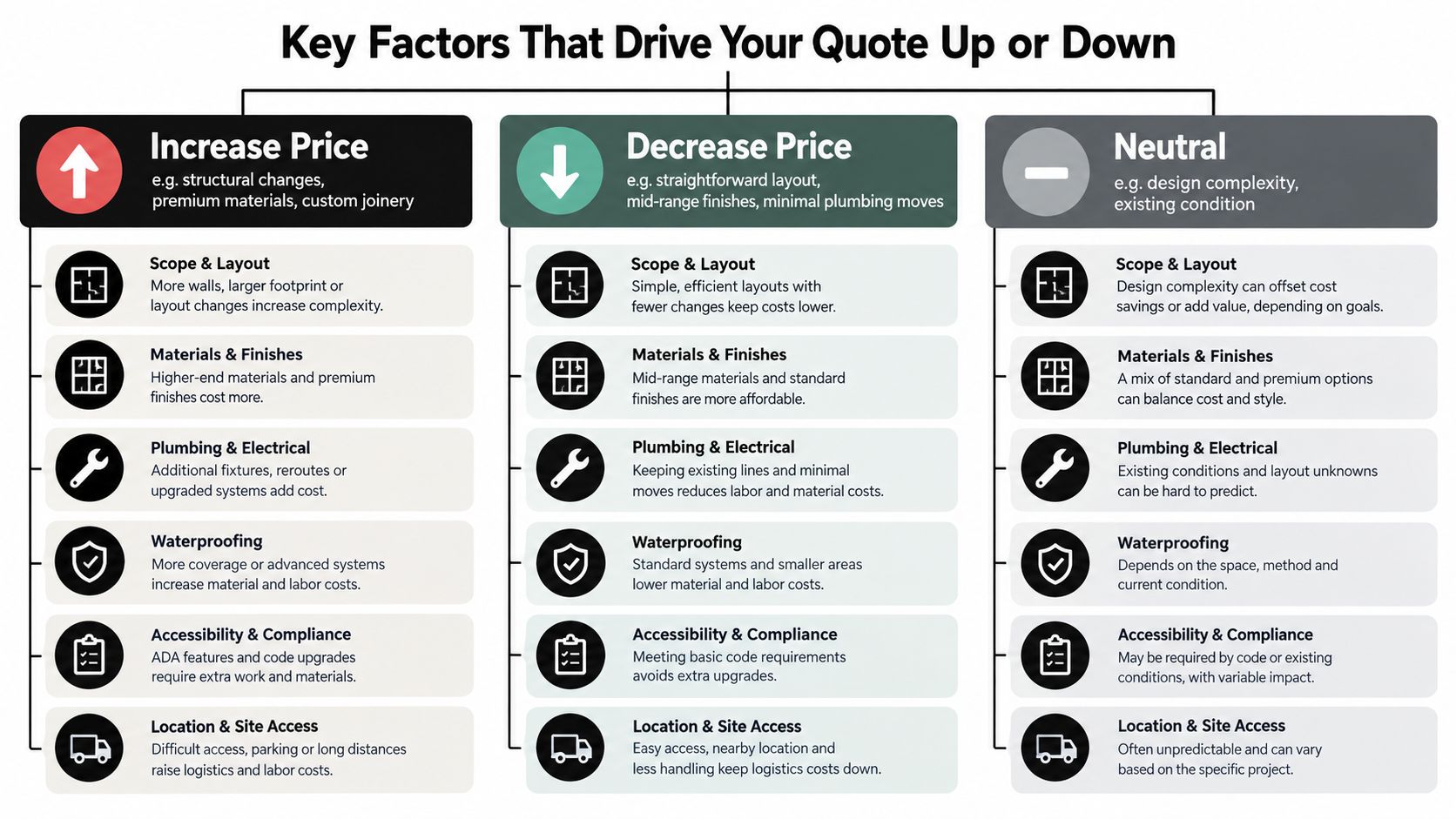
Key Factors That Drive Your Quote Up or Down

A bathroom renovation quote moves when the work, access or risk changes. The most useful way to assess it is to examine each lever and ask what consequence follows from the decision.

A chart detailing key factors that increase, decrease, or have a neutral impact on renovation quotes.

Scope and layout

Keeping the vanity, toilet and shower in their current positions generally creates a simpler plumbing scope. Relocating them can involve floor access, new pipework, additional labour and more complicated coordination. Structural changes, niche construction and altered wall positions can also expand carpentry, waterproofing and tiling requirements.

The key question is whether the quote describes a refresh or a rebuild. A refresh may replace fixtures and finishes without changing the room's arrangement. A rebuild strips the room back and reconstructs several systems.

Materials and finishes

Materials affect more than the purchase price. Large-format products such as Kerlite or premium stone may need specialised handling, accurate substrate preparation and experienced installation. Custom cabinetry and detailed shower-screen designs can also increase fabrication and coordination work.

A mid-range fixture can provide a sound specification without carrying the cost or installation demands of a highly customised product. Ask each builder to identify the assumed product range, size, finish and supplier rather than accepting “quality fixtures” as a description.

Plumbing, electrical work and waterproofing

Plumbing and electrical services must be coordinated around walls, floors, lighting, ventilation and fixture positions. A change to the shower location can affect pipework, falls, wall preparation and the waterproofing boundary.

Waterproofing also depends on the condition of the substrate. If the existing surface is uneven, damaged or unsuitable, the builder may need to remove material, repair the base and prepare it before applying the membrane. That preparation is part of the system, not an optional cosmetic extra.

Accessibility, compliance and site conditions

Grab rails, step-free access, altered door openings or other accessibility decisions can change the design and construction scope. Compliance work may also require documentation, certificates or inspections.

Location matters too. A bathroom inside an apartment, a narrow terrace or an upper-level property may offer less convenient access for demolition waste, deliveries and materials. A regional property may have different trade availability and travel considerations. Those conditions should appear in the assumptions instead of remaining hidden inside a lump sum.

The Australian market guide linked by Mercateer's plumbing answering service resource is useful background for understanding why plumbing enquiries need clear details before a contractor can assess them. Your own quote still needs a site-specific inspection.

When reviewing the quote, mark each item as fixed, selected, provisional or excluded. That simple classification often explains the price difference more clearly than the headline total.

Why Waterproofing and Compliance Can Make or Break Your Quote

Waterproofing is the part of a bathroom renovation that homeowners see least and depend on most. Tiles, grout and fixtures are visible, but the membrane and prepared substrate protect the structure behind them.

In Australia, AS 3740 requires domestic wet areas to be waterproofed to code by licensed trades. Industry pricing guides commonly place waterproofing around AUD 500 to AUD 1,000 for an average bathroom, or AUD 1,000 to AUD 3,500 where the design is more complex or remediation is required. (Co-architecture's Australian bathroom renovation guide explains these cost categories.)

A professional construction worker uses a caulking gun to seal bathroom wall tiles during a renovation project.

Preparation belongs beside the membrane

A quote that says only “waterproof bathroom” leaves important questions unanswered. Ask whether it includes substrate preparation, junction treatment, falls, penetrations, curing requirements and the relevant certificate or documentation.

Rewaterproofing is different from applying a membrane over a ready surface. If the existing waterproofing has failed, the contractor may need to strip out tiles, repair the substrate and retile the affected area. Recent Australian guides place failed waterproofing repairs at AUD 3,000 to AUD 8,000 or more, compared with standard waterproofing around AUD 500 to AUD 1,800, because the repair includes several layers of work. (Yellow Pages' waterproofing cost guide outlines this distinction.)

A quote that excludes preparation may look cheaper while transferring the risk to you. The apparent saving disappears when the builder discovers loose surfaces, moisture damage or an unsuitable base after demolition.

For a clearer explanation of certification and Victorian requirements, review this guide to a waterproofing compliance certificate in Victoria.

Registered builders in Victoria

Victoria also has a compliance threshold that affects how you appoint a contractor. A person must be registered with the Building and Plumbing Commission when carrying out domestic building work worth more than AUD 10,000. Registration is also required for structural building work or work requiring a building permit, regardless of value. (Consumer Victoria's guidance on builders and tradespeople sets out these requirements.)

For work above AUD 10,000, the builder must use a written major domestic building contract. Consumer Victoria also explains that the requirements apply to renovations above that value even when the work is divided across multiple contracts, so splitting a project doesn't avoid the threshold. (The Victorian renovation checklist covers this point.)

A registered builder isn't a guarantee that every quote is complete, but an unregistered arrangement can create a serious compliance problem. The Victorian registration checklist confirms that practitioners must be registered and approved before commencing relevant domestic building work above AUD 10,000. (The registered building practitioner checklist provides the registration context.)

Typical Bathroom Renovation Costs Across Melbourne and Victoria

Cost bands are useful only when you attach them to a defined scope. A budget bathroom that keeps the existing layout isn't comparable with a premium renovation involving structural changes, specialist surfaces and extensive service relocation.

For Australia, a commonly cited benchmark is about AUD 26,000, with a broad national range of roughly AUD 8,000 to AUD 35,000 or more. In Victoria, typical full renovations are often placed around AUD 15,000 to AUD 35,000, while a Victoria-specific estimator gives low, mid and high estimates of AUD 14,000, AUD 23,000 and AUD 42,000. (Canstar's bathroom renovation cost reference provides these national and Victorian comparisons.)

Location and scope Typical cost range AUD What it usually includes
Melbourne, full renovation scope AUD 10,500 to AUD 21,000 A complete renovation range, with the final amount shaped by layout, products and site conditions
Melbourne, standard full renovation AUD 15,000 to AUD 22,000 Demolition, services, waterproofing, tiling, fixtures and fit-off at a standard specification
Victoria, typical full renovation AUD 15,000 to AUD 35,000 A broad full-renovation scope, with regional and specification differences
Victoria, low to high estimator range AUD 14,000 to AUD 42,000 Low, mid and high project positions from a Victoria-specific estimator
Victoria, basic to high-end guide AUD 14,150 to AUD 59,000 Basic updates through high-end transformations

Other Victorian guidance illustrates the spread more sharply, placing budget projects around AUD 5,905 and premium bathrooms around AUD 32,832. Another guide places a complete Victorian renovation around AUD 29,500, with basic updates near AUD 14,150 and high-end work reaching about AUD 59,000. (RenoCalc's Victoria bathroom cost guide presents these regional and finish-level variations.)

What the bands mean for Melbourne homeowners

Melbourne sits above some lower-cost Australian markets in several published comparisons. A broader market report places a full renovation nationally around AUD 10,221 to AUD 20,443 and Melbourne around AUD 10,500 to AUD 21,000, while reporting that the same scope can cost 28% more in Darwin than Hobart. (RenoCalc's Australian comparison data provides that geographic context.)

Use these numbers as a starting filter, not a promise. A quote around the middle of the Melbourne range may still be incomplete if it excludes waterproofing preparation, while a higher quote may be reasonable if it includes structural repairs, premium stone or complex access.

Current Australian guidance is also moving towards component-level and per-square-metre budgeting rather than relying on one lump sum. (The TFO bathroom renovation cost guide discusses this more transparent way to break down scope and finishes.)

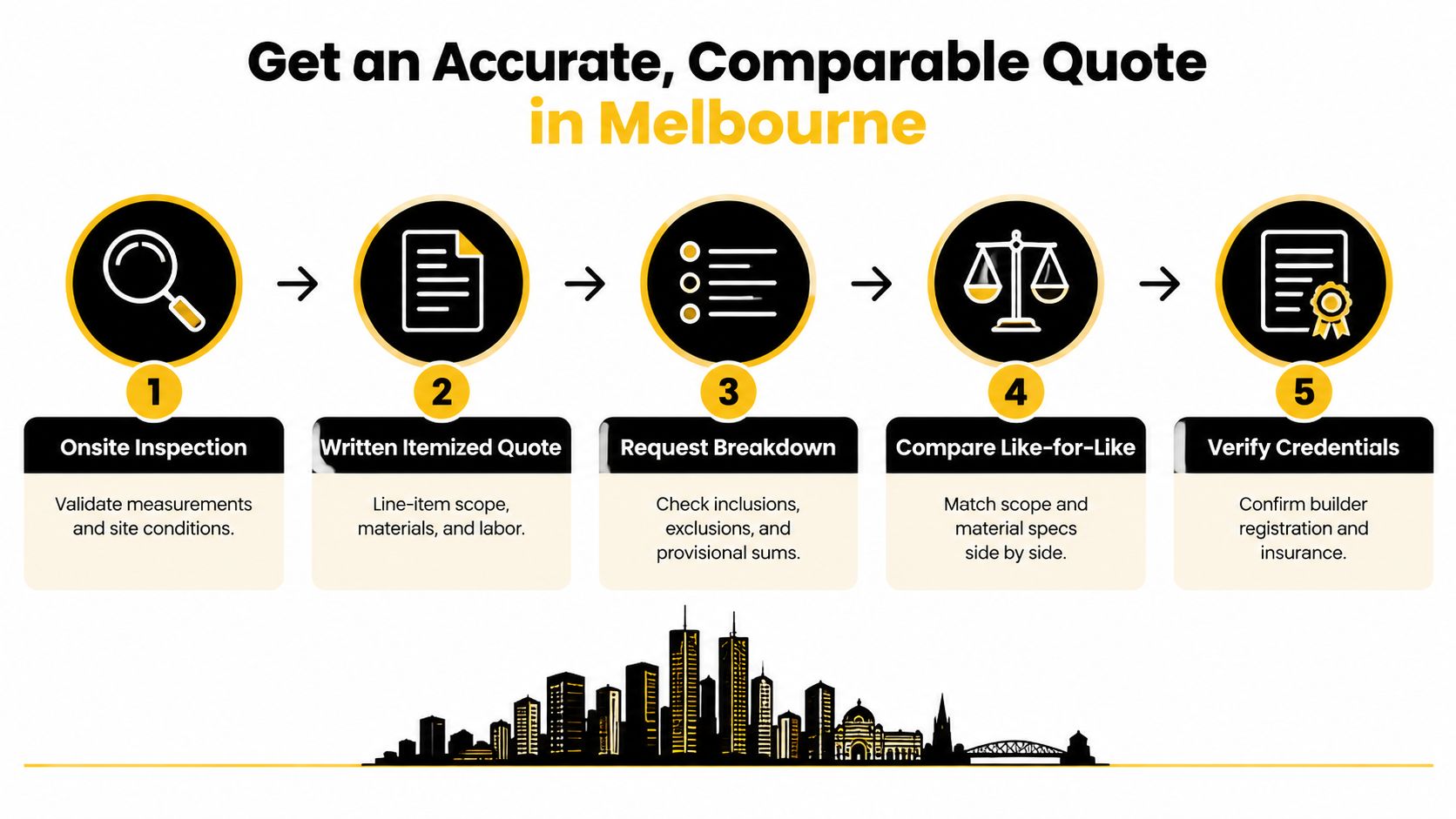
How to Get an Accurate and Comparable Quote in Melbourne

A reliable quote starts with the same information going to every builder. If one contractor receives a sketch and another receives measured drawings, product selections and a written scope, their totals won't be comparable.

Start with the site, then document the scope

An onsite inspection lets the builder check dimensions, access, existing services, visible moisture damage and the condition of walls and floors. Phone estimates can help with an early conversation, but they can't confirm concealed conditions or the practical difficulty of removing materials from your property.

Give each builder a brief containing:

  • Room details: Measurements, photos, ceiling height, door position and fixture locations.
  • Design decisions: Whether the layout stays, which fixtures you want and your preferred tile formats.
  • Work boundaries: Demolition, waste removal, carpentry, plumbing, electrical work, waterproofing, tiling and final fit-off.
  • Documentation needs: Drawings, product allowances, certificates, registration details and insurance information.

A five-step infographic showing how to get an accurate bathroom renovation quote for properties in Melbourne.

Compare the unknowns, not just the totals

Ask for an itemised written quote and separate fixed items from prime cost items and provisional sums. Confirm who supplies tiles, adhesive, grout, fixtures and shower screens, and ask how variations will be approved if the builder finds damaged substrate after demolition.

Three quotes can be useful when each builder has priced the same scope. More quotes aren't automatically better if every contractor has made different assumptions.

Tools can help test those assumptions before you commit. A bathroom renovation calculator can organise room size, materials, fixtures and upgrades into a clearer cost breakdown. For another example of how a plumbing cost sheet can present trade items, review the MG Plumbing Services cost sheet, while remembering that an overseas or general reference can't replace a Victorian site assessment.

Melbourne Tiling Services P/L offers free quotes, 3D drawings and a transparent renovation calculator, alongside bathroom renovation, tiling and waterproofing services. Use those tools to clarify the intended finish before asking builders to price the work.

Finally, verify the builder's registration before work begins, check the contract requirements and keep the written scope with all selections and approved variations. Clear paperwork is what turns a verbal expectation into something you can manage.

How to Compare Quotes and Reduce Costs Without Cutting Corners

Place the quotes side by side and compare each scope line, not just the totals. Check whether every quote includes demolition, waste removal, plumbing, electrical work, substrate preparation, waterproofing, certificates, tiling, fixtures, shower screens and final cleaning.

Use this decision checklist:

  • Scope: Confirm the same layout, demolition extent and finish schedule.
  • Allowances: Identify every prime cost item and provisional sum, then ask what happens if the allowance changes.
  • Waterproofing: Look for preparation, membrane application, documentation and rectification assumptions.
  • Credentials: Verify registered builders and licensed trades where the work requires them.
  • Contract: For relevant Victorian domestic building work above the threshold, request the required written contract.
  • Quality controls: Ask about warranties, inspections, variation approvals and the planned sequence.
  • Access: Confirm delivery, protection of adjoining areas and removal of demolition waste.

The safest savings usually come from reducing complexity rather than removing protection. Retaining the existing layout can limit service relocation, durable mid-range fixtures can avoid unnecessary premium costs, and non-essential upgrades can be phased if the written scope allows it. Don't cut waterproofing, substrate preparation, licensed trade work or compliance documentation to force the total lower.

A good bathroom renovation quote gives you confidence because you can see what you're paying for and what could still change. Choose the builder who offers the clearest scope and strongest coordination, not automatically the builder with the smallest number.


Melbourne Tiling Services P/L can prepare a free, itemised bathroom renovation quote with 3D drawings, waterproofing, tiling and coordinated trade scope for homes across Melbourne and greater Victoria. Visit Melbourne Tiling Services P/L to discuss your bathroom, test the budget with transparent planning tools and arrange the next step.