
You've got black silicone in the shower, a soft edge along the balcony, or a patch that keeps coming back after someone's “quick reseal”. That's usually when Melbourne owners start searching for caulking services Melbourne, but the right answer isn't always a tube of sealant and a good hand. On site, the question is whether you're dealing with maintenance, a defect, or a renovation scope that needs a registered builder and the right compliance path.
Table of Contents
- What Caulking Actually Means on a Melbourne Job Site
- Sealant Types and Where Each One Belongs
- How to Tell When Re-Caulking Is the Wrong Fix
- Typical Caulking Costs and Timelines in Melbourne
- The Caulking Workflow From Inspection to Cure
- Caulking, Bathrooms and the Registered Builder Question
- What Melbourne Tiling Services P/L Brings to a Caulking Scope
- Caulking Questions Melbourne Owners Ask Before Booking
What Caulking Actually Means on a Melbourne Job Site
A homeowner rings after noticing dark silicone around a shower base, or a strata manager spots a damp line on the underside of a balcony edge. The instinct is to ask for a reseal. The better first move is to find out whether the joint has aged, whether movement has opened it up, or whether the failure sits deeper in the substrate.
The bead is the last step, not the whole trade
On a real job, the visible bead is only the finish. Before that comes surface assessment, removal of failed material, cleaning, checking for hollow tiles or cracked grout, and deciding whether the joint is a routine maintenance line or part of a broader rectification scope. That's why caulking in Melbourne is a mature trade niche, with operators reporting 20+ years of experience in the local market, and why the work keeps showing up across bathrooms, balconies and external joints in Victoria, not just at renovation time. See the local market context in Melbourne caulking pricing and service examples.
Practical rule: if the joint is only dirty, the fix is usually different from a joint that has lost adhesion or is tied to water movement behind the tile.
Why the same line of silicone can mean different jobs
A shower edge might need a straightforward maintenance reseal if the substrate is sound. The same-looking line on a balcony can point to movement, weather exposure, or water tracking under a threshold, which is a different job entirely. That distinction matters because the bead is the visible outcome, but the risk sits in what's behind it.
Melbourne service pages often separate bathroom sealing from window frames, render joints and balcony work for a reason. The joint type decides the method, the removal approach, the cure time, and whether the work belongs to a caulker, a tiler, or a registered builder coordinating a larger wet-area scope. For a related sealing example, see sealing stone tiles in Melbourne.
Sealant Types and Where Each One Belongs
The wrong sealant usually fails in one of two ways. It either moves too little and splits, or it sticks in the wrong place and releases when the substrate flexes. In Melbourne wet areas, that's why the key decision is not colour, but movement, exposure and cleaning chemistry.
Start with the joint, not the tube
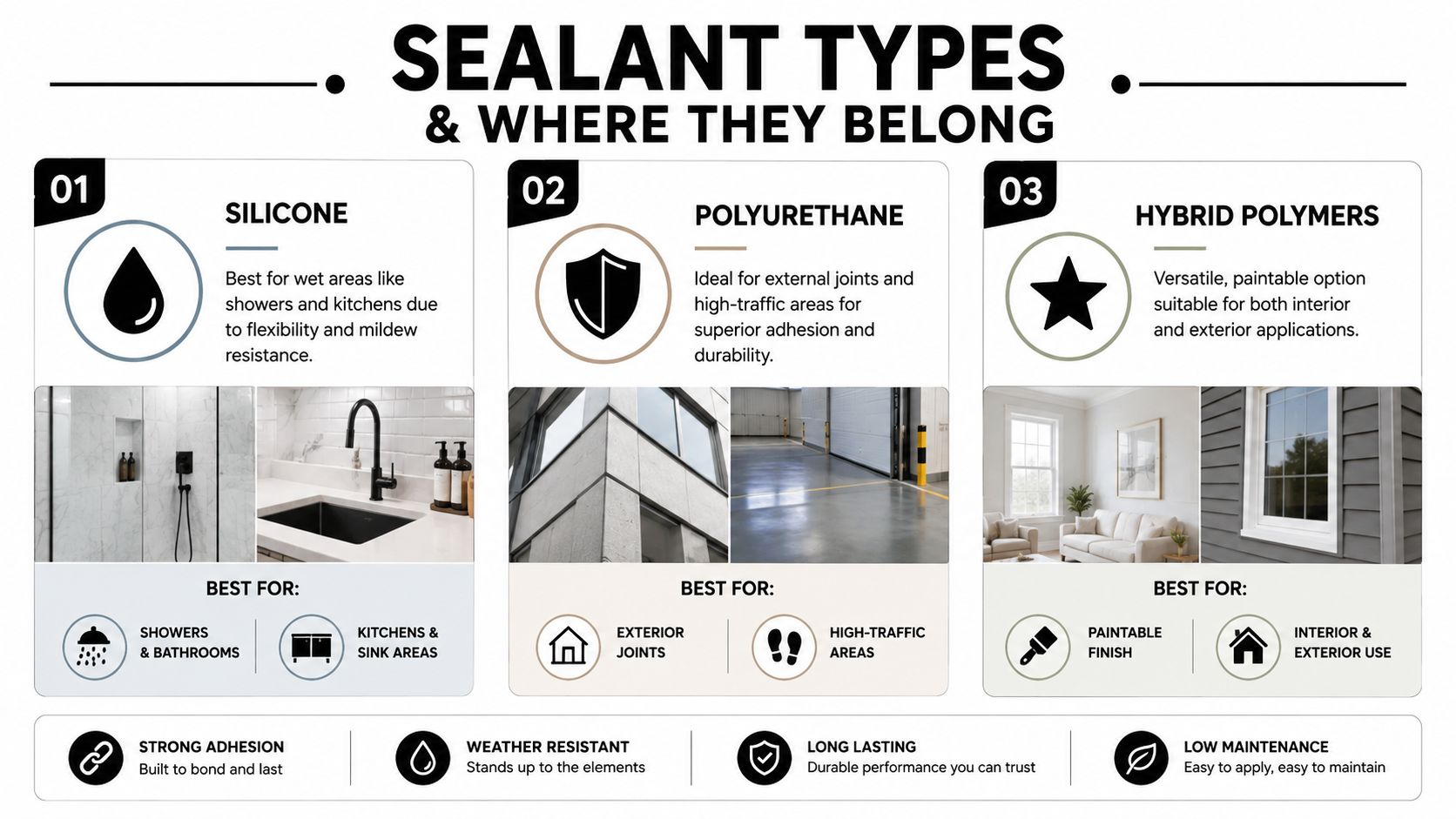
For showers, bathrooms and kitchens, silicone is the usual call because those areas see the most moisture and cleaning activity. Local wet-area pricing guidance places re-caulking at about $6–$8 per linear metre, with a medium home often totaling $900–$1,700, which shows how quickly the total is driven by joint length rather than room count MB Caulking Services pricing guidance. That's the right lens for wet-area work, because a small shower with lots of perimeter detail can take more effort than a plain room with fewer joints.
For external joints, high-traffic lines and exposed transitions, polyurethane is commonly chosen where adhesion and durability matter more than easy wipe-down maintenance. Hybrid polymers sit between those worlds, and local contractor service lists treat them as a separate option rather than a generic fix, especially for applications like windows, render joints and some exterior finishes Gapless service categories.
Match the sealant to the exposure class
Use a simple decision path.
- Bathrooms and showers: silicone, because movement and moisture are constant.
- Window frames and render joints: polyurethane or hybrid systems, depending on exposure and paintability.
- Balconies and precast panels: a movement-capable sealant system, not a cosmetic filler.
- Fire-rated seals and articulation joints: only a system that's specified for that use.
A generic sealant is rarely the right answer on a moving joint. If the substrate shifts, the product choice has to allow for that movement or the bead will fail again.
A contractor who understands the difference can explain why the same home may need more than one caulking system. That matters on Melbourne sites where bathroom, balcony and façade joints often sit side by side.
How to Tell When Re-Caulking Is the Wrong Fix
A fresh bead is not a cure for water that's already getting past the surface. If the room smells musty, the caulking keeps blackening, or the balcony edge shows signs of deeper damage, the issue may have moved beyond maintenance. That's where the diagnosis matters more than the reseal.
Signs that point deeper than a failed bead
The clearest warning signs are the ones that keep returning after cleaning. Blackened silicone usually means mould has taken hold in a line that's staying wet too long. Lifted edges suggest adhesion loss, which can come from movement or poor preparation. Soft grout around the joint often means the surrounding finish is breaking down too, not just the caulk itself.
Tide marks on plaster, recurring mould after cleaning, and balcony efflorescence point toward water moving where it shouldn't. That's the point where a re-caulk may only cover the symptom. If the shower pan, wall junction or balcony membrane has failed, the work shifts into rectification.
Read the pattern before you book the next reseal
A simple checklist helps separate surface failure from structural risk.
- Persistent mould after cleaning: usually means moisture is still trapped or the joint keeps staying wet.
- Peeling silicone: often points to failed adhesion, dirty substrate or movement.
- Tide marks on nearby walls or ceilings: suggest water has already moved beyond the visible joint.
- Efflorescence on balcony edges: often points to water migration through masonry or a hidden membrane issue.
For shower leak diagnosis, the clearest public service resource is how to fix leaking showers, because the correct fix depends on whether the failure is in the bead, grout, waterproofing or the substrate behind the tile.
If the same line keeps failing, stop treating it like a cosmetic issue. Repeating the sealant job without checking the cause usually costs more than doing the fault diagnosis once.
Typical Caulking Costs and Timelines in Melbourne
Price questions usually come up after the first inspection, because most owners want to know whether they're looking at a small maintenance visit or a broader repair. In Melbourne, local guides put general caulking at about $4–$7 per metre, while wet-area silicone re-caulking sits higher at about $6–$8 per linear metre Melbourne caulking pricing guidance MB Caulking Services pricing guidance. That spread reflects joint type, substrate prep and access, not just the product itself.
Typical job examples give a better estimate than room labels
A shower re-caulk often lands around $150–$300, a kitchen around $320, and a balcony around $450 Melbourne caulking pricing guidance. Larger sealing jobs can reach $500–$700 for concrete joints on a small to medium house and $900 for a larger house Melbourne caulking pricing guidance. Those are useful numbers because they show why asking for a quote by joint length is more accurate than asking by room name.
| Job Type | Typical Rate | Indicative Total |
|---|---|---|
| Shower re-caulk | job-based | $150–$300 |
| Kitchen caulk | job-based | $320 |
| Balcony caulk | job-based | $450 |
| Concrete joints, small to medium house | job-based | $500–$700 |
| Concrete joints, larger house | job-based | $900 |
Time depends on scope, access and what's underneath
Routine maintenance is often a half-day to a single day job when the bead is the only issue. Leak rectification is different. Once tiles, membrane or screed need to come up, the scope turns into a multi-day job because the crew has to dry, repair, reset and then re-seal. The cost driver is not the number of rooms, it's the length of the joint, the condition of the substrate and whether the failed joint is just a finish line or part of the waterproofing system.
The Caulking Workflow From Inspection to Cure
Good caulking work follows a sequence. Skip one step and the joint can fail early, even if the bead looks neat on day one. The job has to start with what's under the joint, not the cartridge gun.
The site sequence that actually holds up
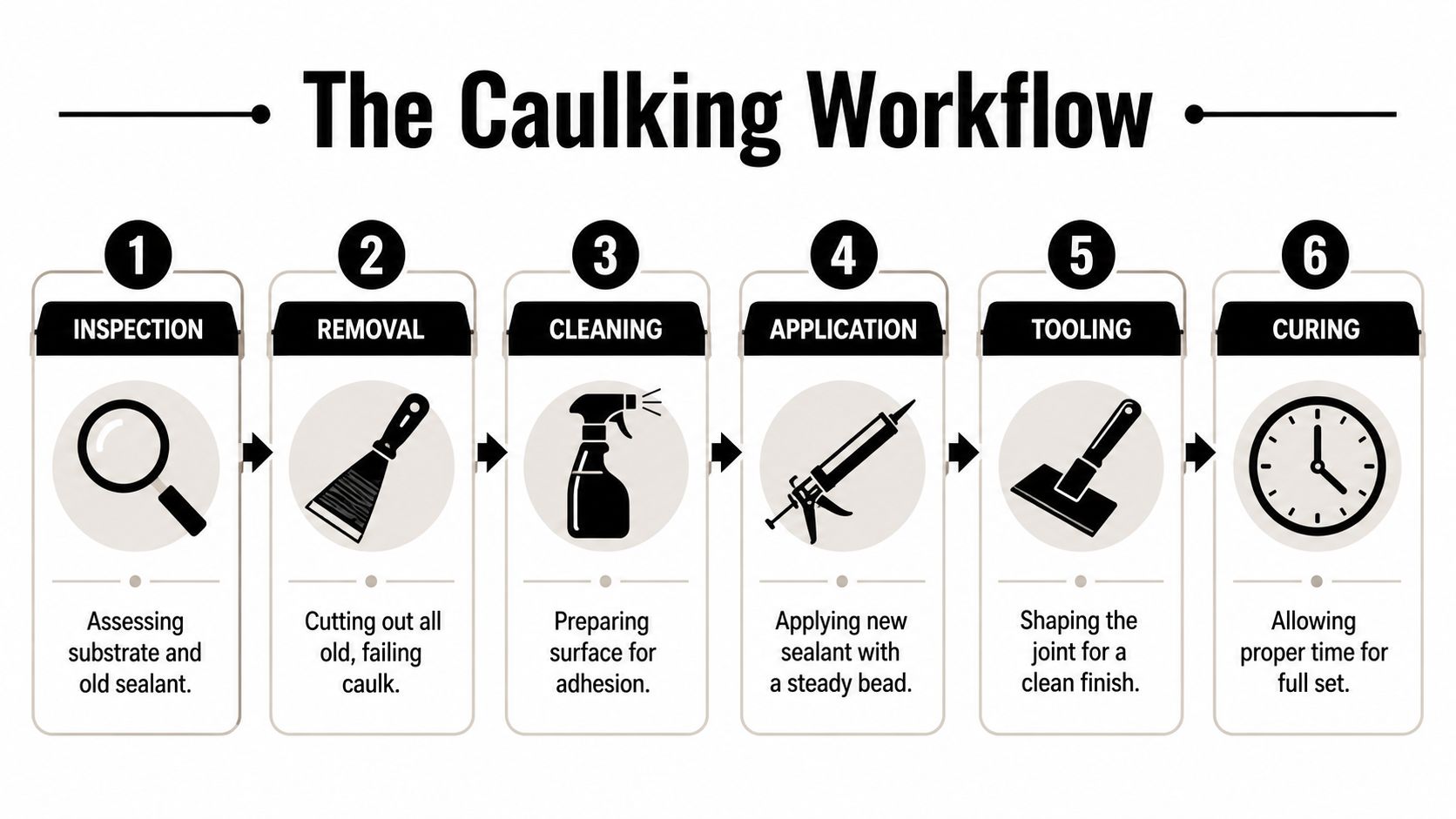
A proper crew usually works through inspection, removal, cleaning, application, tooling and curing. Inspection tells you whether the joint is a maintenance line or a rectification issue. Removal has to cut out all failed material without gouging the tile, stone or render. Cleaning matters because sealant bonds to the substrate, not to dust, soap residue or old silicone film.
The most important interface in wet-area work is the tie-in between the new sealant and the existing waterproofing line at the shower tray or balcony upturn. If that transition is treated casually, the same leak can return even when the bead itself looks fine. The earlier section on diagnosis matters here, because a bad bead on a sound membrane is a maintenance problem, while a failing membrane needs rectification first.
What gets done before the room goes back into service
A real workflow usually includes:
- Inspect the substrate and check for movement, loose tile edges or moisture signs.
- Remove old caulk completely so the new bead isn't bonding to failed material.
- Clean and dry the joint until the surface is ready for adhesion.
- Apply the right sealant for the joint type and exposure.
- Tool the bead to a consistent profile so water sheds cleanly.
- Allow a full cure window before water or traffic returns.
The cure period matters because an early shower or foot traffic can break the finish before it sets. That's why a balcony or bathroom can look finished long before it's ready to use.
Caulking, Bathrooms and the Registered Builder Question
A bathroom renovation often starts with one visible problem and ends up involving waterproofing, plumbing and tiling. That's why caulking can't always be treated as a standalone handyperson task. In Victoria, the compliance line matters once the work moves into proper renovation territory.
The $16,000 threshold changes the job category
If a domestic building contract for bathroom work is over $16,000, the statutory home warranty regime is triggered, and the builder must take out domestic building insurance before receiving any money above that threshold Victorian building insurance guidance. The Victorian Building Authority explains that domestic building insurance applies to most domestic building work over the threshold and protects owners if the builder dies, disappears or becomes insolvent Victorian building insurance guidance. That's not a minor admin step, it's a formal compliance point.
For a bathroom renovation, that distinction matters because caulking sits inside a bigger scope that may include demolition, waterproofing, carpentry, plumbing and tiling. In that setting, a Registered Builder is the right coordinator, because the job is no longer a single trade visit. The same logic is why a one-off shower reseal can be a simple maintenance call, while a recurring leak may require a registered rectification pathway.
Waterproofing and caulking are separate controls
Victorian practice treats waterproofing and surface sealing as different risk controls. That matters on showers and balconies, where a leak diagnosis has to answer whether water is bypassing the bead, the grout, the membrane or the movement joint. A contractor who only treats them as the same thing can miss the actual failure path.
For broader wet-area context, waterproofing in Melbourne is the reference point because the safest repair usually starts with the system, not the finish.
If the work crosses into renovation, ask who is carrying the compliance responsibility before you ask about colour. In a bathroom, the paperwork and the substrate both matter.
What Melbourne Tiling Services P/L Brings to a Caulking Scope
Some jobs only need a reseal. Others need a coordinated team that can handle leak rectification, waterproofing, tiling and the final caulk in one scope. Melbourne Tiling Services P/L sits in that second category, which matters when a failed bead is only one part of a larger bathroom or balcony problem.
The practical advantage is coordination
Melbourne Tiling Services P/L covers start-to-finish bathroom and ensuite renovations, waterproofing, screeding, self-levelling, marble, porcelain and ceramic wall and floor tiling, frameless shower screens and large-format Kerlite work for interior and exterior spaces. It also handles leak rectification for showers and balconies, which is where a caulking issue often stops being cosmetic. As Registered Unlimited Builders, the team can coordinate carpenters, plumbers, electricians, tilers and waterproofers inside one project path, which reduces the handover gap that often causes delays or missed details.
Planning tools change the way owners scope a job
The useful part for owners is that the scope can be priced and visualised before demolition. The business offers free quotes, 3D drawings, and a transparent renovation calculator that typically sits around a $10,000 median for planning scope and budget. That doesn't make every job a renovation, but it gives homeowners a better way to decide whether they're looking at maintenance, rectification or a full wet-area rebuild.
For a caulking issue alone, a stand-alone sealant service is usually enough. For a shower that keeps leaking, or a balcony edge that's tied to membrane failure, an integrated builder-led approach is a cleaner way to manage the repair path. If the job belongs to the bigger renovation category, the same team can carry the work through instead of handing it off between trades.

Caulking Questions Melbourne Owners Ask Before Booking
Is shower re-caulking a maintenance job or a defect job? If the silicone has aged, discoloured or lifted but the substrate is sound, it's maintenance. If the same line keeps failing, or there are signs of water movement beyond the tile, it shifts into defect or rectification territory.
How long should a silicone re-caulk last in a Melbourne bathroom? There isn't one universal answer, because performance depends on movement, cleaning, ventilation and whether the underlying waterproofing is intact. A bead that's installed properly but placed over a failing substrate won't perform like a maintenance reseal on a stable wall.
What about balcony work? A balcony reseal can be a simple surface job if the joints are sound. If there's efflorescence, recurring dampness or staining below the edge, the job usually needs a deeper inspection and may involve membrane or substrate repair before any fresh sealant goes in.
How do I start? Ask for a free quote, request 3D drawings if the job is moving into renovation territory, and use the renovation calculator to get a realistic sense of scope before you commit.
If you're dealing with a shower joint that won't stay sealed, a balcony edge that keeps staining, or a bathroom renovation that needs the compliance side handled properly, speak with Melbourne Tiling Services P/L. They can assess whether your job is maintenance, rectification or a full renovation scope, then quote the work with the waterproofing and caulking tied into one practical plan.
Recent Comments