
A straightforward Melbourne bathroom usually costs about A$500 to A$750 to waterproof, while a more involved project can reach A$1,500 to A$4,000 once size, compliance, second-storey access, or substrate repairs are included. The quote isn't just for membrane, it covers preparation, detailing, labour, drying time, and the documentation needed before tiling.
You may be looking at three bathroom renovation quotes right now, each with a different waterproofing figure and no obvious explanation for the gap. A small ground-floor room on a concrete slab can be relatively predictable. An upstairs bathroom with timber flooring, a shower niche, awkward pipe penetrations, or an old failed membrane is a different trade package entirely.
Melbourne homeowners should treat waterproofing as a structural protection and compliance stage, not a cosmetic add-on. The Australian bathroom waterproofing cost guide places common jobs within a broad range, including an average around A$500 to A$750, while more complex work can rise to A$4,000. The price makes more sense once you separate the quote into labour, materials, substrate preparation, junction detailing, and certification.
Table of Contents
- What Bathroom Waterproofing Costs in Melbourne
- How Waterproofing Works Behind the Tiles
- What Drives the Price on a Melbourne Quote
- Comparing Waterproofing Methods and Materials
- Real Melbourne Bathroom Examples and Case Studies
- Repair or Replace How to Decide
- Estimates Guarantees and Smart Budgeting in Melbourne
What Bathroom Waterproofing Costs in Melbourne
A 1990s Caulfield brick veneer home can show why quotes differ. The owners may have stripped the old bathroom and asked several tilers to price waterproofing. If the room is compact, sits on a sound concrete slab, has easy access, and needs a standard shower floor and wall system, A$500 to A$750 is a realistic starting band for the waterproofing component. The installer still needs to inspect the substrate before confirming that figure.
A mid-range bathroom commonly falls around A$800 to A$1,500, while a complex job can reach A$1,500 to A$4,000. Australian cost guidance reports a national average of A$800, with a minimum of A$500 and a maximum of A$4,000 in one 2023 guide. The range is outlined in the Australian waterproofing price guide.
| Job Type | Typical Melbourne Price | What's Included |
|---|---|---|
| Straightforward ground-floor bathroom | A$500 to A$750 | Basic preparation, membrane application, standard shower and floor detailing |
| Mid-range bathroom | A$800 to A$1,500 | More wall area, additional junctions, repairs, or broader compliant coverage |
| Complex or second-storey bathroom | A$1,500 to A$4,000 | Second-storey access, timber substrate, extensive preparation, difficult falls, or replacement work |
The line items matter more than the headline price. Labour covers site setup, preparation, membrane application, detailing, and the waiting time between coats. Membrane and reinforcement materials are usually a smaller part of the quote, while damaged substrate, difficult junctions, and removal of failed waterproofing can change the scope quickly.
For budget planning, waterproofing is a small but material part of the renovation allowance. Against a A$10,000 renovation benchmark, it can represent roughly 5% to 10%, depending on the work required. Demolition, plumbing, electrical work, screeding, tiling, fittings, and shower-screen installation sit outside that waterproofing figure. Virtual Tour Easy knows renovation planning checklists can help place this stage within the wider renovation sequence.
The main cost drivers are practical decisions:
- Second-storey work: Decide whether the access, timber framing, and extra preparation justify the higher labour allowance.
- Substrate condition: Particleboard, movement, rot, or uneven screed must be addressed before membrane application.
- Room design: Niches, benches, curbless transitions, baths, and extra penetrations require more detailing.
- Legacy waterproofing: Ask whether a failed or non-compliant membrane will be removed rather than covered.
Before accepting a quote, confirm whether it covers a basic membrane application or a complete compliant wet-area system, including preparation and documentation. That distinction often explains a cheaper figure.
How Waterproofing Works Behind the Tiles
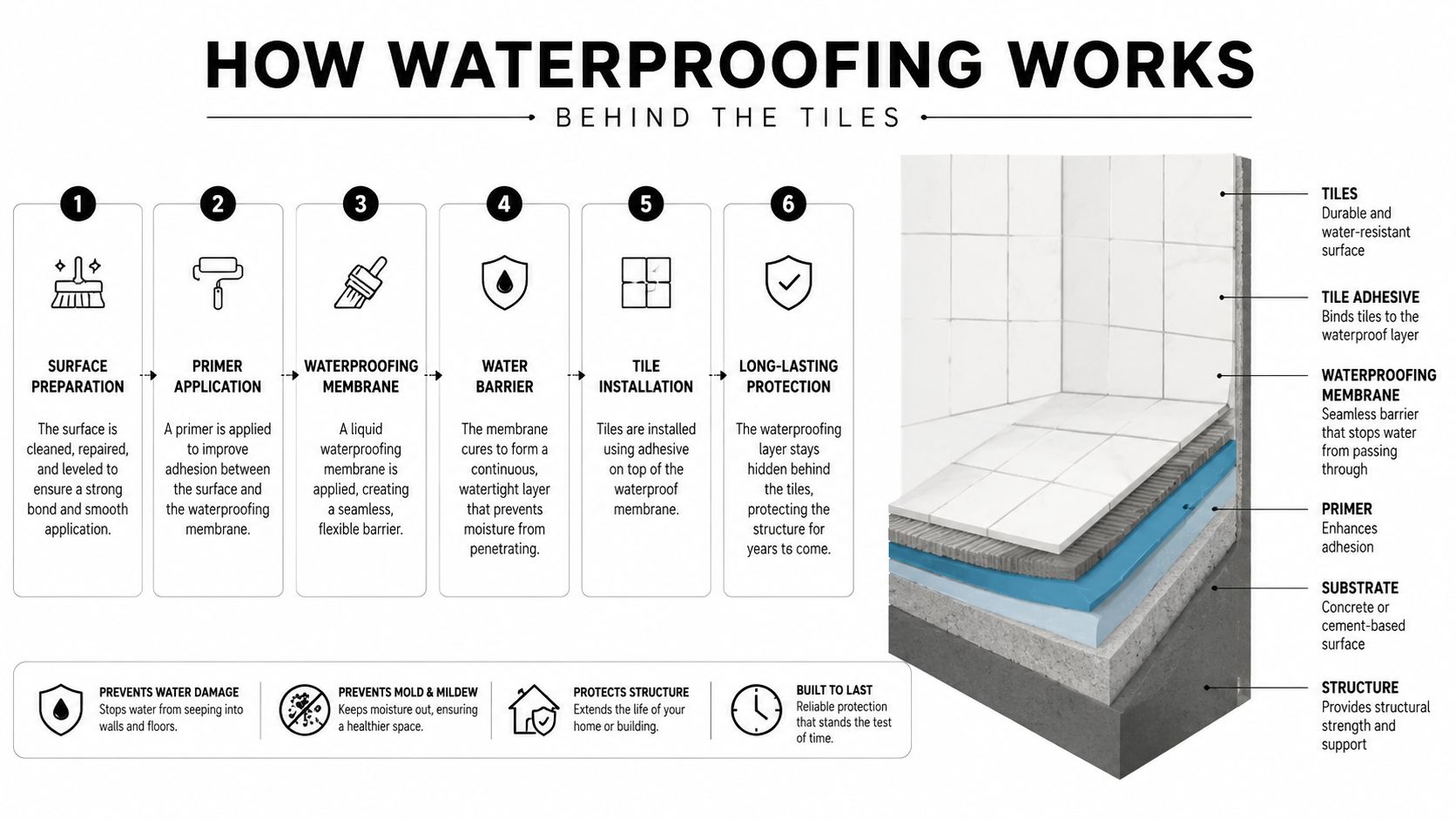
A tiled shower can look finished while water is already reaching the substrate. Tiles and grout are the visible cladding, not the waterproof barrier. The membrane is the tank, so corners, penetrations, junctions, and waste connections must join into one continuous sealed system.
The installation sequence is practical:
- Clean, repair, and prime the substrate.
- Apply the first membrane coat to the specified areas.
- Reinforce wall-to-floor junctions and internal corners with bond-breaker tape or compatible bandage.
- Seal pipe penetrations, wastes, niches, and other openings.
- Apply the second coat over the reinforced areas, reaching the product's required thickness.
- Allow the membrane to cure before tiling, adding another coat if the system or site conditions call for it.
Drying time forms part of the work, not an optional delay. Applying another coat too soon can disturb the layer underneath, while tiling before the membrane has cured can weaken the bond or trap moisture. The installer should follow the selected product's technical data sheet rather than judge readiness by surface appearance.
Falls and wall coverage
A shower recess needs a pre-formed shower tray or a correctly formed, flood-tested membrane fall that directs water to the waste. If the floor is flat, water can remain where the membrane and tile system face the most exposure.
Shower walls must also be waterproofed to the required height. Under the NCC wet-area provisions, shower floors require waterproofing, shower walls must reach at least 1,800 mm, and houses use that same 1,800 mm shower-area height requirement. The NCC wet-area waterproofing provisions provide the regulatory basis.
Australian guidance also covers waterproofing at least 150 mm above shower floors, 25 mm above finished floors, and fully waterproofing timber floors before tiling. The Australian waterproofing standards overview explains how preparation, layer thickness, and curing affect the finished system. Those steps are part of the quoted work, not just the visible paint-like membrane.
What Drives the Price on a Melbourne Quote
A useful quote should let you trace the price from the bare substrate to the signed compliance paperwork. If it only says “waterproof bathroom” with one lump sum, you can't tell whether the installer has allowed for corners, penetrations, drying days, or damaged flooring.
Preparation comes before membrane
Preparation may include removing old tiles, cleaning adhesive, repairing cracks, correcting screed levels, priming porous surfaces, or replacing unsuitable boards. This is often where a cheap quote becomes unstable. Membrane won't compensate for a loose, contaminated, moving, or poorly graded substrate.
The decision is practical. If the floor is sound and level, you may only need cleaning and primer. If the installer finds rotten particleboard or an uneven shower base, the right response is to repair it before waterproofing, not bury it under another coat.
Materials and junction details
The membrane price depends on the selected system, coverage area, and number of coats. The quote should identify whether it uses a liquid acrylic, polyurethane, cementitious-compatible system, or sheet membrane, along with compatible primers, sealants, tapes, corner pieces, and penetration seals.
Edges and junctions consume time because they carry concentrated movement and water exposure. Ask whether the price includes:
- Wall-floor junctions: Bond-breaker tape or reinforcing fleece.
- Internal corners: Reinforcement and compatible sealant.
- Pipe penetrations: Proper collars or seals rather than a brush of excess membrane.
- Waste connection: A compatible puddle flange detail.
- Shower recess: A tray or formed fall, where applicable.
Labour and compliance
Labour is commonly the largest part of a waterproofing quote because the installer must prepare the area, detail weak points, apply coats, return after curing, and check the finished coverage. In Victoria, work valued over A$5,000 requires a Construction Waterproofing Licence from the Victorian Building Authority, which can affect labour pricing, scheduling, and documentation. The Victorian waterproofing licensing and compliance guidance provides the relevant cost and licensing context.
Compliance may include a VBA-recognised certificate, photographic records, and a flood test where appropriate. Victorian wet-area work is governed by AS 3740, and compliance paperwork is expected before tiling proceeds, as outlined in this Victoria waterproofing compliance guide.
| Quote Line Item | Approx. Share of Cost | Homeowner Decision Involved |
|---|---|---|
| Substrate preparation | Variable | Pay for proper repair, or risk sealing an unstable surface |
| Membrane materials | Variable | Choose the specified system and required coat coverage |
| Edges and junctions | Variable | Confirm corners, penetrations, waste, and niches are included |
| Labour | Usually the largest component | Allow for return visits and cure time between coats |
| Compliance documentation | Variable | Confirm certificate, photographs, and testing requirements |
Don't assume a waterproofing-only quote includes a shower-screen refit, tiling, demolition, plumbing alterations, or rotten-subfloor rectification. Those exclusions can change the final bill substantially. If someone offers to skip a second coat to save A$150, or proposes one coat over particleboard, the saving is attached to the part of the system that protects everything above it.
Comparing Waterproofing Methods and Materials
Melbourne quotes usually refer to a few broad system types. The right choice depends less on the product label than on the substrate, room layout, movement, junction count, and installer competence.
Liquid acrylic and polyurethane membranes are the familiar default for many standard bathrooms. The installer rolls or brushes the product over a prepared substrate, reinforces corners and junctions, then builds the system to the manufacturer's required thickness. They suit many concrete-slab bathrooms and compressed fibre-cement surfaces, but application quality matters. A thin or incomplete coat isn't equivalent to a correctly applied system.
Sheet membranes use PVC, CPE, or another bonded sheet with treated seams, corners, and penetrations. They can offer consistent coverage and make sense where the layout contains difficult junctions or where the installer is experienced with that particular system. The material cost may be higher, but a predictable sheet can reduce some application variability.
Pre-formed polyurethane shower trays provide the fall and waterproofing geometry in one component. They're useful where the waste position and shower layout suit the tray, but they don't remove the need to detail wall junctions and penetrations. A tray can simplify the shower base while adding product and fitting considerations elsewhere.
| Method | Typical $ per m² | Best suited to | Expected lifespan | Key trade-off |
|---|---|---|---|---|
| Liquid acrylic membrane | Not fixed | Standard prepared bathrooms on sound substrates | Depends heavily on preparation and application | Accessible pricing, but thickness and curing must be controlled |
| Liquid polyurethane membrane | Not fixed | Areas needing a flexible liquid-applied system | Depends on system specification and installation | Flexible coverage, with careful substrate and cure requirements |
| Sheet PVC or CPE membrane | Not fixed | Complex junctions or installers trained in sheet systems | Depends on seams, corners, and penetrations | Consistent sheet coverage, but higher detailing and material requirements |
| Pre-formed polyurethane tray | Not fixed | Showers where tray dimensions and waste position suit | Depends on compatible installation and surrounding detailing | Provides a formed fall, but limits layout flexibility |
There isn't a verified universal lifespan or Melbourne dollar-per-square-metre figure that applies to every system, so be wary of quotes promising a fixed service life without naming the product and installation conditions. The shower waterproofing membrane service information is useful when comparing membrane approaches, but your installer should still provide the exact product specification.
For a straightforward concrete-slab bathroom, liquid membrane is often the sensible choice when correctly applied. On an upstairs timber floor or a heavily articulated wet room, a sheet system or tray may justify its higher price because the layout demands more controlled detailing. Premium doesn't automatically mean better. Compatibility and installation quality decide whether the system performs.
Real Melbourne Bathroom Examples and Case Studies
Two bathrooms can have similar floor areas and completely different waterproofing quotes. The difference usually appears under the tiles, at the waste, and around the room's junctions.
Ground-floor ensuite in Glen Waverley
The first example is an anonymised ground-floor ensuite in a 1990s Glen Waverley brick veneer home. The room had a straightforward concrete slab, one shower, reasonable access, and no visible substrate surprise after the old finishes were removed.
The scope was easy to define. Preparation involved cleaning and priming the sound surface, the shower walls received the required coverage, and the installer detailed the floor, corners, penetrations, and waste before applying the membrane system. Because the substrate didn't need major correction, the quote stayed within the straightforward bathroom band.
The homeowner's key decision was whether to keep the existing layout. Keeping the waste and shower position avoided additional falls, complicated junctions, and broader screed work. The clear quote separated preparation, membrane application, detailing, and compliance rather than presenting a bare “waterproofing” allowance.
Second-storey bathroom in Brunswick
The second example is a second-storey bathroom in a 1920s Brunswick terrace. The room sat over timber joists, required levelling, needed an increased fall to the floor waste, and demanded careful treatment as a raised wet area under AS 3740.
The headline price per square metre would have been a poor guide. The waterproofer had to inspect the timber substrate, coordinate repairs and levelling, establish the fall, detail more movement-prone junctions, and document the compliant installation. Access also affected how materials and equipment reached the room.
Site inspection changes the quote: A phone estimate can price surface area, but it can't see rotten boards, movement, waste position, or the quality of the old screed.
These examples show why a free quote based only on room dimensions is unreliable. Send substrate photographs before the inspection, identify whether the room is upstairs, and explain whether the existing tiles are being removed. A site visit should also confirm shower-screen locations, niches, baths, floor wastes, and penetrations.
The difference isn't necessarily profiteering. It reflects scope. A slab-based ensuite can need a controlled membrane installation. A terrace bathroom over timber may need a coordinated substrate and compliance package before the waterproofing can even begin.
Ask the contractor to state which assumptions support the price. If the quote depends on “sound substrate” or “no levelling required”, those conditions should be written down so you know what happens if demolition reveals something else.
Repair or Replace How to Decide
A visible leak doesn't always tell you where the waterproofing failed. Water can travel beneath tiles and emerge away from the original gap, which makes a small surface patch an uncertain fix. Replacing grout or applying sealant may improve the finish, but it won't rebuild a continuous membrane behind the wall.
Use three checks before choosing a repair:
- Age: Older membranes deserve closer scrutiny, especially if the installation history and product are unknown.
- Leak location: A localised issue at a known penetration may be different from moisture appearing across several walls.
- Renovation timing: If tiles and wall linings are already being removed, rebuilding the system is usually more efficient than preserving questionable layers.
A spot repair can make sense when the installer can identify a discrete failure and the surrounding system is sound. Partial re-waterproofing may suit a confined shower zone where the rest of the wet area remains intact. Full replacement is more appropriate when the membrane is damaged broadly, the substrate has moved, or the room is being stripped back for a renovation.
The figures need to be read as scope bands, not promises. Simple work may sit in the common A$500 to A$750 range, while broader re-waterproofing can reach A$1,500 to A$4,000 when access, substrate, and compliance requirements expand. The cost of a failed system can also include tile removal, drying, damaged plasterboard, timber repairs, repainting, and work in the room below. Research cited in the Australian waterproofing defect cost discussion identifies waterproofing as a serious defect category and estimates annual economic costs from defects in new residential apartments at A$121 million to A$314 million, with the wider building estimate reaching as much as A$1.2 billion.

Replacement usually wins when: More than one wall shows moisture signs, the membrane is over 15 years old, or tiles are already coming off.
Photograph bubbling paint, swollen skirting, mould, cracked grout, damp ceilings below, loose tiles, and any staining around the shower. Keep those images with the renovation records. They give the waterproofer a starting point and help distinguish a surface maintenance issue from a concealed wet-area failure.
Estimates Guarantees and Smart Budgeting in Melbourne
A useful Melbourne quote should read like a scope of work, not a product receipt. Whether you compare a specialist waterproofer, a tiler, or a bathroom renovation contractor, the estimate should state what happens before the membrane is opened and what evidence you'll receive before tiles cover it.
Read the quote line by line
Look for these items in writing:
- Substrate preparation: Hours or tasks allowed for cleaning, removal, priming, screed correction, and board replacement.
- Membrane specification: Product type, brand, system compatibility, coverage area, and coat count.
- Detailing: Treatment of corners, wall-floor junctions, niches, wastes, pipe penetrations, and shower-screen interfaces.
- Curing stages: Return visits and waiting periods between coats and before tiling.
- Compliance certificate: The certificate, photographs, and any testing included in the price.
- Warranty terms: Separate the product warranty from the installer's workmanship guarantee.
A quote that says “two coats membrane” but doesn't identify the product leaves too much unresolved. So does a price that excludes screed work while assuming the floor is already correctly graded. Ask what triggers a variation and require the contractor to show you the affected area before extra work begins.
For broader bathroom renovations, the legal contracting structure matters. Domestic building work above A$16,000 generally must be carried out by a registered builder in Victoria, and a renovation involving demolition, plumbing, waterproofing, tiling, and fittings commonly reaches that level. The Victorian domestic building guidance explains the registration threshold and its relevance to project supervision.
One industry source states that renovation jobs over A$10,000 require a Registered Builder, while plumbing must be performed by a registered or licensed plumber. Because guidance can differ by project category and source, confirm the current requirement with the relevant Victorian authority and make sure the contract identifies the responsible registered builders and licensed trades. You can also review the role of the Victorian waterproofing compliance certificate before signing.
Set the budget before demolition
For planning purposes, a small ground-floor bathroom may sit around A$500 to A$750, a standard main bathroom around A$1,200 to A$2,500, and a complex second-storey or substrate-replacement project around A$2,500 to A$4,000. These are practical planning brackets, not fixed tariffs, and the final amount depends on the inspected scope.
Against a A$10,000 renovation envelope, keep a contingency of 10% to 15% for surprises behind the tiles. That allowance can cover substrate repairs, levelling, waste alterations, or compliance-related rework, but it shouldn't be used to justify vague pricing. Ask for a written variation with the reason, affected trade, and revised total.
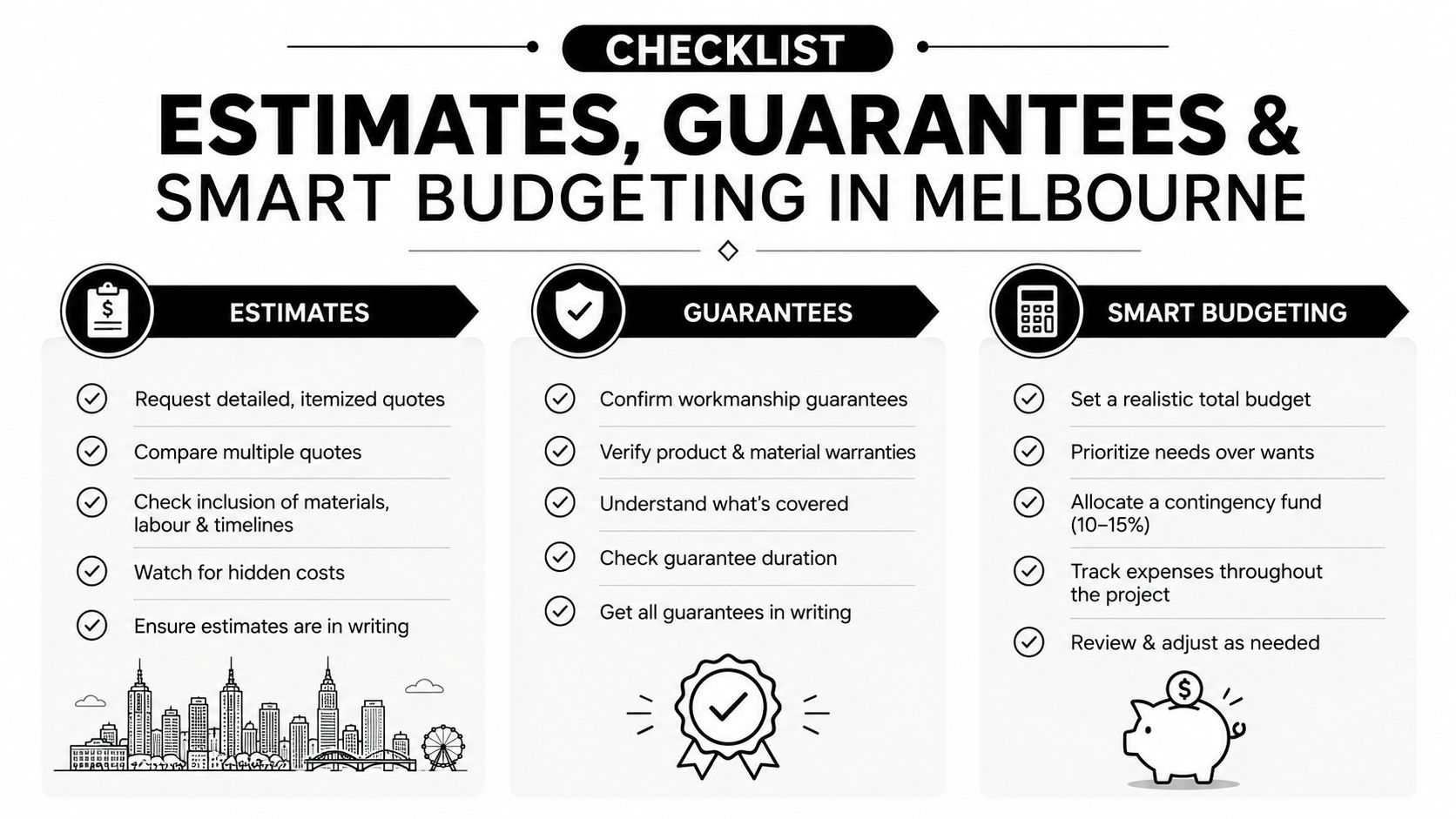
Before you commit, verify the contractor's registration, insurance details, certificate process, warranty wording, exclusions, and responsibility for coordinating plumbers, tilers, and shower-screen installers. A low initial quote only works if it includes the same scope as the quote beside it.
Melbourne Tiling Services P/L provides bathroom waterproofing, screeding, tiling, leak rectification, and complete bathroom renovation coordination, with written estimates and compliance documentation for Victorian projects. To compare your room's substrate, layout, and waterproofing scope against a clear renovation plan, visit Melbourne Tiling Services P/L and request a quote.
Recent Comments