

A brown stain has started spreading across the lounge-room ceiling after a Melbourne downpour. The balcony above looks mostly fine, perhaps with a few tired grout joints and a puddle near the drain, so it's tempting to seal the obvious crack and wait for the next storm. That approach often misses the true entry point.
Balcony water can travel along a membrane, through screed, across a concrete slab and into adjoining construction before it appears indoors. Good balcony leak detection is therefore a triage decision, not a hunt for the nearest crack. You need to identify the early signal, run safe checks, collect useful evidence, and know when the work has moved beyond a handyman's scope.
Table of Contents
- Why Balcony Leak Detection Matters in Melbourne Homes
- Early Visual Signs That Point to a Leaking Balcony
- DIY Balcony Leak Detection Tests You Can Safely Run
- Tools That Sharpen Your Balcony Leak Detection
- How Professionals Diagnose a Balcony Leak
- What the Victorian Data Says About Balcony Defects
- Costs, Temporary Fixes and When to Call a Registered Builder
Why Balcony Leak Detection Matters in Melbourne Homes
A ceiling stain beneath a balcony is a location clue, not a diagnosis. Water can pass through tile bedding, remain trapped in screed, and travel along a slab edge or service penetration before appearing elsewhere. Regrouting one tile or painting over the mark may hide the symptom while the membrane or junction continues to admit water.
The consequences usually spread beyond the original entry point:
- Interior staining: A tea-coloured mark can enlarge after rain even after the balcony surface looks dry.
- Efflorescence: White crystalline deposits on a soffit show that moisture has moved through concrete or masonry.
- Tile failure: Repeated wetting can loosen tiles, create hollow sounds and break down joints.
- Sub-floor damage: Persistent moisture beside timber can contribute to rot.
- Mould complaints: Damp cavities and plaster finishes can create indoor air-quality concerns.
- Room damage: Water may reach cornices, adjoining walls, flooring and built-in finishes.
Victorian research identified 102 buildings with defective balconies, including 79 where water ingress was the primary cause. It also reported that 73% of balcony defects were caused by water ingress and that 78% of impacted buildings were constructed less than 10 years ago. A newer apartment is not automatically protected from balcony failure. The Victorian government research on non-cladding building defects sets out the broader findings.
Practical rule: Treat the first indoor stain as evidence of a building-path problem, not proof that the source sits directly above it.
Use the least invasive check first. Record when the stain appears, inspect visible junctions and drainage, and test without cutting or puncturing the membrane. Moisture readings can narrow the affected area, but they do not replace opening-up where the evidence points below the finished surface.
Escalation depends on the work required. Observation and non-invasive testing are generally a sensible starting point. Removing finishes, repairing waterproofing, altering structural elements or coordinating substantial rectification may require a registered builder in Victoria, so involve a VBA-registered builder before destructive work begins.
Early Visual Signs That Point to a Leaking Balcony
Start below the balcony, not on top of it. In a Melbourne apartment, a soffit may show a tea-coloured halo, peeling paint or a damp-looking patch after rain. White efflorescence can crystallise on the underside, while spalling concrete may expose rusty reinforcement or produce loose flakes.
Look upstairs for changes that seem minor in isolation. A tile that sounds hollow when tapped with a knuckle may have lost contact with its bedding. Cracked grout can admit water, but it doesn't prove the membrane beneath has failed. Check the membrane upturn where visible, the junction at a nib wall, and every balustrade penetration, because these details often receive more movement and weather exposure than the open field of the balcony.
A persistent musty smell in the room beneath is another useful clue, especially after rain. Black mould tracking along a plaster cornice, a door swelling in its frame, or silicone pulling away from a wall junction can indicate moisture is reaching areas beyond the balcony finish. Ponding that remains for more than 30 minutes is a drainage warning and should be photographed rather than immediately covered with sealant.
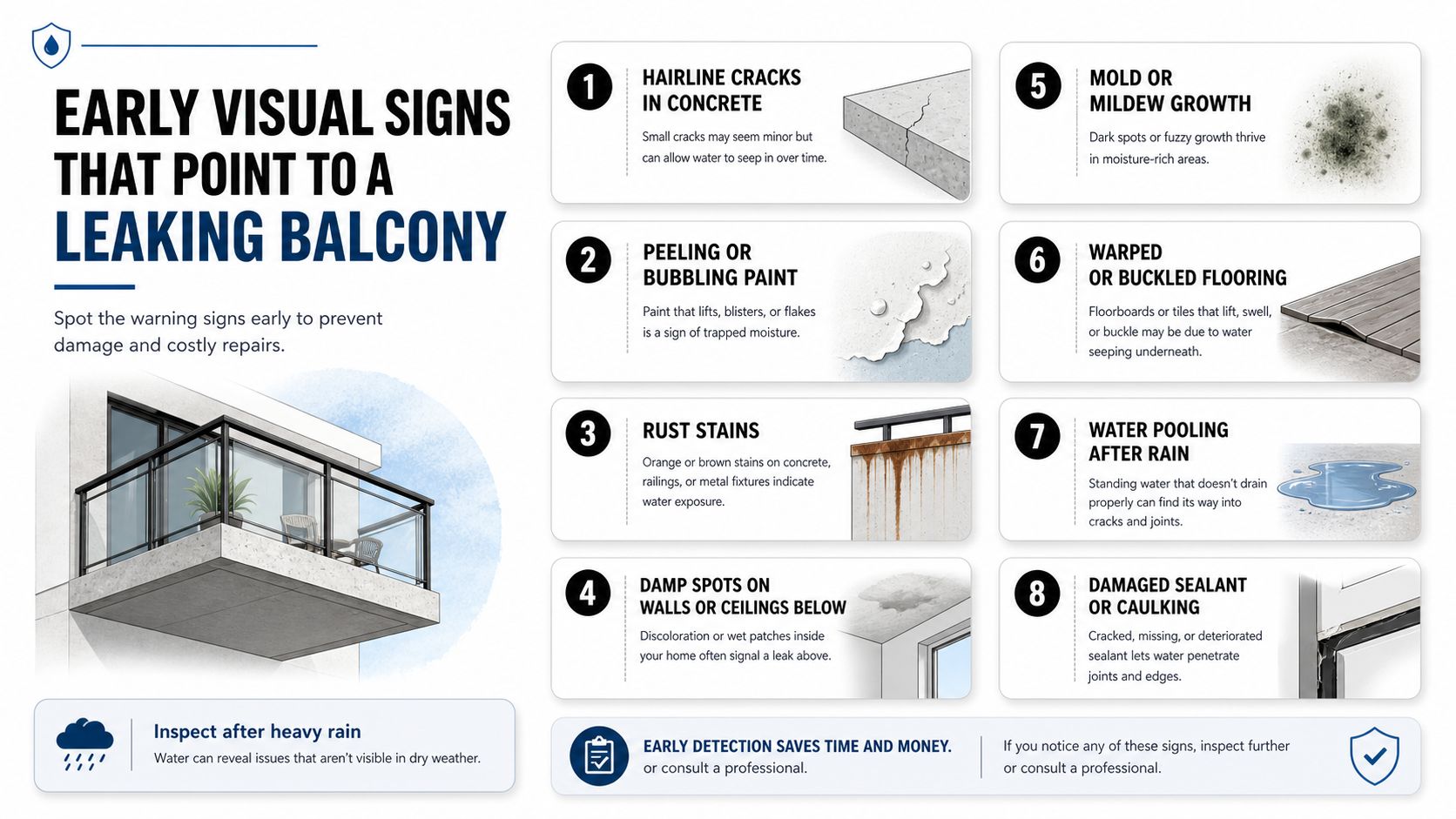
The source is rarely directly above the stain. Mark the stain's size, photograph it in natural light, and record whether it appears after heavy rain, wind-driven rain, balcony washing or ordinary use. For broader household context, this guide for homeowners on hidden leaks is useful when moisture signs appear away from the obvious wet area.
Don't climb onto a visibly deteriorated balcony or disturb loose concrete. Exposed reinforcement, significant cracking, sagging, or a balustrade that moves needs prompt professional assessment rather than a DIY test.
DIY Balcony Leak Detection Tests You Can Safely Run
A controlled weekend inspection can narrow the likely entry point without puncturing the waterproofing system. Start with a passive rain watch. Photograph the ceiling below after each shower, record the weather, and compare the indoor response with wet areas on the balcony. This establishes timing without adding water to an assembly that may already be vulnerable.
If dry weather continues, run a controlled hose test with a second person inside. Wet one zone at a time for 15-minute intervals, starting at the far end, then the middle, and finally the area near the door. Use a gentle flow. The aim is to isolate a zone, not recreate a storm or force water beneath trims through pressure.
Tests that isolate the source
Check the drain and surface falls before testing more aggressively. Remove leaf debris and silt, use a smartphone level to assess direction, and roll a tennis ball across the surface to find low spots. Under AS 4654.2-2012, balcony surfaces should achieve a minimum fall of 1:100 towards drainage. This Australian waterproofing investigation explains how falls, ponding, moisture mapping and selective opening can fit into a leak investigation. For a deeper look at Melbourne-specific waterproofing practices, see our guide to waterproofing balconies in Melbourne.
A flood test carries greater risk. Plug the drain and pool 25 to 50 mm of water for up to 24 hours only if you understand the consequences and accept that concealed damage could worsen. Do not run it when the ceiling below is already wet, the drain is unreliable, or the balcony shows structural warning signs. A wet room below is an escalation point, not a reason to add more water.
Use a torch to inspect grout, silicone and flashing. Look for open joints, failed perimeter seals, and gaps where a threshold or balustrade meets the finished surface. These findings can target later investigation, but they cannot prove that the membrane beneath the finish is intact.
| DIY Balcony Leak Detection Tests Compared | ||
|---|---|---|
| Test | What It Isolates | Key Limitation |
| Rain watch | Timing between rainfall and indoor staining | Weather may not wet the suspected entry point consistently |
| Zoned hose test | Whether one balcony area correlates with the indoor response | Water can migrate beneath finishes and confuse the boundary |
| Drain and falls check | Blockage, ponding and poor surface drainage | It cannot show membrane continuity below tiles |
| Torch inspection | Open grout, silicone and visible junction defects | Surface seals may look intact while concealed layers fail |
| Flood test | Broad water-retention behaviour | It adds load and moisture, and may aggravate an existing breach |
What not to do
- Avoid pressure washing: High-pressure water can force moisture into joints, thresholds and weak details.
- Don't drill test holes: A hole through the membrane creates a new penetration that may become the leak.
- Don't flood blindly: Stop if water appears indoors or the lower ceiling is already damp.
- Don't seal every joint first: Blanket sealing removes useful evidence and can trap moisture.
- Keep records: Label photographs by date, weather and test zone so a professional can interpret them.
DIY testing ends when the evidence points below the finish, or when safety is uncertain. At that stage, stop testing and arrange an assessment by the appropriate VBA-registered builder in Victoria, particularly where the work may involve regulated building work, structural defects or opening the waterproofed assembly.
Tools That Sharpen Your Balcony Leak Detection
Tools improve a diagnosis when someone understands the building assembly behind the reading. They don't turn a homeowner into a waterproofing inspector. A moisture meter can identify suspicious areas, but a single high reading doesn't prove a membrane breach, just as a low surface reading doesn't clear the substrate below.
A pin-type moisture meter measures between probes and can help compare plaster, timber or accessible materials. A pinless meter scans without puncturing the finish, which is useful on tiled surfaces, although readings can be influenced by tile density, metal components and surface geometry. Take readings across a consistent grid rather than chasing the highest number.
An infrared thermometer can identify temperature differences on a slab soffit or wall. It isn't the same as a full thermal camera, and it won't show a leak path by itself. Thermal differences may reflect shade, insulation, air movement or evaporation, so use them to select areas for closer inspection.
A borescope can inspect an accessible cavity, fascia void or flashing area through an existing opening. Dye tracing may show how water moves towards a drain or outlet, but dye below tiles or inside a membrane system is not a substitute for opening the assembly.
| Comparison of Common Balcony Leak Detection Tools | ||
|---|---|---|
| Tool | What it reveals | Where it falls short on a balcony |
| Pin-type moisture meter | Comparative moisture in accessible porous materials | Requires contact or penetration and may not represent concealed screed |
| Pinless moisture meter | Non-invasive moisture patterns beneath or across finishes | Readings can be affected by tile, metal and surface composition |
| Infrared thermometer | Local temperature anomalies on accessible surfaces | It doesn't produce a moisture map and is sensitive to conditions |
| Borescope | Voids, cavity conditions and accessible flashing details | It only sees where an opening already exists |
| Dye tracing | Drainage direction and possible migration paths | It may not identify the membrane breach beneath tiles |
The most useful output is a pattern. Compare readings across dry and suspect zones, pair them with staining, drainage behaviour and weather timing, and record the limits of each instrument. The guide to finding roof leaks also illustrates why water tracing requires attention to paths rather than only the location where damage becomes visible.
How Professionals Diagnose a Balcony Leak
Professional diagnosis usually begins without removing tiles. The inspector records the balcony layout, threshold, outlets, falls, balustrade penetrations and the position of damage below. Moisture metres are used at known grid points, while thermal scanning across the slab and soffit can identify areas that deserve closer examination.
Drainage outlets may be checked with controlled water or dye tracing. The objective isn't to pour water everywhere. It's to test one pathway at a time and compare the response with existing staining. Victorian guidance links water ingress with waterproofing, falls and drainage defects, and supports a staged approach that combines non-invasive mapping with selective opening. The VBA research insights on water ingress in balconies, roofs and drainage explains that investigative logic.
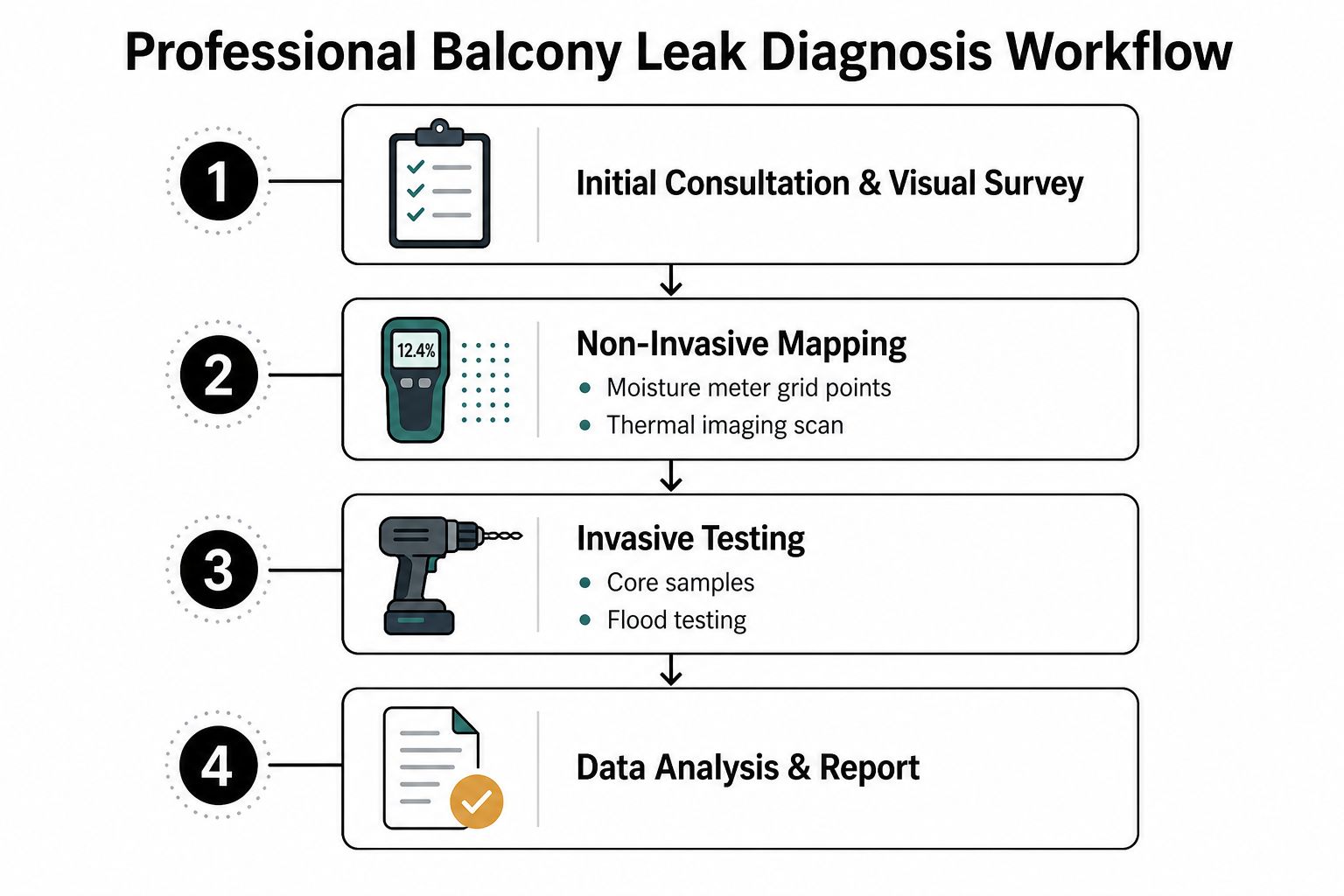
Selective opening instead of blanket demolition
When readings and visual evidence converge, a small area of tile and screed may be lifted. The opening should answer a specific question, such as whether the membrane turns up correctly at a threshold, whether the substrate is saturated, or whether a penetration has interrupted continuity.
That approach is more defensible than removing an entire balcony without evidence. It also gives the builder information to quote against, including the extent of membrane failure, substrate repairs, screed replacement, drainage correction and reinstatement.
AS 4654.2 expectations make the fall gradient, outlet detail and membrane terminations central to the assessment. A professional report should distinguish a cracked tile from a failed waterproofing system and identify whether the visible damage reflects design, drainage or workmanship.
For background on planning to protect your property from leaks, homeowners can also review general water-intrusion response principles. For a Melbourne-specific assessment pathway, balcony leak detection services in Melbourne can be considered when surface testing hasn't isolated the source.
What the Victorian Data Says About Balcony Defects
Victorian evidence makes water ingress a sensible first investigation point, while showing why “leak” is too narrow a diagnosis. Balcony defects can also involve inadequate waterproofing, poor falls, drainage behaviour, concrete deterioration, tile movement and threshold detailing. A surface crack may be the visible symptom rather than the entry point.
The practical triage is to test how water behaves before deciding what to open. Check the outlet, ponding areas, slab edges, balustrade penetrations and door threshold. Compare moisture readings with visible staining, then use controlled testing to narrow the likely path. If the evidence points towards membrane failure, substrate saturation or structural deterioration, escalation to a VBA-registered builder may be required in Victoria, particularly where the work involves structural building work or regulated waterproofing and rectification.
A Swinburne University investigation into water leakage in residential apartment concrete balconies records water ingress and inadequate waterproofing among assessed causes of balcony defects. Its value for a homeowner is practical: persistent leakage can damage more than finishes, especially where water reaches concrete, reinforcement, internal linings or adjoining building elements.
Applying the evidence to your balcony
Building age, exposure, tile type, threshold detail and maintenance history still affect the diagnosis. Older balconies may have had more time for failed joints, blocked outlets and membrane deterioration to develop. Newer buildings can also present defects when falls, penetrations, thresholds or installation details were poorly resolved from the start.
That makes age a clue, not a verdict. A newer balcony with recurring staining still needs a structured assessment, while an older balcony with one isolated sealant failure may not justify broad removal.
Efflorescence can also indicate a moisture-related defect even when water is not passing through the membrane. The visible deposit deserves investigation, but it does not automatically justify a full strip-out. Start with drainage and moisture behaviour, document the findings, and call a registered builder when the proposed work moves beyond minor maintenance or requires membrane, substrate or structural rectification. Guidance on waterproofing in Melbourne can help distinguish surface maintenance from system remediation.
Costs, Temporary Fixes and When to Call a Registered Builder
Balcony repair pricing depends on access, the affected area, screed condition and whether the membrane can be checked without broad removal. A perimeter sealant repair is a different job from membrane replacement, structural concrete repair or tile reinstatement. Request an itemised scope that separates investigation from rectification.
Use the table as a planning framework, not a quoted price list. No verified Melbourne cost ranges are provided for these tiers, so obtain exact amounts through an inspection and written quotation rather than relying on an invented budget.
| Balcony Leak Rectification Costs in Melbourne (2026) | ||
|---|---|---|
| Rectification Tier | Typical Cost (AUD) | Includes |
| Preliminary DIY checks | Variable, based on materials already owned | Photographs, drain clearing, gentle hose testing and basic observation |
| Targeted professional diagnosis | Quote required | Moisture mapping, drainage assessment, thermal investigation and selective opening where justified |
| Localised repair | Quote required | Limited substrate or membrane repair, compatible sealing and surface reinstatement |
| Full balcony remediation | Quote required | Tile and screed removal, membrane replacement, fall or drainage correction and reinstatement |
| Structural or multi-trade rectification | Quote required | Coordination of building, waterproofing, concrete, plumbing and finishing work |
Temporary measures can limit immediate exposure, but they do not repair a membrane breach. Reapplying sealant to a separating perimeter joint may hold back wind-driven water at that joint for a time. A securely fixed tarp can shelter the balcony during forecast rain, provided it does not obstruct drainage. Moisture absorbers may make an internal room feel drier, but they do not remove moisture from the slab or wall cavity.
For balcony waterproofing and rectification, a qualified Melbourne tiling specialist can assess the leak path, membrane condition, screed and tile reinstatement scope. See these balcony waterproofing services in Melbourne when the work has moved beyond surface maintenance.
The Victorian registration threshold
In Victoria, domestic building work worth more than $10,000 must be carried out by a builder registered with the Building and Plumbing Commission. Verify the builder's registration and status before signing a major domestic building contract. The Victorian bathroom, kitchen and laundry renovation registration materials also explain the connection between registration and Home Warranty insurance.
Independent Victorian guidance identifies $16,000 as the threshold for major domestic building work and states that bathroom renovations above that amount require a VBA-registered builder under a major domestic building contract. It also links bathroom waterproofing to AS 3740 and recognises Domestic Builder Unlimited alongside the limited bathroom, kitchen and laundry class. The technical referee report for the limited bathroom, kitchen and laundry renovation class provides that registration context.
Balcony rectification may require structural advice, several trades or work that reaches the major domestic building contract threshold. At that point, stop treating the job as a handyman repair. Confirm the builder's registration class before signing, particularly where waterproofing, plumbing, carpentry and finishes are coordinated. The same compliance thinking applies to bathroom renovations.
Melbourne Tiling Services P/L works across balcony leak rectification, waterproofing, screeding and tiling, and can coordinate investigation and reinstatement where those services suit the project. Ask for a written assessment separating the suspected leak path from the repair allowance.
Melbourne Tiling Services P/L also offers balcony leak investigation, waterproofing, screeding and tile reinstatement, plus start-to-finish bathroom renovations coordinated by registered builders. If a balcony stain keeps returning, visit Melbourne Tiling Services P/L to discuss the site conditions and request a clear quote.
Recent Comments