
For a standard like-for-like toilet replacement in Melbourne, expect roughly A$350 to A$800 installed, with A$1,500+ once the job involves relocating the pan, adding a concealed cistern, or tying into waterproofing work. That range is the one I'd use when a homeowner rings me about a tired, wobbling pan and wants a realistic number before the plumber turns up.
A lot of people are in that exact spot. The old toilet has already been removed, the bathroom is half finished, and the next quote feels like the moment the whole renovation either stays on budget or starts drifting.
Table of Contents
- What Melbourne Homeowners Pay for a New Toilet
- Reading the Quote Line by Line
- Standard, Wall-Hung, and Smart Toilets Compared
- The Hidden Costs Most Quotes Forget
- DIY vs Licensed Plumber in Victoria
- Three Realistic Melbourne Cost Scenarios
- Timeline, Permits, and How to Save Without Cutting Corners
What Melbourne Homeowners Pay for a New Toilet
A Bayside homeowner standing in a half-tiled bathroom usually wants one thing, a number they can trust before the plumber arrives. If the job is a clean swap, the working range in Melbourne is usually A$350 to A$800 installed, based on current install-only benchmarks for a standard replacement in Victoria and wider Australian pricing guides that sit around A$250 to A$800 for a basic swap-out (Plumbing Tips Today, Homewyse). When the toilet moves, the cistern hides in the wall, or the bathroom needs compliance-related plumbing work, the job can push to A$1,500+ and beyond (Plumbing Tips Today).
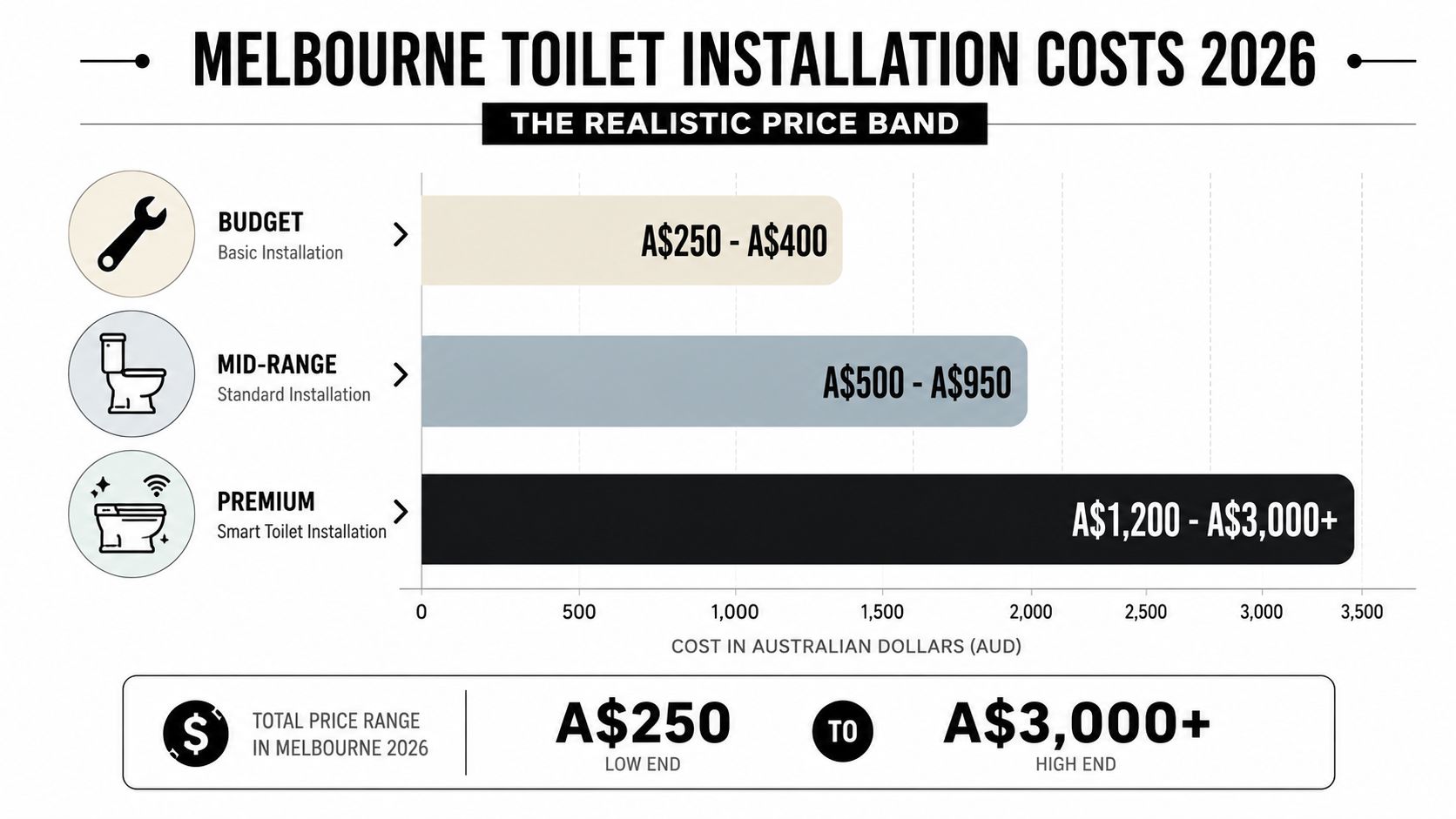
The spread exists because the toilet unit is often the smallest part of the invoice. In Victorian bathroom work, the price usually reflects labour, plumbing changes, disposal, fittings, and whatever the plumber finds once the old pan is lifted. A simple swap can sit near the low end, while concealed cisterns, wall-hung systems, and renovation-grade jobs climb much higher, especially when the toilet is only one line inside a broader project.
That matters in Melbourne because a toilet install is often tied to a larger bathroom scope, not a stand-alone call-out. Once the plumbing change, wall repair, tiling repair, or fixture coordination starts to stack up, the quote starts to look more like a trade package. That is where a renovation coordinator starts asking what is included, what is provisional, and whether the plumber is pricing the obvious job or the hidden repair work that appears after demolition. For a wider view of how a toilet line item sits inside bathroom renovations, the plumbing figure only makes sense once the full bathroom scope is on the table.
What bracket does your job fall into
If the toilet is staying in the same place, the rough-in matches, and the floor is sound, you are probably in the lower bracket. If you are changing the style, reworking the wall, or coordinating the toilet with the rest of the room, the invoice starts behaving like a trade package, not a single plumbing task.
Practical rule: if the quote feels too close to the price of the porcelain alone, something is probably missing.
A lot of homeowners miss that part. A retail toilet might be easy to compare online, but the installed price in Melbourne is shaped by labour, trade coordination, and the risk of repair work that only shows up once the old unit comes out. That is also where the Victorian $10,000 building contract threshold starts to matter, because once a bathroom job is bundled with other trades, the paperwork, scope control, and contract structure deserve the same attention as the fixture price.
Reading the Quote Line by Line
A decent Melbourne quote tells you what the plumber is taking responsibility for. The parts I'd expect to see are the toilet pan and cistern supply, isolation valve, connector kit, seal, silicone, labour, and disposal. If one of those items is missing, ask why before you approve anything.
Here's the way I read an invoice on site. First, check whether the toilet is being supplied by the plumber or by you, because that changes how the quote should be structured. Next, look for the valve and connector kit, because an old valve behind a toilet is one of the easiest ways to create a call-back after the job.
| Typical Melbourne toilet installation invoice line items | Indicative range | Notes |
|---|---|---|
| Toilet pan and cistern supply | Varies by model | Standard suites cost less than concealed or smart systems |
| Isolation valve and connector kit | Varies by job | Often replaced during a proper swap |
| Wax or rubber seal | Included or itemised | Should be replaced during installation |
| Silicone and consumables | Usually minor | Finishes the base and contact points |
| Labour | Fixed job or hourly | Depends on access and complexity |
| Removal and disposal | Sometimes included | Confirm before signing |
| Call-out fee | Sometimes included | More common on smaller repair jobs |
Labour in Victoria is often quoted as a fixed job for a basic replacement, or as a time-based charge when the plumber expects complications. The strongest pricing guides for installation-only work show labour sitting inside a broader job context, with the overall replacement price commonly landing around A$350 to A$800 and more complex jobs rising to A$1,500+ (Homewyse, Plumbing Tips Today). That's useful because it tells you the invoice isn't just a labour ticket, it's a risk assessment on access, fittings, and what might need replacing.
The same logic applies when the toilet is one part of a tiling scope, not a standalone fix. If the bathroom is being reworked, it helps to understand the surrounding finish work too, which is why many homeowners compare the plumbing quote against tile installation cost in Melbourne before they lock in the build sequence.
A quote that names the toilet but ignores the valve, seal, and disposal usually leaves room for an unpleasant “variation” later.
That's the part to press on. If a plumber can't tell you what's included, the cheapest number on paper can become the most expensive one on the day.
Standard, Wall-Hung, and Smart Toilets Compared
The toilet you choose changes the whole job. A standard close-coupled suite is the simplest option because the cistern and bowl sit together and the plumbing is straightforward. Wall-hung and concealed-cistern systems move the installation into structural and finishing territory, while smart toilets add an electrical layer as well as plumbing.
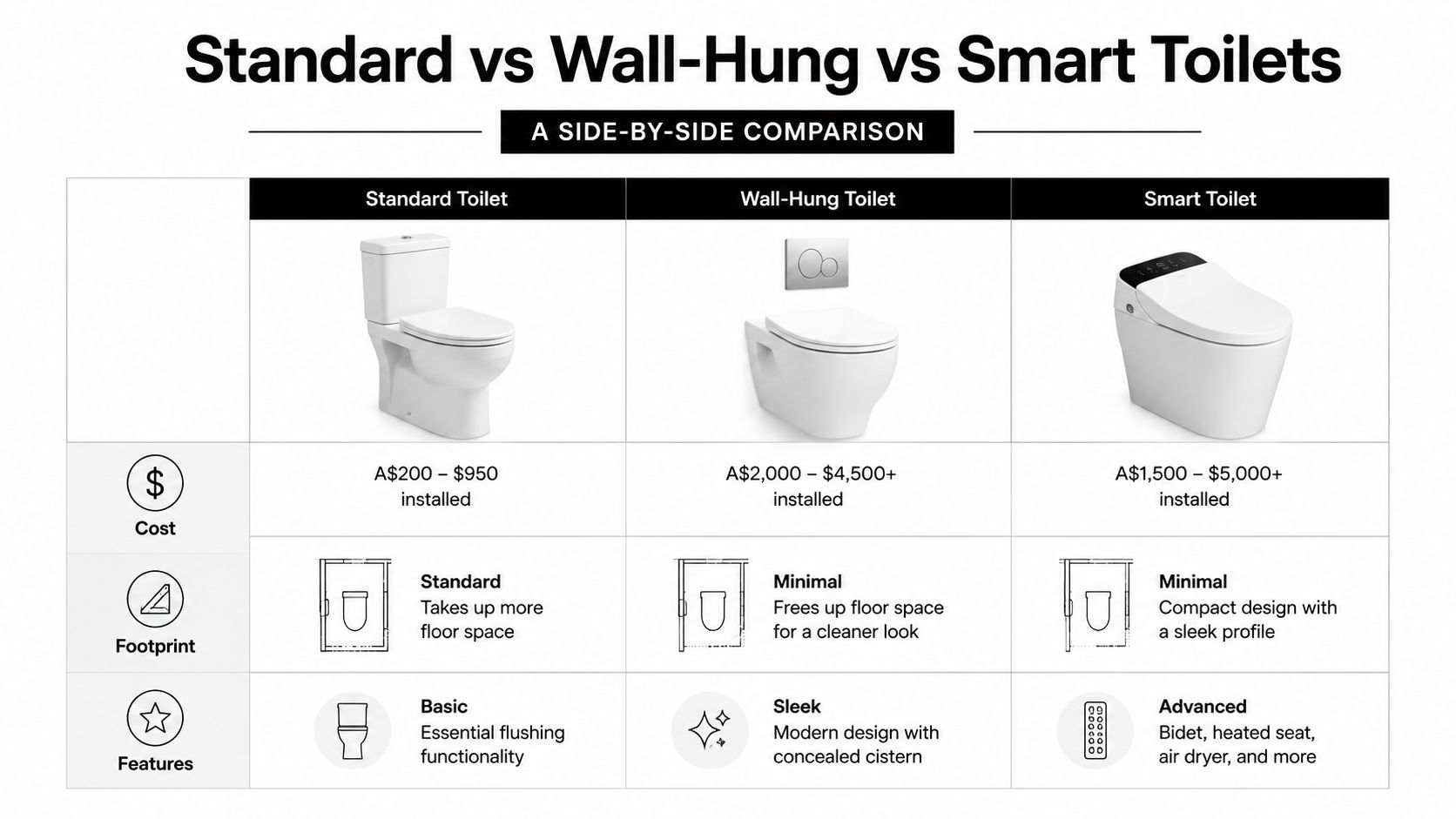
A standard two-piece toilet is the lowest-friction option in renovation work, with installation pricing commonly sitting around A$200 to A$950 (Fixr). A wall-hung or wall-mounted system usually climbs to about A$500 to A$2,000 installed, because the carrier frame, in-wall cistern, and finishing work add complexity (Fixr). Smart toilets can reach A$4,000+ installed, which reflects both the fixture and the extra coordination around power and advanced features (Fixr, HomeServe).
What actually drives the upgrade cost
The bowl isn't the hard part. The hard part is the wall behind it. A concealed system needs the carrier set correctly, the waste aligned, the cavity framed, and the surface finished cleanly. A smart toilet can also require an electrical outlet, which means another trade has to be part of the plan (Checkatrade, HomeServe).
For homeowners, that means the decision is partly about design, but it's also about wall structure and access. If you want a sleek finish and hidden plumbing, the toilet stops being a simple replacement and becomes part of a built assembly. That's why the price curve rises so sharply once the cistern disappears into the wall.
If you're choosing between styles, choose the one your wall can honestly support, not the one that looks cheapest on a showroom tag.
That advice saves grief. The wrong toilet choice often creates the most expensive plumbing quote in the room.
The Hidden Costs Most Quotes Forget
The nastiest surprises usually sit behind the old pan. I've seen quotes look tidy until the plumber lifts the toilet and finds a corroded shut-off valve, a leaking seal, or floor damage that had been hidden by the old fixture. Those are not optional extras, they're the difference between a proper install and a leak waiting to happen.
A concealed-cistern job is where hidden scope becomes obvious. The carrier frame needs to be built, the waste position checked, and the tiled face restored around the access point. If waterproofing tie-ins are needed, the toilet is no longer just a plumbing swap, it's part of the bathroom envelope, which is why homeowners should treat it as renovation work and not only as a fixture replacement. The issue is especially relevant in Victorian bathroom projects where the toilet is being replaced alongside other wet-area work, and waterproofing compliance often sits inside the broader bathroom build process (Melbourne Tiling Services waterproofing compliance information).
The extras that change the invoice
The hidden work most often includes waste relocation, concealed cistern framing, waterproofing tie-ins, and tile reinstatement. Each one adds labour days because the plumber may need to return after carpentry or tiling, or coordinate with another trade before the toilet can be fixed off properly.
Don't ask only “what does the toilet cost”, ask “what happens if you find damage under the old pan?”
That single question changes the quote conversation. It forces the plumber to spell out whether the job includes disposal, whether the base will be resealed, and whether the existing floor or pipework could trigger extra labour.
The practical mistake is to compare only the fixture price and the visible labour. A more honest comparison is whether the job is a straight replacement or a mini-renovation. In older Melbourne homes, especially those with previous patchwork repairs, the second version is far more common than cost guides admit.
DIY vs Licensed Plumber in Victoria
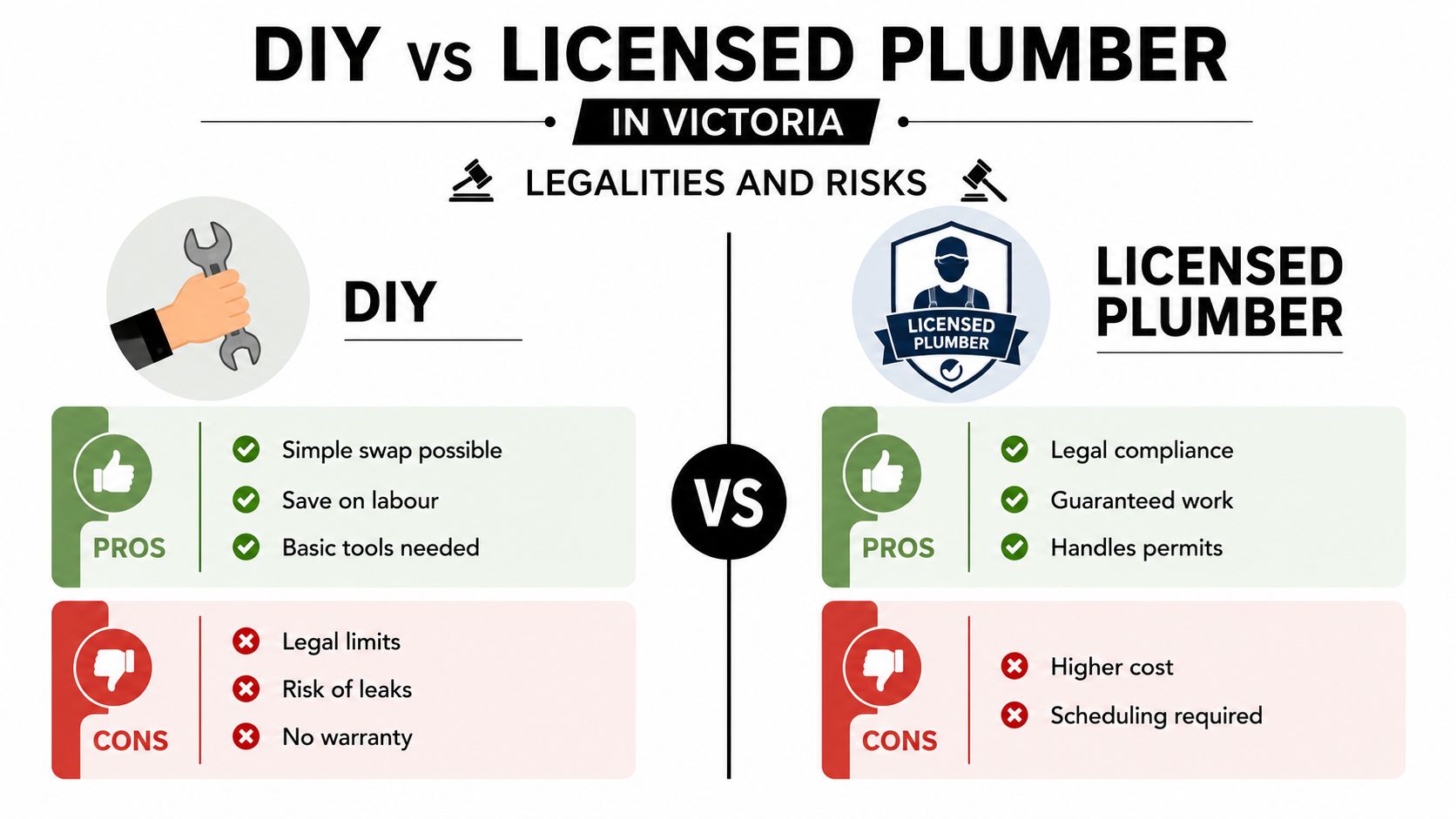
A straight toilet swap sounds simple until the legal and practical limits show up. In Victoria, the work that really matters is the work that touches plumbing, and most Melbourne bathrooms are not set up for casual DIY beyond the narrowest replacement scenario. Once you're altering waste, moving the fixture, touching the wall-hung carrier, or dealing with an apartment stack, you're in licensed territory.
The clearest benchmark in Victoria is that a major domestic building contract applies once the work is over $10,000, and that category includes renovating, improving, or repairing a home, as well as alterations, additions, demolition, or re-erection work (Horow guide on Victorian installation and building context). That matters because a bathroom renovation can move quickly from a small plumbing task into regulated domestic building work once the toilet sits inside a wider project.
What a DIY swap can and can't cover
A very limited DIY scenario is a direct replacement with the rough-in intact, no plumbing alteration, and no wall or floor changes. Even then, the risk sits with leaks, failed seals, and the lack of warranty or compliance support if something goes wrong. In apartments and in most upgraded bathrooms, that narrow window closes fast.
A licensed plumber is the safer choice for anything involving the toilet waste line, carrier system, or compliance-sensitive work. The practical gain is not just legality, it's insurance cover, warranty confidence, and a paper trail if the bathroom is part of a registered renovation.
If you're also comparing finishes and layout changes, the toilet decision doesn't sit on its own. It has to fit the broader bathroom sequence, especially where a registered builder is coordinating trades and the toilet install has to line up with tiling, waterproofing, and final fit-off.
If the toilet sits inside a renovation, the plumber should be thinking about the bathroom, not just the bowl.
That mindset is what keeps the job clean. DIY can look cheaper on day one, but it's the weakest choice the moment the work crosses into structure, drainage, or compliance.
Three Realistic Melbourne Cost Scenarios
A Bayside unit swap is the simplest case, and it's the one homeowners usually hope for. The old toilet comes out, the new one goes in the same location, the floor is sound, and the installer only has to deal with normal replacement parts and labour. That kind of job is where the market still tends to sit near the lower end of the Melbourne range, around A$350 to A$800 installed (Plumbing Tips Today, Homewyse).
A concealed-cistern ensuite is a different animal. The toilet itself may not be the expensive part, but the frame, in-wall cistern, finish reinstatement, and any drainage adjustment push the labour up quickly. Once you're in that territory, the broader installed pricing can move into the A$1,500+ bracket because the job is no longer a simple replacement (Plumbing Tips Today, Fixr).
A full bathroom renovation coordinated by a registered builder sits in its own category. The toilet is only one line in a larger build sequence, and the final number depends on how the plumber, tiler, waterproofing crew, and builder sequence their work. That's where the cost conversation has to widen beyond the toilet and into the bathroom as a whole, which is why many renovation budgets are better planned as a package rather than as disconnected trade quotes.
A simple way to read the three stacks
- Bayside unit swap: toilet supply, seal, labour, disposal.
- Concealed cistern ensuite: fixture, framing, waste alignment, finishing, return visits.
- Full renovation integration: plumbing plus tiling, waterproofing, builder coordination, final fit-off.
The point of these scenarios is not to chase the cheapest option. It's to know which job you're buying before the invoice arrives. A homeowner who understands the stack can spot when a quote is missing labour, finishing, or compliance-sensitive work.
Timeline, Permits, and How to Save Without Cutting Corners
A straight replacement is usually a short job, but a renovation-grade toilet install isn't measured by the screwdriver alone. A simple swap can be done in a few hours, while a full bathroom sequence involving framing, waterproofing, and tiling stretches over several days. Once the toilet is part of a bigger build, the schedule follows the trades, not the porcelain.
The Victorian $10,000 major domestic building contract threshold matters because it's the point where the job can move from a small plumbing task into a regulated renovation framework (Horow guide on Victorian installation and building context). That's the moment where a registered builder becomes useful, because someone has to coordinate the toilet around the rest of the bathroom scope, especially when other wet-area work is already underway.
Ways to keep the bill under control
- Supply your own suite: buying the toilet yourself can help you control the model and style.
- Prepare the access: clear the room and make sure the plumber can get straight to the work.
- Bundle the visit: combining toilet fit-off with other bathroom work reduces wasted call-outs.
- Document the existing plumbing: photos before demolition help the trades understand what they're dealing with.
- Choose standard where you can: the more complex the toilet system, the more labour and coordination it usually needs.
The savings only work when compliance stays intact. Cutting corners on seals, valves, or waterproofing is false economy, because the repair bill is where the pain starts. For Melbourne homeowners planning bathroom renovations, the smartest move is to price the toilet as part of the room, not as a standalone purchase.
If you're planning a bathroom renovation or a toilet replacement in Melbourne, Melbourne Tiling Services P/L can help coordinate the plumbing, tiling, waterproofing, and builder side of the job so the quote reflects the full scope. Visit Melbourne Tiling Services P/L to discuss your renovation, compare options, and get a clearer plan before the work starts.
Recent Comments