
In Melbourne, a straightforward balcony waterproofing job costs about A$85 to A$150 per square metre, while a remedial strip-and-rebuild commonly lands between A$8,000 and A$22,000+. The difference isn't the membrane alone, it's whether the existing tiles, screed, falls, drainage and substrate can stay in place.
That's why the answer to how much does it cost to waterproof a balcony can be misleading. A small balcony with a sound surface may need a controlled recoat. Another balcony of the same size may require demolition back to the slab, concrete repairs, new screed, compliant drainage detailing and complete reinstatement. In Melbourne, the scope decides the bill long before the applicator opens a membrane drum.
Table of Contents
- What Balcony Waterproofing Actually Costs in 2026
- Key Factors That Drive Your Balcony Waterproofing Quote
- Comparing Membrane, Liquid-Applied, and Tile-Over Systems
- Breaking Down Labour Versus Materials on the Quote
- Real-World Quoted Jobs From Melbourne Suburbs
- How Waterproofing Fits Inside a Larger Renovation Budget
- Getting Accurate Quotes and Avoiding Costly Surprises
- Putting It All Together and Planning Your Next Step
What Balcony Waterproofing Actually Costs in 2026
For a straightforward Melbourne membrane job, allow roughly A$85 to A$150 per m², including preparation, the membrane system and drainage detailing. A 12 to 20 m² balcony commonly sits around A$1,100 to A$2,500 when the substrate is sound and access is uncomplicated, according to the Melbourne balcony waterproofing cost guide.
But that range only applies to the simpler end of the work. Remedial strip-out, re-waterproofing and retiling commonly move into A$8,000 to A$22,000+, because demolition, screed replacement, drainage correction and finish reinstatement dominate the labour. A separate Australian pricing guide also records small patch repairs from about A$800, while complex replacement work can approach A$10,000, with difficult apartment jobs reported from A$10,000 to A$17,000 depending on access and rectification requirements. See the Australian balcony waterproofing cost breakdown for the distinction between a surface repair and a full rebuild.
Find your scope before comparing rates
A homeowner should identify one of three scopes before comparing any quote.
Maintenance recoat: The existing membrane and substrate are sound. The contractor cleans, prepares, primes and applies a compatible new coating. For a 12 m² balcony, the practical starting point is around A$1,100, subject to preparation and detailing.
Localised repair: The membrane has failed in specific areas, or the substrate has minor defects. The contractor cuts out damaged sections, repairs cracks or weak patches, reinstates the membrane and seals the vulnerable junctions. A 12 m² balcony can sit around A$2,500 to A$5,000 in this middle category, depending on what the inspection uncovers.
Full strip-and-rebuild: Tiles, adhesive and screed come out, exposing the structural slab. The scope then includes substrate repairs, new screed-to-falls, membrane installation, drainage details and a new finish. Budget from A$8,000 upward, with full Melbourne strip-out scopes commonly reaching A$8,000 to A$22,000+ according to Victorian balcony waterproofing pricing guidance.
| Scope | Typical $/m² | 12 m² balcony estimate | Best for |
|---|---|---|---|
| Maintenance recoat | A$85–A$150 | About A$1,100–A$1,800 | Sound membrane and substrate |
| Localised repair | Varies by defects | About A$2,500–A$5,000 | Isolated leaks and minor substrate damage |
| Strip-and-rebuild | Not meaningfully comparable | A$8,000–A$22,000+ | Failed screed, drainage or widespread membrane failure |
The balcony waterproofing service information is useful for understanding what preparation and reinstatement should appear in a written scope. Don't accept a square-metre rate until the contractor has stated which of these three jobs you're buying.
Key Factors That Drive Your Balcony Waterproofing Quote
Two balconies can have similar floor areas and radically different prices. Surface area establishes the starting point, but substrate condition usually creates the painful variation.
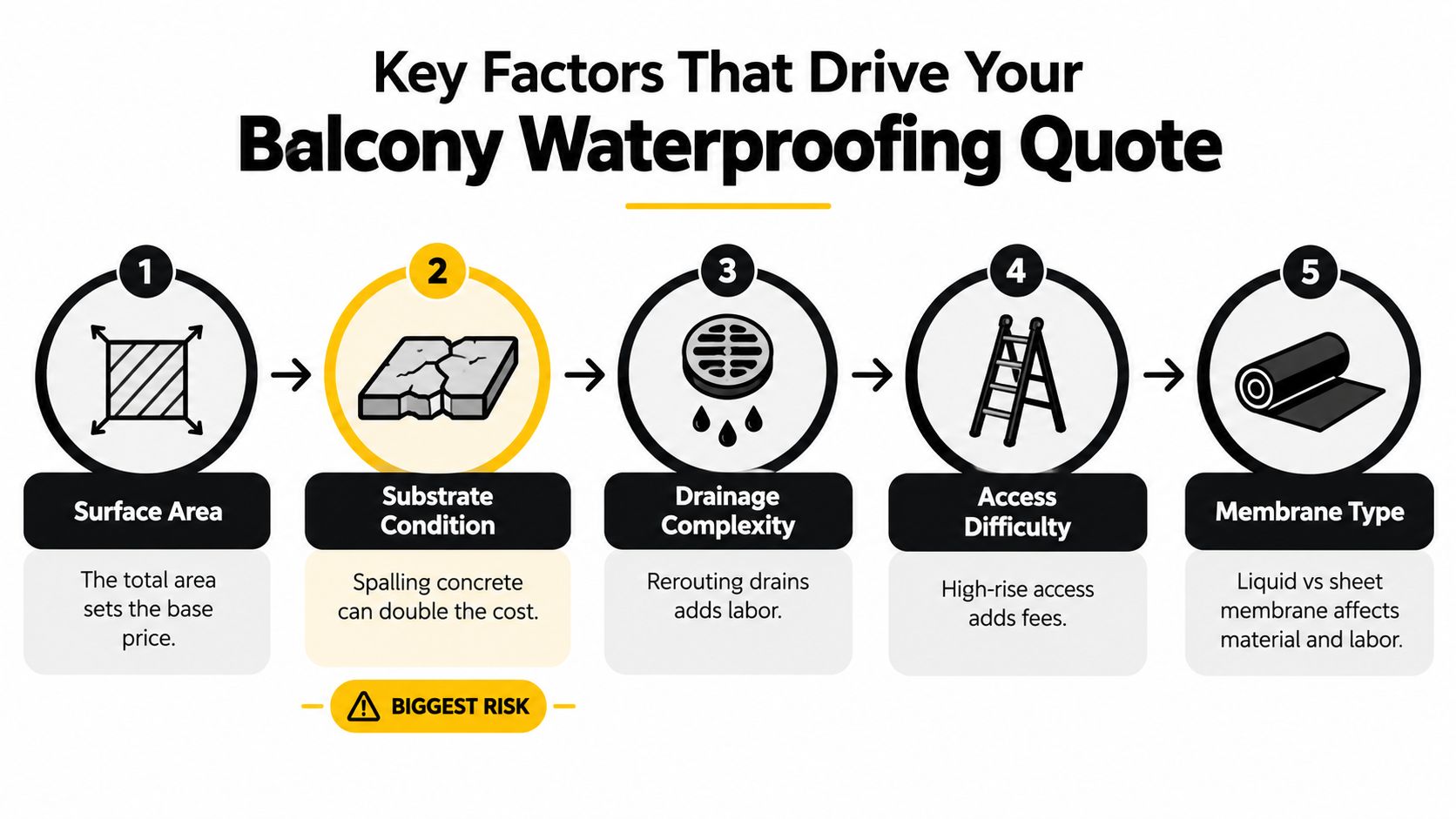
The five cost drivers
Surface area: More floor means more primer, membrane, masking, preparation and finishing. A 10 m² ground-floor recoat may remain near the lower end of the Australian A$85 to A$150 per m² band when the surface is sound, as outlined by Trade Refer's Australian pricing guide.
Substrate condition: Spalling concrete, waterlogged screed, loose tiles and failed falls can turn a coating job into demolition. Rectification alone may add about A$80 to A$200 per m² where those defects are present, according to the pricing assumptions supplied for this Melbourne market comparison. On a 14 m² level-three balcony, that can mean an additional A$1,120 to A$2,800 before membrane and reinstatement costs.
Access difficulty: A ground-floor balcony reached through a side gate is efficient for delivery and waste removal. A level-three apartment may require scaffold, controlled material handling, protection of common areas and a longer set-up. Those costs don't change the balcony's area, but they change the number of labour hours and site visits.
Drainage and edge details: A compliant system needs more than a painted floor. Upturns at walls, door-threshold step-downs, puddle flanges, drip edges and falls that move water away from the building all require careful detailing. Australian guidance also requires balcony and terrace drainage to account for 20-year rainfall intensity events, with overflow provisions at 100-year events, as explained in this AS 4654 waterproofing fact sheet.
Compliance and documentation: Balconies must be designed and installed around AS 4654.1 and AS 4654.2 requirements. In apartments, owner corporation processes, insurance documentation and approvals can add administration and inspection costs. The proposed NCC 2025 provisions are estimated by the ABCB to increase balcony-area costs by around 3%, a relatively small addition compared with hidden substrate damage. That estimate is discussed in waterproofing service cost guidance.
Practical rule: If the quote doesn't identify the substrate condition, drainage approach and access method, it isn't a reliable balcony price. It's only a starting guess.
For the 10 m² ground-floor recoat, ask whether the contractor is keeping the existing finish and what tests confirm that decision. For the 14 m² level-three remedial balcony, ask for separate allowances for demolition, substrate repair, access, drainage and reinstatement. That split tells you whether the quote reflects the work or hides it inside an attractive headline rate.
Comparing Membrane, Liquid-Applied, and Tile-Over Systems
The cheapest system isn't automatically the right system. A sheet membrane can work well on a broad, regular slab, while a liquid-applied polyurethane system is often more practical around corners, wall upturns and awkward penetrations. A tile-over system makes sense when the balcony is already being stripped and retiled.
The supplied system-specific figures below describe common installed ranges for this comparison, but the broader Australian balcony pricing guidance places complete straightforward waterproofing work around A$80 to A$150 per m², depending on preparation and detailing. A system should be selected against the substrate, traffic, finish and warranty terms, not just its material price.
| System | Installed $/m² | Best for | Warranty |
|---|---|---|---|
| Sheet membrane, including bituminous, PVC or EPDM | A$40–A$70 | Large, regular slabs with fewer penetrations | Confirm in writing |
| Liquid-applied polyurethane or acrylic | A$55–A$95 | Melbourne remedial work, corners and complex details | Confirm product and installer terms |
| Tile-over membrane or pre-formed tray system | A$90–A$140 | Balconies being retiled during the same project | Confirm system documentation |
Where each system earns its place
Sheet membranes offer consistent thickness and can be efficient across a simple rectangular area. Their weakness is detailing. Every penetration, junction, upturn and termination must be properly integrated, and poor workmanship at those points defeats the apparent saving.
Liquid-applied systems are more forgiving around irregular geometry. The applicator can form a continuous layer around corners and transitions, but surface preparation and application thickness matter. A liquid membrane isn't a shortcut around cleaning, priming or curing.
Tile-over systems suit a full replacement where the finished surface will be tiled. They can provide a controlled system beneath the tiles, but they still require correct falls, edge treatment and compatible adhesives. For exterior timber structures, homeowners should also distinguish waterproofing from surface maintenance, such as sealing a pressure treated deck, because a deck sealer isn't a balcony waterproofing membrane.
For a broader explanation of product categories and application conditions, review these waterproofing systems for balconies. My recommendation is straightforward: use a liquid system for a sound but geometrically complicated balcony, a sheet system where the slab is broad and uncomplicated, and a tile-over system when demolition and retiling are already unavoidable.
Breaking Down Labour Versus Materials on the Quote
A simple recoat is labour-heavy even when the balcony looks clean. On a 12 m² recoat, labour commonly accounts for 55% to 65%, or roughly A$650 to A$950, while materials make up the remaining 35% to 45%. Those figures cover the preparation and application effort described in the Australian pricing information from Sparky's balcony waterproofing guide.
The contractor isn't charging only for the product in the drum. Labour includes cleaning, grinding, crack preparation, masking, primer, membrane coats, detailing and return visits around cure times. Materials include membrane, primer, sealants, termination bars and disposal consumables.
| Cost component | Simple recoat (A$) | Strip-and-rebuild (A$) |
|---|---|---|
| Labour | A$650–A$950 | Usually 65%–75% of the total |
| Membrane and primers | Balance of the recoat price | Structural primers and new membrane |
| Preparation and demolition | Included at limited level | Major demolition, screed removal and disposal |
| Screed and finish | Usually excluded or limited | New screed, bedding and finish reinstatement |
| Access and administration | May be limited | Scaffold, permits and apartment controls may apply |
On a strip-and-rebuild, labour rises to 65% to 75% because demolition, screeding, waterproofing and rebuilding consume the programme. Materials also become broader, covering new screed, membrane, tile bedding and finish components.
A cheap membrane doesn't rescue an expensive demolition, access or retiling scope.
Ask specifically about waste removal, upper-floor scaffold, trafficable topcoats and apartment permits. Those items can add A$500 to A$2,500 when they aren't included in the initial scope, as reflected in the supplied Melbourne quote assumptions. A quote that lists only “waterproof balcony” gives you no way to see whether those costs are included or waiting to appear as variations.
Real-World Quoted Jobs From Melbourne Suburbs
I won't use invented suburb stories to make a pricing point. The verified Australian data supports clear scope bands, but it doesn't provide authenticated itemised jobs in Brunswick, Glen Waverley or South Yarra. Those specific examples cannot be presented as real Melbourne quotations.
What can be assessed is how the three proposed scopes compare with the verified market ranges. A small patch repair sits above the lowest simple recoat allowance once grinding, primer, localised membrane work and access are included. A sound tiled balcony can remain close to the ordinary per-square-metre band, while a full apartment strip-out belongs in the high-cost remedial category.
| Job | Location | Scope | Size (m²) | Quoted price (A$) |
|---|---|---|---|---|
| Patch repair | Melbourne example not verified | Localised repair | Not verified | From about A$800 |
| Sound-surface waterproofing | Melbourne example not verified | Straightforward membrane work | 12–20 | About A$1,100–A$2,500 |
| Full remedial replacement | Victoria example not verified | Strip-out, re-waterproof and re-tile | Not verified | About A$8,000–A$22,000+ |
The first verified reference point is the small patch repair from about A$800, drawn from Australian balcony waterproofing cost patterns. That figure is relevant only where the defect is localised and the surrounding substrate remains usable.
The second is the 12 to 20 m² straightforward job at about A$1,100 to A$2,500, supported by the Melbourne-specific waterproofing pricing guide. This is the bracket many owners expect, and it is achievable only when tiles, screed, falls and access don't demand major intervention.
The third is the full rectification scope, where the same Melbourne guide places strip-out, re-waterproofing and retiling around A$8,000 to A$22,000+. A separate Australian guide reports complex apartment work reaching A$10,000 to A$17,000 for a small balcony where waterproofing replacement and retiling were required. The lesson is more useful than any made-up suburb case study: compare inclusions, not just the quoted total.
How Waterproofing Fits Inside a Larger Renovation Budget
Balcony waterproofing often appears alongside bathroom renovations, ensuite work or wider apartment rectification. A bathroom is governed by a different standard, AS 3740 Internal Wet Area Waterproofing, which Australian wet-area guidance identifies as the deemed-to-satisfy solution for internal wet areas. Bathroom waterproofing commonly costs A$50 to A$85 per m², with a 6 to 10 m² bathroom typically costing A$900 to A$1,800 for professional waterproofing, according to this Australian bathroom waterproofing cost guide.
That comparison matters because balcony waterproofing faces weather, exposed edges and more complicated drainage. Bathroom waterproofing is usually one controlled line within a larger renovation. A balcony repair may trigger demolition, screed correction, tiling and access work.
Keep the budgets separate
Australian renovation guidance commonly allocates bathroom waterproofing at 5% to 10% of the total project budget, while plumbing takes 20% to 25%, tiling another 20% to 25%, and electrical work around 10%, as set out in this bathroom renovation cost guide.
For registered builders handling Melbourne bathroom renovations, a legally compliant full renovation has a bare minimum of about A$15,000, with standard mid-range projects averaging A$18,000 to A$28,000. Mandatory waterproofing in those registered-builder projects adds about A$30 to A$60 per m², according to Melbourne bathroom renovation guidance.
| Renovation tier | Total budget (A$) | Typical waterproofing share (A$) | Share |
|---|---|---|---|
| Professional bathroom waterproofing | A$15,000 minimum project context | A$900–A$1,800 for the wet area | 5%–10% commonly allocated |
| Standard mid-range bathroom renovation | A$18,000–A$28,000 | Waterproofing included within the renovation | 5%–10% commonly allocated |
| Balcony remedial renovation | A$8,000–A$22,000+ for the balcony scope | Driven by demolition and reinstatement | Varies by scope |
Bundling can save mobilisation, site protection and coordination when the same registered builder is already managing trades, permits and access. It won't always reduce the waterproofing itself, because a specialist membrane applicator may still be subcontracted. For broader water-damage context, AMPM Restoration Services explains costs in relation to restoration work, but balcony waterproofing still needs its own technical scope.
Getting Accurate Quotes and Avoiding Costly Surprises
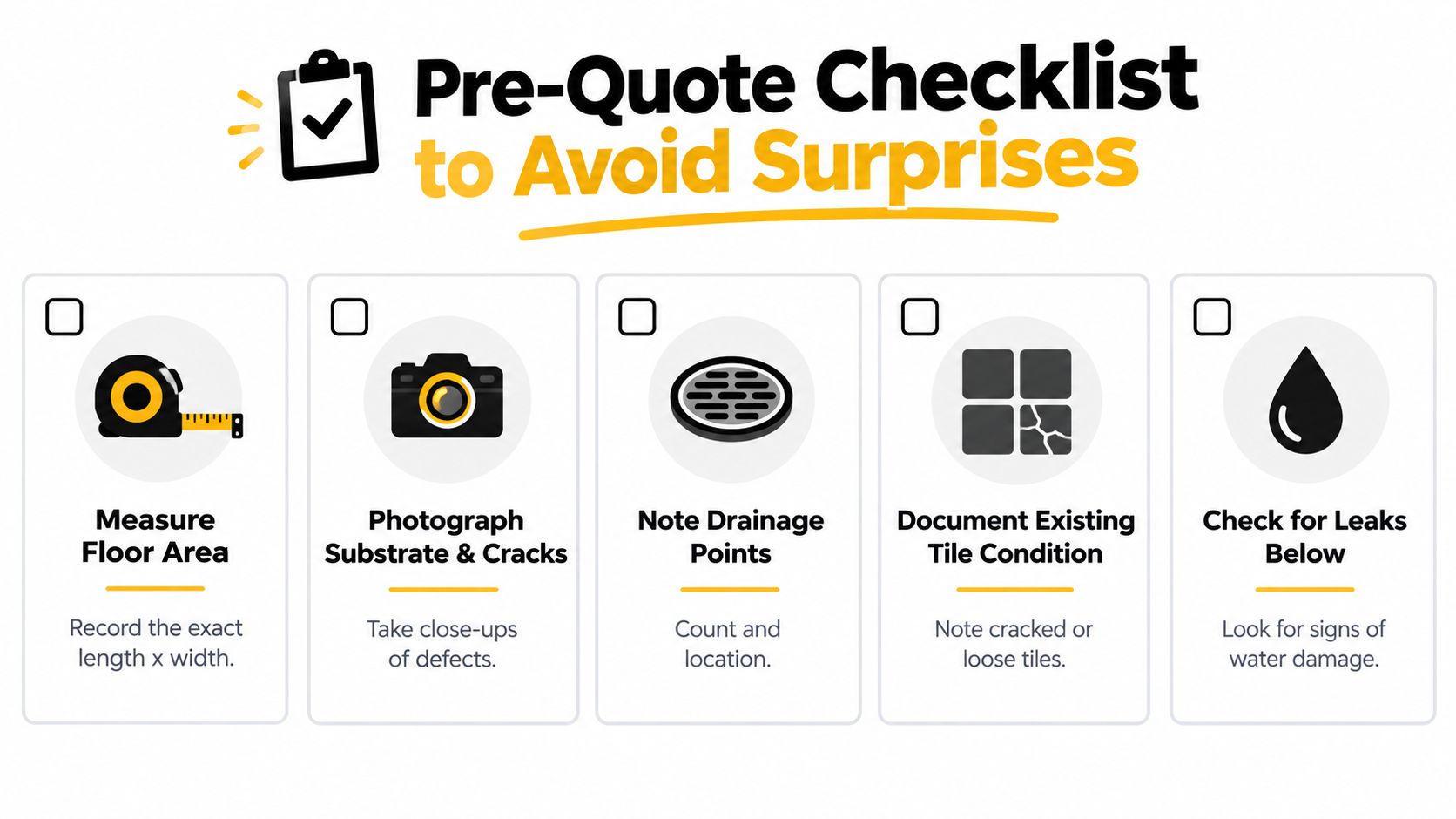
A reliable quote starts before the contractor arrives. Measure the balcony, photograph the surface and underside, record cracks and loose tiles, identify every drain, and check whether water is entering the room below. If the balcony sits above another dwelling, read the owners corporation rules before demolition begins.
Ask every contractor the same questions
- System specification: Which membrane brand and AS 4654 classification are proposed?
- Preparation: Does the price include grinding, crack repair, cleaning and primer?
- Falls: Will the existing screed remain, or will the contractor rebuild the falls?
- Tiling: Is tile lift-and-replace included, excluded or priced as an allowance?
- Drainage: Are puddle flanges, outlets, overflow provisions and drip edges included?
- Warranty: What does the written warranty cover, and who is responsible if the finish fails?
- Making good: Does the price include waste removal, protection of adjoining areas and final reinstatement?
A one-line price is a warning sign. So is a quote that doesn't mention primer, membrane thickness, door thresholds, wall upturns or the written warranty. A contractor who refuses to inspect the balcony properly is asking you to accept the risk of hidden defects.
Watch the video below for a visual introduction to balcony waterproofing considerations.
Get three like-for-like written quotes, insist on a site inspection rather than a drive-by estimate, and verify the contractor's VBA registration before signing. For Victorian documentation requirements, review the waterproofing compliance certificate guidance. The quote should separate the base scope from provisional rectification, so you know what you're paying for now and what could change after demolition.
Putting It All Together and Planning Your Next Step
Start with the scope, not the product. Decide whether the balcony needs a recoat, a localised repair or a strip-and-rebuild, then measure the area and establish whether the substrate, screed and drainage can remain. Only after that should you compare liquid, sheet or tile-over systems.
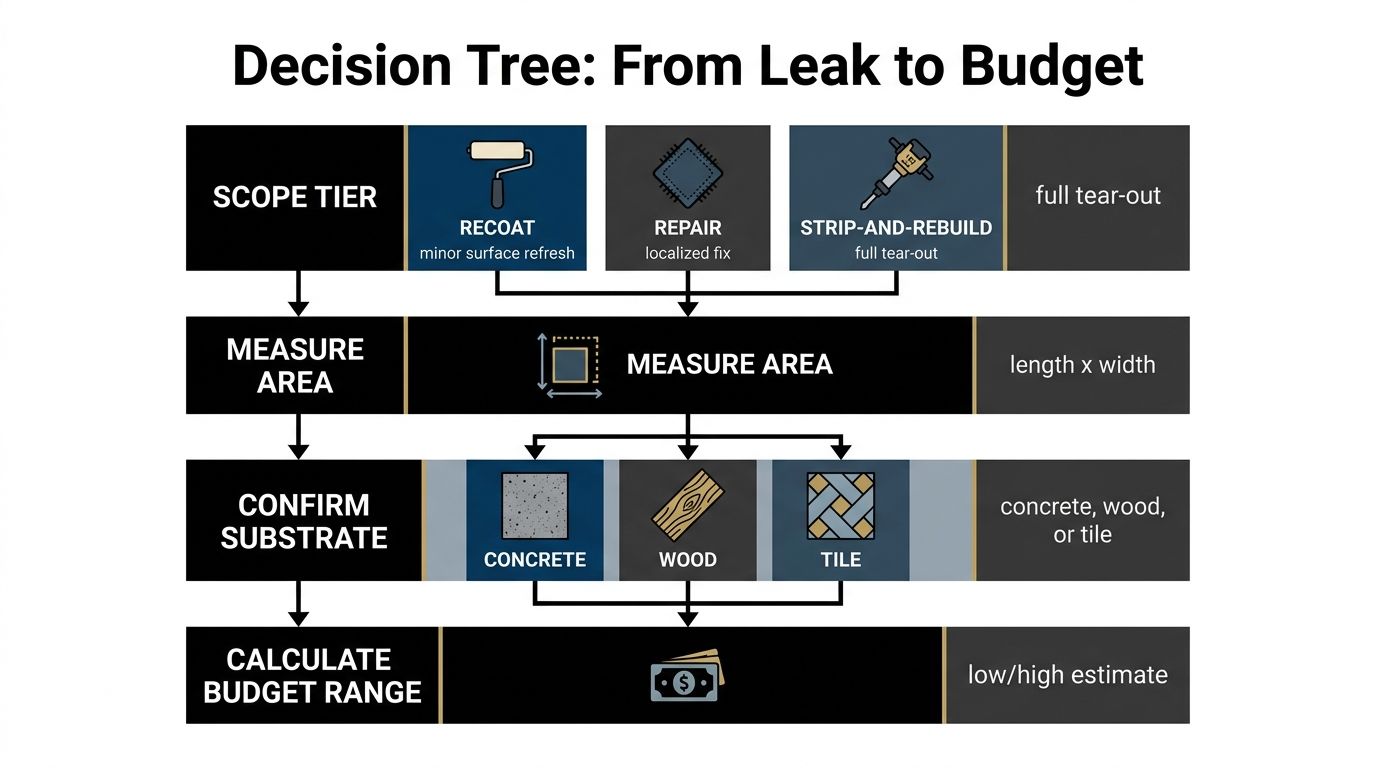
A defensible budget has five parts:
- Scope tier: Identify the actual extent of failure.
- Measured area: Use length multiplied by width, then account for edges and details.
- Substrate assessment: Confirm whether concrete, screed, tiles and falls are serviceable.
- System selection: Match the membrane to exposure, geometry, traffic and finish.
- Itemised quotes: Compare at least three offers from VBA-registered builders.
A registered Melbourne builder gives the owner a clearer compliance pathway, coordinated licensed trades and written documentation for the work. That matters when a balcony sits above a bedroom, another apartment or a shared owners corporation area. Australian balcony systems must address AS 4654 requirements, including membrane upturns, thresholds, drainage and edge detailing.
Book an on-site assessment before approving the work. A photograph-based or satellite-measured remedial quote carries a 15% to 25% accuracy risk on complex scopes, based on the supplied planning guidance. Budget against the realistic middle of the matched scope, not the optimistic floor price, because the first day of demolition is where unsupported assumptions become variations.
If your Melbourne balcony is leaking, tiled, pooling water or showing failed joints, Melbourne Tiling Services P/L can assess the waterproofing, screed, drainage and tiling scope together. Request an on-site quote with a written breakdown so you can decide between a recoat, targeted repair or full strip-and-rebuild before the work begins.
Recent Comments