

You're probably doing what most Sunshine Coast homeowners do at the start of a bathroom project. You search for tilers, save a few photos, request a couple of quotes, and try to work out why one price looks sharp, another feels vague, and a third contractor starts asking questions about waterproofing, screeds, and who's managing plumbing.
That confusion matters because a bathroom renovation isn't just a tiling job with better fixtures. In a coastal setting, the finish you see is only as good as the preparation underneath it. If the floor isn't flat, if the membrane isn't handled properly, or if trades arrive out of sequence, the room can look excellent at handover and still fail early.
The labour market doesn't make that choice any easier. The broader Australian construction industry faces a critical shortfall of approximately 12,000 qualified wall and floor tilers nationally in 2026, which often translates to higher labour premiums and potential scheduling delays for homeowners, according to the 2026 tiler shortage report. Good trades are busy. The best ones usually aren't available next week.
That's why the smartest way to approach tilers on the Sunshine Coast is to think bigger than tile selection and per-square-metre rates. Start by deciding whether you need a standalone tiler or someone who can run the whole renovation properly, the way full-scope bathroom renovation and tiling services are typically coordinated on more complex jobs.
Table of Contents
- Your Sunshine Coast Renovation Starts Here
- Why a Licensed Builder is Key for Bathroom Renovations
- How to Choose the Best Tilers on the Sunshine Coast
- Understanding Tiling and Renovation Costs
- The Renovation and Tiling Process Step-by-Step
- Waterproofing and Materials for Coastal Durability
- Frequently Asked Questions
- Do you need to move out during bathroom renovations
- How long should waterproofing cure before tiling starts
- What's the difference between rectified and non-rectified tiles
- Is tile-over-tile a good option
- What should you do to maintain new grout and silicone
- What's the biggest mistake homeowners make when hiring tilers
Your Sunshine Coast Renovation Starts Here
A lot of bathroom projects begin with a simple assumption. The tiles are old, the shower leaks a bit, the vanity feels tired, so hiring a tiler should sort it out. Sometimes that's true. If the room is otherwise sound and you're only replacing finishes, a capable tiler may be exactly the right trade.
But many bathrooms on the Sunshine Coast aren't that simple. The old substrate may be out of level, the shower area may need rectification, and the existing layout might no longer suit how the household uses the space. Once plumbing, waterproofing, demolition, and fixture coordination enter the picture, the job stops being “just tiling”.
What homeowners usually run into first
The first quote often focuses on visible surfaces. You'll see line items for floor tiling, wall tiling, perhaps feature work, and maybe removal. What's often less clear is who checks the substrate, who signs off on sequencing, and who takes responsibility if another trade's work compromises the tile finish later.
That's the point where many homeowners get stuck. A solo tiler may do excellent laying work, but if no one owns the whole renovation, gaps appear fast.
Practical rule: If multiple trades are involved, someone needs clear responsibility for programming, compliance, and final finish quality.
Why booking the right professional matters more now
With skilled labour under pressure nationally, rushed decisions usually cost more than patient ones. Good tradespeople can be selective. They'll often prioritise projects with a clear scope, realistic access, and a client who understands that quality bathrooms are built in layers, not rushed in one pass.
On the Sunshine Coast, that matters even more because bathrooms live in a humid, coastal environment. Materials move, moisture lingers, and weak preparation gets exposed. Choosing between tilers on the Sunshine Coast isn't only about finding someone available. It's about finding someone who recognises where a standard tile install ends and where renovation risk begins.
The better starting question
Instead of asking, “Who can tile my bathroom?”, ask this first:
- Is this a tiling job or a renovation job
- Who is managing waterproofing and trade sequence
- Who carries responsibility if defects show up after completion
- Is the quote based on existing conditions, or assumptions that may change after demolition
Those questions will tell you far more than a polished gallery ever will.
Why a Licensed Builder is Key for Bathroom Renovations
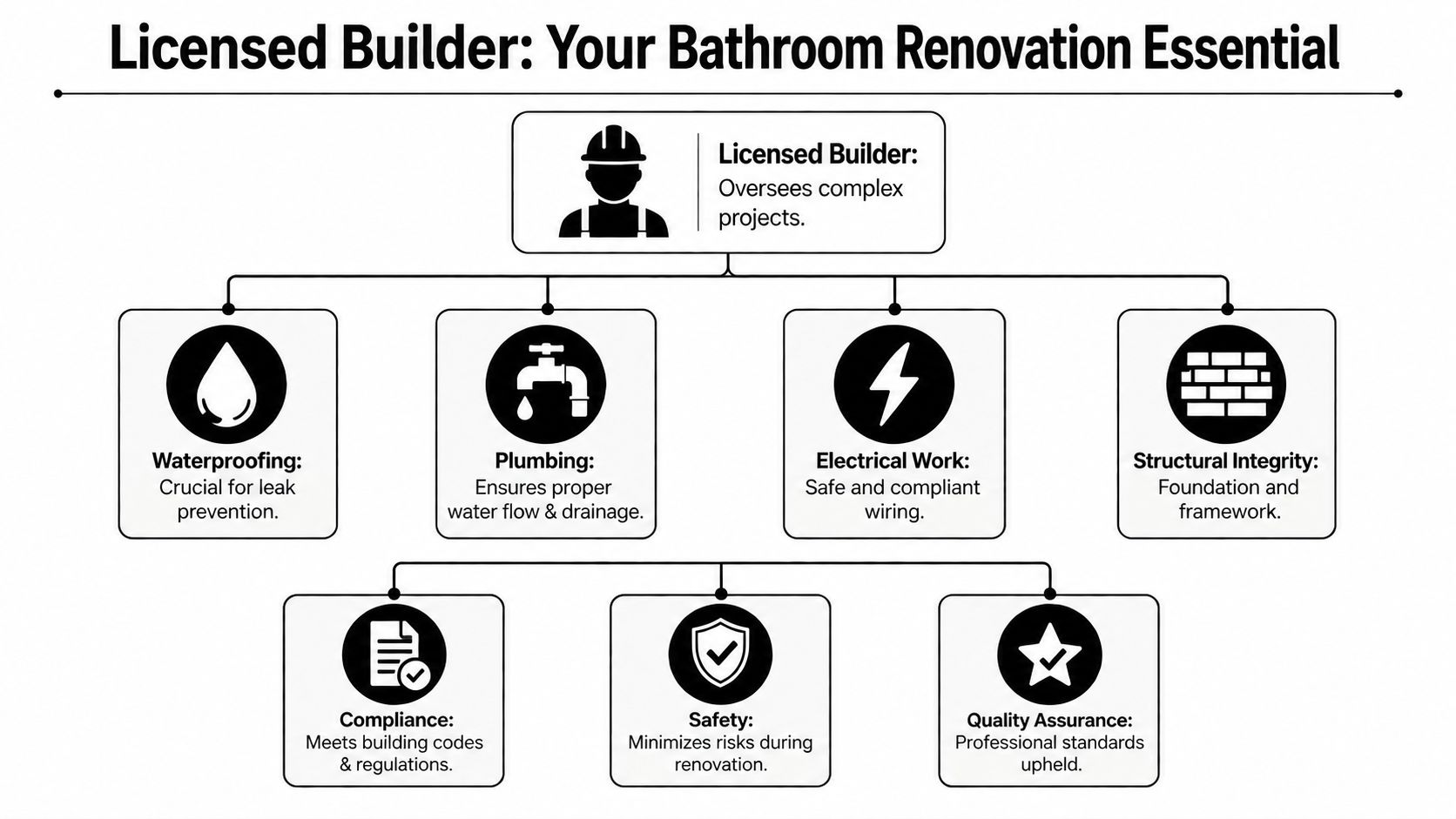
A bathroom renovation has moving parts that need control, not just attendance. Tiles go in near the end. Long before that, someone has to manage demolition, rough-ins, substrate preparation, waterproofing, set-out, and fit-off. If those stages aren't coordinated properly, the final tiling can't rescue the result.
A solo tiler and a renovation lead are not the same role
A solo tiler is usually engaged to tile. A licensed builder managing bathroom renovations is engaged to deliver the whole room. That difference sounds obvious, but it changes accountability completely.
If the walls are out, if the falls are wrong, or if the plumbing penetrations aren't ready, a standalone tiler can only work with what's there or stop and wait. A builder-led renovation model reduces that drift because one party controls sequencing and trade interfaces from the start.
Why the builder model protects the job
In regulated states like Victoria, any domestic building work contract exceeding $10,000 legally requires a registered builder, and using a fully licensed contractor for major renovations is presented as the safest way to protect your investment in the Victorian bathroom renovation guide. Queensland doesn't mirror Victoria exactly, but the principle still holds. When a bathroom is being rebuilt rather than merely retiled, builder-level oversight is the safer model.
Here's where that matters in practice:
| Project issue | Solo tiler approach | Licensed builder approach |
|---|---|---|
| Plumbing delays | Waits for plumber | Reprograms job and coordinates access |
| Waterproofing scope confusion | May rely on others | Clarifies scope before tiling starts |
| Defect responsibility | Can become fragmented | One lead contractor manages resolution |
| Layout changes mid-project | Limited authority | Can assess broader renovation impact |
What tends to go wrong without one lead contractor
Separate trades can all be competent and still produce a poor result if no one is running the job. The plumber may finish late. The waterproofer may arrive before prep is complete. The tiler may inherit a floor that should have been corrected earlier. Then every trade starts protecting its own scope instead of the room as a whole.
The cleanest bathrooms are usually built by teams with one person making final calls on sequence, standards, and handover quality.
For homeowners comparing tilers on the Sunshine Coast, this is the key distinction. If you're replacing a splashback or laying a small floor, a tiler may be enough. If you're doing a full bathroom renovation, a licensed builder is often the difference between a coordinated project and a chain of subcontractor assumptions.
How to Choose the Best Tilers on the Sunshine Coast
Once you know whether you need a tiler or a renovation lead, the shortlist gets easier. The next step is filtering out quotes that look acceptable on paper but won't hold up once demolition starts.
Start with credentials, then move to evidence
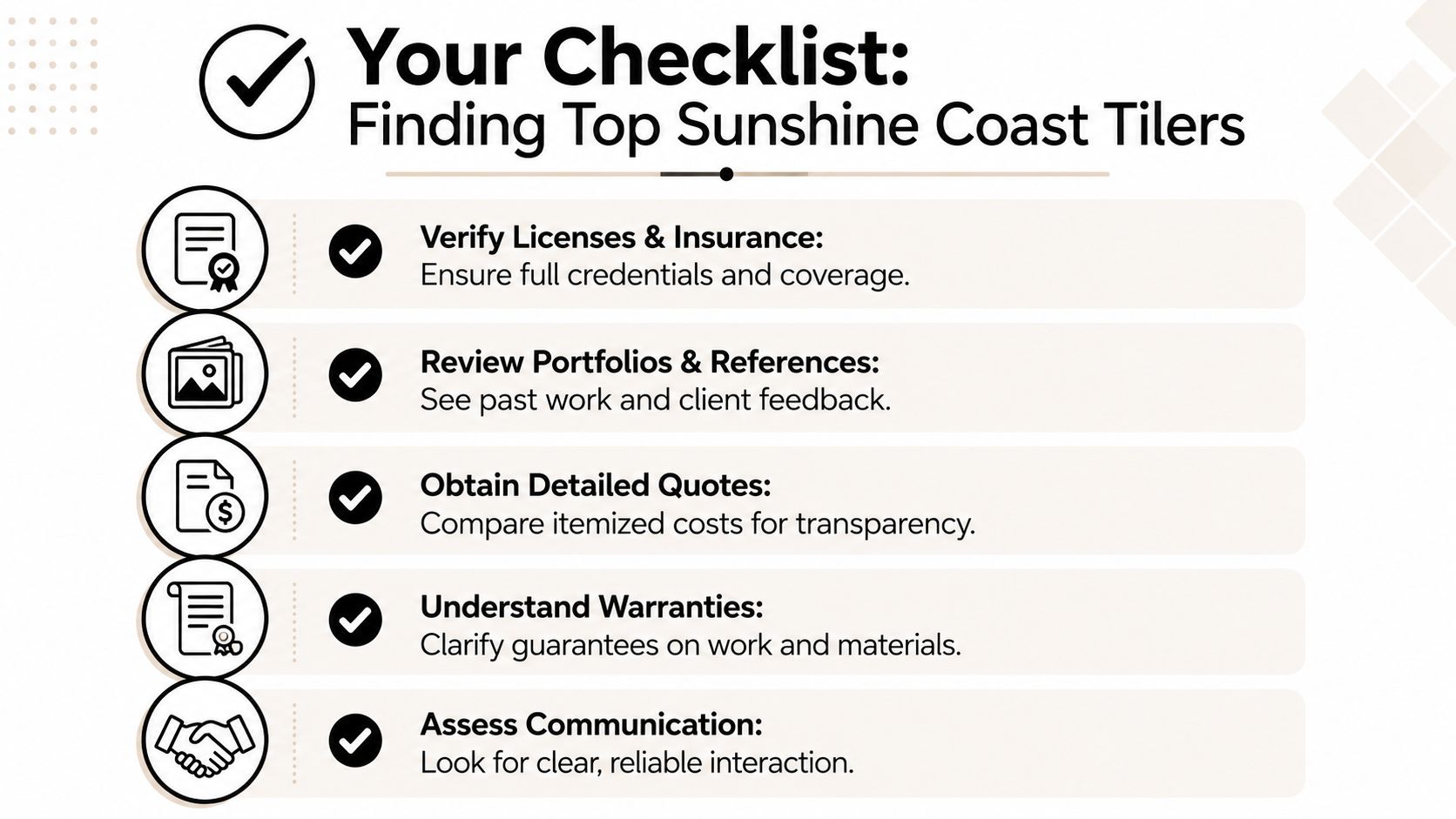
Before you discuss tile patterns or grout colour, verify the contractor's licence status and make sure the scope they're proposing matches the work you want done. If they're quoting a renovation, they should be able to explain exactly who manages demolition, waterproofing, plumbing, and electrical coordination.
Insurance matters too. Public liability should be current, and the contractor should be comfortable discussing who is responsible for each stage of the work.
Review the portfolio with the right questions
A portfolio should show more than pretty finished rooms. Look for evidence that the contractor understands full wet-area work, not just the decorative layer. If you're assessing examples of local tiling contractors near you, ask what happened before the photos were taken.
Use this checklist:
- Ask what was corrected before tiling: Was the floor self-levelled, screeded, or rebuilt in parts?
- Check for large-format experience: Bigger porcelain tile demands tighter prep and cleaner set-out than smaller ceramics.
- Look at junctions and edges: Niches, returns, trims, and transitions reveal care faster than hero shots do.
- Request local references: A contractor should be able to point to nearby work and explain the project type.
- Read the quote line by line: Vague wording around prep and waterproofing usually creates disputes later.
Pay attention to how they communicate
Good contractors ask specific questions. They'll want to know whether you're changing the layout, keeping fixtures in place, supplying tiles yourself, or working around access issues. That isn't overcomplication. That's job control.
Poor communication early usually becomes poor communication on site. If someone can't explain their scope clearly before the deposit, don't expect better once the room is stripped out.
“A clear quote is usually a sign of a clear process.”
Red flags worth taking seriously
Some warning signs show up fast:
- Extremely fast availability: Sometimes that's luck. Sometimes it means the schedule is empty for a reason.
- One-price-only quoting: If there's no discussion of possible substrate issues, the number may not survive demolition.
- No mention of waterproofing responsibility: Wet-area work needs explicit ownership.
- Dismissive answers about prep: Tile doesn't hide movement, poor falls, or unstable backgrounds for long.
The best tilers on the Sunshine Coast don't just sell neat lines. They show how they'll control the conditions that make neat lines last.
Understanding Tiling and Renovation Costs
Pricing gets messy when homeowners compare unlike scopes. One quote may cover tile laying only. Another may include removal, prep, screeding, and full bathroom coordination. If you don't separate labour, materials, and renovation management, the cheapest number can be the most expensive decision.

On the Sunshine Coast, standard floor tiling labour ranges from $34 to $87 per square metre, wall tiling ranges from $39 to $97 per square metre, and a complete bathroom tiling job typically requires a labour investment of $580 to $1,550, excluding tile supply costs, according to this Sunshine Coast tiling cost guide. The same guide notes that tile supply can add $20 to $250 per square metre, depending on the material selected.
What changes the number
The rate isn't driven by tile size alone. Cost usually moves because of condition and complexity.
A plain square room with stable walls and straightforward set-out is one thing. A bathroom with niches, hob details, feature strips, uneven backgrounds, or extensive cutting is another. Mosaic and feature work also sit in a higher labour bracket than standard floor or wall tile work.
Labour and materials are different conversations
Here's a clean way to clarify:
| Cost area | What it usually covers |
|---|---|
| Labour | Laying, cutting, alignment, grouting, finish detail |
| Tile supply | Porcelain, ceramic, natural stone, feature products |
| Preparation | Levelling, screeding, substrate correction, removal |
| Renovation management | Trade coordination, scheduling, compliance oversight |
A cheap tile can still be costly to install if the room needs major prep. A premium porcelain can be economical long term if it lays cleanly and suits the space.
For a practical look at how trade pricing discussions often unfold, this walkthrough is useful before comparing quotes:
What a good quote should spell out
You want itemised scope, not just a grand total.
- Preparation allowances: If demolition exposes defective substrate, how is that handled?
- Tile format assumptions: Large-format porcelain, mosaics, and natural stone don't install the same way.
- Supply responsibilities: Clarify who is supplying tiles, trims, grout, adhesives, and sealants.
- Exclusions: If waterproofing, fixture removal, or disposal isn't included, it should be stated plainly.
That's how you compare tilers on the Sunshine Coast properly. Not by headline price, but by what the contractor has allowed for.
The Renovation and Tiling Process Step-by-Step
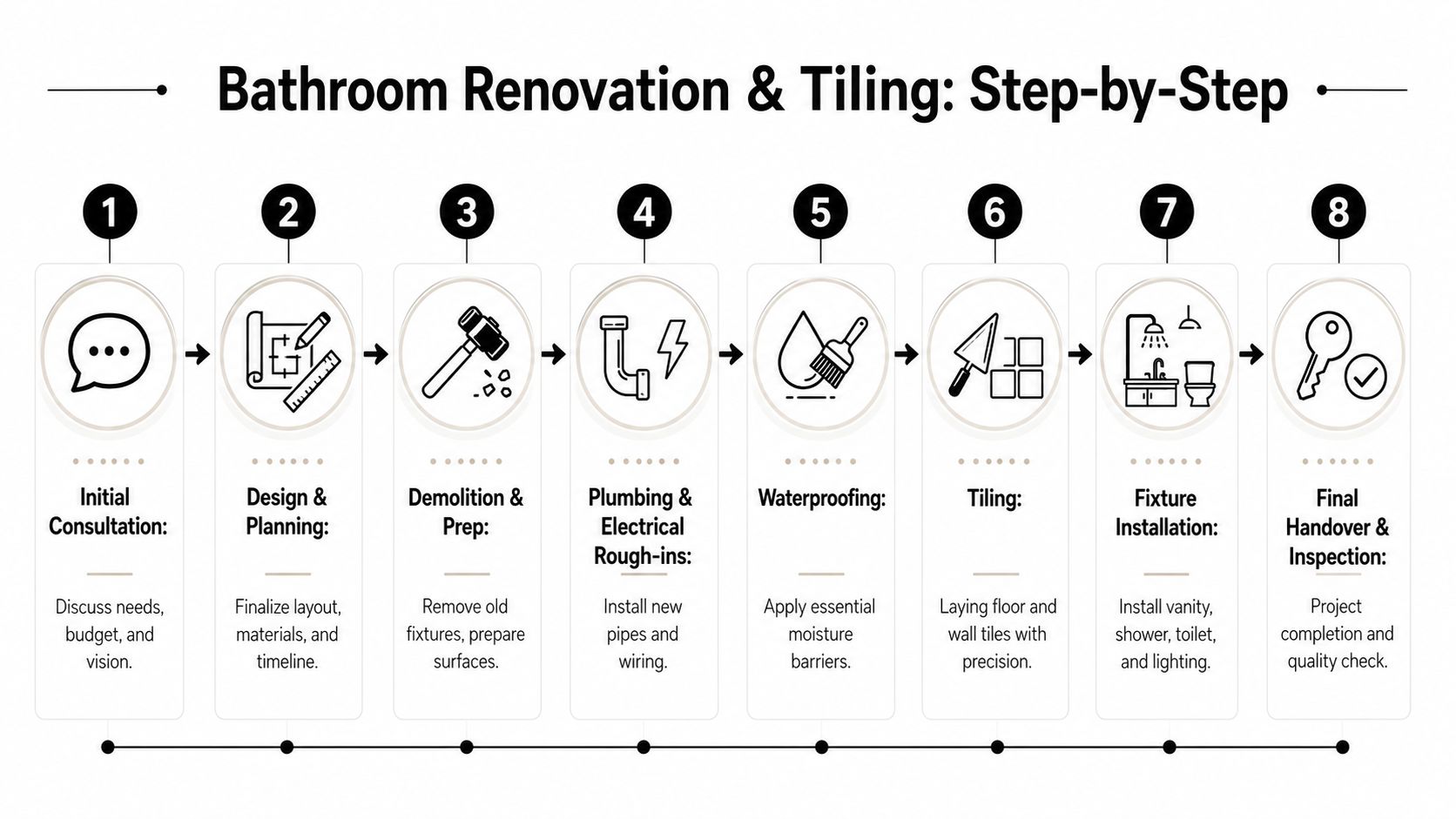
A good bathroom build follows a sequence. If that sequence gets compressed or rearranged to save time, the defects usually appear in the layers you can't see once the room is finished.
Consultation and planning
The job starts with scope, not demolition. Layout decisions, fixture selection, tile format, drainage details, and access all affect the build path. On better-run renovations, this stage also identifies likely substrate issues before anyone starts pricing as if the room is perfect.
If the client wants recessed niches, large-format wall tiles, or a curbless shower look, those choices need to be resolved early because they affect framing, falls, and set-out.
Strip-out and rough-in work
Demolition exposes the truth of the room. Old water damage, movement, poor sheeting, and non-compliant previous work often become visible only once finishes are removed.
After demolition, the rough-in phase begins. Plumbers and electricians do their work before the room is closed back up. This stage needs discipline because rushed penetrations and late changes can compromise later waterproofing.
Site rule: Don't let the tiler inherit unresolved plumbing, loose sheeting, or uncertain floor falls.
Surface preparation and waterproofing
Successful bathroom renovations hinge on meticulous preparation. Floors may need screeding or self-levelling. Walls may need correction for plumb and alignment. Shower zones need a proper moisture management strategy before a single tile is laid.
Waterproofing must be complete and protected before the tile phase begins. If other trades damage the membrane after application, the problem doesn't disappear because tile goes over it.
Tiling, grouting, and finish detail
Once the room is ready, set-out matters. A skilled tiler doesn't just start at the easiest wall. They work backward from visual lines, cuts, drainage points, and fixture positions so the room looks balanced when complete.
Then comes grouting, sealing where appropriate, and final detail work. This is the stage most homeowners notice, but by then the room's success has already been determined by everything underneath.
Fit-off and handover
The final stage is fixture installation, trim-out, clean-up, and defect inspection. Vanity alignment, screen fitting, silicone work, and drainage performance all need checking before handover.
A sound handover should leave the homeowner with clear care guidance, a realistic understanding of what to monitor in the first weeks of use, and no uncertainty about who to call if an issue appears.
Waterproofing and Materials for Coastal Durability
The Sunshine Coast is hard on wet areas for reasons that aren't always obvious at quoting stage. Bathrooms hold moisture already. Add humid air, coastal conditions, and daily temperature movement, and weak material choices show up faster.
The essential layer is waterproofing. In real bathrooms, the membrane system, the junction treatment, and the protection of that work during later trades matter more than any tile brand or feature wall. If that stage is compromised, the visible finish becomes cosmetic cover over a future defect. Homeowners comparing systems should understand how professional wet-area waterproofing systems fit into the broader renovation, especially where showers and floor wastes are involved.
Large-format tile needs flatter substrate
Large-format porcelain is popular for good reason. It looks cleaner, reduces grout lines, and suits contemporary bathrooms. But it is less forgiving.
According to this guidance on large-format tiling requirements in coastal conditions, large-format porcelain tiles require a substrate variance of no more than 3mm over 3m, and failure to achieve that flatness in the Sunshine Coast's tropical climate can lead to a 40% increase in crack propagation at tile edges due to thermal expansion. That is a technical issue, not a styling issue.
What works and what doesn't
Here's the practical split:
| Material or method | Where it works | Where it fails |
|---|---|---|
| Large-format porcelain | On properly levelled, stable substrate | Over uneven floors or rushed wall prep |
| Mosaic or feature tile | In controlled feature areas and curved details | As a shortcut to hide poor backgrounds |
| Natural stone | Where sealing and maintenance are understood | Where homeowners expect zero upkeep |
| Tile-over-tile | In limited situations with sound substrate and proper prep | As a shortcut over doubtful wet-area conditions |
The mistake isn't choosing ambitious materials. The mistake is choosing them without upgrading the preparation standard to match.
Coastal durability is a maintenance issue too
Bathrooms on the Sunshine Coast need sensible ongoing care. Grout, silicone, and movement joints don't stay at day-one condition forever. That doesn't mean a bathroom is failing. It means wet areas are service environments, not static displays.
Coastal bathrooms last longer when owners treat maintenance as part of the build outcome, not as a separate problem for later.
For homeowners searching for tilers on the Sunshine Coast, the right question isn't only “Can you lay this tile?” It's “Can this room support this tile format, in this climate, for the long term?”
Frequently Asked Questions
Do you need to move out during bathroom renovations
Not always. If it's your only bathroom, daily life gets awkward fast, especially during demolition, waterproofing, and fixture downtime. If the house has a second bathroom, most families stay put and isolate the work area. The decision usually comes down to access, dust tolerance, and whether children or older occupants are in the home.
How long should waterproofing cure before tiling starts
Follow the product system and the installer's process. This isn't the stage to compress because another trade is waiting. In bathrooms, patience at membrane stage is cheaper than leak rectification later.
What's the difference between rectified and non-rectified tiles
Rectified tiles are mechanically finished to a more precise edge. They suit tighter joints and a sharper contemporary look, but they also expose poor set-out more quickly. Non-rectified tiles are a bit more forgiving visually and can suit softer layouts.
Is tile-over-tile a good option
Sometimes, but only when the existing substrate is sound, the levels work, and the wet-area conditions have been properly assessed. It shouldn't be used as a shortcut around deeper renovation issues. If there's any doubt about movement, moisture damage, or previous waterproofing quality, removal is usually the safer path.
What should you do to maintain new grout and silicone
Keep the bathroom ventilated, clean gently, and pay attention to changes rather than waiting for obvious failure. Such vigilance is key, as waterproofing failures are the leading cause of bathroom renovation repairs in Australia, as noted in this industry overview of tiling and waterproofing issues. The visible signs often start small, such as discoloured joints, cracked silicone, or persistent damp smells.
What's the biggest mistake homeowners make when hiring tilers
They compare only the finish and the price. The actual difference between contractors usually sits in prep standards, scope clarity, and who takes responsibility when the project involves more than tile laying.
If you want a builder-led approach to bathroom renovations, waterproofing, and high-end tiling, Melbourne Tiling Services P/L offers start-to-finish project coordination with registered builder oversight, detailed quoting, and a strong focus on durable wet-area work.
Write a Comment