
Standard porcelain tile installation labour in Melbourne averages around $66 to $83 per square metre, but the true cost for a fully prepped, waterproofed bathroom project typically ranges from $75 to $150 per square metre once all wet-area requirements are included. The final invoice depends less on the tile alone than on the condition of the substrate, the format selected, access, waterproofing, and the level of finish expected.
You may be comparing two Melbourne tilers' quotes for the same bathroom and wondering why one appears far cheaper. One price may cover labour on a clean, flat surface, while the other includes demolition, levelling, waterproofing, cutting, trims, grout, silicone, and waste removal. Both figures can be accurate, but they aren't pricing the same scope.
A porcelain bathroom should be budgeted as a complete wet-area project, not as a simple square-metre exercise. That approach gives you a more reliable figure, protects the finished surface from movement and moisture damage, and reduces the risk of variations after demolition begins.
Table of Contents
- Understanding the True Porcelain Tile Installation Cost
- Standard Porcelain Versus Large-Format Kerlite Panels
- The Hidden Costs of Substrate Prep and Waterproofing
- Budgeting for Complete Bathroom Renovations
- Why Registered Builders Are Essential for Compliance
- How to Audit Your Tiling Quote for Exclusions
- Securing a Premium Finish in Melbourne Homes
Understanding the True Porcelain Tile Installation Cost
You've chosen the tile, measured the room, and multiplied the area by an advertised installation rate. Then the quote arrives with separate charges for preparation, waterproofing, adhesive, trims, and disposal. This is a common point of confusion because the headline rate often describes only one stage of the work.
Australian installed flooring benchmarks commonly sit around A$50 to A$150 per square metre, with porcelain specifically listed at about A$83 per square metre in one national guide. The same guide places the overall Australian average for tile flooring installation at A$72 per square metre. These figures are useful starting points, but they don't automatically describe a completed Melbourne bathroom. Trade Heroes' Australian tiler cost guide explains the distinction between broad flooring averages and the more demanding requirements of porcelain work.
Labour-only and fully installed pricing
A labour-only quote assumes the installer can begin on a suitable substrate. That generally means the floor or wall is sound, flat enough for the selected tile, clean, dry, and ready to receive adhesive. It may exclude demolition, grinding, self-levelling, screeding, waterproofing, tile supply, grout, silicone, trims, and removal of building waste.
A fully installed price should connect all the necessary stages. In a bathroom, that can include stripping the existing finishes, inspecting the substrate, correcting falls, preparing wall junctions, waterproofing the required areas, setting the porcelain, grouting, sealing movement joints, and cleaning the site. If the quote doesn't identify these tasks, you can't compare it fairly with a more detailed proposal.
Porcelain usually costs more to install than basic ceramic because it is denser and harder to cut. Rectified edges also demand a more precise set-out, while narrow grout joints make uneven walls and floors easier to see. A small error at the start can carry across an entire wall, so an experienced installer spends more time checking lines, levels, cuts, and transitions before fixing tiles.
Practical rule: A low square-metre rate isn't a saving until you know what condition the substrate must be in and which wet-area tasks are excluded.
A realistic Melbourne baseline
The right question isn't just, “What does porcelain cost per square metre?” Ask instead, “What has to happen before the first tile can be fixed, and what remains after the last tile is laid?” That change in wording exposes the overall budget.
For a straightforward, prepared floor, the rate may be relatively easy to estimate. A Melbourne bathroom with old adhesive, uneven masonry, shower recesses, penetrations, niches, or difficult access needs a broader allowance. Large-format selections increase the consequences of substrate movement and unevenness, while intricate layouts increase measuring and cutting time.
A cost calculator can help you separate labour, materials, preparation, and contingency instead of hiding them inside one total. The JobsiteStack cost calculator is useful at this planning stage because it encourages a true-cost view before you request final trade quotes.
Standard Porcelain Versus Large-Format Kerlite Panels
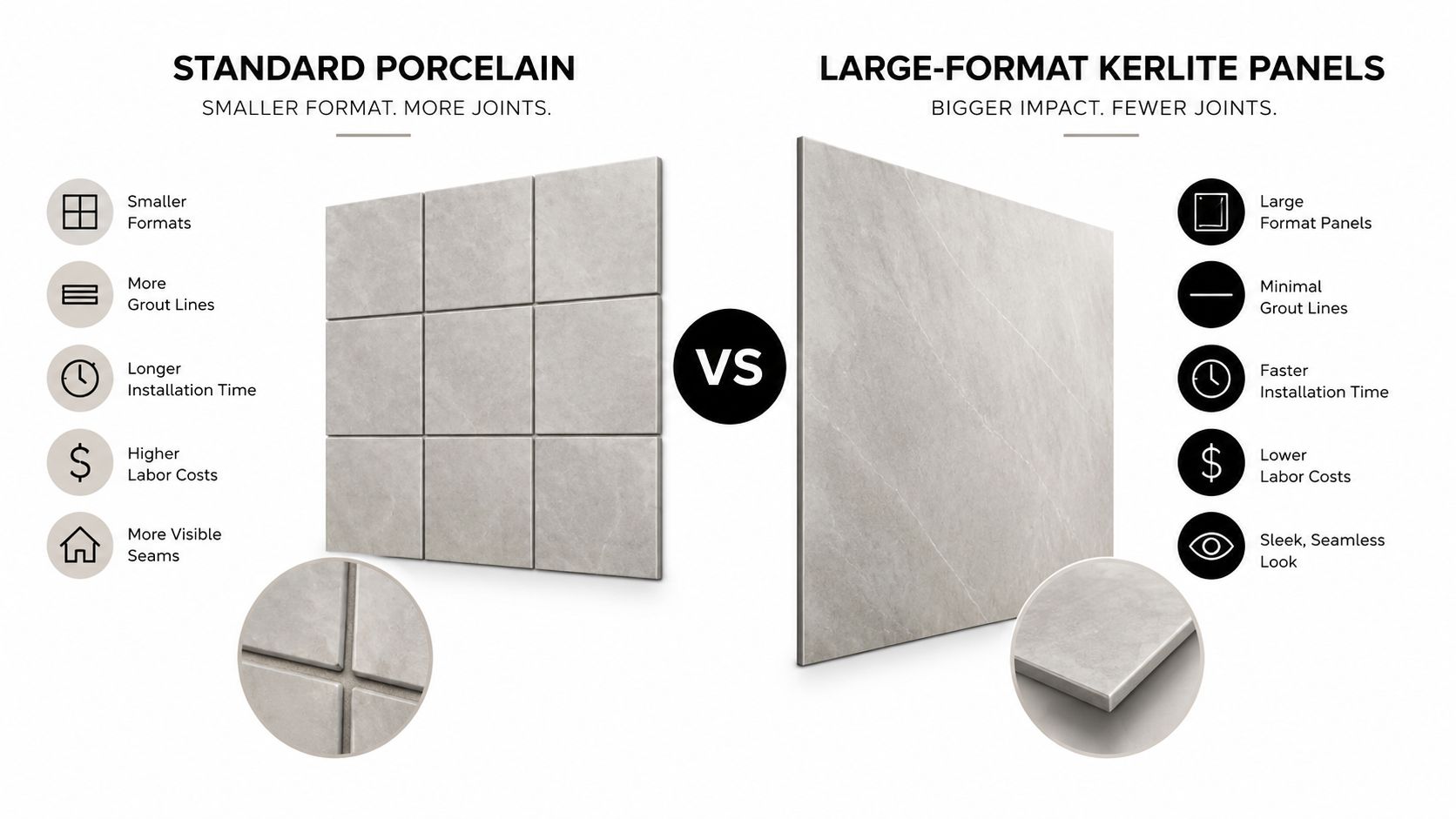
A standard porcelain tile and a large-format Kerlite panel may both be described as porcelain, but they create very different installation conditions. Smaller tiles are easier to carry, position, replace, and cut around corners. Large panels reduce grout lines and create a calm architectural appearance, yet they leave much less room for an imperfect wall or floor.
Why the format changes the labour
Standard porcelain can suit a conventional straight-lay floor or wall when the substrate is already stable and reasonably flat. The installer still needs to plan the starting point, distribute cuts, maintain consistent joints, and protect finished edges, but each individual tile remains comparatively manageable.
Kerlite-style panels require a more controlled process. The substrate must be exceptionally flat because a large panel can't easily follow local hollows or ridges. Installers may use panel lifters, suction equipment, carefully prepared adhesive coverage, and coordinated handling to reduce flexing and breakage. Cutting openings for wastes, niches, mixers, windows, and power points also requires accurate measurement and specialised tools.
Rectified edges sharpen the visual result, but they also expose lippage. With a smaller tile, a slight variation may be distributed across several pieces. With a large panel, a small deviation can remain visible along a long edge. That makes checking the wall plane and floor plane an essential part of the job, not an optional refinement.
Comparing the price bands
Australian 2026 pricing guidance places large-format porcelain labour around $60 to $120 per square metre in some NSW-style guides and roughly $80 to $180 per square metre in some Australian service guides. Straightforward floor tiling is listed at about $45 to $85 per square metre. These ranges are labour comparisons, so they shouldn't be mistaken for a complete wet-area project total. Yakka Labour's tiler rate guide provides the relevant comparison between standard and large-format work.
The premium reflects handling, preparation, layout control, cutting risk, and the experience needed to achieve a flat, aligned finish. It is not just a charge for a fashionable appearance. If the design depends on a continuous stone-look surface, saving on specialist installation can result in visible lippage, chipped edges, cracked panels, or expensive replacement work.
For a closer look at the practical scope behind this format, review this guide to large-format tile installation costs. It helps homeowners assess whether their room, access route, substrate, and installer are suitable for panels before they order materials.
Large-format panels should be selected early, because the choice affects framing, niche placement, wall preparation, delivery, storage, and sequencing with other trades.
The Hidden Costs of Substrate Prep and Waterproofing
The tile is the visible finish, but the substrate determines whether that finish stays sound. Older Melbourne bathrooms often reveal uneven floors, damaged plasterboard, loose screed, movement cracks, previous leak damage, or walls that were never built to receive large-format porcelain.
Australian guidance places standard porcelain installation at around $40 to $80 per square metre on a prepared substrate. Labour can rise to $100 to $150 per square metre for large-format porcelain, complex layouts, mosaics, or difficult access. Grinding, levelling, and waterproofing can add another $20 to $60 per square metre. BuildPilot's tile cost guidance sets out these differences clearly.
What preparation involves
Preparation isn't one universal task. The installer needs to inspect the existing surface and choose the correction that matches the defect.
Grinding removes high points, old adhesive, and surface contamination where the base is generally sound but uneven.
Self-levelling corrects suitable floor irregularities where a consistent plane is required before tile fixing. It won't solve every structural or drainage problem, and it must be applied over an appropriately prepared base.
Screeding forms or corrects a graded surface, particularly where a bathroom floor needs controlled falls towards a waste.
Substrate replacement may be necessary when the existing sheet material, plasterboard, screed, or affected backing has deteriorated through moisture exposure.
Waterproofing seals the wet-area system around floors, shower walls, junctions, penetrations, and other required details. It needs compatible products, correct curing, and careful treatment of changes in plane.
A tiled surface can look perfect while the waterproofing beneath it is incomplete. Water can then reach framing, adjacent rooms, or lower-level ceilings. Rectifying that failure usually means removing finishes that were recently installed, so waterproofing should be treated as a core part of the scope.
Melbourne wet-area cost breakdown
| Project Phase | Standard Dry Area | Bathroom Wet Area |
|---|---|---|
| Surface inspection | Confirm the base is sound and ready for fixing | Check for moisture damage, movement, falls, and failed previous work |
| Surface correction | Local grinding or minor patching where required | Grinding, levelling, screeding, or replacement may be needed |
| Moisture protection | Usually not a wet-area waterproofing scope | Waterproofing and sealing of required wet-area details |
| Tile installation | Set-out, fixing, cuts, grout, and finishing | Set-out plus penetrations, junctions, falls, niches, and wet-area detailing |
| Final finishing | Clean-up and edge treatment | Silicone movement joints, waste interfaces, trims, and leak-conscious detailing |
The exact scope depends on what demolition exposes. A quote that lists only “tile floor and walls” leaves too much open to interpretation. Read this explanation of what substrate preparation involves before approving a bathroom tiling proposal, especially if the home is older or the new tile is large-format.
Waterproofing is not cosmetic preparation. It is part of the system that protects the building behind the porcelain.
Budgeting for Complete Bathroom Renovations
Porcelain rarely sits on its own in a bathroom renovation. Once demolition, plumbing, electrical work, cabinetry, fixtures, shower screens, painting, waterproofing, and tiling are combined, the tile decision affects the whole sequence and not just one line on the estimate.
Australian bathroom renovations average around A$26,000, with common project ranges of about A$8,000 to A$35,000 or more, depending on scope, materials, and labour. Canstar's bathroom renovation cost guide provides that broader context.
Match the tile ambition to the renovation tier
A budget renovation is commonly placed around A$8,000 to A$15,000, a standard renovation around A$15,000 to A$35,000, and a major renovation above A$35,000. These tiers are outlined in Savings.com.au's bathroom renovation cost guide.
The lower tier may suit a limited replacement where plumbing stays in place, the layout remains simple, and standard porcelain is fixed to a serviceable base. That doesn't mean compromising on waterproofing. It means controlling the number of moving parts and avoiding a tile format that requires extensive correction or specialist handling.
A standard renovation gives more room for upgraded porcelain, new cabinetry, improved lighting, a replacement shower screen, and better finishing details. The tile may still be laid in a straightforward pattern, but the overall room receives a coordinated upgrade rather than a surface-only change.
A major renovation can involve layout changes, new plumbing positions, custom niches, structural adjustments, premium fixtures, large-format panels, and extensive substrate work. The porcelain may represent an important visual investment, but it must be supported by the construction budget. High-end panels fixed over an unstable or poorly prepared base are false economy.
Scope drives the final result
A homeowner may prefer a continuous stone-look panel because it reduces grout lines. Another may choose a smaller format to control handling and cutting costs. Neither choice is automatically right. The suitable option depends on access, wall dimensions, waste locations, desired joint layout, drainage, maintenance preferences, and the capability of the installation team.
Plumbing changes can also affect tile cost indirectly. Moving a shower mixer or waste creates new penetrations and may require additional substrate repairs and waterproofing detailing. A freestanding bath, wall-hung vanity, or recessed niche needs accurate coordination before the tile setter begins.
Build the renovation budget in this order:
- Define the layout: Confirm whether plumbing, walls, doors, niches, and shower locations are changing.
- Choose the tile format: Decide whether standard porcelain or large-format panels suit the room and substrate.
- Allow for the base: Include demolition, repairs, levelling, screeding, and waterproofing before comparing finishes.
- Coordinate the trades: Make sure plumbing, electrical, carpentry, waterproofing, and tiling responsibilities are clear.
- Specify the finish: Record grout colour, joint size, trims, silicone colour, thresholds, and cleaning expectations.
The most reliable quote reflects the entire room, not just the area covered by porcelain.
Why Registered Builders Are Essential for Compliance
A bathroom renovation involves several trades working on one connected system. The tiler depends on the waterproofer, the waterproofer depends on the substrate and plumbing penetrations, and the final finish depends on every trade completing its part in the correct order. A low tiling rate doesn't protect you if the wider project lacks proper coordination.
The Victorian threshold
In Victoria, a practitioner can't carry out or contract for domestic building work valued over A$10,000 unless they are registered or licensed in the relevant category. Consumer Affairs guidance also identifies bathroom renovations as domestic building work. The legal position is summarised in this Victorian bathroom renovation cost and compliance guide.
That threshold matters when a porcelain installation forms part of a wider bathroom renovation. A standalone tiling discussion can obscure the fact that the project may also include demolition, carpentry, waterproofing, plumbing, electrical work, and installation of fixtures. The person contracting for that combined work needs the appropriate registration or licensing.
Why coordination protects the finish
Registered building oversight provides a clearer point of responsibility. It can help organise licensed plumbers and electricians, confirm that waterproofing is completed before tiling, manage inspections and documentation, and control variations when demolition reveals hidden damage.
Ask prospective contractors:
- Who holds the contract: Identify the party responsible for the overall domestic building work.
- Who performs each trade: Confirm that plumbers, electricians, waterproofers, and carpenters hold the relevant licences.
- How waterproofing is documented: Request the product system, preparation requirements, and completion records where applicable.
- How changes are approved: Make sure variations are written, priced, and agreed before extra work proceeds.
- What warranty applies: Clarify who is responsible if a leak, loose tile, cracked grout, or failed finish appears later.
A tiler can deliver excellent porcelain work without being the right person to contract an entire bathroom renovation. Conversely, a registered builder still needs qualified tilers and waterproofers with the skills suited to the selected format. Compliance and craftsmanship are related, but they aren't interchangeable.
How to Audit Your Tiling Quote for Exclusions
Two quotes become comparable only when they describe the same work. A proposal that says “supply and install porcelain tiles” may omit the most expensive decisions, particularly in a bathroom where the existing substrate isn't visible until demolition.
Australian pricing guidance distinguishes between standard tiling labour of around $45 to $90 per square metre and large-format or intricate porcelain labour of about $70 to $150 per square metre. Waterproofing, screeding, epoxy grout, and other wet-area additions can push the fully installed total higher. Webblend's tiler rates guide is a useful reference for separating labour from project add-ons.
Read the inclusions line by line
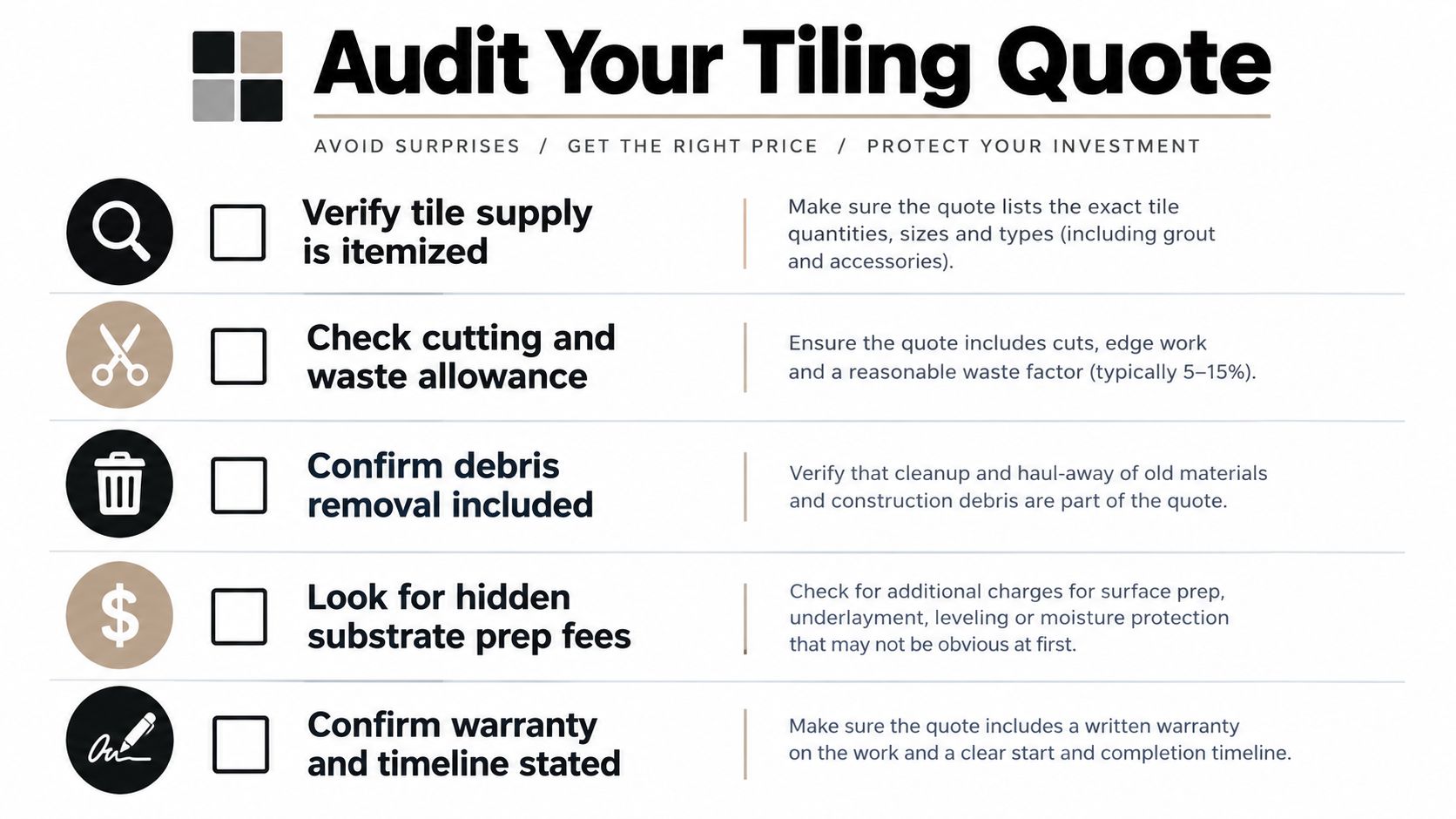
Start with the tile itself. The quote should state whether the price includes supply, delivery, batch inspection, cuts, breakage allowance, and any special pieces. If you're supplying the tile, confirm who checks quantities and who carries responsibility for defects or shade variation.
Then examine the installation scope:
- Substrate condition: Does the quote include grinding, patching, levelling, screeding, or backing-board replacement?
- Waterproofing: Identify the areas covered, the preparation required, the system used, and whether penetrations and junctions are included.
- Adhesive and grout: Confirm product type, coverage, colour, and whether epoxy grout is specified where you require it.
- Cuts and penetrations: Ask whether cuts around wastes, niches, outlets, mixers, windows, and door jambs are included.
- Trims and edges: Check the material, finish, profile, thresholds, and exposed tile edges.
- Silicone work: Make sure movement joints and changes of plane are identified rather than assumed.
- Removal and disposal: Confirm who removes existing tile, packaging, rubble, and unusable material.
- Access and protection: Clarify parking, stairs, narrow hallways, lifting requirements, floor protection, and site cleaning.
- Programme and warranty: Require a stated start window, anticipated sequence, completion conditions, and warranty terms.
The phrase “subject to site conditions” isn't automatically a problem. It becomes a problem when the quote gives no method for pricing those conditions. Ask what happens if the floor needs levelling, the wall backing is damaged, or old waterproofing has failed.
Compare like with like
A good comparison table might have separate columns for tile supply, demolition, substrate preparation, waterproofing, installation, grout, silicone, trims, waste removal, and exclusions. If one contractor combines all of these into a single total while another lists them individually, ask the first contractor to clarify the components before deciding.
You can also use a detailed bathroom renovation quote guide to structure the questions you send to each contractor. The aim isn't to force every contractor into identical wording. It's to ensure that a cheaper quote isn't relying on unpaid assumptions.
The strongest quote is specific about uncertainty. It tells you what is included, what may change, who decides, and how an approved variation will be priced.
Securing a Premium Finish in Melbourne Homes
A premium porcelain bathroom doesn't begin with the first visible tile. It begins when the installer measures the room, checks the substrate, confirms the drainage and waterproofing sequence, and resolves the layout before adhesive reaches the wall.
Consider a typical Melbourne ensuite with a stone-look porcelain selection. The homeowner wants large panels, a recessed niche, minimal grout lines, and a frameless shower screen. A rushed contractor may start with the most visible wall and discover later that the niche cuts don't align, the floor needs a different fall, or the panel delivery can't reach the room without extra handling. The tile may be expensive, but the real failure is poor sequencing.
A careful team develops the set-out before fixing begins. It coordinates the niche with grout lines, positions cuts away from focal points, checks the relationship between the floor tile and shower waste, and confirms where silicone and trims will be visible. When the substrate requires correction, that work happens before the finish is placed, not after cracking or lippage exposes the problem.
Precision saves more than it costs
Experienced porcelain installers know when a format doesn't suit the substrate or access conditions. They can recommend a practical alternative, adjust the layout, or identify preparation work before the project is committed. That advice may change the initial quote, but it gives the homeowner a clearer choice between appearance, installation risk, maintenance, and budget.
3D drawings can help confirm tile direction, niche proportions, fixture locations, and transitions before demolition. A transparent renovation calculator can separate the visible finish from the less visible work beneath it. These tools don't replace a site inspection, but they make the scope easier to discuss and reduce decisions made under pressure.
The most durable result comes from combining:
- A suitable tile format for the room and access.
- A properly corrected substrate with appropriate falls and stability.
- A complete waterproofing system installed and allowed to cure correctly.
- A coordinated trade sequence that protects finished surfaces.
- A written quote that identifies inclusions, exclusions, variations, and warranties.
The cheapest porcelain tile installation cost is rarely the lowest number on a first quote. It is the cost of completing the work correctly without paying twice for failed preparation, damaged panels, or leak rectification.
Melbourne Tiling Services P/L offers start-to-finish bathroom and ensuite renovations, waterproofing, screeding, self-levelling, porcelain and Kerlite installation, leak rectification, 3D drawings, and transparent renovation quoting across Melbourne and greater Victoria. Visit Melbourne Tiling Services P/L to discuss your bathroom scope, substrate condition, tile format, and a practical installation budget.
Write a Comment