
Tile adhesive is a factory-blended, polymer-modified bonding layer engineered to secure tiles mechanically and chemically, and C2 products are built for tougher jobs than basic C1 products. The wrong adhesive is one of the fastest ways to turn a bathroom renovation or balcony job into cracked grout, hollow spots, or debonding.
Many people still call it “glue”, but that framing is too simple for Melbourne conditions. In real tiling work, the adhesive has to suit the tile, the substrate, the moisture load, and the amount of movement the surface will see.
Table of Contents
- Tile Adhesive Is Not Just Glue
- The Main Types of Tile Adhesive Explained
- Understanding Performance Classifications and Technical Criteria
- Matching Adhesive to Tile Material and Installation Environment
- Your Tile Adhesive Selection Checklist
- When Professional Installation and Registered Builders Matter
- Melbourne Considerations for Tile Adhesive and Tiling Projects
Tile Adhesive Is Not Just Glue
The biggest mistake homeowners make is treating tile adhesive like a commodity. It's not just glue, it's a performance layer that has to bond, hold, and sometimes flex while the structure beneath it moves, dries, or heats up.
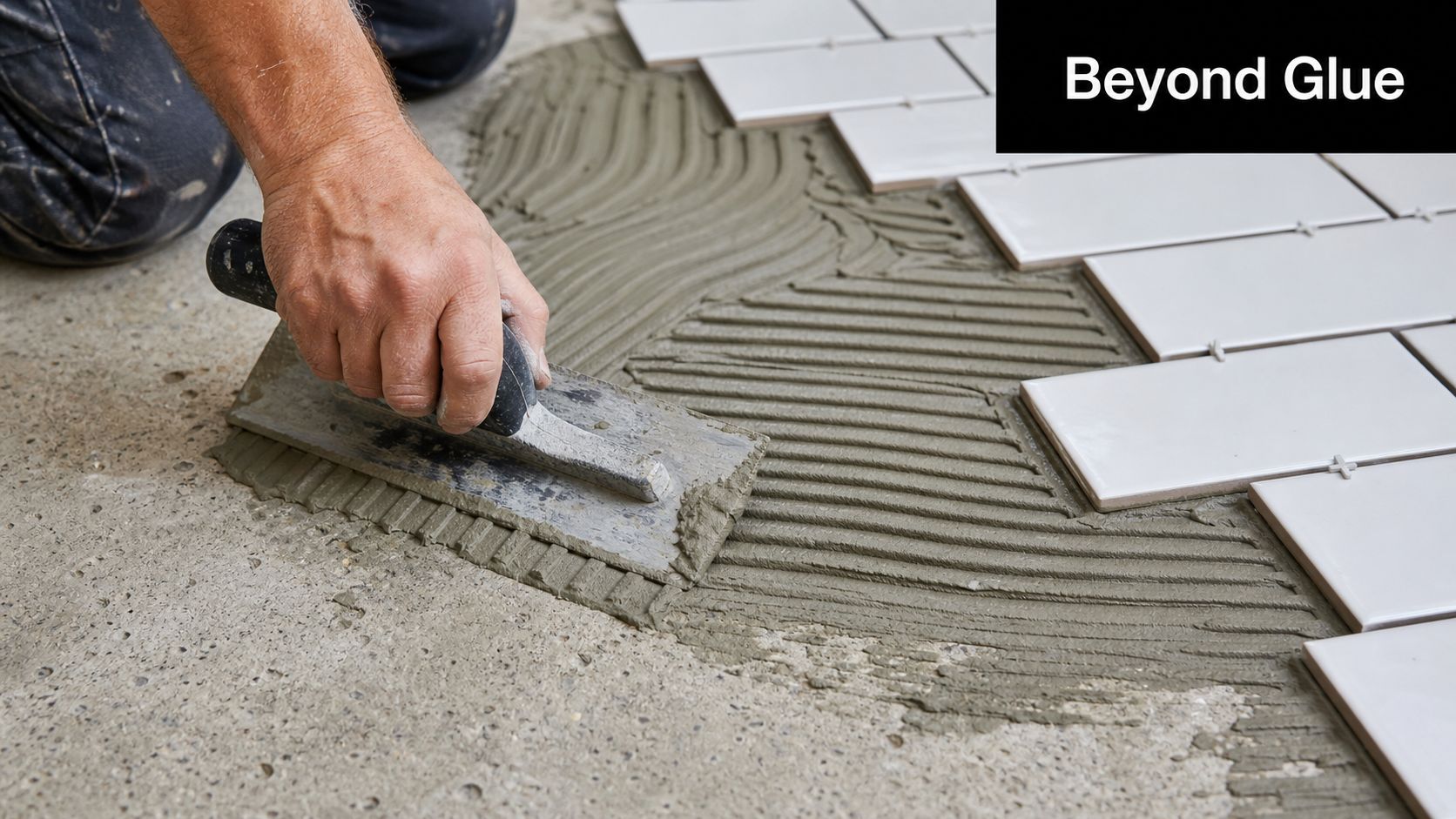
In Australian bathrooms, that distinction matters because the tiled surface sits inside a wet-area system, not a dry decorative finish. Adhesive choice has to work with waterproofing, substrate preparation, and the tile format, which is why the wrong product can fail even when the install looks neat on day one. Tile adhesive usage is tied closely to renovation and high-performance tiling applications, especially where moisture resistance and flexibility matter.
What the bond actually does
Tile adhesive creates two kinds of hold. It forms mechanical interlock with the substrate and tile back, and it also cures into a bonded layer that resists lifting, sliding, and separation. That's why surface condition, trowel coverage, and curing matter as much as the label on the bag.
Practical rule: If the substrate is moving, dusty, slick, or poorly prepared, a premium adhesive still won't save the job.
That's the reason professionals treat adhesive as one part of a system. Screeding, leveling, waterproofing, tile type, and adhesive classification all affect the final outcome. If you're planning bathroom renovations, the adhesive choice should sit alongside the surface prep work, not after it. Screeding is often the step that makes the adhesive perform properly.
Why this matters more in Melbourne renovations
Melbourne homes throw up real-world complications. Older slabs can be uneven, balconies can move, and renovated bathrooms often combine new board substrates with waterproofed wet zones. A generic product might hold a kitchen splashback, but that same product can struggle in a shower recess or on a balcony where temperature swings and moisture exposure are part of daily life.
That's why the better question isn't “what is tile adhesive?” in the simple sense. It's “what engineering job does this adhesive need to do on this specific surface?” Once you ask that, the product category starts to make sense fast.
The Main Types of Tile Adhesive Explained
Tile adhesive comes in a few practical families, and each one behaves differently once it hits the wall or floor. The type you choose affects how you mix it, how fast you can work, and how forgiving the job will be.
Cement-based powder adhesives
This is the professional default for most tiled floors and walls. It's mixed on site with water, which gives the tiler control over consistency and working time, and it's the most common choice for everyday installations because it balances cost and performance well. Market data also shows cementitious adhesives leading with 36.6% of the market in 2024 in one global market view, which lines up with their broad use in routine wall and floor work (Grand View Research).
Powder adhesives are also the right starting point when the job involves porcelain, larger formats, or wet-area work. For bathroom renovations, that flexibility matters because the adhesive often has to bridge different substrates and hold up under moisture.
Epoxy adhesives
Epoxy is the tougher, more specialised option. It's used when chemical resistance, stain resistance, or heavy-duty wet-area performance is required, and it's less about convenience than resilience. Most homeowners won't need epoxy everywhere, but in demanding commercial zones or very exposed conditions, it earns its place.
Acrylic-modified adhesives
Acrylic-modified products are chosen for added flexibility and improved bond behaviour. They can help where the surface isn't perfectly forgiving, but they still need to match the tile and substrate properly. A flexible product doesn't excuse poor prep.
Ready-mix tub products
Ready-mix products are the ones many homeowners recognise first because they're easy to open and apply. They can suit small, dry-area wall tiles, but they're not interchangeable with powder products in wet zones, large-format installs, or floors that need stronger performance. That's where a lot of DIY confusion starts.
The simplest way to sort them is this, powder products cover most serious renovation work, epoxy handles demanding environments, acrylic-modified products add flexibility, and premixed tubs are limited in scope.
For larger projects, especially those involving wall-to-floor continuity, the adhesive type has to line up with the tile weight and the substrate. That's why many tilers look at large-format tiles and the adhesive together, not separately.
Understanding Performance Classifications and Technical Criteria
The codes on a technical sheet only look abstract until you map them to the job in front of you. On site, they tell you whether an adhesive can handle a waterproof bathroom, a balcony with movement, or a feature wall carrying heavier tiles. That is the actual value, because tile adhesive works as an engineered performance system, not generic glue.
What the codes mean in practice
A C1 adhesive meets the standard bond-strength baseline. A C2 adhesive is the improved class, and it gives more confidence on porcelain, large-format tiles, and moisture-exposed surfaces. Technical guidance also ties these classes to minimum tensile adhesion values, which is one reason installers usually move to C2 for tougher residential work, especially where the substrate has been waterproofed or the tile is carrying more weight (Wacker).
| Classification | Meaning | Typical Use Case |
|---|---|---|
| C1 | Standard bond strength | General interior tiling where conditions are stable |
| C2 | Improved bond strength | Porcelain, large-format tiles, wet areas, moisture-exposed substrates |
| T | Reduced slip | Vertical wall work where sag control matters |
| E | Extended open time | Jobs that need a wider window for placement and adjustment |
For homeowners planning a renovation, those letters matter because they tell you where a product is built to perform and where it is likely to struggle. If the tile is dense, the room is wet, or the installation includes a substrate that has already been waterproofed, the extra margin from a C2 adhesive is usually worth having.
Why S1 and S2 matter
The S1 and S2 classes describe deformability, which is the adhesive's ability to cope with small movement without losing the bond. S1 is the flexible class most DIYers hear about, and it sits in the moderate deformability range in the technical standard. That matters when a substrate moves slightly, because a rigid adhesive can crack or let the tile lose contact. The same technical guidance also frames S2 as highly deformable, which pushes it into more specialist territory for jobs where movement is more likely.
Practical rule: Flexibility helps with movement, but it does not fix a bad floor, bad screed, or poor waterproofing.
In Melbourne bathrooms, I treat deformability as insurance against minor movement, not a shortcut around preparation. If the substrate is unstable, the adhesive is only one part of the system, and it cannot carry the whole problem.
Open time and adjustment time
Workability matters just as much as strength. One AU-relevant technical sheet for large-format tile adhesive specifies more than 30 minutes open time, about 45 minutes adjustment time, and 24-hour foot-traffic readiness. Those figures matter because large tiles are unforgiving once they are bedded in, and installers need enough time to correct alignment without the adhesive skinning over too early (Mapei technical data sheet_10c709f9b9a64d3bb0605fbf4612ba43.pdf?sfvrsn=f8939151_0)).
That is especially relevant on bathroom floors, where you are juggling falls, drains, and waterproofing details at the same time. A product with the wrong working time can turn a careful layout into a rushed fix, and rushing is where tile lines start drifting.
Slip resistance on walls
The T classification is there for vertical work. It reduces the risk of tiles sliding before the adhesive grabs, which is especially useful with heavier wall tiles and larger formats. In practice, that is a quiet detail that keeps a bathroom wall line straight and saves a lot of re-setting later.
If you are comparing products across tile types, it helps to cross-check the adhesive class with the tile material itself. A good place to start is a practical overview of tile materials for bathroom and renovation work, then match the adhesive to the demands of the tile, the substrate, and the room.
Matching Adhesive to Tile Material and Installation Environment
Tile adhesive has to be matched to the tile, the substrate, and the room conditions. A product that behaves well on a small ceramic splashback can be the wrong call for porcelain, natural stone, or a balcony that moves with Melbourne's weather.
Tile material changes the adhesive choice
Ceramic tiles are usually more forgiving than dense porcelain, so many standard wall jobs feel straightforward. Porcelain is denser and often needs higher bond performance, which is why C2 products are usually the safer choice. Natural stone adds another layer of care because staining, colour bleed, and movement sensitivity can affect the result, so the adhesive and grout system both need to suit the stone.
Large-format tiles, including thinner slab-style products such as Kerlite, call for a different approach. The adhesive needs enough working time to stay open, enough body to resist slumping, and enough coverage under more of the tile back. If the bed is uneven, the result can be lipping, hollow sounds, or bond failure later.
Wet areas, balconies, and heated floors
Bathrooms and ensuites are wet areas first and decorative spaces second. Adhesive selection has to work with waterproofed substrates and handle the regular moisture load around showers, vanities, and floor waste transitions. The same applies to balconies, where external exposure and movement put more pressure on flexibility and bond strength.
| Situation | What to prioritise | What usually fails |
|---|---|---|
| Shower or ensuite | Moisture resistance, coverage, compatibility with waterproofing | Cheap premix products in wet zones |
| Balcony | Flexibility, external durability, movement tolerance | Rigid adhesive on a moving substrate |
| Large-format floor tile | Extended open time, high bond strength, good bed support | Fast skinning and poor coverage |
| Stone feature wall | Material compatibility and careful product selection | Generic adhesive chosen only for price |
For a practical overview of tile materials for bathroom and renovation work, the key point is simple, the tile, the substrate, and the room need to be matched before the adhesive is chosen.
That trade-off is clearer on the jobs that fail first. Exterior areas and heavier internal installs place more demand on the bond, which is why adhesive specification matters more as the installation gets more exposed or more demanding.
Your Tile Adhesive Selection Checklist
A good quote should tell you more than a price and a tile brand. It should show that the installer has matched the adhesive to the material, substrate, and room conditions.
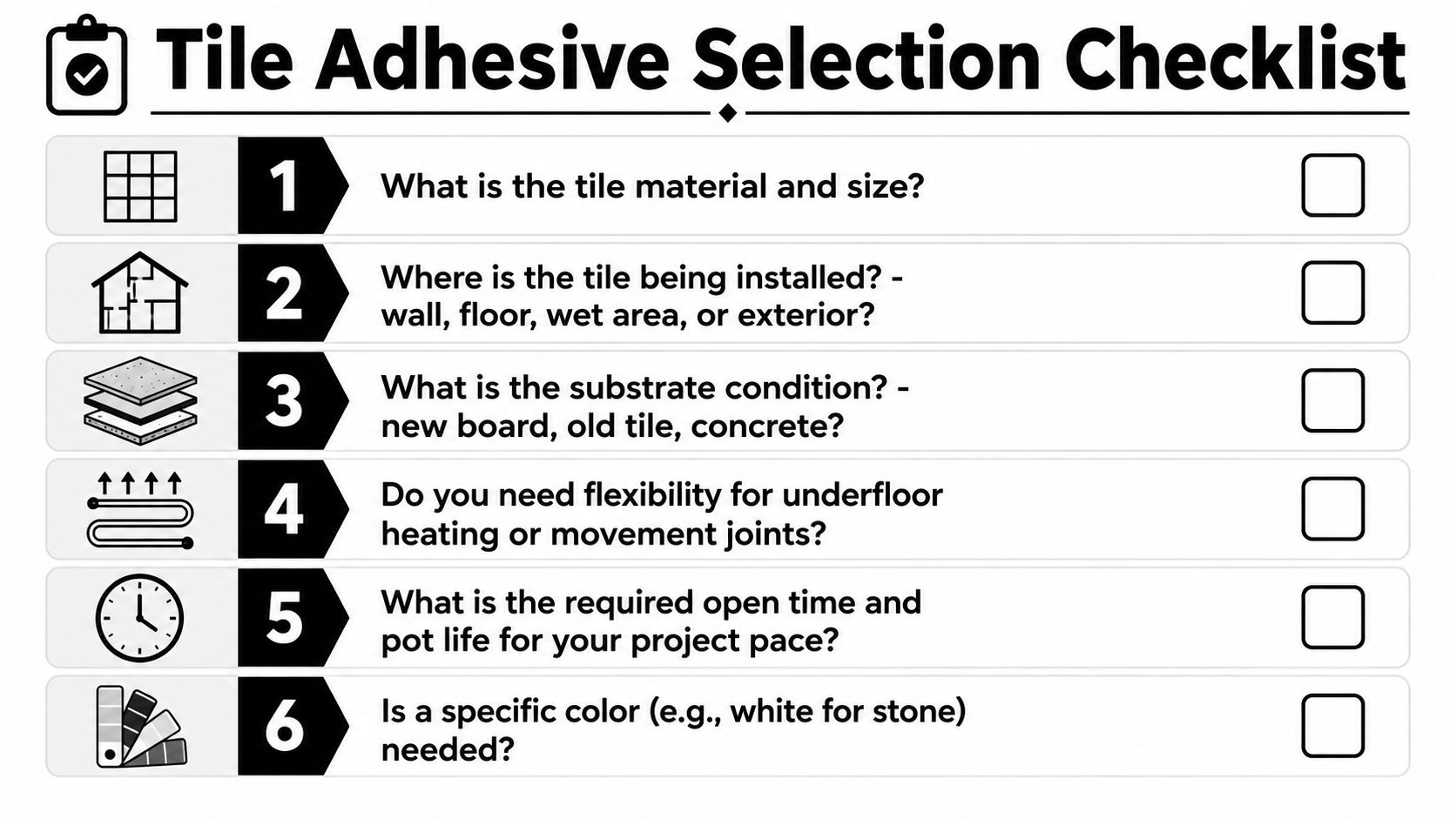
What to ask before you sign off
- What tile size and material are being used? Dense porcelain, ceramic, natural stone, and large-format panels don't behave the same way.
- Where is the tile going? Wall, floor, shower, balcony, and exterior areas each put different demands on the adhesive.
- What is the substrate? Concrete, fibre-cement board, waterproofed wall systems, and old tile overlays all need different preparation.
- Does the project need flexibility? Movement joints, underfloor heating, and balcony conditions can change the adhesive class you need.
- What open time does the job require? Large-format tiling often needs a more forgiving product so the bed doesn't skin over too fast.
- Is colour important? White adhesive is often chosen where light stone or translucent finishes are involved.
Red flags in a quote
If a quote says “tile adhesive included” with no further detail, ask for the actual product class. If a premixed product is being used in a wet area, that's another question mark unless the installer can justify it for a very specific application. If waterproofing compatibility isn't mentioned at all, the system hasn't been thought through properly.
Ask for the adhesive class, not just the brand name. The class tells you more about suitability than the marketing label does.
A clear quote should also show whether the installer has allowed for substrate work before the tiles go down. In bathroom renovations, the adhesive is only as good as the surface underneath it.
When Professional Installation and Registered Builders Matter
A good adhesive can still fail in the hands of a rushed installer. Wet-area tiling is a system job, and the system includes waterproofing, screeding, service coordination, tile setting, and cure time.
Why the installer matters as much as the product
Professional tilers don't just spread adhesive and walk away. They check substrate flatness, set trowel size, manage coverage, and choose a product that suits the tile and room. In showers and balconies, that judgement matters because moisture, movement, and transitions are where defects show up first.
Bathroom renovations also bring multiple trades into the same space. Plumbers, electricians, carpenters, waterproofers, and tilers all affect the final result, so the schedule and sequence have to line up. If one trade cuts corners, the adhesive often gets blamed for a problem that started elsewhere.
Registered builders and coordination
In Victoria, registered unlimited builders play a useful role in that coordination because they can manage the whole renovation sequence rather than treating each trade as an isolated task. That matters in bathrooms where waterproofing must be completed before tiling, and where screeding or self-levelling can determine whether the adhesive bed performs the way it should.
The technical side also matters on specialist jobs. Large-format Kerlite and similar systems need careful handling, even bed coverage, and the right adhesive class for the substrate and tile weight. A builder or tiler who has seen enough failure points will ask different questions before the first bag is mixed.
For some homeowners, a full-service tiling and renovation outfit such as Melbourne Tiling Services P/L is one practical option because it coordinates tiling, waterproofing, screeding, and bathroom renovation work under one roof. That kind of setup can reduce handover errors when the job involves wet areas or complex floor preparation.
Melbourne Considerations for Tile Adhesive and Tiling Projects
Melbourne jobs tend to expose weak products and weak prep quickly. Temperature swings affect exterior work, older homes can hide uneven substrates, and apartment balconies add movement and waterproofing pressure that basic products don't always handle well.
Bathroom renovations in older Melbourne homes often need more surface correction than new builds. That's where screeding, levelling, and the right adhesive class come together, because a poor base will show through as soon as the tiles go down. For balcony remediation, the product choice also has to account for external exposure and structural movement, not just appearance.
The local market is also shifting toward premium formats, especially large-format porcelain and Kerlite-style panels. That pushes adhesive selection away from the “cheap bag of glue” mindset and toward a more technical approach, because the tile format can dictate the open time, slip resistance, and deformability required.
Melbourne homeowners planning a renovation should expect a tiler to ask practical questions before quoting. What's the substrate, what's the waterproofing state, what tile size is being installed, and is the area wet or exposed? Those answers drive the adhesive choice, and the adhesive choice drives the durability of the result.
If you're planning bathroom renovations in Melbourne and want the adhesive, waterproofing, screeding, and tile selection handled as one system, visit Melbourne Tiling Services P/L to request a quote and discuss the right setup for your bathroom, balcony, or large-format tiling project.
Write a Comment