
You're probably in one of two spots right now. Either you're planning a bathroom renovation and trying to work out who can waterproof it properly, or you're looking at the trade itself and wondering whether the Certificate III in Construction Waterproofing is enough to get you on site and working legally.
That confusion matters because waterproofing isn't decorative work. When it fails, the damage sits behind tiles, under screeds, around shower bases, inside timber frames, and beneath finishes that looked perfect on handover day. Registered builders see the same pattern over and over in failed bathroom renovations. The tiling might look straight, the tapware might be expensive, and the shower screen might be premium, but if the waterproofing was handled by someone without the right training or licensing, the whole job is vulnerable.
The important point is simple. The Certificate III in Construction Waterproofing is the trade foundation, not the whole legal pathway in Victoria. That distinction catches out new tradespeople and homeowners alike.
Table of Contents
- Why Your Bathroom Renovation Depends on One Qualification
- What the Certificate III in Construction Waterproofing Covers
- The Practical Skills of a Certified Waterproofer
- From Certificate to Licensed Contractor in Victoria
- Your Career Path and Earning Potential as a Waterproofer
- How to Choose a Reputable Training Provider in Melbourne
- The Foundation of Every Successful Building Project
Why Your Bathroom Renovation Depends on One Qualification
The bathroom looks finished on Friday. By winter, paint is bubbling on the hallway side of the wall, the skirting has swollen, and the owner is arguing with the tiler, plumber, and builder about who is responsible.
I see this pattern regularly. The failure usually starts long before the first cracked grout line or water stain appears. It starts behind the tiles, where poor preparation, bad detailing, or the wrong membrane application gets buried and signed off as if the job were sound.
That is why the Certificate III in Construction Waterproofing matters on bathroom renovations. It is the trade qualification that shows the installer has been trained to carry out waterproofing work as a building system, with sequence, substrate preparation, junction treatment, compatibility, curing, and compliance all handled properly. Homeowners often focus on the finish they can see. Builders focus on the work that can fail after handover.
The gap between a qualified waterproofer and a person who has only applied waterproofing products previously is wide. In a bathroom, small errors cause expensive failures. A poorly treated wall to floor junction, an untreated penetration, or a rushed flood-test sequence can leave water tracking into framing, sheeting, insulation, and adjoining rooms. By the time that damage is visible, the repair usually means demolition.
That same distinction is often misunderstood in Victoria. Holding the Certificate III is not the same as holding a contractor licence or registration to take on waterproofing work in your own right. The qualification shows trade competence. The legal right to contract, advertise, and carry responsibility for the work depends on the licensing and registration framework that applies to the job and the person performing it. For tradespeople, that affects the path into the industry. For homeowners, it affects who should be hired and who carries accountability if the work fails.
Wet areas do not forgive shortcuts.
For people entering the trade, this qualification marks the point where waterproofing stops being treated as a side task and starts being treated as specialist construction work. For clients, it is one of the clearest signs that the person doing the job understands what is at stake before the bathroom is closed up and the evidence disappears.
What the Certificate III in Construction Waterproofing Covers
A proper waterproofing qualification teaches a trade process, not a product demonstration. That distinction matters on site. The person applying the system has to understand the build-up under the tiles, the sequence of other trades, and the standards that govern how wet areas are prepared and treated.
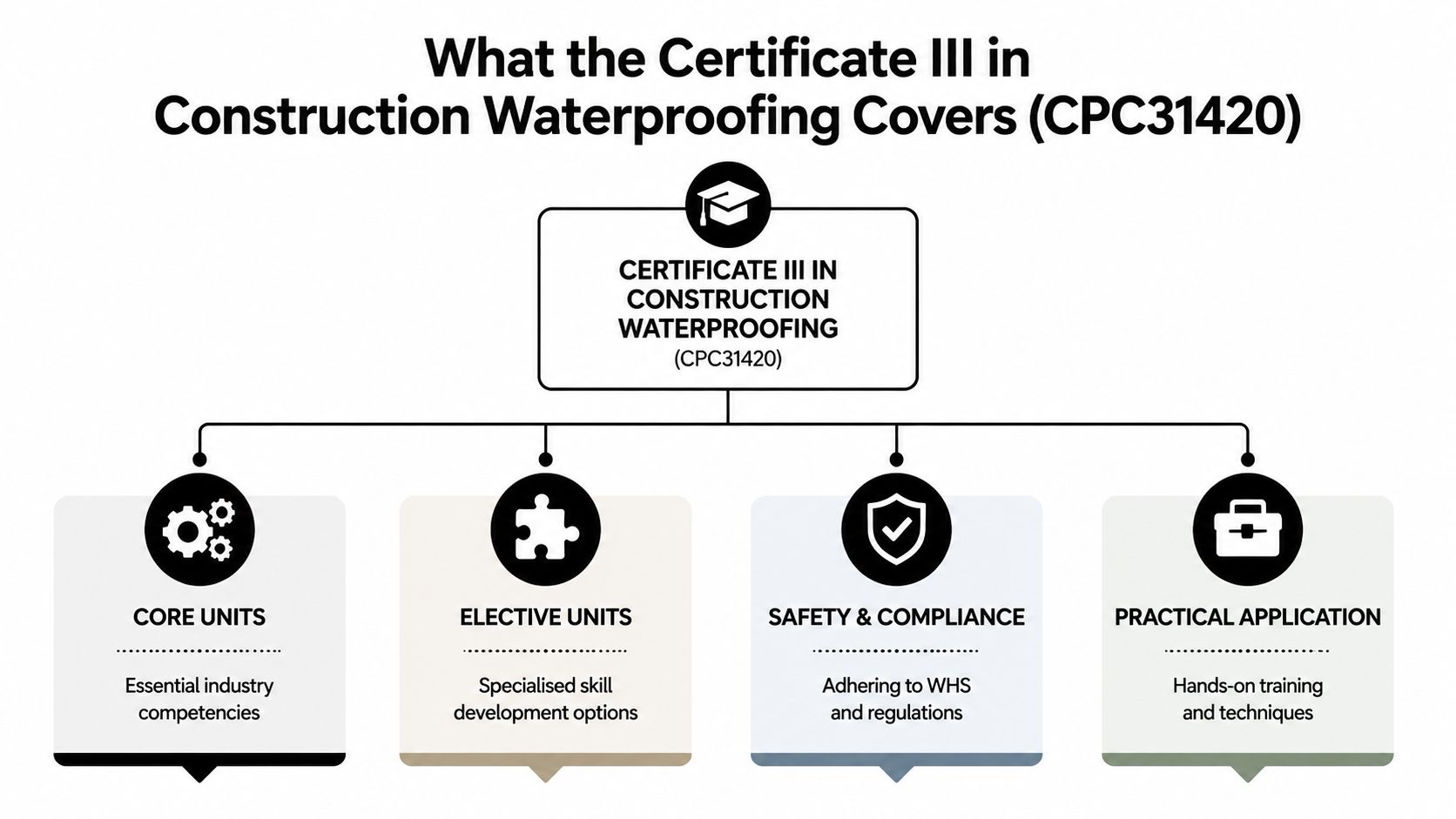
What the qualification structure tells you
The Certificate III is built as a trade qualification with core units and electives. In practice, that means the training is meant to produce someone who can work across common waterproofing situations, not someone who has only seen one membrane brand or one bathroom detail in a classroom.
For tradespeople, that broad scope matters because waterproofing failures rarely come from one dramatic mistake. They usually come from several smaller ones. The falls were never checked. The substrate was still too wet. The bond breaker was skipped at a movement point. The membrane was applied before penetrations were properly detailed. Training needs to cover the full chain, because failures happen across the full chain.
For homeowners and builders, the takeaway is straightforward. A person who has completed the qualification should be able to explain the whole waterproofing sequence from inspection to final application, including why each step affects compliance and durability.
What competent training should develop
Good training builds judgment as much as technique. It should develop capability in areas such as:
| Area | Why it matters in practice |
|---|---|
| Plan reading | The installer needs to identify set-downs, wet-area extents, junction details, penetrations, and drainage intent before work starts. |
| Surface preparation | Membranes fail early on dusty, unstable, contaminated, or damp substrates. Prep work decides whether the system bonds properly. |
| Material handling | Primers, sheet systems, liquid membranes, bond breakers, and sealants all have different limits, curing times, and application methods. |
| Assessment skills | The waterproofer has to judge whether the area is ready, whether previous trade work is acceptable, and whether the specified system suits the conditions. |
The strongest operators are the ones who can stop a job before it goes wrong.
That might mean rejecting a substrate, sending a plumber back to fix penetrations, or delaying application because moisture levels and curing times are not right. Anyone can open a bucket. A trained waterproofer is expected to know when not to.
This is also where people often get confused in Victoria. The Certificate III shows that a worker has been trained in the trade. It does not automatically mean that person can contract directly with clients as a licensed waterproofing contractor. That licensing and registration question sits beyond the qualification itself, and it matters just as much as the training when work is being priced, signed off, and warranted.
For anyone comparing course content with real site work, a step-by-step guide to waterproofing a shower properly helps show how many separate decisions sit behind what looks like one simple trade task. That is the gap the Certificate III is supposed to address. It trains the work, not just the coating.
The Practical Skills of a Certified Waterproofer
A trained waterproofer protects the parts of the bathroom renovation that nobody wants to reopen later. That means the work has to be accurate before tiles, stone, screed, grout, and fixtures cover everything up.
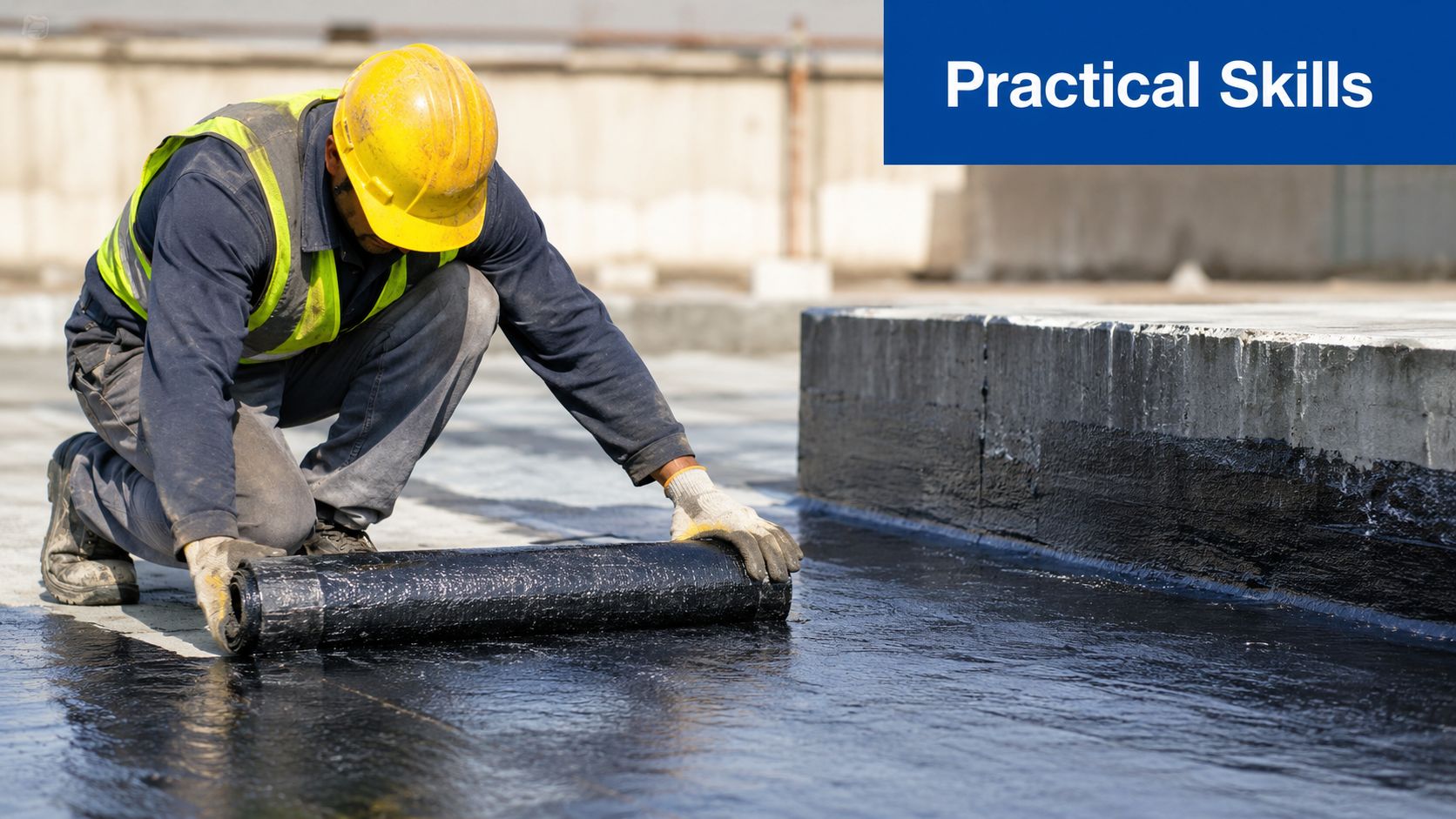
The difference between a certified waterproofer and a general handyman usually comes down to detail. A tradesperson with proper training understands that a membrane system only works when the substrate, junction treatment, penetrations, curing sequence, and drainage intent are all handled properly. Miss one of those and the rest of the job can still fail.
Membrane thickness is not guesswork
One of the clearest examples is membrane coverage. The Certificate III in Construction Waterproofing mandates competence in applying liquid-applied membranes to achieve a minimum wet-out thickness of 1.5mm for shower bases and 1.0mm for vertical walls, as specified in AS 3740:2021, according to this training overview on Certificate III waterproofing requirements.
That matters because membrane thickness isn't cosmetic. Too thin, and the system can't perform as intended. Too inconsistent, and weak points appear where movement, ponding, or ongoing moisture exposure will test the installation.
On site, the better operators don't rush this stage. They inspect the substrate, check corners and junctions, allow for bond breakers where needed, and apply the system evenly instead of chasing speed.
If you want a practical look at the process in a shower area, this guide to how to waterproof a shower properly is useful because it shows the sequence matters as much as the product.
Falls, trays, and substrate preparation decide whether the job lasts
A compliant waterproofed bathroom also relies on drainage. Water must move to the waste, not sit in corners, puddle under tile finishes, or linger at doorway transitions. The same verified training source notes that trained practitioners must be competent in installing pre-formed shower trays with a minimum 1:100 slope to the waste.
That requirement goes straight to one of the most common practical failures in bathroom renovations. People focus on the membrane and ignore the fall. But waterproofing over a bad surface profile doesn't fix drainage. It just seals in a defect.
A certified waterproofer should be able to judge whether the area is ready to waterproof. That includes:
- Substrate soundness: Cracked, unstable, contaminated, or damp surfaces need attention before any membrane goes down.
- Correct falls: Water must move to the waste consistently, especially in shower bases and wet floors.
- Trade coordination: Plumbing penetrations, carpentry details, and screed levels have to align before the membrane system is installed.
If the substrate is wrong, the membrane is being asked to rescue a problem it wasn't designed to solve.
That's the practical value of the qualification. It doesn't just certify that someone has seen waterproofing done. It certifies that they've been trained to recognise the conditions that make waterproofing succeed or fail.
From Certificate to Licensed Contractor in Victoria
This is the part that causes the most confusion in the trade. Many people finish the course and assume they're now a licensed waterproofer. In Victoria, that's not how it works.
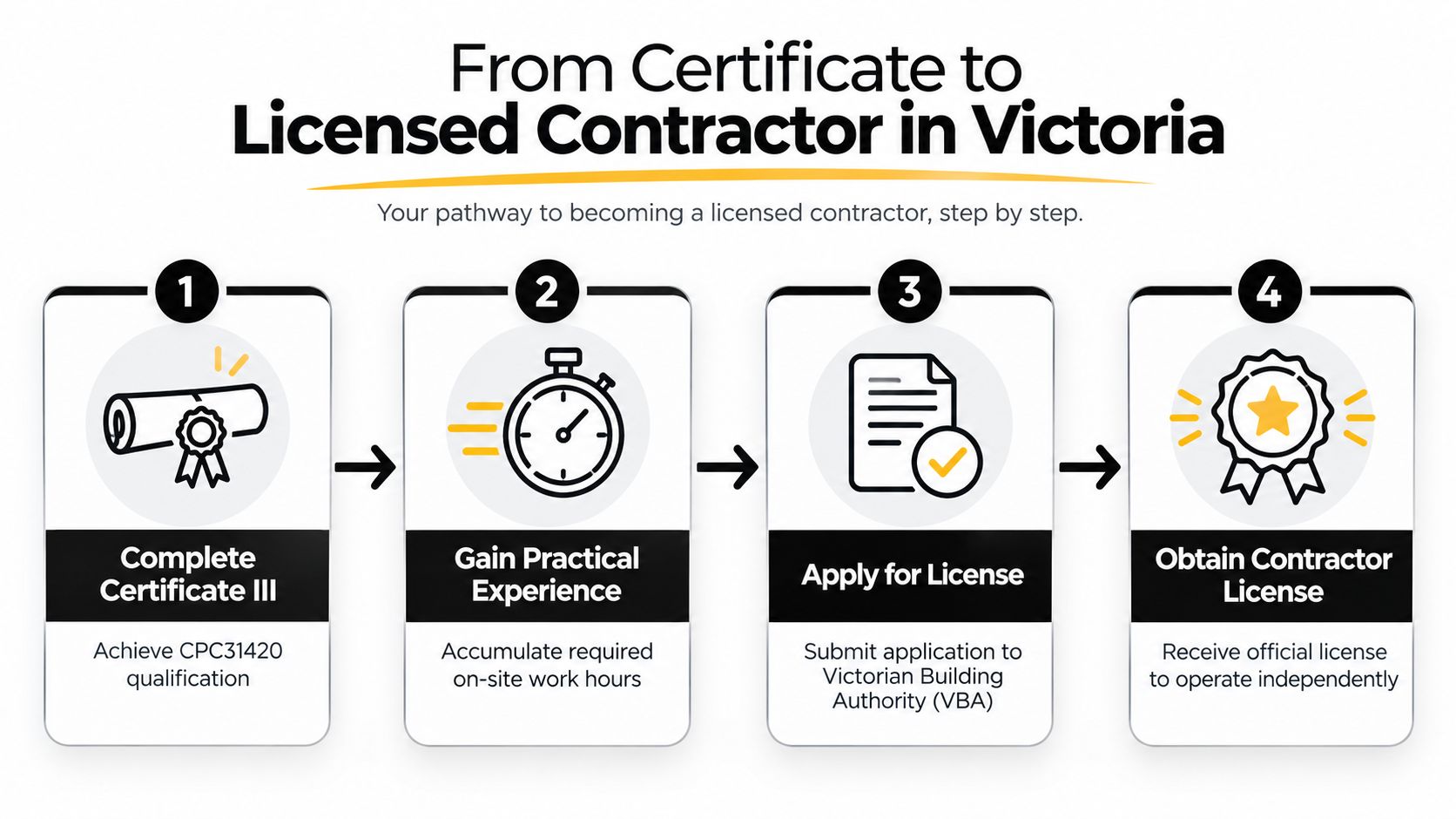
The qualification and the licence are not the same thing
The key distinction is legal, not academic. Completing the Certificate III does not grant a licence in Victoria. As explained in this Victorian guide to hiring a licensed waterproofer, an aspiring waterproofer must separately apply to the VBA and provide evidence of competency and insurance.
That same source also states that any bathroom waterproofing job valued over $5,000 in labour and materials, including GST, requires the waterproofer to hold a specific contractor licence in Victoria, and owner-builders are prohibited from performing their own wet area waterproofing work even if they hold an owner-builder permit.
This catches out two groups all the time:
- New tradespeople who think the certificate is the final box to tick.
- Homeowners who assume that a person saying they're “qualified” must also be legally licensed to contract for the work.
They're not the same thing. Qualification shows formal trade training. Licensing is the separate legal approval to contract for regulated work.
What this means on real projects
For homeowners, the risk is obvious. You can hire someone who has done some training, speaks confidently, and prices the job attractively, but still isn't properly licensed for the work they're taking on. If the job value crosses the legal threshold, that matters immediately.
For registered builders, the distinction matters for procurement and liability. A bathroom renovation doesn't run in isolation. Waterproofers work in sequence with plumbers, carpenters, screeders, tilers, and shower screen installers. If the waterproofer's status isn't verified properly, the risk doesn't stay with that trade alone. It spreads through the whole project.
A compliance document also becomes part of the discussion. Homeowners regularly ask what proof they should expect after completion, and that's where understanding the waterproofing compliance certificate requirements in Victoria helps frame the conversation.
A certificate from a training provider proves education. A contractor licence proves legal authority to take on regulated work.
A practical pathway for new tradespeople
If you're entering the trade in Victoria, the sensible way to think about the process is:
- First, get the qualification. The Certificate III is the trade base and the prerequisite discussed in the verified material for contractor licensing pathways.
- Then build evidence of real competence. You need to be able to demonstrate that you can perform the work properly, not just pass coursework.
- Arrange the required insurance and complete the VBA application. This is the step many overlook, even though it's where legal contracting capacity is determined.
- Only contract within the rules once licensed. Taking on work beyond what you're authorised to do is where minor confusion turns into major exposure.
There's also a broader interstate lesson here. The verified training details note that in NSW, applicants for a waterproofing licence must have at least two years of practical on-the-job experience under supervision, alongside the Certificate III qualification, as outlined in the training details for CPC31411. The details differ by state, but the pattern is the same. Training alone isn't always the whole legal pathway.
That's why smart operators don't stop at “I've done the course.” They ask the harder questions. Can I legally contract for the work? Can I prove competence? Do I have the insurance and paperwork to back up what I'm offering clients? Those are the questions that separate someone preparing for a long-term trade career from someone drifting into avoidable trouble.
Your Career Path and Earning Potential as a Waterproofer
For people considering the trade, waterproofing offers something many construction roles don't. It's specialised, regulated, and directly tied to project risk. That combination usually gives qualified operators a stronger position than general labour roles.

Why the trade pays well
In Victoria, that value shows up clearly in pay. Licensed waterproofers holding the qualification command average annual salaries between $75,000 and $85,000, with experienced professionals earning up to $110,000 and licensed contractors potentially reaching $90,000–$120,000 per annum, according to this Australian waterproofer salary overview.
The same source ties that pay level to the mandatory licensing environment and notes a median bathroom renovation cost in Melbourne of approximately $10,000, which reflects the importance clients place on compliant and durable wet-area work. It also states that construction industry employment is projected to grow by 137,900 workers, or 13.0%, over a five-year period.
Those numbers make sense from a builder's point of view. Waterproofing defects are expensive, disruptive, and often discovered after multiple downstream trades have finished. When one trade can prevent that kind of exposure, builders and clients pay attention.
Where the career can lead
The career path usually develops in layers rather than leaps.
- Newly qualified worker: You start by applying what you learned under supervision and building consistency on site.
- Trusted specialist: With experience, you become the person builders want on wet areas that need reliable execution, not rework.
- Licensed contractor: Once you've completed the legal pathway, you can contract for the work in your own right within the Victorian framework.
- Broader site role: Some waterproofers move into supervision, coordination, or specialist subcontracting roles with registered builders on larger projects.
That progression rewards precision. Builders remember the waterproofers who arrive prepared, reject poor substrates, sequence work correctly, and leave clear records. They also remember the ones who say “she'll be right” and create defects that others have to uncover and repair.
The trade pays better when people trust your judgement, not just your labour.
For someone choosing between a general construction path and a specialist one, that's the primary appeal of Certificate III in Construction Waterproofing. It creates a route into a trade where proper training has visible market value.
How to Choose a Reputable Training Provider in Melbourne
Not all training experiences prepare people equally well for site work. The qualification code may be the same, but the standard of delivery can vary sharply. If you're choosing a provider in Melbourne, cost alone is a poor filter.
What to check before you enrol
A strong provider should give you more than classroom exposure. It should train you to recognise site conditions, work through wet-area details, and handle practical application with discipline.
Use this checklist when comparing options:
- Hands-on training: Ask how much of the course involves practical application work, not just theory, slides, or product talk.
- Wet-area realism: Find out whether students work through bathroom-style details such as junctions, penetrations, corners, shower bases, and wall-floor transitions.
- Trainer background: You want instructors who understand site sequencing, defects, and remedial issues, not just course administration.
- Assessment quality: Ask how practical competence is assessed. A trade like this needs observation of technique, not just written answers.
- Industry relevance: Providers with stronger links to local construction work usually have a better feel for what builders and contractors expect in practice.
A decent provider should also answer direct questions plainly. If they can't explain the gap between qualification and licensing in Victoria, that's a warning sign.
What homeowners and builders should look for in a contractor
Even if you're not enrolling in the course yourself, this still matters. Homeowners and registered builders can use the same logic when checking a contractor's background.
Look for someone who can clearly explain:
- How they prepare substrates before waterproofing
- How they manage falls, drainage, and penetrations
- What evidence supports their qualification and licence status
- How their waterproofing work fits into the wider bathroom renovation sequence
The best contractors don't get defensive when you ask technical questions. They answer them clearly, because they understand the trade and they know those details protect the project.
The Foundation of Every Successful Building Project
The Certificate III in Construction Waterproofing matters because waterproofing is one of the few trades that can make an otherwise beautiful project fail from underneath. In bathroom renovations especially, the risk sits behind the finishes, which means errors stay hidden until the damage is already spreading.
For tradespeople, the qualification is the proper entry point into a specialised trade. For homeowners and registered builders, it's the first sign that the person doing the work has been trained to handle more than a bucket of membrane and a roller. In Victoria, the bigger lesson is even more important. A qualification is not the same as a contractor licence. Anyone hiring for regulated wet-area work needs to understand that difference before the job starts.
If you're checking standards, comparing contractors, or planning leak prevention in a renovation, it helps to understand how professional waterproofing in Melbourne should be approached from both a compliance and workmanship point of view.
Done properly, waterproofing protects the whole build. Done poorly, it drags the whole build backwards.
If you're planning a bathroom renovation, leak rectification, or compliant wet-area waterproofing in Victoria, Melbourne Tiling Services P/L can help with high-end bathroom and ensuite renovations, tiling, waterproofing, and coordinated trade delivery by experienced registered builders.
Write a Comment