
You're usually looking at outdoor tiling in Melbourne for one of two reasons. You want to upgrade a tired patio, balcony, or pool area into something clean and usable, or you already have a problem and water is getting where it shouldn't. In both cases, the same truth applies. The tile you see on top is only one part of the job.
Outdoor tiled areas in Melbourne live hard lives. They deal with rain, standing water, sun, movement in the substrate, and day to day wear. On a ground-level patio, poor preparation leads to drummy tiles, lipping, and puddling. On a balcony or terrace, the consequences are worse. Leaks, cracked grout, swollen framing, damaged ceilings below, and expensive rectification work.
That's why outdoor tiling isn't just a decorative trade item. It's a building project. The success of the job depends on substrate preparation, compliant waterproofing, drainage, movement control, and coordination between trades. If there's structural movement, failing falls, or waterproofing defects, a new tile finish won't fix the root cause. A registered builder can.
Table of Contents
- Why Melbourne Outdoor Tiling Is a Job for a Builder
- Choosing Tiles That Survive Melbourne's Four Seasons
- The Unseen Foundation Screeding Waterproofing and Fall
- Budgeting for Your Melbourne Outdoor Tiling Project
- The Installation Process From Quote to Completion
- Long-Term Care and Fixing Common Tiling Problems
- Your Checklist for Hiring a Tiling Contractor in Melbourne
Why Melbourne Outdoor Tiling Is a Job for a Builder
A lot of outdoor tile failures start with the wrong assumption. People think they're buying a surface finish, when they're really buying a waterproofed, drained, movement-managed system.
That matters even more in Melbourne. A paved courtyard, a front entry, a pool surround, a balcony, and a suspended terrace don't behave the same way. The substrate, drainage path, expansion control, and waterproofing requirement can change completely from one to the next. A tiler can lay tiles well, but if the slab has no fall, the balcony edge detail is wrong, or the membrane has failed, the problem sits outside simple tile laying.
Australia's tiling and carpeting services industry was valued at $8.0 billion in 2026, with 20,099 businesses operating nationally, which shows that this is a mature trade category with established standards and a deep subcontractor market under ANZSIC E3243 industry tracking.
Why builder oversight changes the result
On complex outdoor tiling jobs, somebody has to take responsibility for more than the tile line and grout colour. That includes:
- Substrate assessment: Is the slab stable, cracked, ponding, or moving?
- Drainage design: Will water leave the surface quickly, or sit at door tracks and corners?
- Waterproofing coordination: Has the membrane been selected and installed for external exposure?
- Trade sequencing: Do carpenters, plumbers, waterproofers, and tilers need to be coordinated?
- Compliance risk: If the job leaks later, who owns the rectification path?
Practical rule: If the tiled area sits over a room, next to internal door thresholds, or on a balcony edge, treat it as building work first and tiling work second.
This is the same mindset good contractors bring to bathroom renovations. In a bathroom, nobody sensible starts with the feature tile before checking falls, puddle flanges, waterproofing, and penetrations. Outdoor tiling in Melbourne deserves the same discipline.
Choosing Tiles That Survive Melbourne's Four Seasons
Homeowners often begin with the look. Grey porcelain, travertine-look pavers, bluestone, concrete-look slabs. That's normal. But outdoors, appearance comes second. A tile can look right in the showroom and still be the wrong product for a wet balcony, shaded path, or exposed terrace.
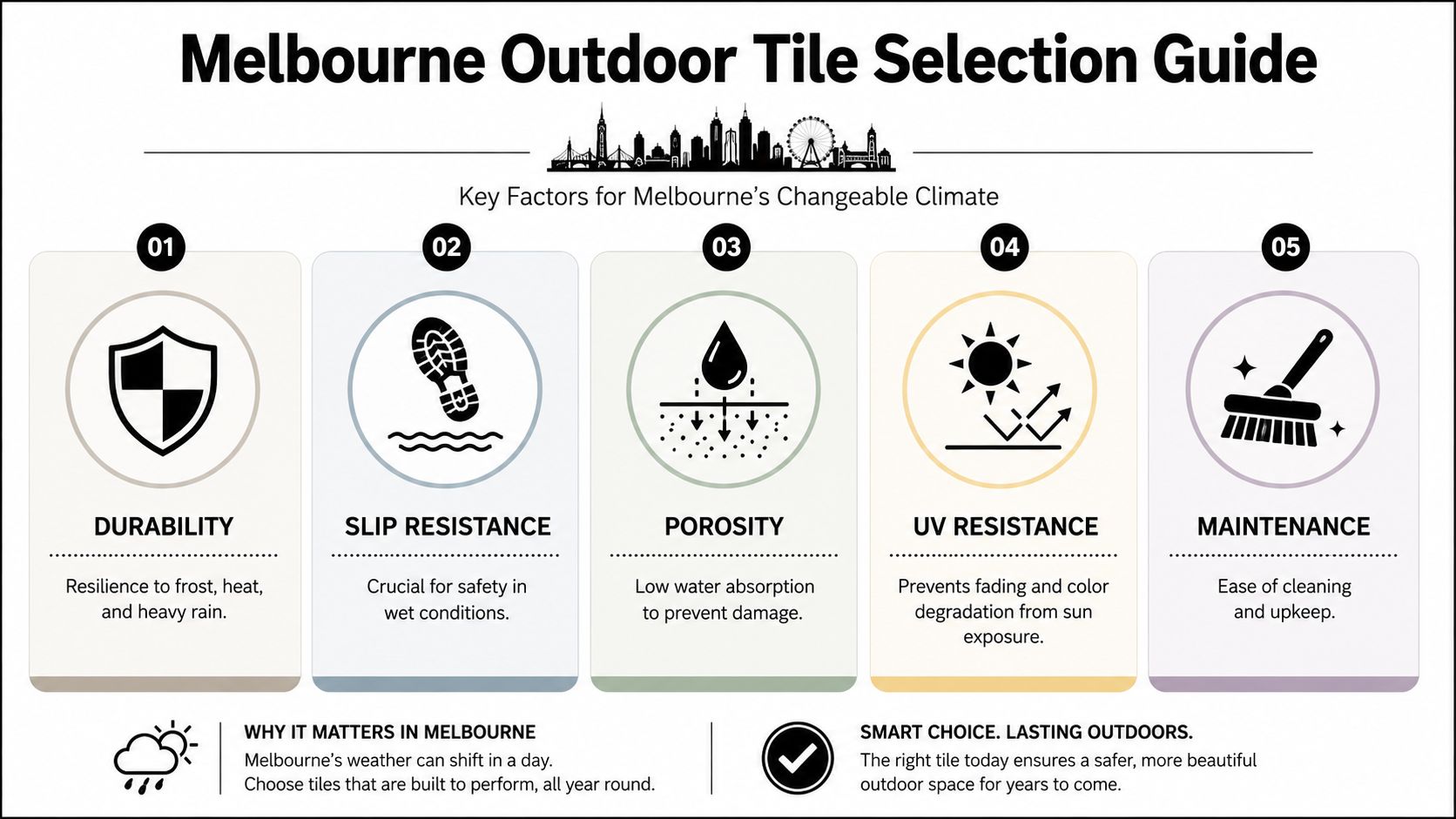
The first filter is safety and weather performance. In Victoria, tiling services are typically reported at $57 to $132 per square metre, while outdoor installations commonly average around $55 per square metre nationally and can range from $40 to $130 per square metre, depending on material and complexity. Guidance for outdoor applications commonly recommends P4 or P5 slip ratings, 10 to 20 mm thickness for durability, and porcelain with water absorption of less than 0.5% for better moisture resistance in wet conditions, as outlined in this Victoria outdoor tiling cost and specification guide.
Start with performance, not colour
For most outdoor tiling Melbourne projects, the shortlist usually comes down to porcelain, natural stone, or a paver-style product.
- Porcelain: Dense, stable, and usually the safest choice when you want low water absorption and consistent sizing.
- Natural stone: Attractive and often well suited to premium exterior designs, but it needs closer attention to sealing, maintenance, and variation between pieces.
- Standard ceramic: Fine in many internal settings, but often not my first recommendation for exposed Melbourne exteriors.
What works well outdoors is a tile that can cope with water, UV, and repeated cleaning without becoming slippery or unstable. What doesn't work is choosing solely by colour sample and then discovering the surface is too smooth, the body is too porous, or the tile needs a more controlled substrate than the site can provide.
For homeowners considering oversized panels, it helps to understand the installation side as well as the product side. This guide to large-format tile applications in Melbourne is useful if you're weighing cleaner lines against tighter tolerances.
A quick visual comparison helps before you lock anything in.
Large-format tiles need tighter installation control
Large-format outdoor porcelain can look excellent. Fewer grout joints, a more architectural finish, and cleaner visual flow from inside to outside. But large pieces are less forgiving.
Most local content talks about durability in broad terms. It rarely gets into the trade-offs of large-format porcelain in Melbourne's wet, UV-exposed conditions, or the extra installation sensitivity that larger and thinner panels bring, as noted in this discussion of outdoor tile system trade-offs.
Bigger tiles don't remove movement. They make poor preparation easier to see.
That means flatter substrates, more careful adhesive coverage, more disciplined handling, and sharper control at edges and transitions. If the slab is out, the tile won't hide it. If water sits on the surface, a premium tile won't solve it. On many sites, a smaller module or paver system is the more forgiving and longer-lasting choice.
The Unseen Foundation Screeding Waterproofing and Fall
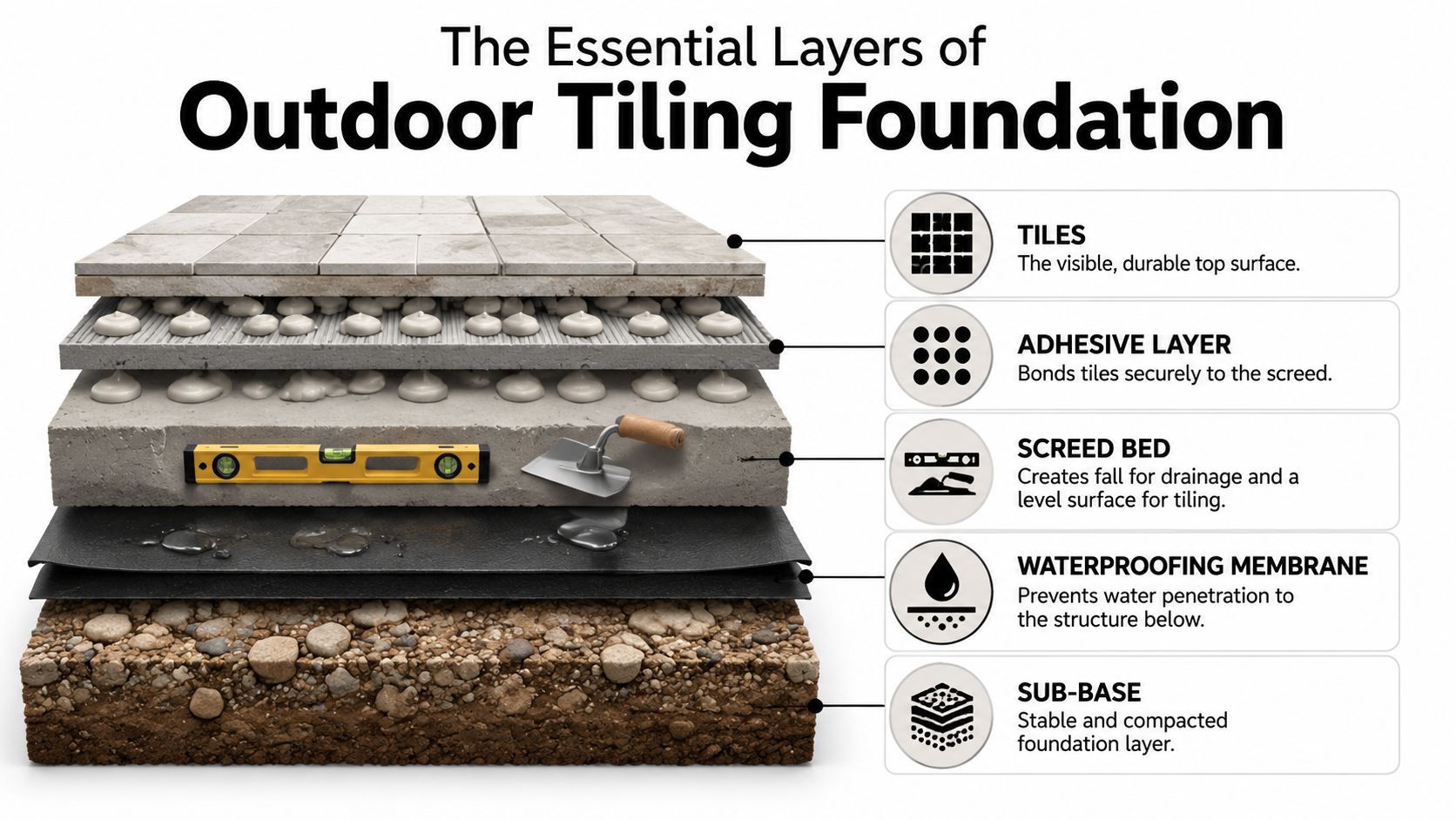
When an outdoor tiled area fails, the tile itself is often blamed first. In practice, the problem usually starts underneath. The visible surface gets the attention. The hidden layers decide whether the job lasts.
The Victorian Building Authority frequently cites waterproofing failures as a common cause of building defects and water ingress complaints, and external tiled areas depend on a complete system that includes membranes, drainage, and movement joints, as discussed in this overview of outdoor tile system failures and waterproofing risk.
What sits under the tile matters most
A sound outdoor tiling build-up generally includes a stable base, a waterproofing layer where required, a screed or prepared surface with proper fall, suitable adhesive selection, movement control, and the tile finish itself.
Here's the part many quotes skip over. Screeding isn't just “levelling”. On outdoor work it often establishes the fall so water moves to the drain or edge instead of ponding in the middle. That fall has to be intentional and consistent. If water sits, grout stays saturated, dirt builds up faster, and any weakness in the membrane or termination detail gets exposed.
For balcony and terrace work, I'd always want the client to understand the membrane side before they choose the tile side. If you need more detail, this guide to waterproofing requirements in Melbourne tiled areas outlines what should be checked before installation starts.
Where outdoor tiled areas usually fail
Most failures come from a small group of issues:
- No effective fall: Water ponds instead of draining.
- Poor membrane detailing: Water tracks into adjacent building elements.
- Missing or inadequate movement joints: Expansion and contraction stress the tile bed and grout.
- Unstable substrate: Cracks transfer through the finish.
- Bad edge and threshold transitions: Water reaches doors, walls, or soffits.
If a balcony is leaking, replacing the tile without checking the membrane, falls, and drainage path is often just expensive camouflage.
A proper builder-led inspection should look beyond hollow tiles or cracked grout. It should ask where water is entering, where it is being trapped, and whether the structure below has already been affected. That's the difference between a cosmetic redo and a real fix.
Budgeting for Your Melbourne Outdoor Tiling Project
Outdoor tiling quotes can look simple on paper. Rate per square metre, tile allowance, adhesive, grout, done. The problem is that two balconies of the same size can have completely different preparation needs, and preparation is often where the actual cost sits.
What the square metre rate does and doesn't tell you
The published Victorian range gives you a starting point, not a full project number. If a quote is built around installation only, you still need to ask what happens if the existing surface is out of level, the falls are wrong, the membrane is defective, or the substrate has cracks that need treatment.
The final cost usually moves on factors like these:
- Surface condition: A clean stable slab is cheaper to work with than a failed balcony.
- Tile specification: Slip-rated, thicker, lower-absorption products usually cost more than decorative indoor-grade material.
- Access and handling: Tight access, stairs, or upper-level work increases labour.
- Edge details and drains: More cuts and more coordination usually mean more time.
- Rectification scope: Demolition, disposal, waterproofing, screeding, and crack repair can exceed the visible tile-laying component.
A simple way to read a quote
A good quote separates finish work from remedial work. If it doesn't, you can't compare offers properly.
| Cost Component | Estimated Cost Range (AUD) |
|---|---|
| Tiling installation for 20sqm using Victorian general tiling rates | Based on $57 to $132 per square metre |
| Outdoor installation benchmark reference | Around $55 per square metre nationally |
| Alternative national outdoor range reference | $40 to $130 per square metre |
| Performance-driven tile specification factors | P4 or P5 slip rating, 10 to 20 mm thickness, porcelain with less than 0.5% water absorption |
Use a table like this as a prompt, not a final budget. It shows why a headline rate doesn't tell you enough about the whole build-up.
Ask for these items to be stated separately:
- Demolition and disposal
- Substrate repair or crack treatment
- Waterproofing scope
- Screeding and fall correction
- Tile supply versus tile laying
- Grouting, caulking, sealing, and clean-up
If you're comparing quotes and one is much lower, the first thing to check is what's missing underneath.
The Installation Process From Quote to Completion
A balcony leak in Melbourne often starts long before the first tile is lifted. The owner sees cracked grout or drummy tiles. A builder sees a bigger sequence to check first. Is the slab sound, are the falls correct, is water getting trapped at the threshold, and who is responsible for the waterproofing, drainage, and any structural repair once demolition starts?
That is why outdoor tiling needs a builder-led process, especially on balconies, terraces, podiums, and any tiled area over a habitable space. The tiles go on last. The project succeeds or fails underneath them.
A proper site visit should test more than the finish. The existing substrate, door heights, drainage points, movement joints, adjoining walls, balustrade penetrations, and signs of moisture all need review before anyone talks about tile pattern or grout colour. On remedial work, the surrounding evidence matters. Damp plaster below, staining at slab edges, musty smells, swelling at internal finishes, or movement around balustrade posts usually means the scope is wider than tile replacement.
From there, the job should follow a clear construction sequence:
- Inspection and scope definition: confirm whether the work is cosmetic replacement, leak rectification, or a broader rebuild of the tiled system.
- Demolition: remove failed tiles, screed, adhesives, and any loose or contaminated material so the underlying substrate condition is visible.
- Substrate repair and building works: address cracks, falls, edge details, drainage defects, threshold issues, and any structural or carpentry items before waterproofing starts.
- Waterproofing: apply the specified membrane system to a sound, prepared surface and allow proper curing time.
- Screeding and set-out: form consistent falls to drainage, establish finished levels, and resolve edges, step-downs, and interfaces with doors and walls.
- Tile installation: lay tiles to the set-out, keep joint widths consistent, install movement joints in the required locations, and finish perimeter sealant work properly.
- Handover checks: review drainage performance, surface finish, jointing, edge details, and any items that affect durability.
This sequence protects everyone. It gives the owner a defined scope, gives the trades clear handover points, and reduces the common argument that the leak must be “in the grout” when the underlying problem sits in the substrate or drainage design.
Bathroom projects follow a similar logic, but outdoor work is less forgiving. Melbourne weather puts more stress on the assembly. Heat, cold, rain, UV exposure, and building movement all act on the same surface. If the build-up is wrong, a neat tile finish can still fail early.
Melbourne Tiling Services P/L is often involved where the work extends beyond tile laying into waterproofing, balcony remediation, bathroom renovations, or rectification tied to building defects. That matters because outdoor tiling regularly overlaps with builder-managed scope, not just finish trade scope.
The smooth jobs are the ones where responsibilities are allocated before demolition begins, the substrate is treated as the main issue, and no one mistakes tile installation for the whole project.
Long-Term Care and Fixing Common Tiling Problems
A well-built outdoor tiled area shouldn't need constant attention, but it does need observation. Most expensive repairs don't begin with a dramatic failure. They start with small signs that were easy to dismiss.
Routine care that prevents bigger problems
Melbourne weather means your outdoor area goes through wet periods, dry heat, leaf litter, wind-driven grime, and seasonal movement. A maintenance routine doesn't need to be complicated, but it should be consistent.
- Keep drainage points clear: Leaves and dirt around outlets are a common cause of ponding.
- Wash with the right products: Mild cleaners are safer than aggressive acids or harsh chemicals that can affect grout and sealants.
- Check movement joints and silicone: If these open up, water finds a path quickly.
- Watch after heavy rain: Standing water tells you something about falls, not just weather.
- Inspect edges and thresholds: Door tracks, wall junctions, and balcony perimeters are common weak points.
If the area includes natural stone, sealing and cleaning need to suit that specific material. If it's porcelain, maintenance is often simpler, but grout lines and joints still need periodic checking.
When a repair is enough and when it isn't
Three common complaints come up again and again.
The first is leaks. If water is showing below a balcony or at an adjoining internal wall, don't assume regrouting will solve it. Grout isn't the waterproofing system. A leak often means failure in the membrane, detailing, drainage, or movement accommodation.
The second is efflorescence, the white chalky residue that appears on grout lines or tile edges. That usually tells you moisture is travelling through the system and bringing salts to the surface. Cleaning it off may improve the look, but the moisture source still needs attention.
The third is cracked grout or loose tiles. Sometimes that's localised and repairable. Sometimes it's a sign the substrate is moving, the adhesive bond is poor, or there's no proper movement joint strategy.
A practical way to judge the seriousness is this:
| Symptom | Often means | First response |
|---|---|---|
| Local cracked grout | Minor movement or isolated bond issue | Inspect joints and adjacent tiles |
| Repeated ponding | Inadequate fall or blocked drainage | Check outlets and surface levels |
| Ceiling staining below balcony | Waterproofing or edge-detail failure | Arrange a proper building inspection |
| White residue returning after cleaning | Ongoing moisture migration | Investigate source, don't just clean |
| Multiple hollow or loose tiles | Bond failure or substrate issue | Lift and assess the underlying layers |
Cleaning solves dirt. It doesn't solve water movement.
The biggest mistake is patching the symptom because it's visible. The durable approach is to identify whether the problem sits in the finish, the bedding, the membrane, or the structure.
Your Checklist for Hiring a Tiling Contractor in Melbourne
Hiring for outdoor tiling in Melbourne is really about hiring for risk control. You're not just choosing somebody to lay tiles neatly. You're choosing who will identify hidden defects, coordinate the right trades, and stand behind the system underneath the finish.
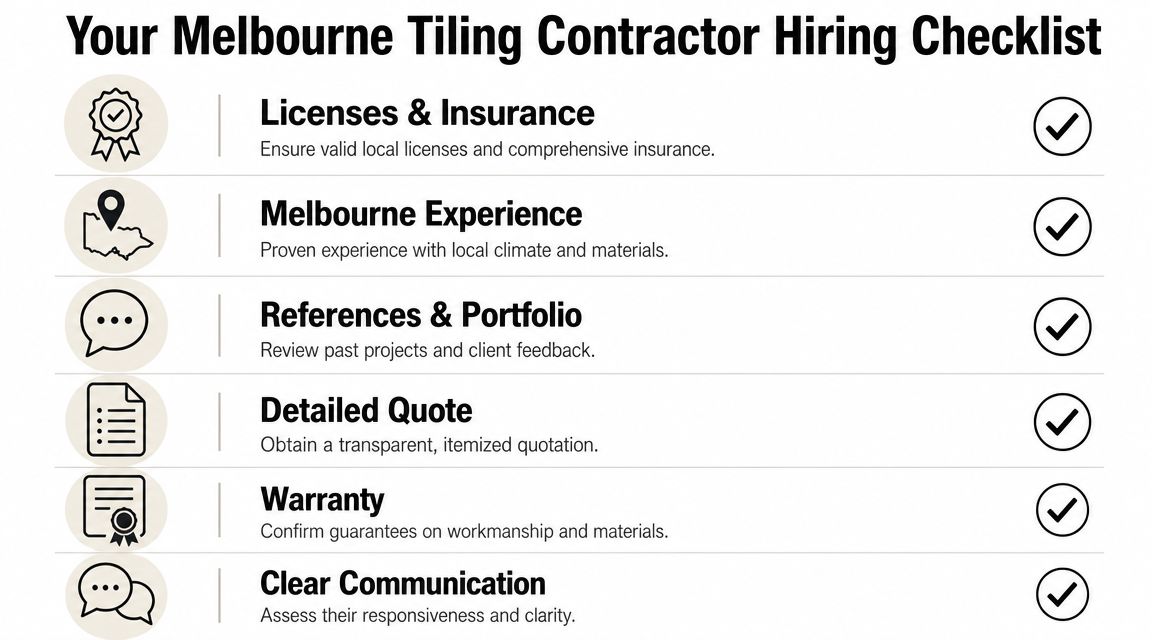
Questions worth asking before you sign
Use these questions early. They'll tell you very quickly whether you're speaking to a finisher or a contractor who understands external wet-area risk.
- Are you a registered builder for projects that involve waterproofing, structural repair, or multi-trade coordination?
- Who handles the waterproofing and what compliance documentation is provided?
- Does the quote include substrate preparation, screeding, and fall correction if needed?
- How do you deal with movement joints and drainage details?
- Have you completed balcony, terrace, or leak-rectification work in Melbourne conditions?
- Who manages associated trades if plumbing, carpentry, or remediation work is required?
For homeowners still comparing options, it helps to review what local tiling contractors near you in Melbourne list as part of their scope, rather than assuming every tiler offers builder-level coordination.
What a good quote should include
A solid quote should make it easy to see what is and isn't included. Look for clear separation between preparation, waterproofing, tile installation, and finishing. If the quote only talks about laying tiles, it may be missing the part of the project that matters most.
Check for:
- Site preparation details
- Responsibility for demolition and waste
- Waterproofing scope and who performs it
- Drainage and fall treatment
- Tile type and finish assumptions
- Movement joint and sealant allowance
- Exclusions and latent conditions
The right contractor won't pretend every outdoor area needs the same treatment. They'll explain what the site requires, what can go wrong if it's skipped, and where the true value lies.
If you're planning outdoor tiling, dealing with a leaking balcony, or comparing quotes for a more complex tile and waterproofing job, Melbourne Tiling Services P/L can inspect the site, explain the build-up underneath, and scope the work as a building project rather than just a surface finish.
Write a Comment