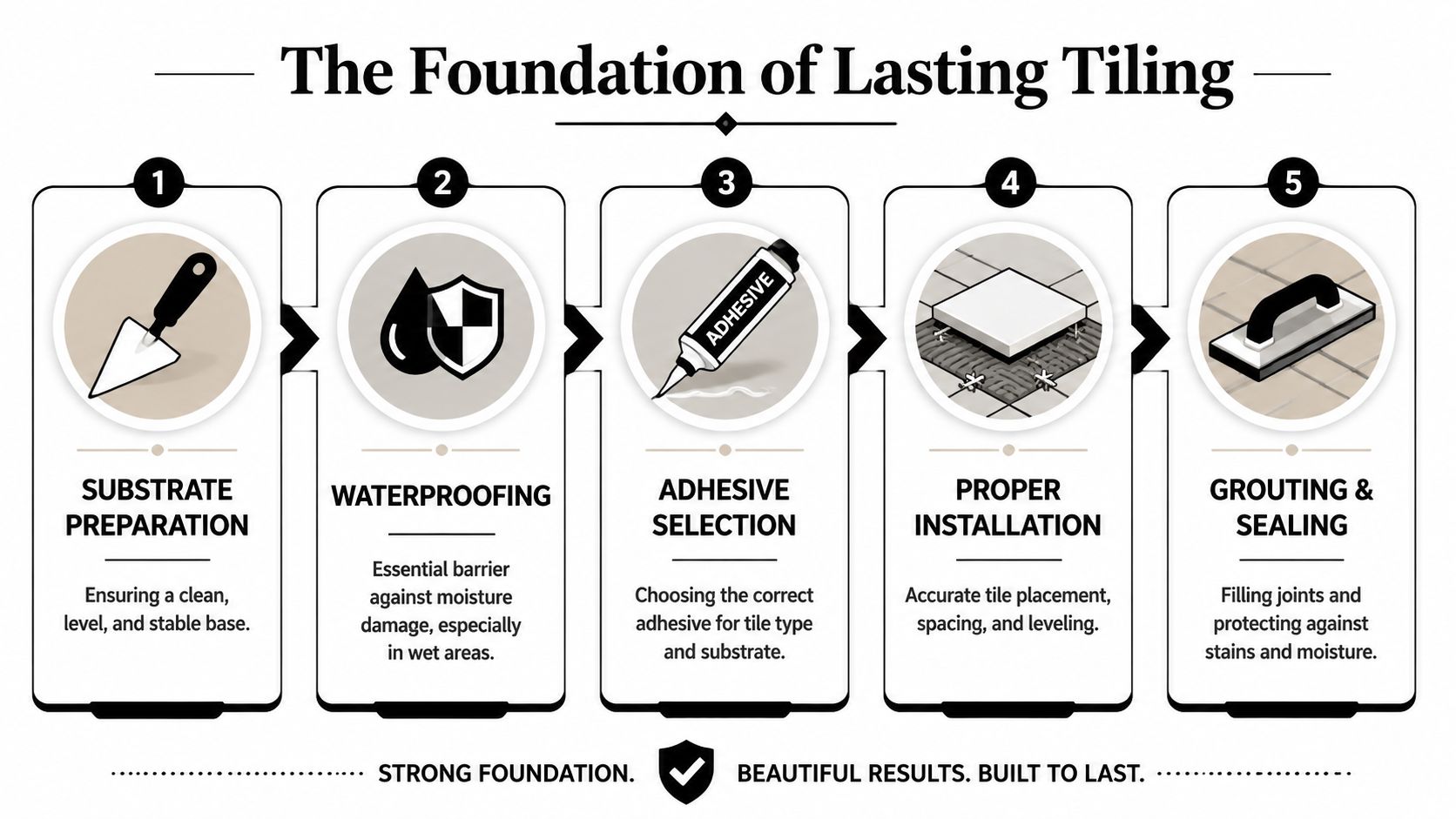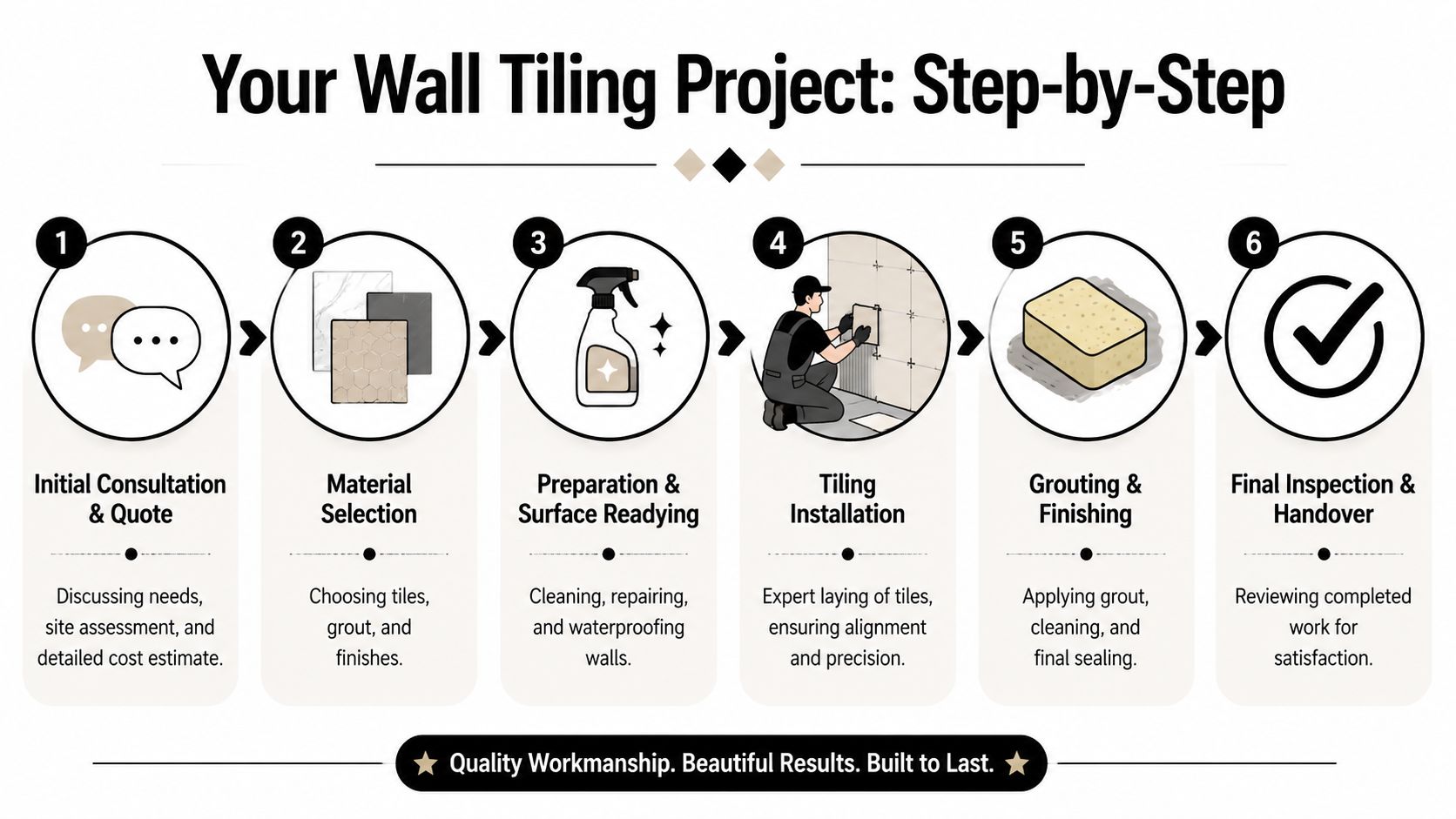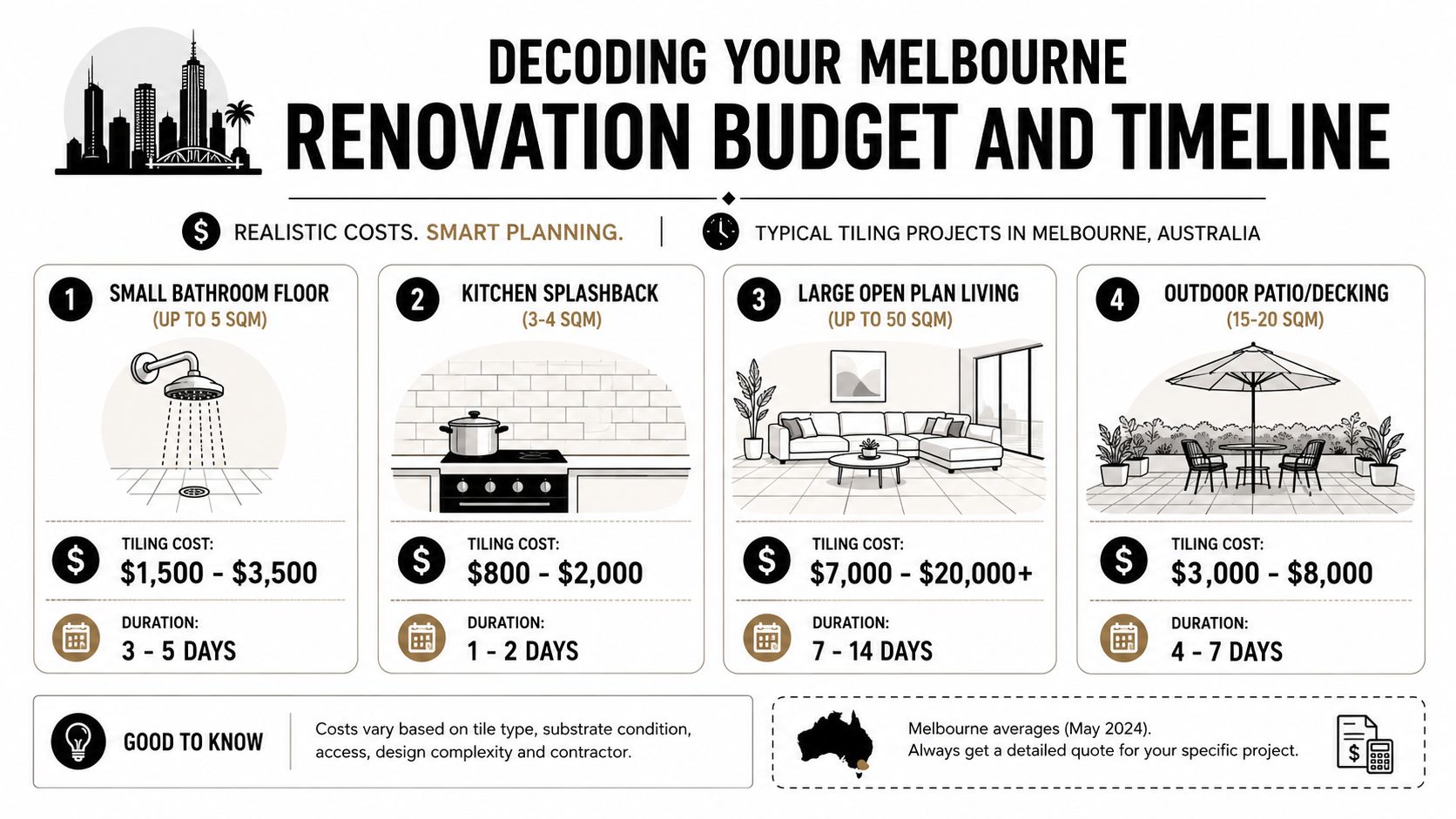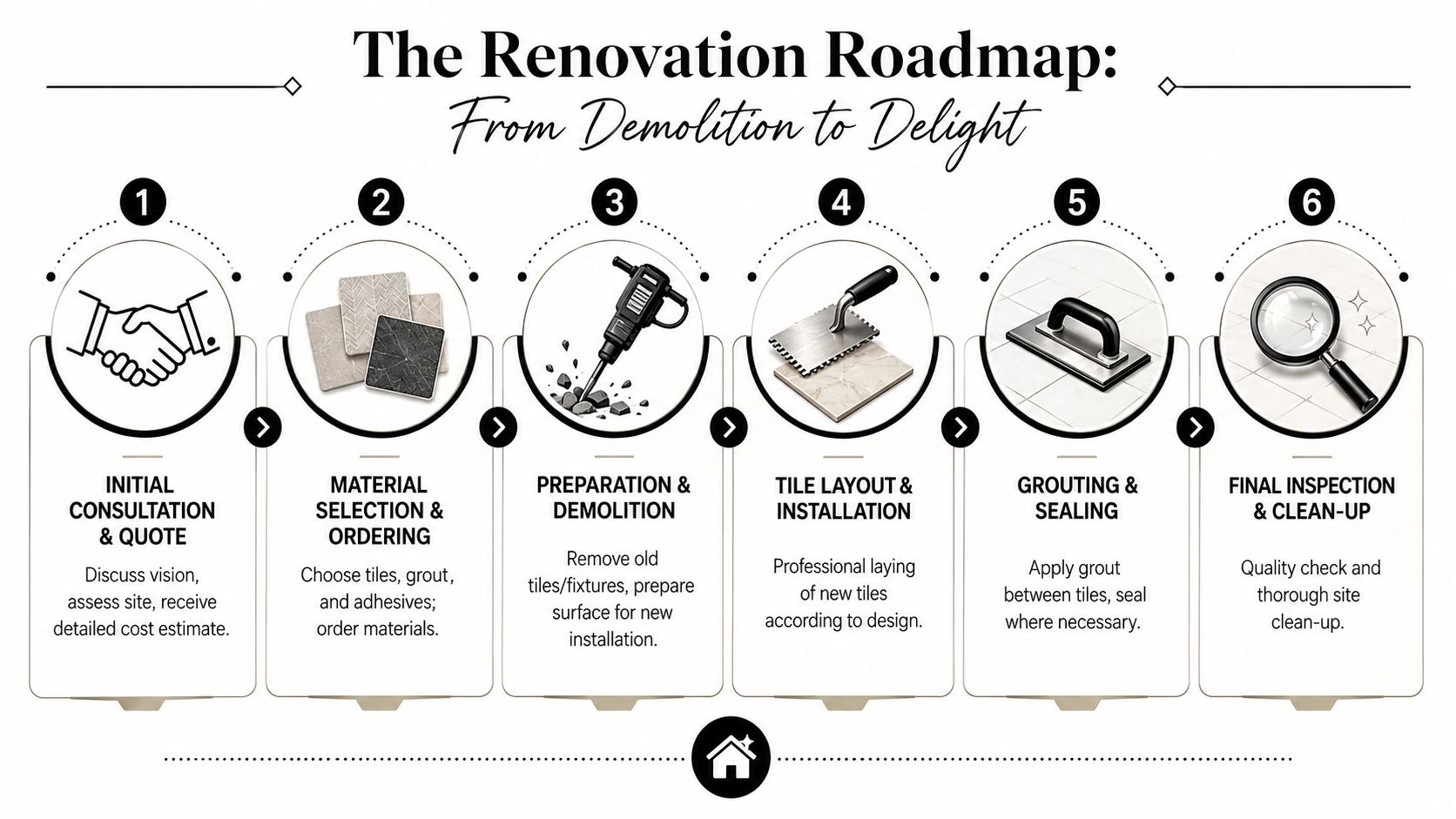

Mastering Outdoor Tiling Melbourne: Tips from Builders

You're usually looking at outdoor tiling in Melbourne for one of two reasons. You want to upgrade a tired patio, balcony, or pool area into something clean and usable, or you already have a problem and water is getting where it shouldn't. In both cases, the same truth applies. The tile you see on top is only one part of the job.
Outdoor tiled areas in Melbourne live hard lives. They deal with rain, standing water, sun, movement in the substrate, and day to day wear. On a ground-level patio, poor preparation leads to drummy tiles, lipping, and puddling. On a balcony or terrace, the consequences are worse. Leaks, cracked grout, swollen framing, damaged ceilings below, and expensive rectification work.

That's why outdoor tiling isn't just a decorative trade item. It's a building project. The success of the job depends on substrate preparation, compliant waterproofing, drainage, movement control, and coordination between trades. If there's structural movement, failing falls, or waterproofing defects, a new tile finish won't fix the root cause. A registered builder can.

Table of Contents

Why Melbourne Outdoor Tiling Is a Job for a Builder

A lot of outdoor tile failures start with the wrong assumption. People think they're buying a surface finish, when they're really buying a waterproofed, drained, movement-managed system.

That matters even more in Melbourne. A paved courtyard, a front entry, a pool surround, a balcony, and a suspended terrace don't behave the same way. The substrate, drainage path, expansion control, and waterproofing requirement can change completely from one to the next. A tiler can lay tiles well, but if the slab has no fall, the balcony edge detail is wrong, or the membrane has failed, the problem sits outside simple tile laying.

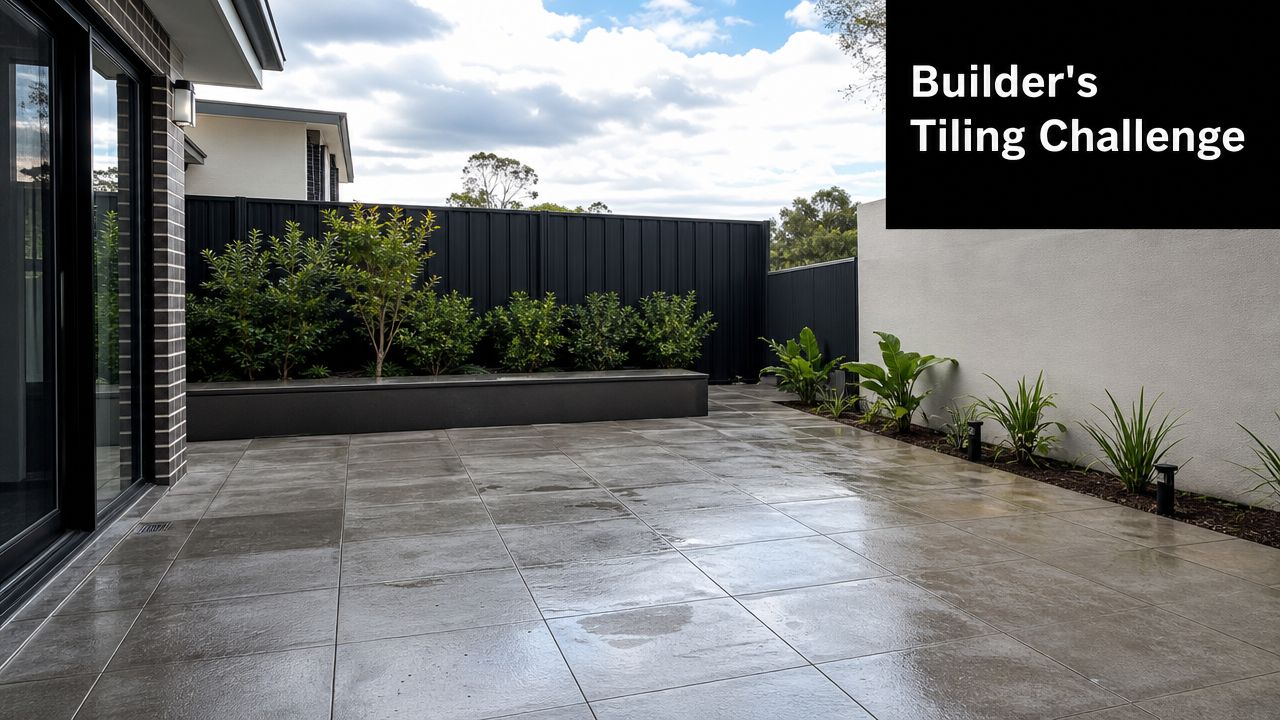
A modern outdoor patio space featuring large grey tiles and a landscaped garden bed against a fence.

Australia's tiling and carpeting services industry was valued at $8.0 billion in 2026, with 20,099 businesses operating nationally, which shows that this is a mature trade category with established standards and a deep subcontractor market under ANZSIC E3243 industry tracking.

Why builder oversight changes the result

On complex outdoor tiling jobs, somebody has to take responsibility for more than the tile line and grout colour. That includes:

  • Substrate assessment: Is the slab stable, cracked, ponding, or moving?
  • Drainage design: Will water leave the surface quickly, or sit at door tracks and corners?
  • Waterproofing coordination: Has the membrane been selected and installed for external exposure?
  • Trade sequencing: Do carpenters, plumbers, waterproofers, and tilers need to be coordinated?
  • Compliance risk: If the job leaks later, who owns the rectification path?

Practical rule: If the tiled area sits over a room, next to internal door thresholds, or on a balcony edge, treat it as building work first and tiling work second.

This is the same mindset good contractors bring to bathroom renovations. In a bathroom, nobody sensible starts with the feature tile before checking falls, puddle flanges, waterproofing, and penetrations. Outdoor tiling in Melbourne deserves the same discipline.

Choosing Tiles That Survive Melbourne's Four Seasons

Homeowners often begin with the look. Grey porcelain, travertine-look pavers, bluestone, concrete-look slabs. That's normal. But outdoors, appearance comes second. A tile can look right in the showroom and still be the wrong product for a wet balcony, shaded path, or exposed terrace.

The first filter is safety and weather performance. In Victoria, tiling services are typically reported at $57 to $132 per square metre, while outdoor installations commonly average around $55 per square metre nationally and can range from $40 to $130 per square metre, depending on material and complexity. Guidance for outdoor applications commonly recommends P4 or P5 slip ratings, 10 to 20 mm thickness for durability, and porcelain with water absorption of less than 0.5% for better moisture resistance in wet conditions, as outlined in this Victoria outdoor tiling cost and specification guide.

An infographic titled Melbourne Outdoor Tile Selection Guide highlighting five key factors for choosing outdoor tiles.

Start with performance, not colour

For most outdoor tiling Melbourne projects, the shortlist usually comes down to porcelain, natural stone, or a paver-style product.

  • Porcelain: Dense, stable, and usually the safest choice when you want low water absorption and consistent sizing.
  • Natural stone: Attractive and often well suited to premium exterior designs, but it needs closer attention to sealing, maintenance, and variation between pieces.
  • Standard ceramic: Fine in many internal settings, but often not my first recommendation for exposed Melbourne exteriors.

What works well outdoors is a tile that can cope with water, UV, and repeated cleaning without becoming slippery or unstable. What doesn't work is choosing solely by colour sample and then discovering the surface is too smooth, the body is too porous, or the tile needs a more controlled substrate than the site can provide.

For homeowners considering oversized panels, it helps to understand the installation side as well as the product side. This guide to large-format tile applications in Melbourne is useful if you're weighing cleaner lines against tighter tolerances.

A quick visual comparison helps before you lock anything in.

Large-format tiles need tighter installation control

Large-format outdoor porcelain can look excellent. Fewer grout joints, a more architectural finish, and cleaner visual flow from inside to outside. But large pieces are less forgiving.

Most local content talks about durability in broad terms. It rarely gets into the trade-offs of large-format porcelain in Melbourne's wet, UV-exposed conditions, or the extra installation sensitivity that larger and thinner panels bring, as noted in this discussion of outdoor tile system trade-offs.

Bigger tiles don't remove movement. They make poor preparation easier to see.

That means flatter substrates, more careful adhesive coverage, more disciplined handling, and sharper control at edges and transitions. If the slab is out, the tile won't hide it. If water sits on the surface, a premium tile won't solve it. On many sites, a smaller module or paver system is the more forgiving and longer-lasting choice.

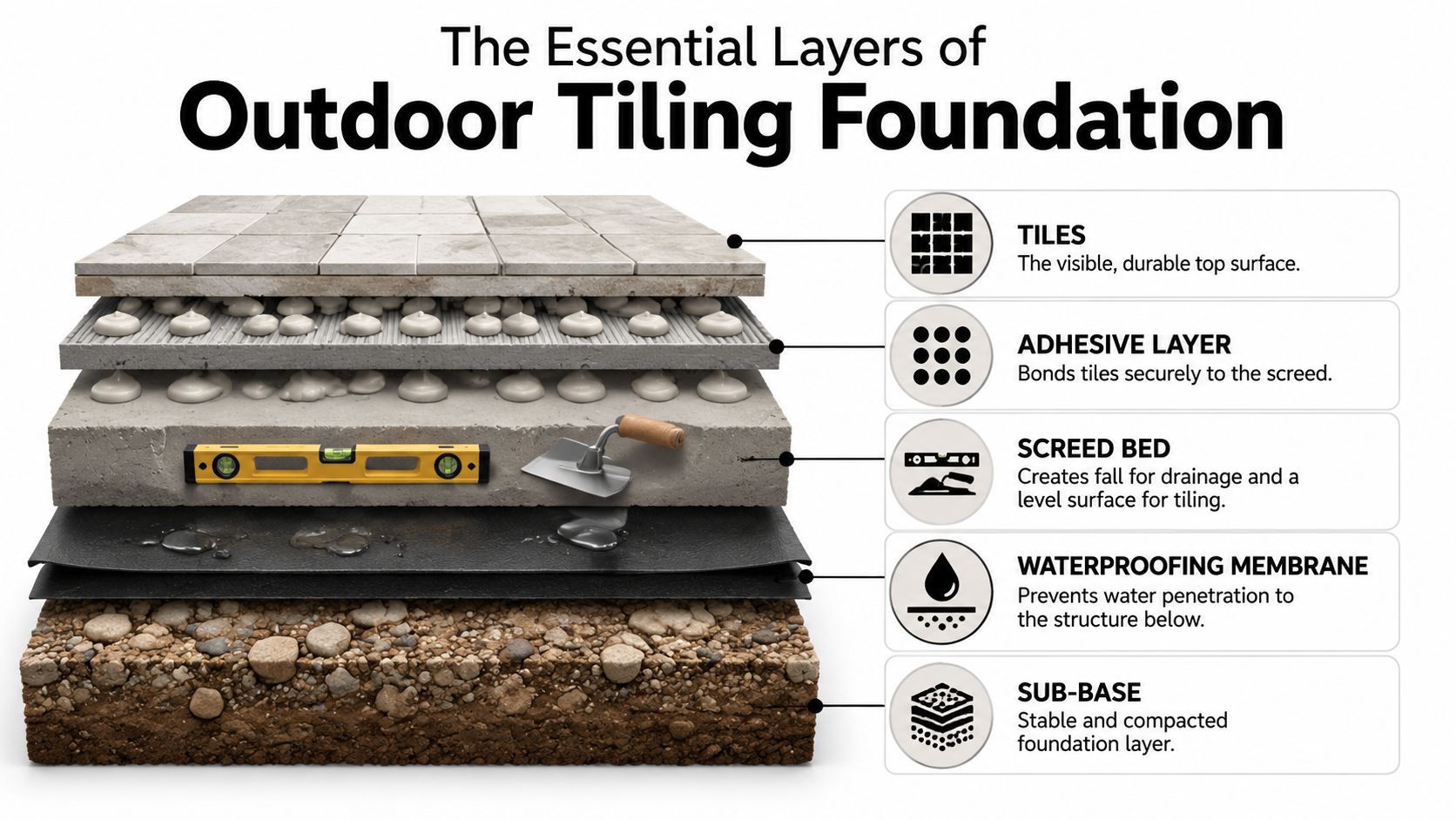
The Unseen Foundation Screeding Waterproofing and Fall

When an outdoor tiled area fails, the tile itself is often blamed first. In practice, the problem usually starts underneath. The visible surface gets the attention. The hidden layers decide whether the job lasts.

The Victorian Building Authority frequently cites waterproofing failures as a common cause of building defects and water ingress complaints, and external tiled areas depend on a complete system that includes membranes, drainage, and movement joints, as discussed in this overview of outdoor tile system failures and waterproofing risk.

A diagram illustrating the essential construction layers of an outdoor tiling foundation, including base, membrane, and screed.

What sits under the tile matters most

A sound outdoor tiling build-up generally includes a stable base, a waterproofing layer where required, a screed or prepared surface with proper fall, suitable adhesive selection, movement control, and the tile finish itself.

Here's the part many quotes skip over. Screeding isn't just “levelling”. On outdoor work it often establishes the fall so water moves to the drain or edge instead of ponding in the middle. That fall has to be intentional and consistent. If water sits, grout stays saturated, dirt builds up faster, and any weakness in the membrane or termination detail gets exposed.

For balcony and terrace work, I'd always want the client to understand the membrane side before they choose the tile side. If you need more detail, this guide to waterproofing requirements in Melbourne tiled areas outlines what should be checked before installation starts.

Where outdoor tiled areas usually fail

Most failures come from a small group of issues:

  • No effective fall: Water ponds instead of draining.
  • Poor membrane detailing: Water tracks into adjacent building elements.
  • Missing or inadequate movement joints: Expansion and contraction stress the tile bed and grout.
  • Unstable substrate: Cracks transfer through the finish.
  • Bad edge and threshold transitions: Water reaches doors, walls, or soffits.

If a balcony is leaking, replacing the tile without checking the membrane, falls, and drainage path is often just expensive camouflage.

A proper builder-led inspection should look beyond hollow tiles or cracked grout. It should ask where water is entering, where it is being trapped, and whether the structure below has already been affected. That's the difference between a cosmetic redo and a real fix.

Budgeting for Your Melbourne Outdoor Tiling Project

Outdoor tiling quotes can look simple on paper. Rate per square metre, tile allowance, adhesive, grout, done. The problem is that two balconies of the same size can have completely different preparation needs, and preparation is often where the actual cost sits.

What the square metre rate does and doesn't tell you

The published Victorian range gives you a starting point, not a full project number. If a quote is built around installation only, you still need to ask what happens if the existing surface is out of level, the falls are wrong, the membrane is defective, or the substrate has cracks that need treatment.

The final cost usually moves on factors like these:

  • Surface condition: A clean stable slab is cheaper to work with than a failed balcony.
  • Tile specification: Slip-rated, thicker, lower-absorption products usually cost more than decorative indoor-grade material.
  • Access and handling: Tight access, stairs, or upper-level work increases labour.
  • Edge details and drains: More cuts and more coordination usually mean more time.
  • Rectification scope: Demolition, disposal, waterproofing, screeding, and crack repair can exceed the visible tile-laying component.

A simple way to read a quote

A good quote separates finish work from remedial work. If it doesn't, you can't compare offers properly.

Cost Component Estimated Cost Range (AUD)
Tiling installation for 20sqm using Victorian general tiling rates Based on $57 to $132 per square metre
Outdoor installation benchmark reference Around $55 per square metre nationally
Alternative national outdoor range reference $40 to $130 per square metre
Performance-driven tile specification factors P4 or P5 slip rating, 10 to 20 mm thickness, porcelain with less than 0.5% water absorption

Use a table like this as a prompt, not a final budget. It shows why a headline rate doesn't tell you enough about the whole build-up.

Ask for these items to be stated separately:

  1. Demolition and disposal
  2. Substrate repair or crack treatment
  3. Waterproofing scope
  4. Screeding and fall correction
  5. Tile supply versus tile laying
  6. Grouting, caulking, sealing, and clean-up

If you're comparing quotes and one is much lower, the first thing to check is what's missing underneath.

The Installation Process From Quote to Completion

A balcony leak in Melbourne often starts long before the first tile is lifted. The owner sees cracked grout or drummy tiles. A builder sees a bigger sequence to check first. Is the slab sound, are the falls correct, is water getting trapped at the threshold, and who is responsible for the waterproofing, drainage, and any structural repair once demolition starts?

That is why outdoor tiling needs a builder-led process, especially on balconies, terraces, podiums, and any tiled area over a habitable space. The tiles go on last. The project succeeds or fails underneath them.

A proper site visit should test more than the finish. The existing substrate, door heights, drainage points, movement joints, adjoining walls, balustrade penetrations, and signs of moisture all need review before anyone talks about tile pattern or grout colour. On remedial work, the surrounding evidence matters. Damp plaster below, staining at slab edges, musty smells, swelling at internal finishes, or movement around balustrade posts usually means the scope is wider than tile replacement.

From there, the job should follow a clear construction sequence:

  • Inspection and scope definition: confirm whether the work is cosmetic replacement, leak rectification, or a broader rebuild of the tiled system.
  • Demolition: remove failed tiles, screed, adhesives, and any loose or contaminated material so the underlying substrate condition is visible.
  • Substrate repair and building works: address cracks, falls, edge details, drainage defects, threshold issues, and any structural or carpentry items before waterproofing starts.
  • Waterproofing: apply the specified membrane system to a sound, prepared surface and allow proper curing time.
  • Screeding and set-out: form consistent falls to drainage, establish finished levels, and resolve edges, step-downs, and interfaces with doors and walls.
  • Tile installation: lay tiles to the set-out, keep joint widths consistent, install movement joints in the required locations, and finish perimeter sealant work properly.
  • Handover checks: review drainage performance, surface finish, jointing, edge details, and any items that affect durability.

This sequence protects everyone. It gives the owner a defined scope, gives the trades clear handover points, and reduces the common argument that the leak must be “in the grout” when the underlying problem sits in the substrate or drainage design.

Bathroom projects follow a similar logic, but outdoor work is less forgiving. Melbourne weather puts more stress on the assembly. Heat, cold, rain, UV exposure, and building movement all act on the same surface. If the build-up is wrong, a neat tile finish can still fail early.

Melbourne Tiling Services P/L is often involved where the work extends beyond tile laying into waterproofing, balcony remediation, bathroom renovations, or rectification tied to building defects. That matters because outdoor tiling regularly overlaps with builder-managed scope, not just finish trade scope.

The smooth jobs are the ones where responsibilities are allocated before demolition begins, the substrate is treated as the main issue, and no one mistakes tile installation for the whole project.

Long-Term Care and Fixing Common Tiling Problems

A well-built outdoor tiled area shouldn't need constant attention, but it does need observation. Most expensive repairs don't begin with a dramatic failure. They start with small signs that were easy to dismiss.

Routine care that prevents bigger problems

Melbourne weather means your outdoor area goes through wet periods, dry heat, leaf litter, wind-driven grime, and seasonal movement. A maintenance routine doesn't need to be complicated, but it should be consistent.

  • Keep drainage points clear: Leaves and dirt around outlets are a common cause of ponding.
  • Wash with the right products: Mild cleaners are safer than aggressive acids or harsh chemicals that can affect grout and sealants.
  • Check movement joints and silicone: If these open up, water finds a path quickly.
  • Watch after heavy rain: Standing water tells you something about falls, not just weather.
  • Inspect edges and thresholds: Door tracks, wall junctions, and balcony perimeters are common weak points.

If the area includes natural stone, sealing and cleaning need to suit that specific material. If it's porcelain, maintenance is often simpler, but grout lines and joints still need periodic checking.

When a repair is enough and when it isn't

Three common complaints come up again and again.

The first is leaks. If water is showing below a balcony or at an adjoining internal wall, don't assume regrouting will solve it. Grout isn't the waterproofing system. A leak often means failure in the membrane, detailing, drainage, or movement accommodation.

The second is efflorescence, the white chalky residue that appears on grout lines or tile edges. That usually tells you moisture is travelling through the system and bringing salts to the surface. Cleaning it off may improve the look, but the moisture source still needs attention.

The third is cracked grout or loose tiles. Sometimes that's localised and repairable. Sometimes it's a sign the substrate is moving, the adhesive bond is poor, or there's no proper movement joint strategy.

A practical way to judge the seriousness is this:

Symptom Often means First response
Local cracked grout Minor movement or isolated bond issue Inspect joints and adjacent tiles
Repeated ponding Inadequate fall or blocked drainage Check outlets and surface levels
Ceiling staining below balcony Waterproofing or edge-detail failure Arrange a proper building inspection
White residue returning after cleaning Ongoing moisture migration Investigate source, don't just clean
Multiple hollow or loose tiles Bond failure or substrate issue Lift and assess the underlying layers

Cleaning solves dirt. It doesn't solve water movement.

The biggest mistake is patching the symptom because it's visible. The durable approach is to identify whether the problem sits in the finish, the bedding, the membrane, or the structure.

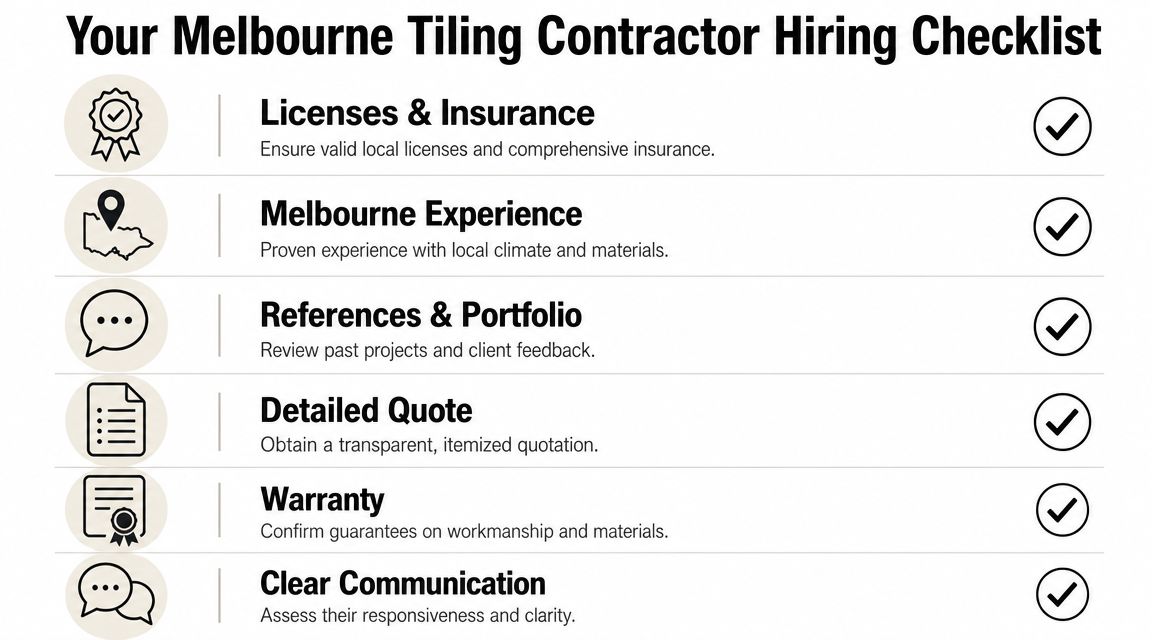
Your Checklist for Hiring a Tiling Contractor in Melbourne

Hiring for outdoor tiling in Melbourne is really about hiring for risk control. You're not just choosing somebody to lay tiles neatly. You're choosing who will identify hidden defects, coordinate the right trades, and stand behind the system underneath the finish.

A checklist for hiring a tiling contractor in Melbourne, featuring tips on insurance, experience, and communication.

Questions worth asking before you sign

Use these questions early. They'll tell you very quickly whether you're speaking to a finisher or a contractor who understands external wet-area risk.

  • Are you a registered builder for projects that involve waterproofing, structural repair, or multi-trade coordination?
  • Who handles the waterproofing and what compliance documentation is provided?
  • Does the quote include substrate preparation, screeding, and fall correction if needed?
  • How do you deal with movement joints and drainage details?
  • Have you completed balcony, terrace, or leak-rectification work in Melbourne conditions?
  • Who manages associated trades if plumbing, carpentry, or remediation work is required?

For homeowners still comparing options, it helps to review what local tiling contractors near you in Melbourne list as part of their scope, rather than assuming every tiler offers builder-level coordination.

What a good quote should include

A solid quote should make it easy to see what is and isn't included. Look for clear separation between preparation, waterproofing, tile installation, and finishing. If the quote only talks about laying tiles, it may be missing the part of the project that matters most.

Check for:

  • Site preparation details
  • Responsibility for demolition and waste
  • Waterproofing scope and who performs it
  • Drainage and fall treatment
  • Tile type and finish assumptions
  • Movement joint and sealant allowance
  • Exclusions and latent conditions

The right contractor won't pretend every outdoor area needs the same treatment. They'll explain what the site requires, what can go wrong if it's skipped, and where the true value lies.


If you're planning outdoor tiling, dealing with a leaking balcony, or comparing quotes for a more complex tile and waterproofing job, Melbourne Tiling Services P/L can inspect the site, explain the build-up underneath, and scope the work as a building project rather than just a surface finish.

Tile Repair Melbourne: Expert Solutions for 2026

A lot of tile problems start small. One cracked floor tile near the vanity. A shower tile that sounds hollow when you tap it. Grout that keeps darkening no matter how often you clean it. Most homeowners in Melbourne look at that and think the same thing. Can this be patched quickly and cheaply so life can get back to normal?

Sometimes yes. Often, no.

Good tile repair in Melbourne isn't just about swapping a broken tile for a new one. It's about working out why the tile failed in the first place. In bathrooms, ensuites, laundries, balconies, and wet areas, a surface defect can be the visible part of a deeper issue involving movement, moisture, drainage, screed failure, or waterproofing breakdown. That's where a repair decision overlaps with the bigger picture of bathroom renovations and building compliance. A proper fix protects the room, not just the tile face.

Table of Contents

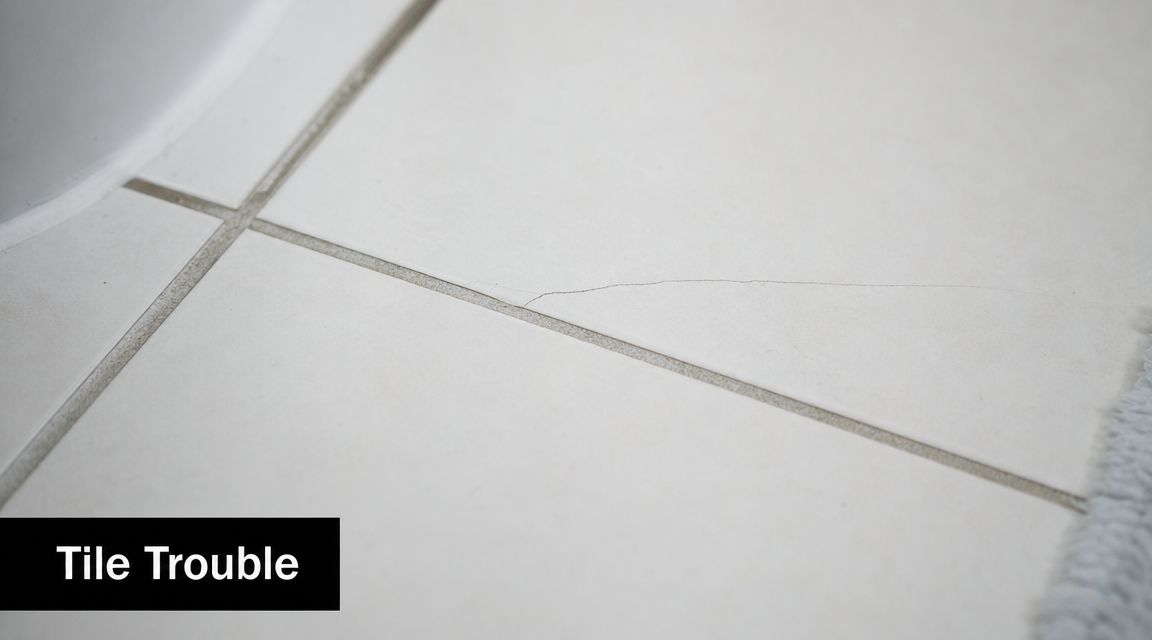
That Cracked Tile Is Telling You a Story

You step out of the shower and feel a slight crunch underfoot. Later, you notice a fine crack running from the corner of a floor tile to the grout line. A week after that, one patch of grout near the screen always looks damp. None of those signs seem dramatic on their own, but together they usually mean the room is asking for attention.

In Melbourne homes, tile failures often get treated as cosmetic problems first. A handyman replaces one tile. Fresh grout goes in. Silicone gets neatened up. The bathroom looks better for a while, but the same spot starts failing again because the actual problem was underneath.

A close-up view of a cracked white floor tile in a bathroom near the grout lines.

That's why the first question isn't “How do we hide this?” It's “What caused it?”

A single cracked tile can come from impact. Several cracks appearing over time can point to movement in the substrate. A loose shower tile may be a bond failure. Damp grout can be surface moisture, but it can also be a warning sign that water is getting where it shouldn't. In wet areas, especially older bathrooms, the tile layer is only one part of the system. If the waterproofing, screed, falls, or base preparation has failed, a neat patch-up won't last.

Practical rule: If the same area keeps cracking, sounding hollow, leaking, or losing grout, stop treating it as a one-off tile problem.

A Registered Builder matters. A tiler can replace tiles. A builder looks at the room as an assembly of trades, substrate, waterproofing, drainage, and compliance. That broader view is what separates a worthwhile repair from a false economy. In many bathroom renovations, the smartest money is spent on diagnosis first, because that determines whether a local repair will hold or whether the room needs deeper remedial work.

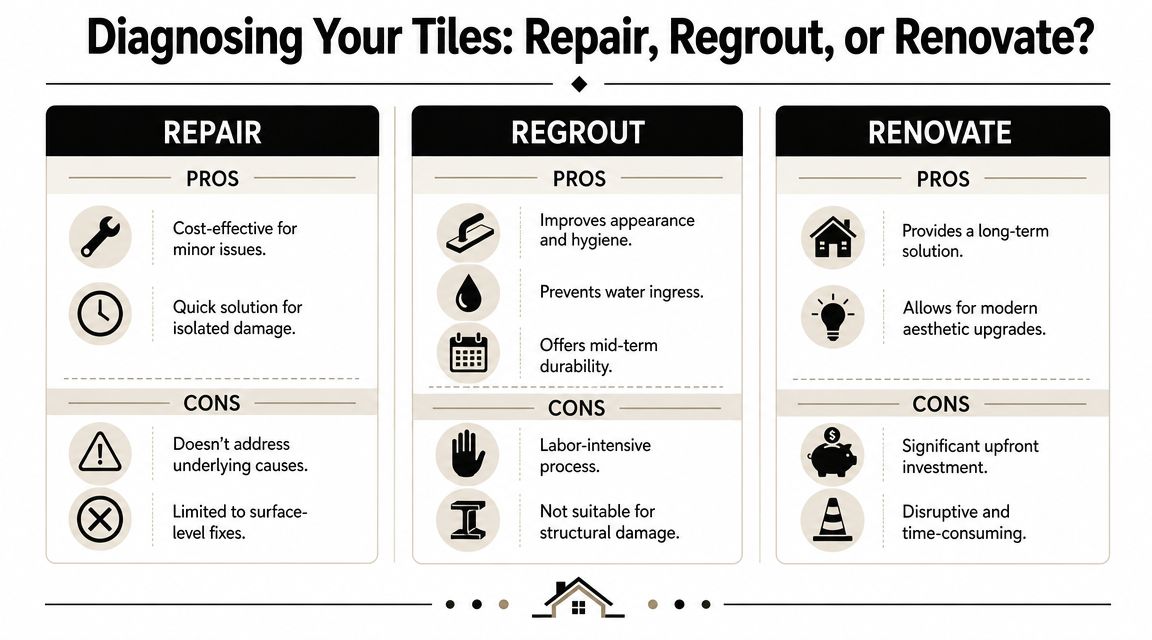
Diagnosing Your Tiles Repair, Regrout, or Renovate?

Many homeowners want the smallest possible job. That's understandable. But the right answer depends less on what you can see and more on what the symptoms are telling you. One of the biggest mistakes in tile repair Melbourne jobs is choosing a cosmetic fix for a structural or waterproofing problem.

Many Melbourne homeowners ask “Can you just replace the broken tile?” when the more important question is “Why did it fail?” A diagnostic approach matters because failed waterproofing is treated as a systemic risk, and recurring grout loss, hollow tiles, and leaks after rain often mean concealed water damage makes a simple patch repair short-lived, as discussed by Melbourne tile regrouting guidance.

A comparison chart outlining the pros and cons of tile repair, regrouting, and full renovation projects.

When a repair is usually enough

A localised repair can work well if the failure is clearly isolated.

  • Single impact damage: One chipped or cracked tile after something heavy was dropped.
  • Stable surrounding area: Adjacent tiles are firm, level, and well bonded.
  • No moisture signs: No mould smell, staining, soft walls, or recurring grout issues.
  • Replacement tile available: The colour, calibre, and finish can be matched closely enough.

This kind of job is still delicate. Removing one tile without damaging its neighbours takes care, especially with rectified porcelain or tightly jointed walls.

When regrouting makes sense

Regrouting is useful when the tiles are sound but the joints are tired, porous, stained, or crumbling. It can improve hygiene, appearance, and water shedding at the surface. It isn't a cure for movement or waterproofing failure.

Good regrouting depends on removing failed grout properly, cleaning the joints, and choosing the right product for the area. If you're comparing surfaces and finishes before any rework, it helps to understand how ceramic, porcelain, marble, and other tiling materials behave in wet areas and repairs.

Regrouting works best when the tile assembly is still healthy. It fails fast when the base underneath is moving or staying wet.

When renovation is the smarter call

There comes a point where repair costs stack up without solving the room. That's when a bathroom renovation or partial rebuild becomes the better decision.

Common signs include:

  • Multiple drummy tiles
  • Leaks outside the shower recess
  • Recurring grout cracking at the same joints
  • Loose floor tiles near the waste or doorway
  • Swelling skirtings, damaged architraves, or staining in adjacent rooms
  • Older bathrooms with repeated patch jobs

In those cases, the issue is rarely just the visible tile. It's more often the system beneath it. A renovation gives access to the substrate, waterproofing, falls, drainage points, and penetrations. That lets the repair address the cause instead of chasing symptoms.

A useful way to think about it is this:

Symptom Best first response
One cracked tile after impact Local repair
Sound tiles, dirty or failing joints Regrout assessment
Hollow tiles plus dampness Investigate substrate
Shower leak or balcony leak Builder-led inspection
Repeated failures in same area Renovation assessment

The cheapest quote is often for the smallest scope. The best value comes from choosing the scope that corresponds to the failure.

A Guide to Common Tile Failures in Melbourne Homes

Tile failure usually follows a pattern. Once you know what to look for, it becomes easier to describe the problem properly and get the right trade involved from the start.

Impact cracks versus movement cracks

An impact crack is usually obvious. Something heavy hits the tile and the damage is centred around that point. The surrounding tiles often stay stable, and the grout lines may remain intact.

Movement cracks behave differently. They tend to appear along stress lines, near corners, across several tiles, or repeatedly in the same zone. That points to movement below the tile surface. In bathrooms, that can mean deflection in the floor, substrate instability, or stress around penetrations and transitions.

Loose tiles and drummy floors

A “drummy” tile sounds hollow when tapped. Homeowners often notice it first by feel rather than sound. The floor feels different. The tile may flex slightly, or grout around it starts powdering out.

That hollow sound usually means the bond between tile and base has been compromised. Sometimes the issue is poor adhesive coverage. Sometimes moisture has weakened the bond. In older wet areas, persistent water exposure can affect more than one layer of the assembly, so the tile is only the first thing you notice.

Grout breakdown that keeps returning

Grout does age, and not every grout problem means a major rebuild. But if the same joints keep cracking or washing out, there's usually a reason. Recurrent failure often points to movement, trapped moisture, or both.

Watch for these clues:

  • Same line, same problem: Grout keeps reopening in exactly the same joint.
  • Dark joints that never dry: Moisture is lingering where it shouldn't.
  • Powdering and edge staining: Water is moving through the assembly.
  • Silicone failure nearby: Junctions are under stress or staying wet.

If grout fails once after many years, that may be age. If it fails again soon after replacement, assume the grout isn't the real problem.

Leaks that show up away from the tile

Leaking showers and balconies rarely announce themselves neatly. The visible stain may appear outside the bathroom, below the slab edge, in a wardrobe backing onto the shower, or on a ceiling below. That's why homeowners sometimes miss the link between a small tile issue and a bigger waterproofing defect.

Tiles and grout are not the waterproof layer. They're the wearing surface. Once water gets past them and the membrane or substrate isn't doing its job, the moisture travels. By the time you see peeling paint or swollen trim, the repair decision is no longer just about replacing a tile. It's about protecting the building fabric.

DIY vs Professional Repair Is It Worth the Risk?

DIY has its place. Replacing a soap dish, scraping old silicone, or cleaning stained grout can be sensible if you know the limits. The risk starts when a visible tile defect tempts you into disturbing a wet area assembly without understanding what's beneath it.

Where DIY can work

DIY is usually safest when the job stays cosmetic and low-risk.

  • Surface cleaning and maintenance: Removing soap build-up, mould staining, or old sealant residue.
  • Minor aesthetic touch-ups: Small chips in non-critical areas where waterproofing isn't involved.
  • Observation and documentation: Marking crack progression, photographing damp spots, or checking whether a tile sounds hollow.

Once demolition starts, the stakes change. Matching tile size is one thing. Matching the original bed height, maintaining falls, protecting adjacent waterproofing, and avoiding collateral damage are another.

Where a registered builder changes the outcome

In Melbourne bathrooms, repairs often involve more than one trade. That's the point many homeowners discover they don't have a simple tiling issue at all. They have a leaking shower, damaged substrate, poor drainage, or a failed membrane.

If you're weighing up the risks in wet areas, it helps to understand how leaking showers are properly assessed and repaired before deciding whether a patch job is enough.

Here's the practical comparison:

Factor DIY Repair Professional Repair (Registered Builder)
Upfront cost Lower at the start Higher at the start
Long-term cost Can rise quickly if the repair fails Better aligned to root-cause repair
Tools required You source and learn as you go Trade tools and proven methods already in use
Time Weekends, delays, repeat attempts Planned sequence with coordinated trades
Tile matching Often limited to what you can find Better strategy for blending, substitution, or redesign
Waterproofing judgement Easy to underestimate Assessed within the whole room system
Compliance Hard to manage if the scope expands Managed as part of the build process

Professional repair isn't only about workmanship. It's also about decision-making. A registered builder looks at sequencing, protection of other finishes, access, moisture risk, and whether a local repair could create a larger liability later. That matters in family bathrooms, investment properties, and apartments where leaks affect neighbouring lots.

There's also the practical issue of accountability. If a repair touches waterproofing, drainage falls, or concealed damage, you want a scope that reflects the actual condition of the room. That's much harder to achieve with piecemeal patching.

The Professional Process A Registered Builder's Workflow

A sound tile repair job starts before a single tile is lifted. In Melbourne bathrooms and balconies, the visible crack is often the last sign to appear, not the first thing to go wrong. A registered builder approaches the work as fault finding first, repair second.

A professional infographic outlining the seven-step workflow for residential or commercial tile repair and restoration services.

Step one is always diagnosis

The first inspection should look beyond the broken tile. The pattern of failure matters. One loose tile near a doorway can point to movement. Repeated grout loss around a shower base can point to moisture. Hollow sounding tiles across a larger area can suggest bond failure or a problem in the substrate below.

That inspection usually includes checking cracked areas, tapping surrounding tiles, looking at grout joints, inspecting adjacent rooms, and asking practical questions about the room's history. Has the area been repaired before? Does the problem worsen after showers? Has silicon been replaced more than once? Those details help separate a local repair from a room-wide issue.

A builder-led assessment should narrow the scope into the right category:

  • Isolated tile failure
  • Localised debonding
  • Waterproofing concern
  • Drainage or screed defect
  • Full wet-area remedial work

That distinction matters because the repair method changes with the cause. Replacing one tile over a wet or unstable base usually means doing the same job twice. If the fault reaches the waterproofing layer, the work also needs to be judged against Victorian requirements for wet area repairs and certification. The standard for that is clearer when the scope is reviewed alongside waterproofing compliance requirements in Victoria.

Removal prep and rebuild

Once the cause is understood, the site gets prepared properly. In an occupied home, that means protecting vanities, shower screens, timber floors, and access paths. In apartments, it can also mean dust control, lift protection, acoustic limits, and strict work hours.

Tile removal needs control. The goal is to expose the failed area without damaging sound surrounding work that can stay in place. During removal, the underlying condition often becomes obvious. Failed patch repairs, weak bedding, poor adhesive coverage, cracked screeds, and moisture-damaged backing are common findings.

A proper rebuild may involve:

  • Substrate correction: Repairing unstable, damaged, or moisture-affected base materials
  • Screeding or levelling: Restoring the correct plane and falls so water drains as intended
  • Waterproofing repairs where required: Reinstating the wet-area system, not only the tile finish
  • Tile selection and set-out: Matching the existing layout and appearance as closely as practical

A registered builder adds value over a tile-only patch service. If the demolition exposes failed waterproofing, structural movement, or concealed water damage, the scope can be adjusted before the room is closed up again. That protects the rest of the bathroom, not just the spot you can see today.

Finishing the repair properly

The final stage is about service life as much as appearance. Tiles need to sit flat, joints need to be consistent, and replacement pieces need to work with the existing room rather than draw attention to themselves. Grout colour matters. Joint width matters. Movement joints and sealant details at junctions matter as well, especially in showers, balconies, and floor-to-wall transitions.

A clean-looking repair can still fail if water keeps sitting in the wrong place, if the substrate still moves, or if the waterproofing was already compromised.

Melbourne Tiling Services P/L is one example of a builder-led operation that handles bathroom renovations, waterproofing, screeding, leak rectification, and tile installation under a registered building scope. That model suits repairs that affect the integrity of the room, involve more than one trade, or raise compliance questions.

The handover should be clear and practical. Homeowners should be told what failed, what was repaired, what remains outside the repaired area, and whether any further remedial work is recommended. That is how small tile repairs stay small, instead of turning into a larger bathroom problem six months later.

Understanding Costs Timelines and Compliance in Melbourne

A cracked shower tile can look like a half-day job. Then the tile comes up, the bed is damp, the substrate is soft, and the repair is no longer about one tile. That is why pricing and timing in Melbourne vary so much. The visible damage is only the starting point.

A proper quote has to allow for diagnosis, careful removal, protection of adjacent finishes, and making good once the cause is confirmed. If the problem stays local, costs stay contained. If the repair exposes failed waterproofing, movement, or water damage, the job shifts from tile replacement to remedial building work.

What affects cost

The main cost drivers usually include:

  • How much demolition is needed to reach sound material
  • Whether replacement tiles or suitable alternatives can be sourced
  • Tile size, finish, and breakage risk during removal
  • Access conditions in occupied homes, apartments, and strata buildings
  • The condition of the substrate, screed, or wall sheeting
  • Whether other trades are required, such as waterproofers or carpenters

Material also changes the risk profile. Standard ceramic is usually more forgiving. Large-format porcelain, stone, and older brittle tiles often take more time because removal has to be controlled and the finished repair is less tolerant of unevenness, lipping, or colour variation.

The Melbourne market has a wide spread in quoting styles and scope. Some quotes cover a patch only. Others include investigation, rectification, drying time, and compliance steps if the work affects a wet area. The cheaper figure is not always the lower-cost outcome if the original cause is left in place and the bathroom has to be opened again.

What affects timing

Area matters less than sequence.

A single dry-area tile with matching stock on hand can be repaired quickly. A shower repair can slow down for good reason. Materials may need time to dry. Waterproofing and adhesives have curing requirements. Access in apartment buildings can limit working hours, waste removal, and deliveries.

Common timing factors include:

  • Availability of matching tiles, trims, and grout
  • Drying time after leaks or moisture exposure
  • Trade coordination if the job goes beyond tiling
  • Noise, dust, and access rules in occupied properties
  • Strata booking windows, lift protection, and site restrictions

Homeowners usually want one firm timeframe. In practice, the honest answer depends on what is found once the room is opened. Builder-led repairs are better at managing that uncertainty because the scope can be adjusted properly instead of being forced into a tile-only fix that does not suit the condition underneath.

Why compliance matters

Compliance becomes part of the job as soon as the repair touches the waterproofed system or broader building elements. At that point, the question is no longer just how to replace a tile. The question is whether the bathroom still meets the standard expected of a wet area and whether the repair has been documented correctly.

That is where registered builder oversight matters. A builder can assess whether the failure is isolated or part of a larger defect, bring in the right trades, and make sure the repair method suits the actual condition of the room.

If your job may involve wet-area rectification, read more about a waterproofing compliance certificate in Victoria and when it applies. It helps clarify what work needs formal sign-off and why that matters for resale, insurance, and the long-term integrity of the bathroom.

Frequently Asked Questions About Tile and Bathroom Projects

Can you match old or discontinued tiles?

Sometimes. If spare tiles were kept from the original job, that's ideal. Without them, matching becomes a blend of size, edge profile, surface finish, and colour tone. In some repairs, a close match works. In others, a deliberate design change looks better than a poor patch.

Can premium tiles be repaired invisibly?

Not always. High-end porcelain, marble, and large-format products can be difficult to remove and replace without affecting adjacent tiles or revealing slight variation. Repairing premium or large-format tiles in occupied strata properties also brings practical issues like noise limits, dust control, and pattern mismatch risk, as highlighted in this discussion of premium tile repair in occupied properties.

Is a Registered Builder really necessary for bathroom work?

If the issue is confined to an isolated tile, not always. But once the job touches waterproofing, drainage, substrate failure, or multiple trades, builder oversight becomes far more important. Bathrooms are systems, not just finishes.

What about apartments and strata properties?

Access, working hours, waste removal, lift protection, and neighbour impact all need planning. The quality of the repair is only half the job. The other half is how the work is managed.

Should I repair or renovate?

If the failure is local and the cause is clear, repair can be the right move. If the room has repeat issues, hidden moisture, or signs of broader deterioration, renovation is often the more durable decision.


If you need clear advice on tile repair, leaking showers, balcony issues, or a bathroom renovation scope, Melbourne Tiling Services P/L can inspect the problem, explain whether repair or rebuild makes more sense, and provide a practical next step for your property in Melbourne.

Expert Leak Detection Melbourne: Your 2026 Guide

A lot of Melbourne homeowners arrive at the same point the same way. There's a faint musty smell near the bathroom door. A skirting board starts to swell. Paint bubbles for no obvious reason. Or the shower looks fine on the surface, but the room on the other side of the wall doesn't.

That's usually when the worry starts. Is it a pipe leak, a shower leak, failed grout, a cracked tray, bad waterproofing, or something coming from upstairs?

The important thing to know is this. Leak detection in Melbourne isn't the finish line. It's the first diagnostic step. Finding where water is escaping matters, but a lasting result depends on understanding why it's happening and who should fix it properly. In bathrooms, balconies, laundries, and apartment wet areas, the underlying issue is often bigger than a simple patch.

Table of Contents

That Unsettling Feeling of a Hidden Leak

It often starts with something small that doesn't quite make sense. The laundry smells damp even after you've aired it out. A ceiling stain appears below an upstairs bathroom, then seems to dry, then comes back. The shower still drains, the taps still work, and nothing looks dramatic, so it's tempting to leave it for another week.

That delay is where leaks become expensive. Water rarely stays where the original problem began. It tracks along framing, under tiles, through slab edges, behind cabinetry, and into rooms that seem unrelated to the source.

In Victoria, the broader scale of hidden water loss is serious. A University of Technology Sydney paper citing National Performance Report data noted a Victorian real-loss figure of 778 litres per service connection per day, which shows how much water can disappear before anyone sees obvious evidence on the surface (UTS leak detection research).

Practical rule: If the signs are intermittent, that doesn't mean the problem is minor. It often means water is moving through the building in a way that's harder to trace.

Homeowners usually call for leak detection because they want a location. Fair enough. But in real building work, location is only part of the answer. A leak from a failed mixer connection is one kind of job. A shower leaking through failed membrane junctions, cracked movement joints, or poor bathroom renovation detailing is another.

That difference matters because the right trade can change. Sometimes you need a plumber. Sometimes you need a registered builder to coordinate demolition, substrate repair, waterproofing, tiling, and compliant reinstatement. Often you need both, in the right order.

Telltale Signs Your Melbourne Home Has a Water Leak

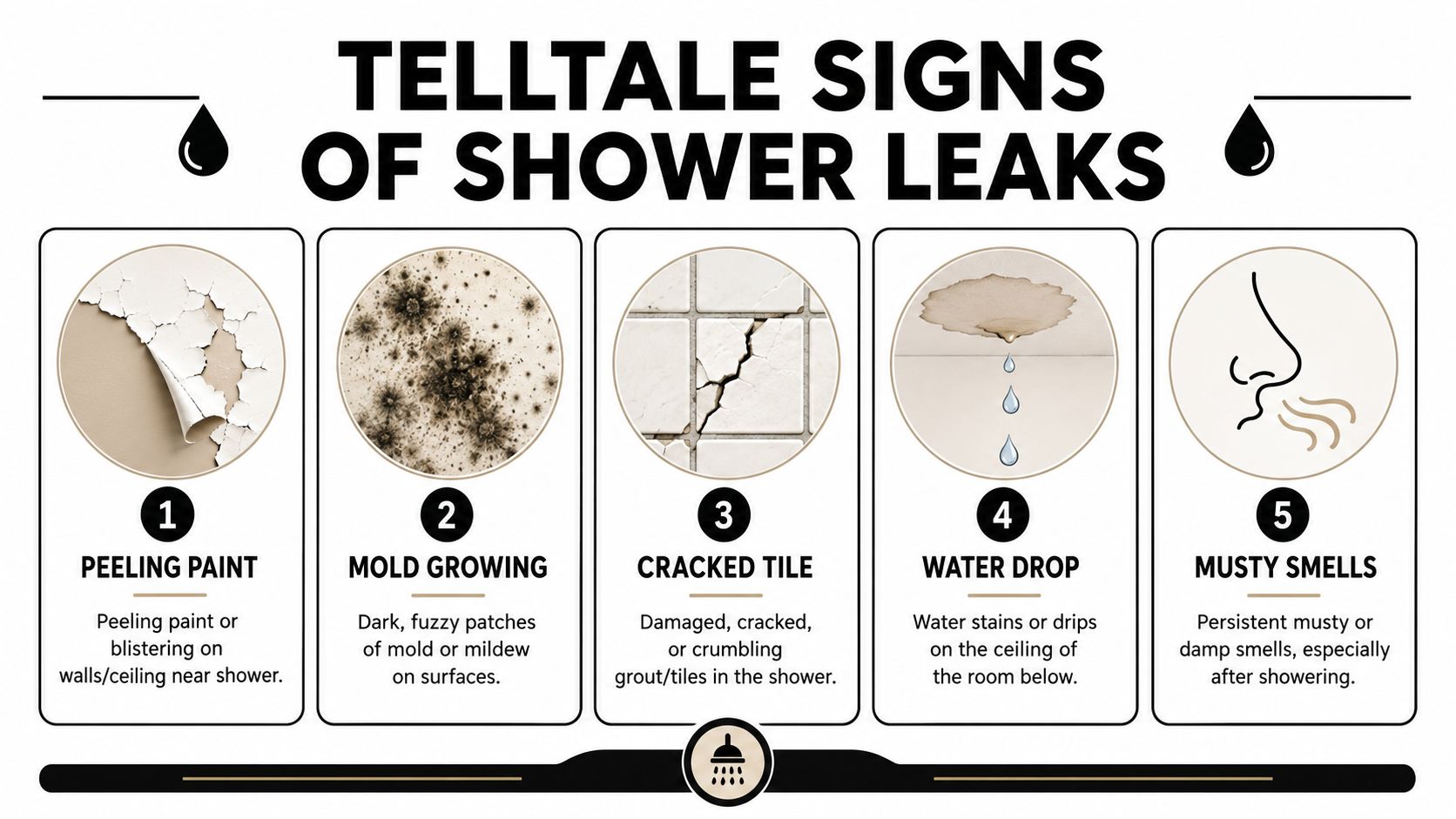
Telltale Signs Your Melbourne Home Has a Water Leak

The clearest clues usually come from your senses before any tool confirms them. If you're trying to work out whether you need leak detection in Melbourne, start by slowing down and looking at the pattern, not just the damage itself.

What you can see

A hidden leak often shows up as a surface symptom first:

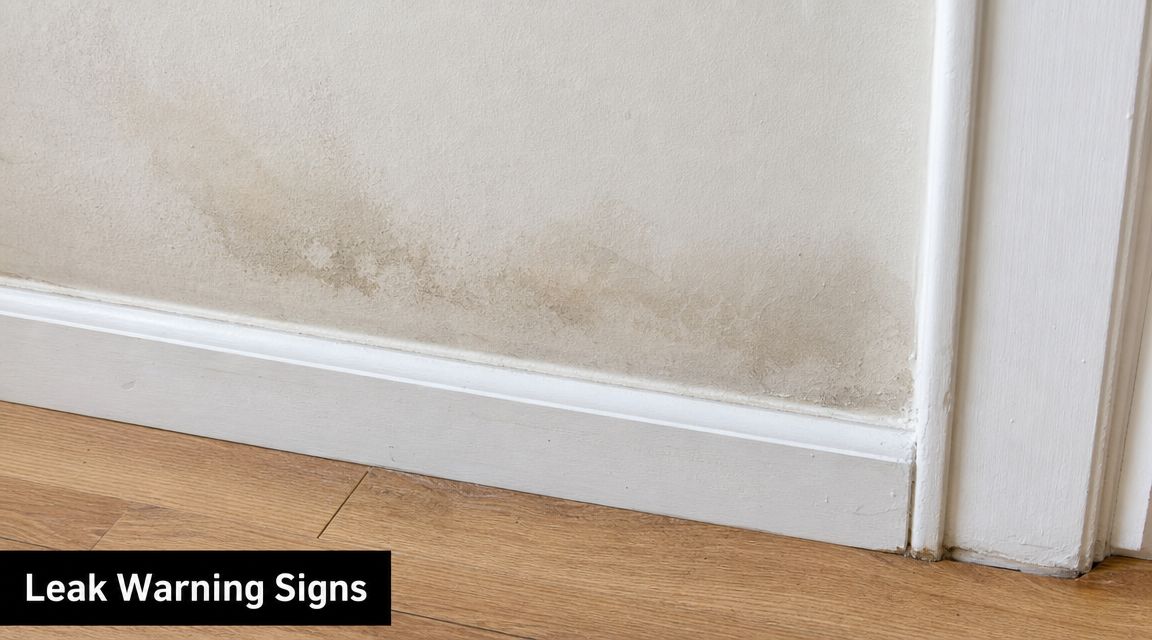
  • Ceiling stains: Brownish or yellowish marks under bathrooms, balconies, or roof-adjacent wet areas often mean water has travelled before becoming visible.
  • Bubbling paint: Paint that lifts or blisters usually points to moisture trapped behind the finish.
  • Swollen skirting or architraves: Timber products absorb moisture early and often reveal a problem before tiles do.
  • Loose or drummy tiles: If tiles sound hollow or start shifting, moisture may have affected the adhesive bed or substrate.
  • Efflorescence on brick or grout: That white, powdery residue is a sign that water has been moving through masonry or cement-based materials.

One detail many people miss is location. A stain directly beside a shower hob suggests one type of failure. Dampness appearing in the hallway outside the bathroom can suggest water is escaping beyond the immediate wet area.

What you can hear and smell

Not every leak leaves a puddle.

A quiet hiss in the wall after taps are turned off can indicate pressure-side pipe issues. Dripping sounds at night, when the house is quiet, are worth paying attention to. So is a musty smell that gets stronger after showers or after using a particular vanity, toilet, or washing machine.

Here's a practical demonstration of signs homeowners often notice before they know the cause:

A bathroom can smell “old” when it's actually staying damp behind the tiles, under the tray, or inside the wall cavity.

When the location gives the game away

Different rooms suggest different causes. That doesn't replace testing, but it helps narrow the field.

Area where you notice it Common underlying issue
Around a shower screen Failed seals, movement joints, grout cracking, poor falls
Wall behind a vanity Flexible hose connection, trap leak, basin waste issue
Ceiling below bathroom Shower leak, toilet seal issue, pipe connection, failed waterproofing
Balcony door threshold Membrane failure, poor drainage, flashing detail problem
Laundry cabinet base Tap connection, appliance hose, waste leak

If you've got more than one sign at once, such as smell plus swollen skirting plus loose tiles, the issue usually isn't cosmetic. Water has been there long enough to affect surrounding materials.

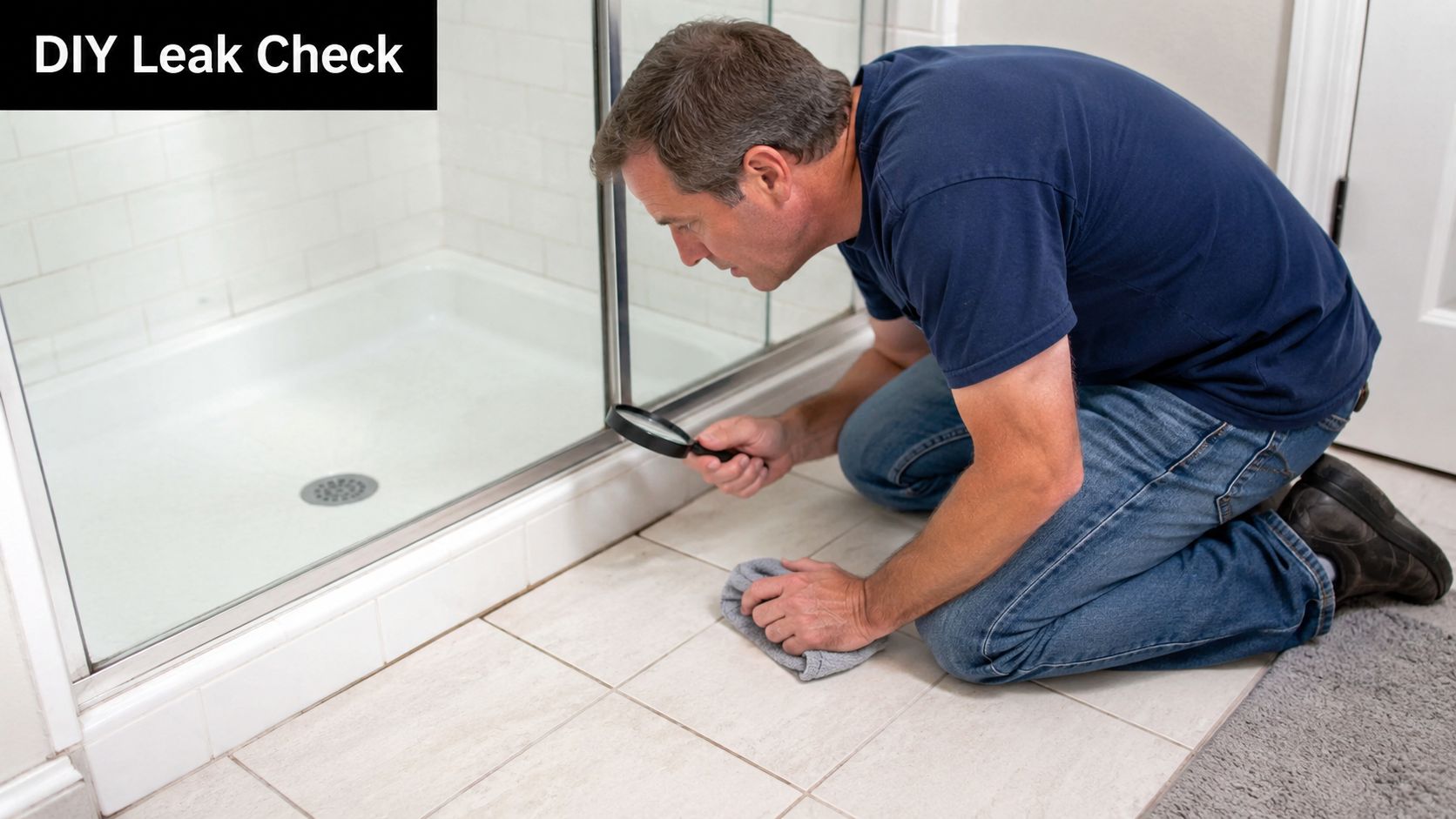
Safe DIY Leak Checks You Can Perform This Weekend

You can do a few useful checks yourself without damaging the building. The key word is safe. A good DIY check helps you decide how urgent the problem is. It doesn't replace proper leak detection when the source is hidden.

Start with the water meter

The most useful homeowner test is a basic meter isolation check.

  1. Turn off all water fixtures and appliances inside and outside the home. That includes dishwashers, washing machines, irrigation, and any tap that may be dripping.
  2. Check that toilets have finished refilling before you start.
  3. Read the water meter and note the position carefully.
  4. Don't use any water for a set period. Overnight is practical because the house is usually quiet and still.
  5. Recheck the meter in the morning.

If the reading has changed despite no water use, there's a strong indication that water is moving somewhere it shouldn't. That doesn't tell you whether the problem is under the slab, in a wall, in a toilet cistern, or in an external line. It does tell you the issue deserves proper testing.

Check the fixtures that commonly leak quietly

A lot of small leaks hide in plain sight.

  • Toilet cisterns: Add a few drops of food colouring to the cistern and wait before flushing. If colour appears in the bowl, water is passing where it shouldn't.
  • Under-sink pipework: Run your hand around trap connections and isolation valves. Look for moisture on the cabinet floor, not just obvious drips.
  • Shower edges and corners: Check silicone joints, base junctions, and adjacent skirtings. If the shower leaks after use but no plumbing is exposed, failed waterproofing becomes more likely.
  • Appliance hoses: Pull the washing machine or dishwasher forward if it's safe to do so and inspect for slow weeping around hose connections.

If you're dealing with a shower specifically, it also helps to understand the difference between a surface seal issue and a deeper waterproofing failure. This guide on how to fix leaking showers is useful for understanding where basic resealing ends and proper rectification begins.

What not to do

Don't start removing tiles, cutting plaster, drilling exploratory holes, or tightening fittings you can't properly assess. Those moves often create a second problem.

Avoid these mistakes:

  • Don't chase stains blindly: The visible mark is often not the source.
  • Don't rely on grout as waterproofing: Grout can crack and absorb moisture. It isn't the system that protects the structure.
  • Don't keep resealing without diagnosis: Fresh silicone can hide evidence and delay the actual fix.
  • Don't ignore intermittent leaks: Shower-related leaks often appear only after use, then dry out enough to mislead you.

An Inside Look at Professional Leak Detection Methods

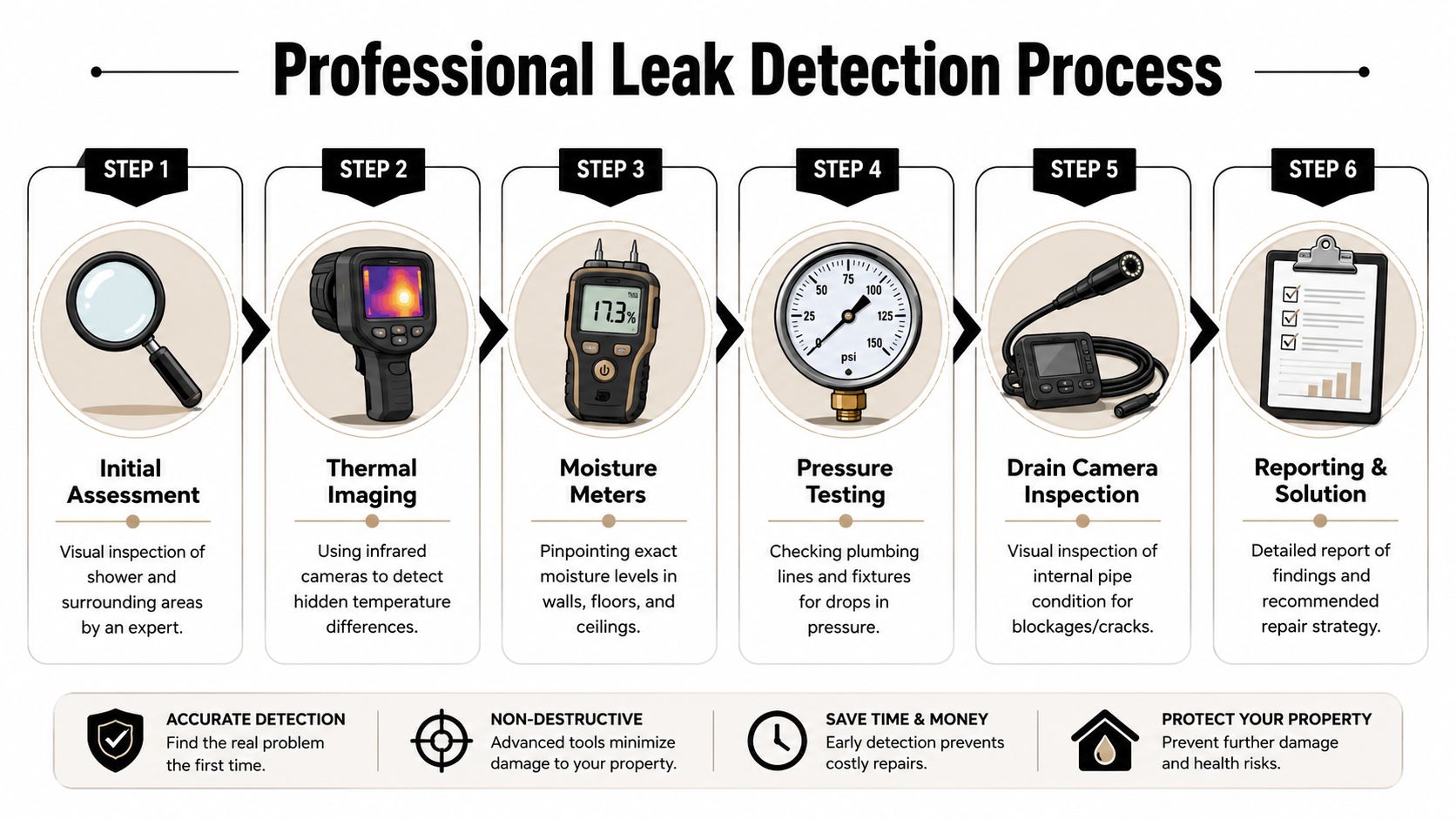
Professional leak detection works best when the method matches the failure type. Good operators don't wave one gadget at every problem. They test a theory, isolate possibilities, and use the least destructive method that can produce reliable evidence.

An Inside Look at Professional Leak Detection Methods

Thermal imaging and moisture tracing

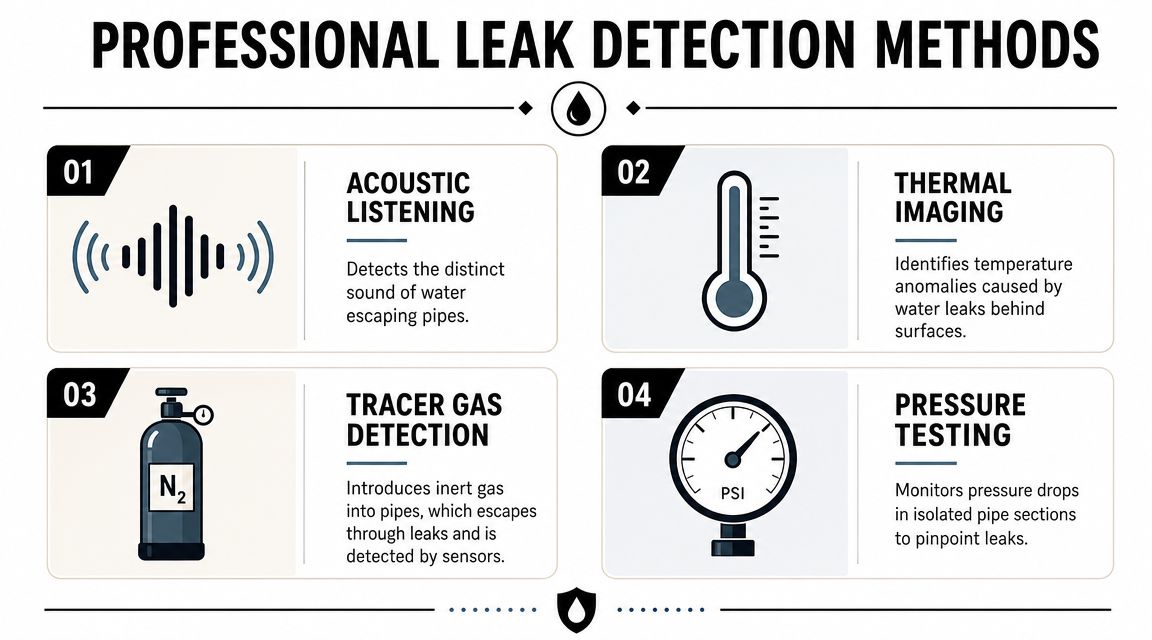
Thermal imaging cameras pick up temperature differences on surfaces. They're useful when hidden moisture changes the temperature profile of a wall, ceiling, or floor. Hot water line leaks can show clearly. Shower leaks can also create patterns, though interpretation matters because not every cool patch is a leak.

Moisture meters are often used alongside thermal imaging. The camera shows where to look. The meter helps confirm whether the material is retaining moisture.

What works well:

  • Locating broad zones of concern behind finished surfaces
  • Tracing moisture migration paths
  • Narrowing down areas before opening up

What doesn't:

  • Treating a thermal image as final proof on its own
  • Assuming every anomaly is the exact leak point

Acoustic testing and pressure testing

Acoustic listening devices help detect the sound of water escaping under pressure. In the right conditions, they can be very effective on concealed pressure pipes and underground services. Background noise, pipe material, and building layout all affect accuracy.

Pressure testing is more controlled. A technician isolates a section of pipework, applies test pressure, and watches for pressure loss. This doesn't always show the precise physical hole, but it does confirm whether a section is compromised.

A practical benchmark from Australia comes from a NSW Smart Sensing Network trial in urban pipes. Its failure-prediction model was cross-checked against real failures every three months and achieved approximately 80% detection in validation tests, which shows how predictive leak workflows improve when sensor data is checked against real-world outcomes rather than treated as guesswork (NSW Smart Sensing Network trial results).

On site, the best result usually comes from combining methods. One tool narrows the field. Another confirms it.

Drain cameras and targeted investigation

CCTV drain cameras are used for waste lines and stormwater, not pressure pipes. They're useful when the concern is a cracked drain, displaced joint, blockage, or a defect causing water escape around waste systems.

Homeowners sometimes misunderstand that a drain camera won't diagnose every shower leak. If the issue is failed waterproofing around a bathroom floor waste, the camera may show the drain condition but not the membrane problem around it.

At the utility level, Melbourne is also testing more advanced monitoring. An Australian Water Association report described an Intelligent Water Networks trial using existing telecommunications fibre in Melbourne's west as a massive array of vibration sensors to detect leaks, with partners including Greater Western Water, Veolia, and FiberSense. The aim is early warning for leaking pipes, including both large and small leaks, without waiting for obvious bursts (Melbourne fibre-based leak detection trial).

That same thinking applies on private property. The less guesswork, the less unnecessary demolition.

Beyond Detection From Diagnosis to a Lasting Repair

A leak report can tell you where water is showing up. It doesn't automatically solve the defect that allowed water in. That's the turning point many homeowners miss.

Beyond Detection From Diagnosis to a Lasting Repair

Why bathroom leaks often need more than a plumber

If a copper line pinholes in a wall, a plumber may be the main trade. But many bathroom leaks in Melbourne aren't really pipe failures. They're wet-area construction failures.

That can include:

  • damaged or poorly installed waterproofing membranes
  • failed shower base junctions
  • incorrect falls that hold water where it shouldn't sit
  • cracked grout and movement joints that allow ongoing water entry
  • deteriorated substrate behind tiles
  • previous patch repairs that sealed the symptom, not the system

This is why a leak can “come back” after a seemingly successful repair. The original path for water was never properly addressed.

According to the Insurance Council of Australia, water damage is one of the most common home insurance claims, and Victorian building data consistently shows waterproofing failures in wet areas are a recurring source of those problems (water damage and wet-area failure context). In practical terms, that means a wet bathroom wall isn't just a nuisance. It can point to a failed assembly.

What a builder-led rectification process looks like

A registered builder looks at the whole build-up, not just the first wet spot.

That usually means asking:

Question Why it matters
Is this a plumbing leak or a waterproofing failure? The repair path changes completely depending on the answer
Has moisture damaged the substrate? Tiles can be replaced, but swollen or degraded backing materials need rectification
Does the wet area still comply once opened? Partial patching can leave non-compliant details in place
Would a renovation be more sensible than piecemeal repair? In older bathrooms, repeated rectification can be poor value

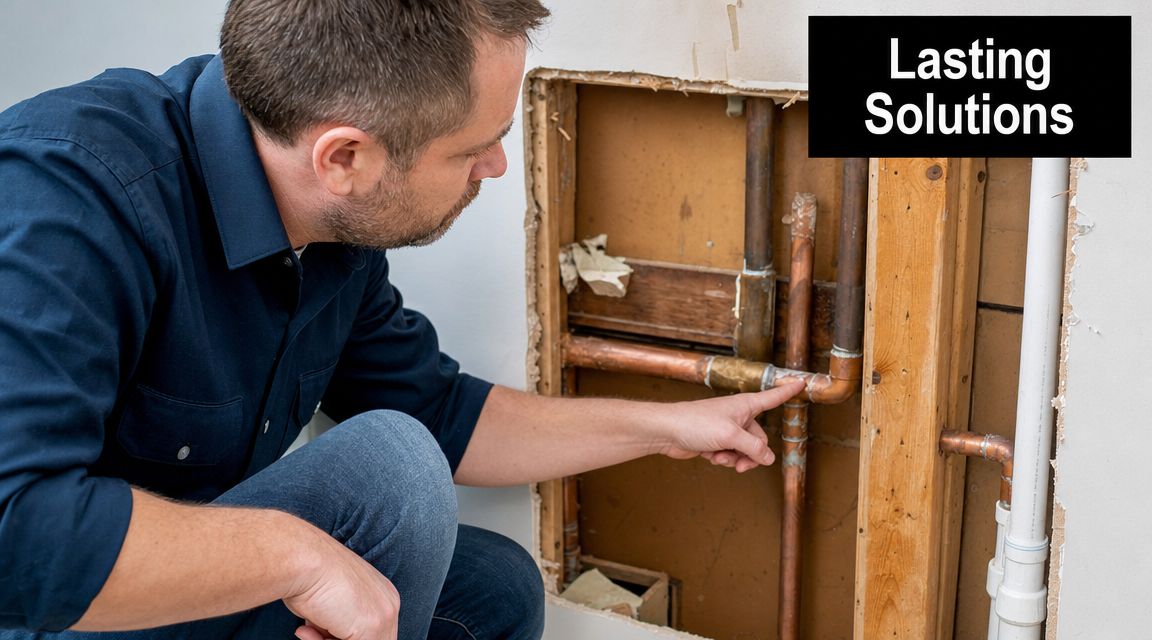
In many jobs, the lasting fix isn't a dab of silicone. It's a controlled strip-out, repair of affected structure or linings, proper waterproofing, and reinstatement by the right licensed trades under one scope.

That's where bathroom renovations come into the conversation. If the shower is leaking because the wet area assembly has failed, a renovation isn't cosmetic. It can be the correct rectification method. The same applies to ensuites and apartment bathrooms where access is tight and damage has spread beyond one wall.

For homeowners trying to understand that threshold, a focused shower leak repair service in Melbourne is a better starting point than repeated patching. Melbourne Tiling Services P/L is one example of a registered builder-led business that handles wet-area rectification and bathroom renovation work under a coordinated scope.

Fix the leak path, not just the wet mark. If the membrane, substrate, or shower build-up has failed, surface repairs won't last.

How to Choose Your Melbourne Leak Detection Specialist

Not every leak detector is the right fit for every job. Some are strong on pipe tracing but stop at the report. Others understand wet-area construction, waterproofing failure, and what rectification will involve afterward.

How to Choose Your Melbourne Leak Detection Specialist

Questions worth asking before anyone starts

Ask direct questions. A good operator won't be offended.

  • Are you licensed for the work you're doing? If there's plumbing investigation, that matters. If the issue may lead into bathroom rectification or rebuilding, ask whether a registered builder is involved.
  • Do you handle waterproofing-related diagnosis, or only pipe leaks? That answer tells you whether they understand bathroom failures properly.
  • What testing methods do you use on this type of leak? The right method should match the scenario, not the other way around.
  • Will your findings help with insurer, strata, or builder discussions? A vague verbal opinion isn't much use once responsibility gets disputed.

One of the most useful indicators is whether they speak in terms of cause, not just location.

What a useful report should tell you

A report should be clear enough that another party can act on it. That matters in apartments, landlord matters, and renovation planning.

Look for:

  • Source findings: where the leak is likely originating
  • Affected areas: where moisture or damage has spread
  • Method used: thermal, acoustic, pressure, camera, or visual inspection
  • Recommended next step: plumber, registered builder, waterproofer, or combined scope
  • Limits of the inspection: what was and wasn't accessible

If your concern is shower failure, balcony leakage, or a bathroom that may need rectification, it also helps to choose someone who understands the broader waterproofing context. This overview of waterproofing in Melbourne is relevant because many recurring leaks are building-envelope or wet-area issues rather than simple fixture faults.

A specialist who can find the problem but can't explain the repair pathway leaves you with half a solution.

Frequently Asked Questions About Melbourne Leaks

How much does leak detection in Melbourne cost?

It depends on the suspected leak type, access, and the testing required. A simple fixture-related investigation is different from a shower leak through a slab edge, balcony, or apartment boundary. The useful question isn't only price. It's whether the inspection will tell you what failed and what trade needs to rectify it.

How long does leak detection take?

Some leaks are identified quickly. Others need staged testing because the water appears far from the source or only leaks when a fixture is used. Bathrooms are a common example. A shower may only leak under use conditions, which means proper testing matters more than speed.

Can a leak be fixed without removing tiles?

Sometimes, yes. If the issue is a tap connection, toilet seal, hose, or accessible plumbing fitting, there may be no need for demolition. If the waterproofing system behind the tiles has failed, tile removal and builder-led rectification are often the correct path.

Who pays for a leak between apartments?

When a leak crosses apartment boundaries, responsibility usually depends on where the leak originates, whether that source is in private property or common property. A professional leak detection report is often the key piece of evidence the owners corporation needs to act under strata rules in Victoria (apartment leak responsibility in Victoria).

Should I call a plumber or a builder first?

If you've got an obvious pipe or fitting problem, start with a plumber. If the leak involves a shower, wet-area floor, balcony, repeated dampness, or signs of failed waterproofing, a builder-led assessment is often the smarter first move because the repair may go beyond plumbing.


If you're dealing with a shower leak, bathroom moisture problem, or a wet-area failure that needs more than a quick patch, Melbourne Tiling Services P/L can help assess the cause and advise on the right rectification path, including bathroom renovations, waterproofing repair, and registered builder-led rebuilds where needed.

Balcony Waterproofing Melbourne: A Builder’s Guide (2026)

A lot of Melbourne homeowners first notice a balcony problem from inside the house, not outside it. It's the water stain on the ceiling below, the bubbling paint near a door, the musty smell after a run of rain, or the grout line that never seems to dry out. By the time those signs appear, water has usually been getting in for a while.

That's why balcony waterproofing melbourne isn't a cosmetic job. It's a building-envelope job. If the cause is diagnosed properly and the system is rebuilt properly, the balcony stays dry and the rooms below stay protected. If the cause is guessed at, you end up paying twice.

Table of Contents

Your Guide to a Leak-Free Melbourne Balcony

If you're reading this because your balcony has started leaking, don't assume the fix is just “paint on a new membrane”. That's one of the most expensive mistakes owners make. A balcony is a full assembly made up of slab, falls, drainage, membrane, terminations, tile bed, tiles, grout, sealants and penetrations. If one part is wrong, the whole system is compromised.

This isn't a fringe problem either. A Victoria-focused balcony defects study found that 52% of assessed apartment buildings had defective balconies caused by water ingress, with a further 19% showing explicit waterproofing issues. For homeowners and apartment owners in Melbourne, that tells you two things. First, balcony leaks are common. Second, you need a methodical repair, not a rushed patch-up.

What a proper starting point looks like

A seasoned builder won't begin by talking about brands and colours. The first job is diagnosis.

A proper site inspection should look at:

  • Where the water shows up: Ceiling below, internal wall, door threshold, slab edge, balustrade fixing or tile joints.
  • How the balcony sheds water: Whether water runs to drains cleanly or ponds on the surface.
  • What's been done before: Regrouting, silicone touch-ups, patch membranes or retiling over an old problem.
  • Whether movement is involved: Cracks at corners, wall junctions and around posts usually point to stress points, not just surface wear.

Practical rule: If someone quotes to re-waterproof your balcony before checking falls, drainage and penetrations, they're pricing a symptom, not the cause.

What homeowners need to demand

You don't need to know every clause in a standard to make a good decision. You do need to insist on a contractor who can explain the failure path in plain English.

Ask them to identify:

  1. where water enters,
  2. how it travels,
  3. why the existing system failed,
  4. what has to be removed,
  5. how the repaired system will be verified before finishes go back on.

That's the difference between a temporary improvement and a durable repair.

Why Balconies Really Leak The Culprits Beyond the Membrane

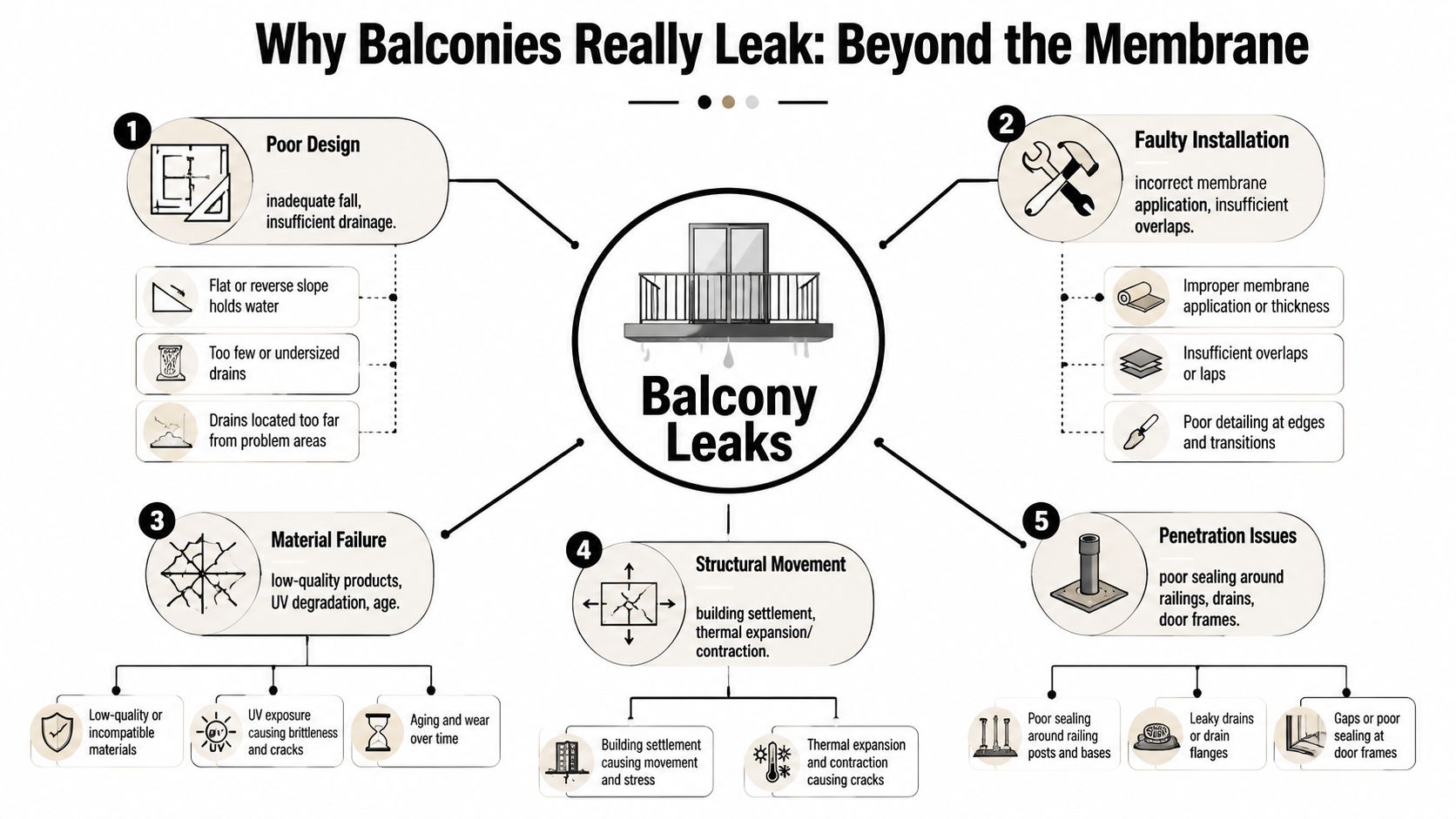
The membrane gets blamed for almost every balcony leak in Melbourne. Sometimes that's fair. Often it isn't. In practice, balconies usually leak because several small failures combine. Water ponds where it shouldn't, a sealant line cracks, a threshold is poorly detailed, or a drain can't cope because the geometry was wrong from the start.

The Victorian Building Authority guidance on water ingress in balconies, decks and terraces says balcony water ingress is often caused by poor design, inadequate water diversion, blocked drains, failed sealants, inappropriate external materials and other drainage-related defects, not just membrane failure. That's the most important mindset shift for owners. Replacing the membrane without fixing the water path often means the leak comes back.

An infographic detailing five primary causes of balcony leaks including poor design, installation, materials, movement, and penetrations.

The failure points that show up most often

Some causes are obvious once you know where to look.

  • Poor falls: Water sits on the surface instead of moving to the outlet. Standing water always finds weakness.
  • Blocked or badly located drains: Even a sound membrane struggles if the outlet arrangement is poor.
  • Failed sealants: Door frames, balustrade bases and threshold joints are frequent entry points.
  • Penetrations: Every post, flange and pipe passing through the surface creates a risk point.
  • Surface cracking and movement: Buildings move. Rigid details fail first at corners and junctions.

Many owners focus on cracked grout because that's what they can see. Grout matters, but it's usually not the primary waterproof layer. If the balcony underneath has poor falls or bad detailing at a threshold, regrouting won't solve the leak.

Why patch jobs usually disappoint

Silicone over joints. A waterproof paint from the hardware store. Replacing a few cracked tiles. These fixes can reduce symptoms for a while, but they rarely address the assembly underneath.

A proper diagnosis usually includes checking the balcony in wet conditions if possible, reviewing the edge details, examining drain setup, and tracing whether the leak appears after heavy rain, routine washing, or only wind-driven weather. Those patterns help identify whether the issue is surface ponding, overflow, a threshold problem or a penetration failure.

The best repair isn't the one with the biggest product list. It's the one that removes the actual entry point and controls where water goes.

If you want balcony waterproofing melbourne done properly, start with water management. The membrane matters. The drainage path matters just as much.

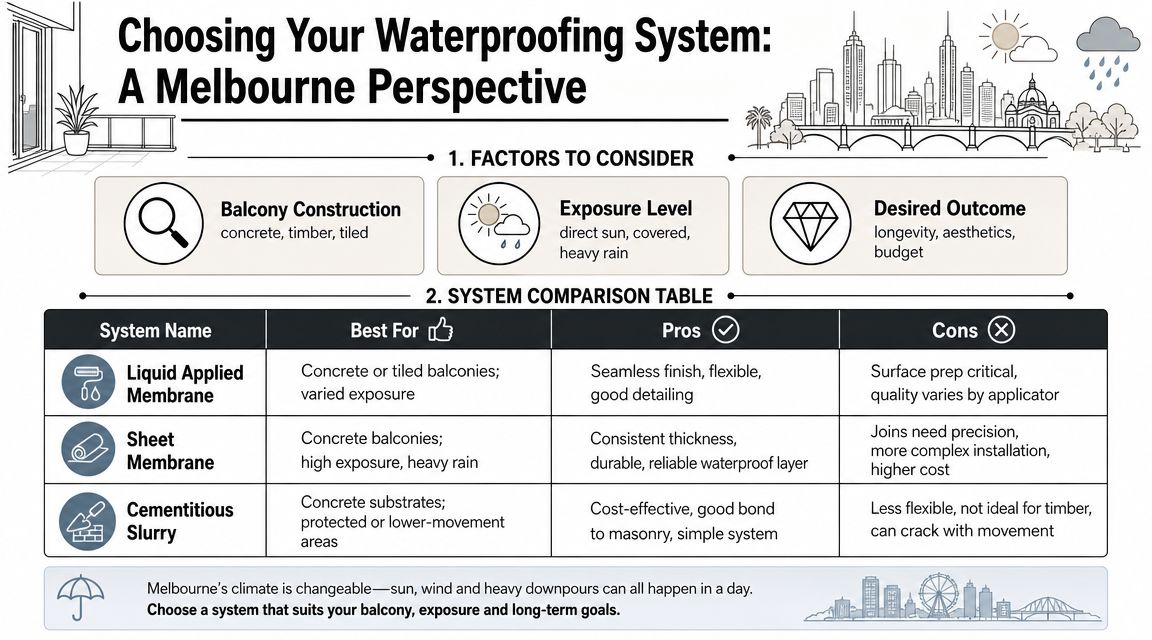
Choosing Your Waterproofing System A Melbourne Perspective

A leaking balcony often gets sold a membrane before anyone has chosen the right system for the build. That is how owners pay twice. The product matters, but the better question is whether the system suits the substrate, the finish, the movement in the structure, and the way the balcony sheds water in Melbourne weather.

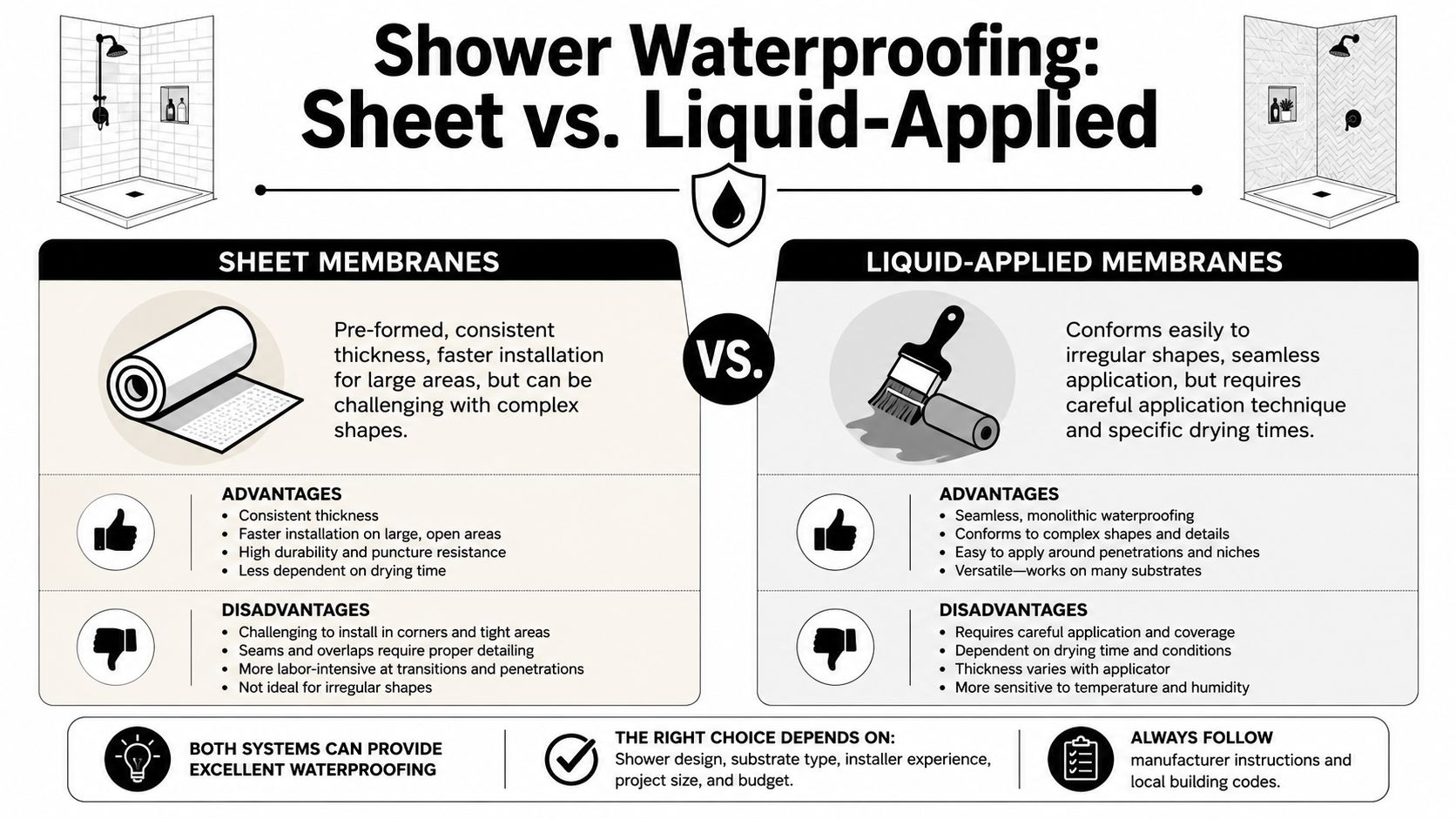
For many projects here, a liquid-applied membrane with reinforced corners and junctions, installed in at least two coats to achieve the required dry-film thickness, is a practical choice, as described in this Melbourne balcony waterproofing guide. It works well on balconies with awkward edges, multiple penetrations, and detailed junctions. It also leaves less room for sloppy application. If the installer guesses coverage rates or rushes recoat times, the membrane can fail even though the surface looks finished.

An infographic comparing different balcony waterproofing systems suitable for the variable climate in Melbourne, Australia.

What builders usually compare first

Balcony Waterproofing Systems Compared Best For Pros Cons
Liquid-applied membrane Concrete balconies, complex shapes, detailed junctions A continuous, joint-free surface, good around corners and penetrations, widely used in remediation Thickness must be controlled properly, cure times matter, poor application creates weak spots
Sheet membrane Larger open areas where consistent sheet installation is practical Factory-controlled thickness, durable when seams and terminations are done properly Seams are critical, detailing around penetrations can be more demanding
Tile-over remediation systems Existing tiled balconies where demolition may be avoidable in limited cases Can reduce disruption when the substrate and existing finish are genuinely suitable Only works if the underlying structure is stable and the existing problem is not trapped below

The trade-off is straightforward. Liquid systems are more forgiving of complex shapes. Sheet systems are more controlled across big open runs. Tile-over systems can save time on the right balcony, but they are often oversold to owners who should be opening the assembly up and fixing the causes underneath.

That last point matters in Melbourne strata buildings. If the leak involves a balcony over another lot, a threshold tied into the building envelope, or balustrade fixings connected to common property, system choice is not just a product decision. It affects scope, access, approvals, and who should be carrying out the repair.

Where each system works and where it doesn't

Liquid systems suit many Melbourne balconies because they can be worked into drain flanges, floor-to-wall junctions, door upstands, and irregular slab edges without forcing extra joins into risky spots. I use them often in remedial work for that reason. The catch is quality control on site. Wet film thickness, reinforcement at change-of-plane areas, and curing conditions all need to be checked, not assumed.

Sheet membranes can be excellent on a new build or a stripped-back balcony with clean geometry. The material gives consistent thickness straight off the roll. The risk sits at the laps, terminations, and penetrations. One poor seam or badly finished outlet detail can undo an otherwise sound installation.

Tile-over remediation systems need the hardest scrutiny. They only make sense where the existing substrate is stable, the adhesion is reliable, moisture is not trapped below, and the balcony geometry already works. If the falls are wrong, if the threshold height is marginal, or if movement has already broken the surface assembly, going over the top usually hides the defect rather than fixing it.

A proper scope usually includes more than selecting the membrane:

  • Substrate preparation: remove contaminants, weak material, and anything that will interfere with adhesion
  • Crack and joint treatment: detail movement areas before the field membrane goes down
  • Drain and edge integration: make sure outlets, drips, terminations, and threshold details work with the chosen system
  • Compatibility checks: confirm primers, adhesives, screeds, tiles, and sealants are approved to work together
  • Verification: check dry-film thickness, inspect the finished work, and use flood testing where the detail allows it

Melbourne Tiling Services P/L handles balcony waterproofing together with tiling, screeding, and renovation work. That broader scope matters because balcony failures are often shared between trades. The membrane installer, tiler, screeder, and builder all affect whether the finished balcony stays dry.

The Rules of the Game Australian Standards and VBA Compliance

Balcony waterproofing isn't just a trade preference. It sits inside a compliance framework. If the work is external above-ground waterproofing, the technical benchmark in Melbourne is AS 4654.2, and the Victorian Building Authority notes that NCC compliance for balconies requires membranes to comply with AS 4654.1 and AS 4654.2 in a complete system, not just as a coating product. The VBA fact sheet on water ingress research insights also points directly to AS 4654.2 for the minimum details needed to comply.

That matters because many failed balconies weren't undone by the middle of the membrane field. They were undone at a transition, an edge, a drain, a post or a door.

What compliance means on site

Compliance in practical terms means the builder has to think in assemblies.

That includes checking:

  • Substrate suitability: The base must be sound and appropriate for the selected system.
  • Termination heights: Membrane returns and upturns have to be detailed so water can't overrun them.
  • Penetration detailing: Balustrade fixings, pipes and outlets need proper sealing and integration into the waterproofing system.
  • Evidence of installation quality: Inspection, thickness confirmation and testing matter more than a glossy finished look.

On-site reality: A balcony can look perfectly tiled and still be non-compliant underneath.

Many cheap quotes often fall apart. They price demolition, membrane, tile and grout as if the job is linear. Real waterproofing work isn't linear. It's detail-heavy. The slow parts are usually the parts that prevent leaks later.

Why registered builders matter

For homeowners, engaging registered builders matters because balcony leak repairs often touch more than one trade. You may need demolition, carpentry repairs, screeding, waterproofing, tiling, plumbing around drains, and joinery or threshold adjustments at door openings.

That's also why the overlap with bathroom renovations is so strong. The same discipline applies. Membranes have to suit the substrate. Falls have to be formed correctly. Penetrations have to be planned before finishes lock everything in. A contractor who understands only one layer of that process often misses the defect that sits in the next layer down.

More Than a Balcony Why Your Waterproofing Expert Should Be a Renovation Pro

A leaking balcony and a failed shower recess usually come from the same kind of mistake. Somebody treated waterproofing as a product instead of a system. In both settings, water is controlled by falls, junctions, penetrations, drainage, movement detailing and finish sequencing. That's why the best balcony repairers are often the same people who understand bathroom renovations at a high level.

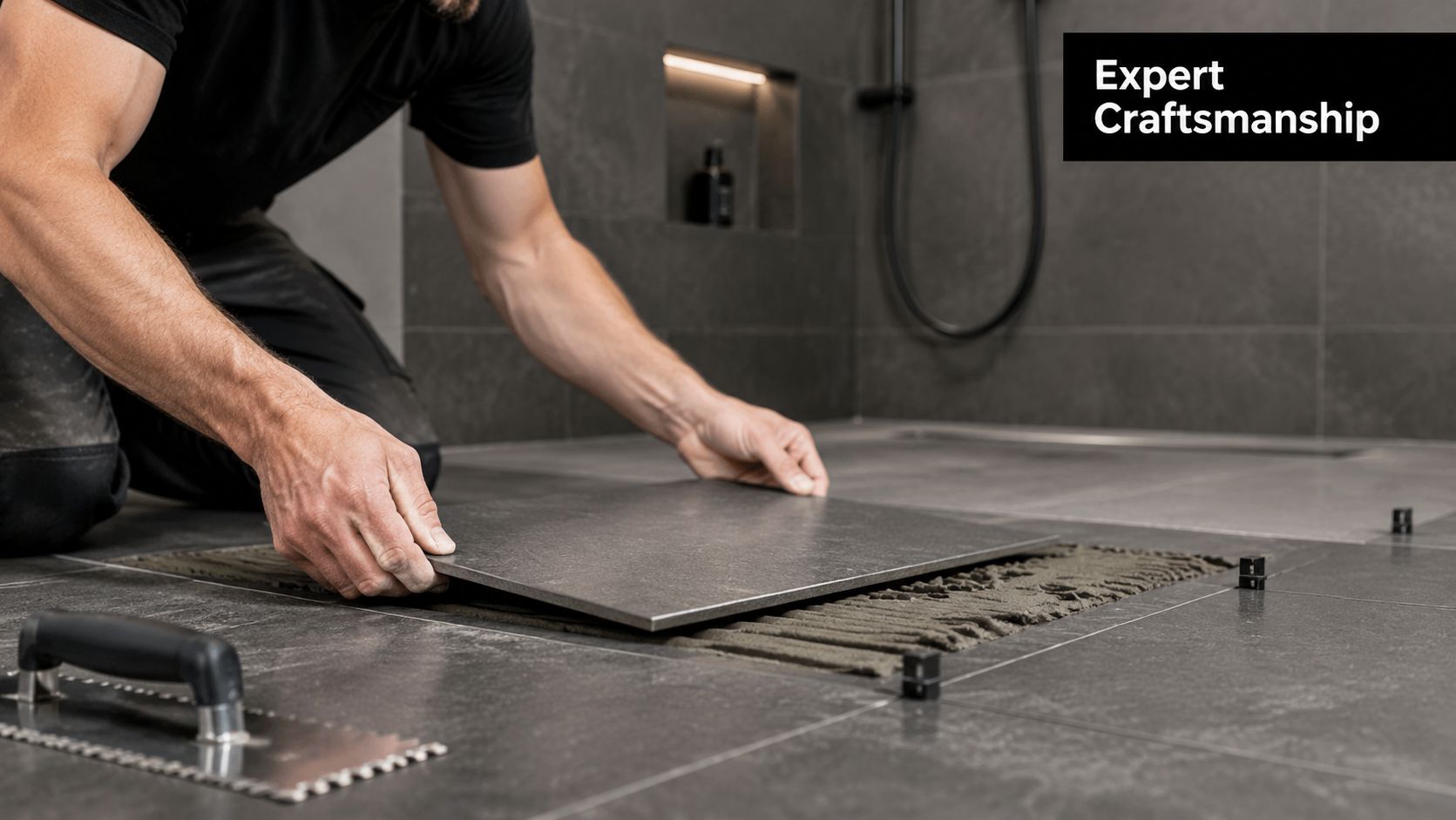
A professional tiler carefully installing a large dark ceramic floor tile onto adhesive in a bathroom.

Balconies and bathrooms fail in similar ways

The principle is identical. Water sits on or behind a finished surface, then moves through the weakest detail.

Common crossover issues include:

  • Bad falls: Water doesn't move to the waste or outlet.
  • Weak corners: Floor-to-wall junctions crack first if they aren't reinforced and detailed properly.
  • Poor penetration sealing: Shower fittings and balcony posts create similar risk points.
  • Finish-first thinking: People focus on the tile they can see, not the waterproofing they can't.

That's why a contractor who also handles bathroom renovations often has a stronger grip on sequencing. They know the screed can't be an afterthought. They know the drain detail can't be improvised once tiling starts. They know movement joints aren't optional just because the tile layout looks cleaner without them.

One trade alone usually isn't enough

Owners sometimes hire a tiler because tiles are cracking, or a waterproofer because there's a leak, or a handyman because the job “looks minor”. That can work for small surface maintenance. It usually doesn't work for recurring failures.

A durable balcony repair often needs coordinated work across:

  1. Assessment and strip-out
  2. Substrate repair and fall correction
  3. Drainage and threshold detailing
  4. Waterproofing installation
  5. Tiling, sealing and final verification

If the person quoting can only talk about membrane brand but not screed, drainage, door heights or tile build-up, they probably don't control the whole risk.

That's why homeowners are usually better served by a renovation-minded contractor who understands wet-area systems from slab to finish.

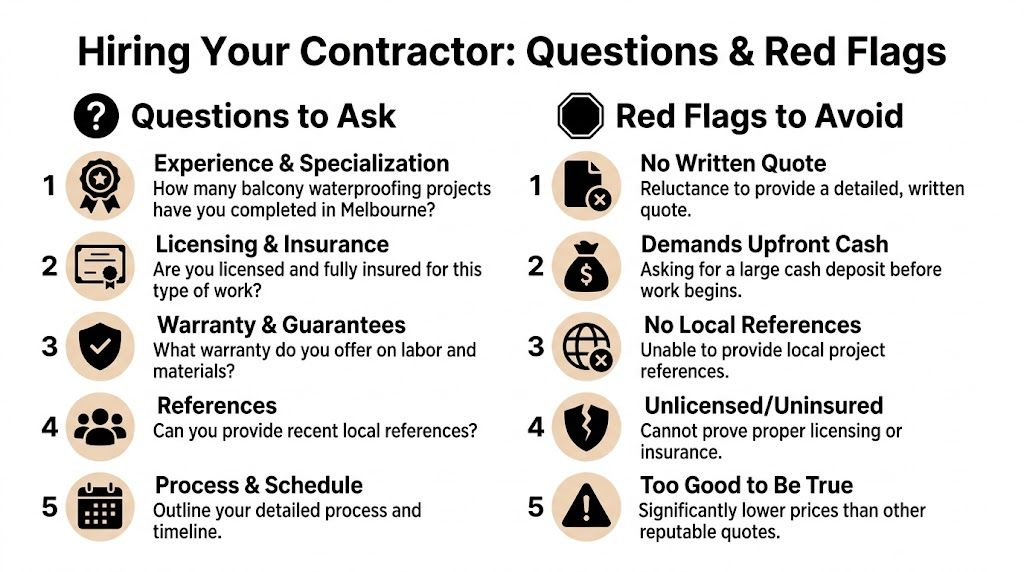
Hiring Your Contractor Questions to Ask and Red Flags to Avoid

Choosing the contractor is where most owners either protect themselves or create a bigger problem. Balcony waterproofing melbourne attracts everyone from capable registered builders to people who mainly sell “quick reseals”. The difference isn't always obvious from a photo gallery.

Use the checklist below before you accept a quote.

An infographic titled Hiring Your Contractor listing five essential questions and five red flags for waterproofing.

Questions that reveal real competence

  • Registration and insurance: Ask for the builder registration details and proof of current insurance. A professional won't hesitate.
  • Failure diagnosis: Ask what they believe is causing the leak. If they can't explain the likely path of water entry, keep looking.
  • System build-up: Ask exactly what layers are included. Demolition, substrate prep, screed correction, membrane, flood or water testing, tiling, sealant and finishes should be clear.
  • Compliance evidence: Ask how they verify membrane thickness, terminations and penetrations before tiling over.
  • Occupied-apartment experience: If you're in strata, ask how they deal with access, approvals, neighbours below and Owners Corporation communication.

For apartment owners, responsibility is a major part of the conversation. The Melbourne balcony repair FAQ notes that the waterproofing membrane is often the lot owner's responsibility, while the structural slab underneath may be common property, depending on the title, plan and source of the defect. A competent contractor should be able to explain where their scope starts and where Owners Corporation involvement may be needed.

A short explainer can help if you're comparing quotes:

Red flags that usually lead to trouble

Some warning signs are consistent across bad waterproofing jobs.

Red flag Why it matters
Verbal quote only If the scope isn't written down, exclusions and shortcuts appear later
Focus on regrouting alone Regrouting may improve appearance, but it rarely solves a system failure by itself
No discussion of falls or drainage That usually means the contractor is treating the symptom
No mention of testing or inspection Good work is verified, not assumed
Pressure to choose the cheapest option Cheap waterproofing often becomes expensive rectification

Ask one simple question: “What are you doing to stop water getting in at the threshold, corners and penetrations?” The answer tells you a lot.

In strata buildings, also ask who they want copied into communication. Good contractors are usually comfortable dealing with owners, building managers, and Owners Corporations because responsibility can be split across finishes, membrane and structure.

Your Next Steps to a Dry and Durable Balcony

You usually find out a balcony has been leaking after the water has already travelled. A stained ceiling below, swollen skirting near the adjoining room, loose tiles at the doorway, rust marks on the slab edge. By then, the membrane may be only part of the problem.

The next step is to get the cause identified properly. On Melbourne balconies, leaks often start with poor drainage, blocked outlets, failed junctions at thresholds and balustrade penetrations, or movement that has opened up the system over time. If the balcony sits in a strata building, confirm who is responsible before work starts. The surface finishes may sit with the lot owner, while the slab, structure, or parts of the defect may involve the Owners Corporation.

Good repair work starts with a written scope. It should set out what will be removed, whether falls need correcting, how drainage will be dealt with, what waterproofing system will be installed, and how the work will be checked before tiles or finishes go back on.

Do not approve a patch job unless the contractor can show why it will work.

I tell owners the same thing on site. If the quote jumps straight to resealing grout lines or adding more silicone, the leak path probably has not been traced. Water rarely respects the visible crack. It follows the easiest route, then shows up somewhere else.

For homeowners, landlords, and apartment owners, the safest option is to use registered builders who understand waterproofing, screeding, tiling, and renovation sequencing together. Balcony failures are often assembly failures, not just membrane failures, so the repair needs to be coordinated that way.

If you need a practical assessment of a leaking balcony, Melbourne Tiling Services P/L can inspect the issue, identify the likely cause, and provide a written scope for compliant repair work, including related tiling, screeding, waterproofing, and renovation requirements.

Floor Tiling Melbourne: Expert Guide to the Best Finish

You're probably looking at tile samples, Pinterest saves, and a bathroom that's overdue for work, while also wondering where the budget blows out and how to avoid a leak six months after handover. That's a normal place to start. Most Melbourne homeowners don't struggle with choosing a colour. They struggle with knowing what sits underneath the tile and whether the whole job is being built properly.

That matters more now because renovation costs have been moving the wrong way for homeowners. Australian Bureau of Statistics housing data for Victoria shows renovation spending rose 12% in 2025 due to inflation in materials like ceramic tiles, which is why clear planning and cost control matter from day one, as noted by Melbourne Tiling Services on renovation budgeting in Victoria.

Floor tiling melbourne projects go well when the finish is treated as the last step, not the first. In a proper bathroom renovation, the tile selection, subfloor preparation, waterproofing, drainage falls, and trade coordination all affect the final result. That's the difference between a floor that still looks right years later and one that starts sounding hollow, holding water, or cracking around movement points.

Table of Contents

Starting Your Melbourne Tiling Renovation

A bathroom floor rarely fails because the tile was unattractive. It fails because the planning was shallow. Homeowners often come in focused on pattern, size, and price per tile, then find out too late that the essential decisions were about substrate condition, shower falls, waterproofing details, and whether the person quoting the work can manage the whole renovation.

As a Registered Builder, the first thing I look at isn't the tile board. It's the room itself. Older Melbourne homes often have movement in the floor, previous water damage, patched plumbing penetrations, or walls that aren't square. If those issues aren't resolved before tiling starts, the finish will always be compromised no matter how expensive the tile is.

Start with the room, not the tile

A sound tiling plan should answer a few basic questions early:

  • What is the subfloor made of: Concrete behaves very differently from timber.
  • Is this a tile-only job or part of a bathroom renovation: The answer changes sequencing, access, and who carries responsibility.
  • Will the drainage work properly: Wet area performance matters more than visual symmetry.
  • Who is coordinating trades: Plumber, waterproofer, carpenter, electrician, screen installer, and tiler all affect the floor outcome.

Practical rule: If the quote talks a lot about finishes and very little about preparation, it's incomplete.

Builder thinking changes the result

A tiler can install a floor well. A builder has to think about compliance, sequencing, and risk across the entire room. That matters in bathroom renovations because one rushed trade can undo another. A plumbing change can alter falls. A poor patch can create movement. A missed waterproofing detail can send water behind finished surfaces.

That broader view is what keeps floor tiling melbourne projects from becoming repair jobs later. The best finish starts before a single tile is laid.

Choosing the Right Tile for Your Melbourne Home

Good tile selection is about where the tile is going and how the room will be used. A bathroom floor, laundry, hallway, and open-plan living area don't ask the same things from the material. Some homeowners choose based on showroom appearance alone, then end up with a product that needs more maintenance than expected or highlights every issue in the substrate.

A young couple reviewing various colored tile samples for home renovation on a bright kitchen table.

If you're comparing finishes, these tiling materials used in bathroom renovations give a useful starting point. The ultimate test is matching the material to the room.

Porcelain for hard-wearing bathrooms and living areas

Porcelain is usually the safest all-round choice for Melbourne homes. It's dense, durable, and works well in wet areas, especially when you want a clean modern look without the upkeep of natural stone. For bathroom floors, it gives you a reliable surface that handles moisture well and suits both small formats and large-format layouts.

It also gives builders and tilers more flexibility in design without creating maintenance issues for the owner. In family homes, rentals, and busy ensuites, porcelain tends to be the material that causes the fewest long-term complaints.

Ceramic where design matters more than punishment

Ceramic still has a place. It can work well on walls and in lower-stress areas, and many homeowners like it because there's a wide range of colours and finishes. On floors, though, I'm more selective.

If the room takes regular foot traffic, gets wet often, or needs to stand up to daily wear, ceramic usually isn't my first recommendation. It can still perform well in the right application, but it's less forgiving of poor product choice and poor installation.

Marble when you want character and accept maintenance

Marble looks excellent when the design calls for softness, variation, and a more natural finish. It suits high-end bathrooms, entry spaces, and homes where the owners understand what natural stone involves.

That trade-off matters. Marble needs more care than porcelain. It can mark, it can require sealing, and it shows installation errors quickly because the eye reads natural stone differently than it reads a uniform manufactured tile. If the substrate isn't flat and the layout isn't carefully controlled, marble won't hide it.

Marble can look refined for years, but only if the owner accepts that natural stone is not a low-maintenance product.

Kerlite for large-format minimalism

Kerlite and other large-format slim porcelain products create a very different visual effect. Fewer grout lines, broader visual flow, and a more architectural finish. They can work beautifully in bathrooms and open-plan areas, but they demand a flat substrate and careful handling.

What works with standard porcelain doesn't always work with a large-format slab. Minor irregularities underneath become visible quickly. Adhesive selection, handling, coverage, and cutting technique all matter more. Installer experience becomes particularly evident.

A practical way to choose

When clients are torn between options, I narrow it down like this:

Tile type Best suited to Main advantage Main trade-off
Porcelain Bathrooms, ensuites, living areas, hallways Durable and low maintenance Can feel plain if the selection is too safe
Ceramic Selected floors, many wall applications Broad style range Less ideal for harder-wearing floor areas
Marble Premium bathrooms and statement spaces Natural variation and character Higher maintenance and less forgiving
Kerlite Large-format designer spaces Minimal grout lines and sleek finish Installation demands are much higher

If you want one material that balances appearance, performance, and practicality, porcelain is often the steady choice. If you want a statement surface, marble or Kerlite can deliver it, but only when the preparation and installation standard match the material.

How to Budget for Floor Tiling Costs

A bathroom floor quote often looks reasonable until the old tiles come up. Then the actual costs appear. In Melbourne homes, especially older timber-frame houses, the floor can need straightening, stiffening, new sheeting, or a full rebuild of the wet area base before any tiling starts.

That is why I price bathroom floors as part of the renovation system, not as an isolated tiling job. Tile selection matters, but the bigger cost swings usually come from what is under the tile and how much coordination the room needs across demolition, plumbing, waterproofing, carpentry, and tiling.

Labour rates are only one part of the number

Recent Australian market guides published in late 2025 put tiler labour for standard floor tiling in a broad range, with natural stone and more complex layouts sitting above standard porcelain rates, as noted in this Australian tiler rates per square metre guide. Use that as a rough check only.

Small bathrooms rarely price neatly by square metre. A 10m² bathroom can involve dozens of cuts, set-outs around wastes and corners, waterproof detailing, trim work at doorways, and tighter tolerances than a much larger open floor. Builder-led pricing also has to allow for what happens before the tiler starts, because if the substrate is moving or the falls are wrong, the floor finish is already at risk.

What a proper quote should cover

A floor tiling allowance should break out the items that commonly get missed or underquoted:

  • Demolition and strip-out: Removal of tiles, screed, bedding, sheet underlay, and any failed substrate material.
  • Waste removal: Skip bin, tip fees, and labour to remove debris, especially where access is tight.
  • Subfloor correction: Levelling, patching, new underlay, cement sheet, screed, or structural rectification on timber floors.
  • Waterproofing: Membrane application, bond breakers, corners, penetrations, and curing time.
  • Setting materials: Adhesives, grout, primers, trims, movement joints, silicone, and stone sealers where needed.
  • Detailing: Floor waste cuts, threshold transitions, shower screen line-up, and final finish quality.

For wider project planning, this bathroom renovation cost guide for Melbourne homeowners helps place floor tiling inside the total bathroom budget.

Sample Budget Breakdown for a Standard Melbourne Bathroom (10m² Floor)

Expense Item Typical Cost Range (AUD)
Demolition and waste removal $600 to $1,500
Subfloor preparation and levelling $800 to $2,500
Waterproofing $700 to $1,500
Tiler labour for porcelain $800 to $1,600
Tiler labour for marble or other natural stone $1,200 to $2,400
Adhesives, grout, sealants, trims $350 to $900
Final detailing and clean $150 to $400

These figures are examples, not fixed rates. Access, floor condition, tile size, pattern, drainage setup, and whether the bathroom sits on concrete or timber all shift the final number.

The biggest budgeting mistake is comparing quotes that do not include the same scope. A cheap price can mean no substrate repair, minimal waterproofing allowance, weak material specs, or no provision for correcting falls. That saving disappears fast if the bathroom floor has to be redone after handover.

The expensive part is not always the tile. In many bathroom renovations, the expensive part is fixing what was hidden underneath.

The Renovation Process From a Builder's Perspective

A floor tiling job inside a bathroom renovation needs the right order. Good trades can still produce a poor result if the sequence is wrong. Builder-led projects usually feel more controlled for this reason, because someone is responsible for the room as a whole, not just one part of it.

A five-step infographic showing the professional high-quality process for tiling installation from design to final inspection.

The sequence that prevents failure

The job usually starts with demolition and assessment. Once the existing floor is exposed, the substrate has to be checked for movement, damage, moisture issues, and level. On concrete, that often means grinding or patching. On timber, it may involve structural correction before any sheet underlay goes down.

Then comes forming the floor properly. In wet areas, this stage is essential because Australian Standard AS 3958.1 mandates a minimum floor fall of 1:80 in wet areas to ensure effective drainage, as outlined in this explanation of Australian tiling standards. If the floor doesn't drain, water sits. Once water sits, grout, tile bond, and adjacent finishes all start dealing with a problem they shouldn't have had.

After falls are established, waterproofing is applied in line with the room layout and penetrations. This stage needs clean surfaces, proper detailing, and curing time. Rushing straight from one step to the next is one of the most common reasons bathroom floors fail.

Why each layer matters

Each stage solves a different problem:

  1. Subfloor correction deals with movement and unevenness.
  2. Screeding or levelling establishes the geometry of the finished floor.
  3. Waterproofing protects the structure beneath the tile.
  4. Tiling and bedding create the wearing surface.
  5. Grouting, caulking, and final sealing where required finish the system.

When builders coordinate the room, they also coordinate the handover points between trades. The plumber can't leave penetrations messy. The carpenter can't leave a springy section under a premium tile. The waterproofer can't apply over a dirty or unstable base. Those details are where good bathroom renovations separate themselves from average ones.

The tile is the visible surface. The renovation quality sits underneath it.

Why trade coordination matters

This is also where a registered builder adds value over a tiling-only approach. In a bathroom renovation, the floor ties into shower screens, plumbing set-outs, cabinetry, door clearances, and sometimes underfloor heating or balcony thresholds. Those elements need to be coordinated before the tile goes down, not improvised after.

One example is Melbourne Tiling Services P/L, which handles bathroom renovations, waterproofing, screeding, self-levelling, and tile installation under a registered builder model. That type of setup can reduce confusion on site because one party is managing sequencing and accountability across the room.

Avoiding Common and Costly Tiling Disasters

Most floor failures don't look dramatic on day one. They start small. A tile sounds hollow. Water sits near the shower entry. A hairline crack appears at a doorway. Then the owner starts chasing repairs in a finished bathroom.

A close-up view of a cracked marble floor tile in a hallway with modern interior design.

Cracked and drummy tiles on timber floors

This is common in older Melbourne homes. The bathroom might look solid from above, but the timber subfloor underneath still moves. Tile and grout don't like movement. They want a stable base.

That's why Australian Standards require a fibre-cement underlay on timber floors and a maximum deflection of 1/360 of the span to prevent tile cracking from substrate movement, according to the Australian Tile Council tiling facts guide. If that requirement is ignored, the floor can flex under traffic and the finish starts to fail.

The fix is straightforward in principle, even if it isn't cheap. Stabilise the substrate, install the right underlay, fasten it correctly, and only then prepare for tiling. Skipping that process to save time is exactly how drummy floors and cracked grout lines show up.

Leaks that start below the tile

Homeowners often blame the tile when a shower leaks. Usually the tile isn't the main problem. The issue is below it. Failed waterproofing junctions, poor detailing at penetrations, and rushed floor preparation are much more common causes.

If you're reviewing methods before work starts, look at how bathroom waterproofing systems are applied in renovation work. The floor and wall junctions, waste locations, and transitions matter far more than the tile pattern.

A quick visual explanation can help if you're trying to spot the signs of poor practice on site.

Three red flags during installation

  • Tiles laid over an obviously uneven base: The installer is asking the adhesive to fix a substrate problem.
  • No clear discussion of movement and transitions: Floors need to cope with real building movement.
  • Wet area work pushed through too fast: Curing time matters. A rushed bathroom often becomes a repair job.

If the person doing the work can't explain what sits under the tile, they probably shouldn't be laying it.

How to Hire a Reputable Melbourne Tiler or Builder

Melbourne gives homeowners plenty of choice, but choice can make vetting harder. Australia's tiling services industry has over 20,000 businesses, which makes it a fragmented market where reputation, licensing, and reliable process matter, based on IBISWorld's analysis of Australia's tiling and carpeting services industry.

That size is one reason low quotes and polished sales talk don't tell you much. You need to know who is legally responsible for the work, who is coordinating the other trades, and whether the contractor understands bathroom renovations as a system rather than a tile-laying task.

A professional contractor in a green uniform shakes hands with a female client in a kitchen.

What to check before you sign

A reputable contractor should be comfortable being checked. If they get evasive about registration, insurance, or process, that's useful information.

Use a simple shortlist:

  • Verify registration and licensing: For bathroom renovations, check whether you're dealing with a properly registered builder where required.
  • Ask who manages the full scope: A solo tiler may do good work, but bathroom renovations involve more than tiling.
  • Review wet area experience: Bathrooms, balconies, and leak rectification require a stronger process than a dry internal floor.
  • Look at previous work carefully: Focus on drainage, detailing, finish consistency, and edge treatment, not just styling.
  • Read the quote line by line: If preparation is vague, ask for detail in writing.

Questions worth asking on site

Don't ask generic questions like “Do you do quality work?” Ask questions that force a technical answer.

  • How will you assess the existing subfloor before tiling starts
  • How are floor falls formed in the shower and main bathroom area
  • Who handles waterproofing and how is that coordinated with the tiling
  • Have you installed the exact material I've selected before
  • Who is responsible if another trade delays or affects the floor finish
  • What happens if you uncover substrate damage after demolition

The main difference between hiring a tiler and engaging a registered builder is accountability. A tiler is responsible for tiling work. A registered builder on a bathroom renovation is responsible for how the whole project is organised, sequenced, and delivered. If your project involves plumbing changes, waterproofing, structural correction, or multiple trades, that difference matters.

Project Timelines and Long-Term Floor Care

A realistic bathroom floor timeline

A standard bathroom floor tiling job usually moves through demolition, substrate preparation, waterproofing, tiling, grouting, and final curing. The exact timing depends on access, substrate condition, product choice, and whether the floor is part of a larger bathroom renovation. The mistake homeowners make is assuming tiling starts the moment the old floor comes up.

The slow parts are often the important parts. Preparation has to be done properly. Waterproofing needs time. Adhesives and grout need to set before the room is put back into service. If the schedule sounds too compressed, ask what has been shortened.

How to keep the floor looking right

Long-term care is simple when the installation is sound.

  • Use pH-neutral cleaners: Harsh products can damage grout, sealers, and some stone finishes.
  • Keep sealant lines in good condition: Perimeter and transition joints should be inspected, not ignored.
  • Don't drag heavy items across the floor: Chips usually come from impact, not normal foot traffic.
  • Clean standing water promptly: Especially near screens, doorways, and edges.

A well-built tiled floor shouldn't need constant attention. It should just perform.


If you're planning floor tiling melbourne work as part of a bathroom or ensuite renovation, Melbourne Tiling Services P/L can help with builder-led advice on tile selection, budgeting, waterproofing, and full project coordination across Melbourne and greater Victoria.