

A lot of roof tiling jobs in Melbourne start the same way. You notice a brown mark on the ceiling, a damp patch near a cornice, or flaking paint above the shower, and you hope it's a one-off. Then the next spell of rain hits, and the stain grows.
That's when most homeowners find out the roof problem and the internal damage are rarely separate jobs. Water gets in at the roof line, tracks along timbers, insulation, wiring paths or wall cavities, and eventually shows up where you least want it. Bathrooms are a common casualty because they already deal with moisture, exhaust penetrations, tiled junctions and ceiling linings that can hide damage until it's advanced.
A practical fix isn't just replacing a few tiles and walking away. The smarter approach is to assess the roof, the cause of the leak, and any inside damage as one project. That's where a Registered Builder becomes valuable. Instead of hiring one contractor for the roof, another for plaster, another for waterproofing, and then trying to work out who owns the defect if the leak returns, you've got one accountable party managing the sequence properly.
Roof tiling also sits inside a large, active Australian trade category. The Australia roofing market is estimated at AUD 7.22 billion in 2025 and projected to reach AUD 11.21 billion by 2035, with forecast growth at a 4.50% CAGR from 2026 to 2035, according to Australia roofing market research. That matters because it tells you roof tiling in Melbourne isn't a niche sideline. It's established building work with clear systems, suppliers and standards.
Table of Contents
- Your Guide to Roof Tiling in Melbourne
- Choosing Your Roof Tiles for Melbourne's Climate
- Budgeting for Your Melbourne Roof Tiling Project
- The Professional Roof Tiling Process Explained
- Navigating Permits and Victorian Regulations
- Selecting Your Melbourne Roofing Professional
- Roof Maintenance and When to Repair or Replace
- Frequently Asked Questions About Roof Tiling
Your Guide to Roof Tiling in Melbourne
Roof tiling in Melbourne isn't just about kerb appeal. It's about keeping water out, controlling wind uplift, protecting insulation and ceilings, and stopping a small external fault from turning into a much larger internal repair.
In practice, homeowners usually come to this decision in one of three situations. The first is obvious leakage. The second is a roof that looks tired but hasn't failed yet. The third is a renovation project, often a bathroom renovation, where hidden moisture damage is found and the investigation traces the problem upward.
A proper roof tiling job starts with diagnosis, not product selection. If the roof has broken field tiles, loose ridge capping, deteriorated flashing, sagging battens or failed underlay, the visible leak point inside the house may be well away from the actual entry point outside. That's why quick patch jobs often disappoint. They treat symptoms, not the water path.
Practical rule: If water damage has already reached internal linings, treat the roof, ceilings, framing and wet-area finishes as one connected building issue.
The end-to-end job usually involves more than laying tiles. It can include access equipment, strip-out, timber checks, sarking, battens, valleys, flashing, ridge work, debris removal and internal rectification. If the leak has affected a bathroom, that may also mean replacing damaged plaster, checking mould risk, re-waterproofing wet area junctions, and retiling.
Why one managed scope works better
When separate trades each quote only their own slice, gaps open up. The roofer fixes tiles. The plasterer patches the ceiling. The bathroom contractor repairs finishes. If the leak returns, each points somewhere else.
A Registered Builder can coordinate those moving parts under one scope and one sequence. That matters in occupied homes, especially where the roof leak has affected bathrooms, ensuites or upper-storey wet areas.
What good roof tiling Melbourne work looks like
You should expect clear defect identification, a written scope, compliant installation methods, tidy staging, and handover that explains what was repaired, what was replaced, and what still needs monitoring if any staged works remain. Good work is organised long before the first tile is lifted.
Choosing Your Roof Tiles for Melbourne's Climate
Melbourne weather is hard on roofs. Heat, cold, wind, hail and sudden rain all test how well the system has been designed and fixed. Material choice matters, but not in isolation. The tile has to suit the house, the roof structure, the exposure level and the level of maintenance the owner is prepared to keep up with.
What matters more than colour
A lot of owners start with appearance. That's understandable, but performance comes first. Australian tile guidance notes that properly installed tiled roofs offer higher resistance to wind suction than lightweight sheet roofing, and they can also reduce external noise by up to 30 dB, compared with about 12 dB for sheet metal, according to Australian roof tile technical guidance. In Melbourne suburbs near tram routes, busy roads or flight paths, that noise difference is worth taking seriously.
The main trade-off isn't “good tile versus bad tile”. It's which tile is right for your house.
- Terracotta suits owners who want strong visual character and stable colour over time.
- Concrete suits practical budgets and broad style choice.
- Slate suits heritage work or high-end custom projects where weight, detailing and premium finish are part of the brief.
If you're comparing finishes for broader renovation work as well, it helps to look at tile materials used across residential projects so your roof choice and internal tile selections don't clash.
Roof Tile Material Comparison for Melbourne Homes
| Material | Typical Cost (per m²) | Lifespan | Pros | Cons |
|---|---|---|---|---|
| Terracotta | Varies by supplier, profile, access and scope | Long service life when maintained | Distinct appearance, colour runs through the material, suits many classic Melbourne homes | Higher upfront cost in many cases, brittle if impacted, replacement tiles can be harder to match on older roofs |
| Concrete | Varies by profile, brand and roof complexity | Good long-term performance when maintained | Broad style range, practical option for many suburban homes, commonly available | Can weather differently over time, surface appearance may age faster than terracotta |
| Slate | Varies significantly depending on source and detailing | Long-lasting when properly installed | Premium look, strong heritage and architectural fit | Heavy, usually more demanding structurally, higher install complexity and cost |
How the three options behave on site
Terracotta works well where the roof is a visible architectural feature. It's often chosen for period homes and homes where owners want a finish that doesn't rely on surface colour alone.
Concrete is the workhorse option. It's widely used because it balances appearance, availability and practicality. For many roof tiling Melbourne projects, it's the material that solves the brief without turning the roof into the most expensive part of the renovation.
Slate is different again. It's less forgiving to budget and structure, but when the house suits it, nothing else really substitutes for it visually.
Don't choose a roof tile by sample board alone. Look at weight, fixing method, edge detailing, availability of matching accessories and whether the existing structure is suitable.
Budgeting for Your Melbourne Roof Tiling Project
Roof tiling prices vary because roofs vary. A simple single-storey house with clean access, a straightforward pitch and no hidden timber issues is one thing. A steep roof with difficult access, old valleys, multiple penetrations and internal water damage is another.

The mistake homeowners make is comparing quotes as if they cover the same scope. Often they don't. One quote might include removal, disposal, sarking upgrades, ridge works and flashing renewal. Another may price only the visible tile replacement and leave the rest as variations.
What usually drives the budget
The biggest cost variables are usually:
- Roof size and shape. More roof area means more material and labour. Complex roof geometry adds cutting, detailing and time.
- Pitch and access. Steeper roofs and restricted sites need more safety planning and slower production.
- Material choice. Terracotta, concrete and slate sit in different supply and labour brackets.
- Substrate condition. Once old tiles are removed, damaged battens, sarking or localised timber decay can add repair work.
- Penetrations and flashings. Skylights, chimneys, vents and valleys create the details that separate a watertight job from a leaking one.
- Internal damage rectification. If the leak has reached a bathroom or ceiling below, the project may extend beyond roofing into plaster, waterproofing and tiling repairs.
What a proper quote should spell out
A thorough quote should identify inclusions clearly. Look for:
- Site setup and protection
- Scaffolding or edge protection if required
- Strip and disposal of existing materials
- Sarking and batten scope
- Tile type and profile
- Ridge, hip and valley works
- Flashing details
- Allowances or exclusions for structural repair
- Clean-up and waste removal
- Whether internal make-good is included
If the roof leak has affected a bathroom, ask whether the builder is pricing the internal works now or leaving them for later. Delaying that question often creates budget creep because the ceiling, waterproofing and tiling trades end up being procured separately after the roof is finished.
A cheap roofing quote can become the expensive option if it excludes the parts of the job that actually stop the leak.
The Professional Roof Tiling Process Explained
A Melbourne roof tiling job usually starts after a problem has already shown itself. A stain appears on the bathroom ceiling. Paint lifts near a cornice. After heavy rain, water tracks down a wall even though the damage started much higher up at a valley, ridge, flashing or cracked field tile. By the time the roof is opened up, the work often extends beyond the outside skin of the house.
That is why process matters. A re-roof is not just tile removal and tile replacement. It is diagnosis, weather protection, repair of the roof system, then proper reinstatement of any internal damage the leak caused. If water has reached a wet area, it also makes sense to deal with the inside under one scope, especially where waterproofing compliance requirements in Victoria may be part of the rectification.
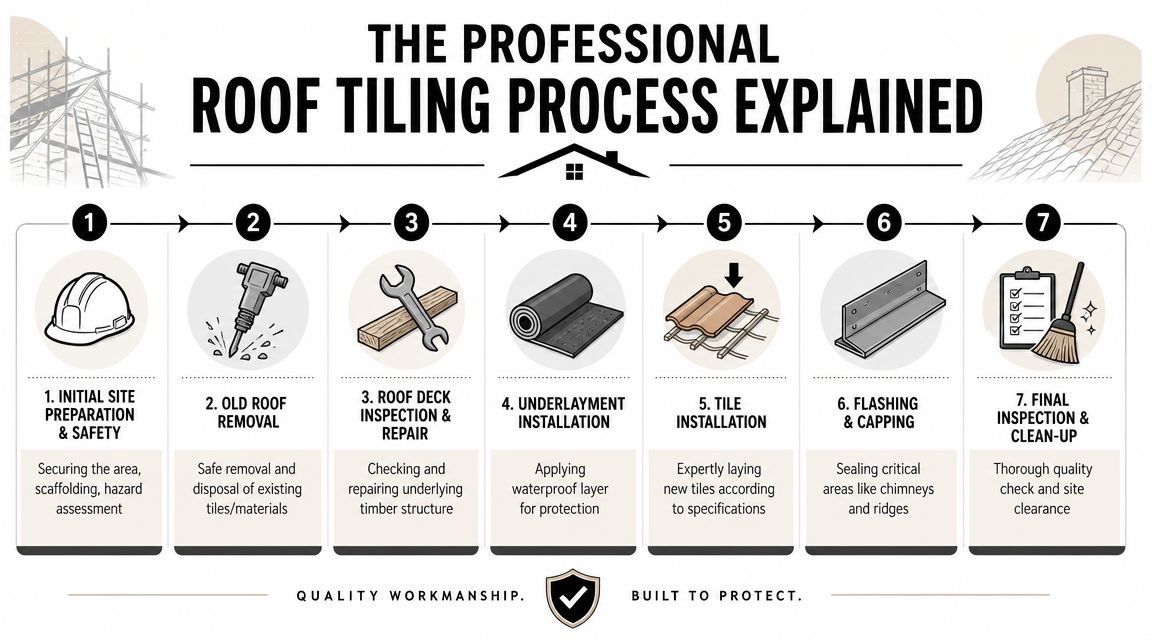
How the work should run on site
Site setup and protection
Access, fall protection, material staging and protection of gardens, paths and internal ceilings are handled first. On occupied homes, the builder also needs a plan for keeping the roof watertight if weather turns mid-job.Strip-off and controlled removal
Old tiles, ridge materials and failed flashings are removed in stages, not ripped off blindly. That gives the team a chance to isolate active leak points and avoid unnecessary damage to salvageable areas.Open-up inspection
Once the old covering is off, the condition of the roof becomes clear. Battens may be out of gauge, sarking may be torn or missing, and local timber repairs may be needed around valleys, eaves, skylights or chimneys.Roof preparation
Good jobs are distinguished from cosmetic ones during this stage. The roof plane is set out properly, underlay or sarking is installed or repaired, battens are fixed to suit the selected tile profile, and drainage paths are checked before the new covering goes on.
A practical installation walkthrough is also easier to follow on screen:
The installation stages that decide whether the roof stays dry
After preparation, the visible work starts. Tiles are laid to the correct gauge and line so water sheds as intended and the finished roof does not look uneven from the street. Cutting around penetrations needs care. Small errors here tend to show up later as leaks, rattling tiles or untidy edge lines.
Flashings, valleys, ridges and hips are then completed as a system, not as separate patch jobs. That point matters on older Melbourne homes where multiple repairs have often layered new materials over failed old ones. A registered builder managing the whole scope can coordinate the roofing work with plaster repairs, bathroom make-good, and any tiling or waterproofing reinstatement inside the house, instead of leaving the owner to organise separate trades after the leak path has already affected internal finishes.
Where shortcuts usually show up
The defects I see after poor roof tiling work are usually predictable:
- Tile courses drift out of line, which affects both appearance and water run-off
- Flashings are surface-fixed or patched, instead of being integrated properly into the roof build-up
- Ridge bedding and pointing are rushed, which leads to early cracking or loose caps
- Debris is left in valleys and gutters, creating drainage problems at the first heavy rain
- Internal moisture damage is ignored, so the roof is finished but the ceiling, bathroom wall or wet-area substrate keeps deteriorating
The final inspection should cover more than the roof face. It should include penetrations, gutters, downpipe discharge, visible alignment, and any internal areas that were affected by the original leak.
Roof tiling failures rarely start with the tile itself. They usually start at the junctions, the flashings, or the decision to treat the roof and the internal water damage as two unrelated jobs.
Navigating Permits and Victorian Regulations
Permits confuse a lot of homeowners because roofing work can look straightforward from the street while still triggering formal requirements. The legal position depends on scope. Replacing isolated damaged tiles is one thing. Major re-roofing, structural changes or broader building work are another.
When permits enter the picture
If the project changes the structure, involves substantial replacement, or forms part of wider remedial works, permit requirements can become relevant. That's especially true where roof failure has led to internal building damage and the rectification extends into ceilings, framing, wet areas or other building elements.
The practical issue isn't just paperwork. It's accountability. A roof is a weatherproofing system tied into structure, flashings, drainage paths and adjacent finishes. Once a project affects more than the visible tile layer, permit and compliance questions need to be checked early, not after demolition starts.
Why builder-led coordination matters
Using a Registered Builder makes life easier. Instead of trying to interpret permit triggers yourself, you're engaging someone who can assess the whole scope, identify whether approvals are needed, and coordinate the right sequence of trades and inspections.
For homeowners also dealing with shower leaks, balcony remediation or wet-area reinstatement, that broader compliance mindset matters just as much inside the house. It's worth understanding how a Victorian waterproofing compliance certificate fits into regulated wet-area work, because roof leaks and internal moisture damage often end up crossing over into bathroom and waterproofing rectification.
A Registered Builder also gives you one point of responsibility for the project logic. That means fewer gaps between roofing, carpentry, waterproofing and internal finishes, and less risk of discovering late that a piece of required compliance work was never allowed for.
Selecting Your Melbourne Roofing Professional
A roof leak rarely stays a roof-only problem for long. Water gets into insulation, stains ceilings, swells cornices, and if it tracks far enough, it can end up affecting a bathroom, ensuite or hallway below. That is why the right hire is not just the person who can replace tiles. It is the person who can assess the whole chain of damage and take responsibility for the repair sequence.
Roof tiling is a recognised trade, and on many Melbourne homes the job quickly overlaps with broader building work. If the scope includes substrate damage, structural rectification, internal reinstatement, waterproofing, or wet-area repairs, a Registered Builder is usually the safer way to run the project. You get one party looking at cause, access, sequencing and liability across the whole job, not separate trades each covering only their own piece.
What to verify before signing anything
Start with documents, not promises.
- Registered Builder details, where the scope goes beyond straightforward tile repair or replacement
- Public liability insurance that is current and appropriate for residential site work
- WorkCover and properly managed labour, especially if subcontractors will be on site
- A written scope with exclusions, so you know whether flashings, battens, disposal, scaffold, make-good and internal repairs are included
- Experience in occupied homes, because weather protection, site cleanliness and access planning matter more when people are living there
For larger properties or jobs with several trades working in sequence, it also helps to use a contractor familiar with commercial tiling and coordinated project delivery in Melbourne. That kind of experience usually shows up in better site control, clearer programming and fewer gaps between trades.
Questions that expose weak operators fast
A proper contractor should answer these clearly:
- Who inspects the roof before the quote is issued?
- What is the process if rotten battens, damaged sarking or timber issues are found after strip-out?
- Who is responsible for flashings, penetrations and weatherproofing details?
- What protection is in place if rain arrives mid-project?
- Are ceiling repairs, plaster replacement, repainting or bathroom rectification included, excluded, or costed separately?
- Who manages the internal trades if the leak has already damaged rooms below?
Those answers matter because a cheap roofing quote can become an expensive coordination problem. I have seen owners hire a roofer for the external repair, then chase separate plasterers, waterproofers, tilers and painters once the inside damage becomes clear. The work drags out, and each trade points back to someone else when defects or delays appear.
A better approach is to use a Registered Builder who can manage both the roof fault and the resulting building repairs under one scope. A factual example is Melbourne Tiling Services P/L, which handles bathroom renovations, waterproofing and multi-trade remedial work. That model suits Melbourne homes where a roof leak has already affected an upstairs bathroom, ensuite, ceiling cavity or adjacent finishes.
If a contractor cannot explain what happens after the tiles come off, they are not ready to run the job properly.
Roof Maintenance and When to Repair or Replace
A roof that leaks into the house is rarely just a roofing problem for long. In Melbourne homes, water can start at a cracked tile or failed ridge line, then track into insulation, ceiling plaster and wet-area finishes below. Once that happens, the decision is no longer just about swapping a few tiles. It is about stopping the source and limiting the building repairs that follow.
Repair is fine when the fault is isolated
Repairs are usually the right call when the defect is local and the rest of the roof is still performing properly. That includes a handful of broken tiles after a storm, one flashing detail that has opened up, or a small section of ridge capping that has shifted while the balance of the roof remains stable.
Maintenance helps keep those smaller jobs small. Clear gutters and valleys, check the roof after heavy wind, and take recurring ceiling marks seriously. Mortar in gutters, damp insulation and musty roof spaces are all signs worth inspecting early.
A good repair should deal with the cause, not just the visible entry point.
Replace when the roof is failing as a system
For Melbourne homes with recurring leaks or widespread cracked ridge capping, patch repairs are often a false economy, and the decision becomes about triaging whether the roof has broader systemic failures, as discussed in Victorian consumer-focused guidance on roofing scam risks and repair triage.
Common signs include repeated leak callouts in different areas, brittle or slipping tiles, deteriorated bedding and pointing across large sections, and underlay that has failed in more than one location. In that situation, each small repair buys limited time and can make owners pay twice. Once for patching, then again for the proper reroof.
This is also where the inside of the house matters. If water has reached an upstairs bathroom, ensuite or ceiling cavity, delaying the roof replacement often increases the internal scope. Ceiling linings may need replacement. Exhaust penetrations may need resealing. Waterproofing, tile reinstatement or repainting may also be part of the final job.
That is why many Melbourne owners are better served by one Registered Builder managing the roof fault and the internal rectification under a single scope. It reduces handover gaps between trades and gives you one party responsible for sequencing the external repair with the plaster, waterproofing, tiling and finishing work inside.
Frequently Asked Questions About Roof Tiling
Can a roof leak end up causing bathroom renovation work
Yes. Water rarely drops in a straight line from roof to floor. It can track through framing, along penetrations and into wet-area ceilings or walls before it becomes visible. If the leak reaches a bathroom, the fix may involve ceiling replacement, waterproofing checks, tile reinstatement and mould-related clean-up. That's why one Registered Builder managing both the roof and the bathroom-side repairs is often the cleanest approach.
Can you tile over an existing roof
Sometimes people ask about laying new roofing over the old system to save time. In most remedial situations, that's the wrong move. The old roof usually needs to come off so the structure, battens, flashings and underlay can be inspected. If you skip that, you're covering defects instead of fixing them.
What's the difference between restoration and re-roofing
Restoration usually means keeping the existing roof and carrying out remedial work such as replacing damaged tiles, addressing ridge issues, cleaning, sealing or related maintenance items. Re-roofing means stripping and installing a new roof system. The right choice depends on whether the roof still has sound bones.
How long does a roof tiling job take
It depends on access, weather, roof complexity, the extent of repairs under the old roof, and whether internal damage also needs rectification. A straightforward job moves much faster than one that includes structural fixes, permit steps or bathroom reinstatement after a leak.
What should I ask before signing a contract
Ask who is responsible for permits if required, who manages safety, what happens if hidden damage is found, whether flashings are included, how the site is protected during rain, and whether internal make-good is included or excluded. Also ask who your main contact is once the work starts.
Is a Registered Builder necessary if the leak seems minor
If it's a small isolated roof repair, not always. But if the leak is recurring, the roof needs larger-scale tiling work, or water has affected a bathroom or internal finishes, a Registered Builder is usually the safer path because the work has moved beyond a basic patch.
If you're dealing with a leaking roof, damaged bathroom ceiling, or a project that needs both external roof tiling and internal rectification, Melbourne Tiling Services P/L can assess the full scope and coordinate the work under one registered building team.
Write a Comment