

A small bathroom renovation in Melbourne typically starts around $8,000 for a basic job, usually sits at $15,000 to $25,000 for a mid-range finish, and can reach $25,000 to $40,000 for a premium project. If you're pricing a proper renovation rather than a cosmetic touch-up, that's the range you should plan around.
If you're reading this, you're probably standing in a tired ensuite or family bathroom wondering how a room this small can cost so much to renovate. That's a fair question. Small bathrooms look cheaper on paper because there's less floor area, fewer tiles, and less cabinetry. In practice, bathroom renovations still need waterproofing, plumbing, electrical, tiling, and coordination across multiple trades, and those costs don't shrink just because the room does.
Melbourne adds another layer. Compliance matters here, moisture issues in older homes are common, and once your project crosses the legal threshold, registered builders aren't optional. That's why a cheap-looking quote can become an expensive problem later.
Table of Contents
- The Real Cost of a Small Bathroom Reno in Melbourne
- A Complete Small Bathroom Renovation Cost Breakdown
- Why a Registered Builder is Essential for Your Melbourne Renovation
- Uncovering Hidden Costs and Planning Your Contingency
- Three Tiers of Small Bathroom Budgets Explained
- Smart Strategies to Save on Your Renovation Budget
- From Timeline to Trowel How to Plan Your Project
The Real Cost of a Small Bathroom Reno in Melbourne
A lot of homeowners start with the same assumption. It's a compact room, so the small bathroom renovation cost should be modest. That only holds true if you're repainting, swapping a vanity, and leaving the waterproofed shell untouched.
Once you strip the room out and rebuild it properly, the numbers move quickly. For 2026, a small bathroom renovation in Australia for a 3 to 5 m² space sits at $8,000 to $15,000 for a basic finish, $15,000 to $25,000 for mid-range, and $25,000 to $40,000 for premium quality, while the average spend on any bathroom renovation in Australia is about $26,000, according to What's The Damage's small bathroom cost guide.
That gives you the broad market view. In Melbourne, the practical reality is this. A genuine full renovation with compliant waterproofing, licensed trades, and decent fixtures usually doesn't behave like a bargain project.
What changes the number
The first major split is cosmetic refresh versus full renovation.
- Cosmetic work: Keeping the room largely intact, repainting, changing fittings, and improving appearance without rebuilding the wet area.
- Full renovation: Demolition, substrate preparation, waterproofing, tiling, plumbing, electrical, fixtures, and finishing.
- Layout changes: Moving a shower, vanity, or toilet adds complexity fast because more trades need to rework the service locations.
Practical rule: If the room is being stripped back and rebuilt, price it as a construction project, not as a decorating job.
Why Melbourne owners need a realistic baseline
The biggest mistake is budgeting from a national headline number without checking local conditions. Inner and middle-ring Melbourne homes often come with old substrates, out-of-level floors, moisture damage, or previous bathroom work that wasn't done well.
If you want a rough planning tool before requesting quotes, a bathroom renovation cost calculator for Melbourne projects can help you map your likely spend against finish level and scope. It won't replace a site inspection, but it will stop you anchoring to an unrealistic figure.
A Complete Small Bathroom Renovation Cost Breakdown
The total price only makes sense when you look at the moving parts. A bathroom quote isn't one cost. It's a stack of trade costs, product selections, and labour hours compressed into a small footprint.
A useful way to think about it is this. The room may be small, but the trade sequence isn't.
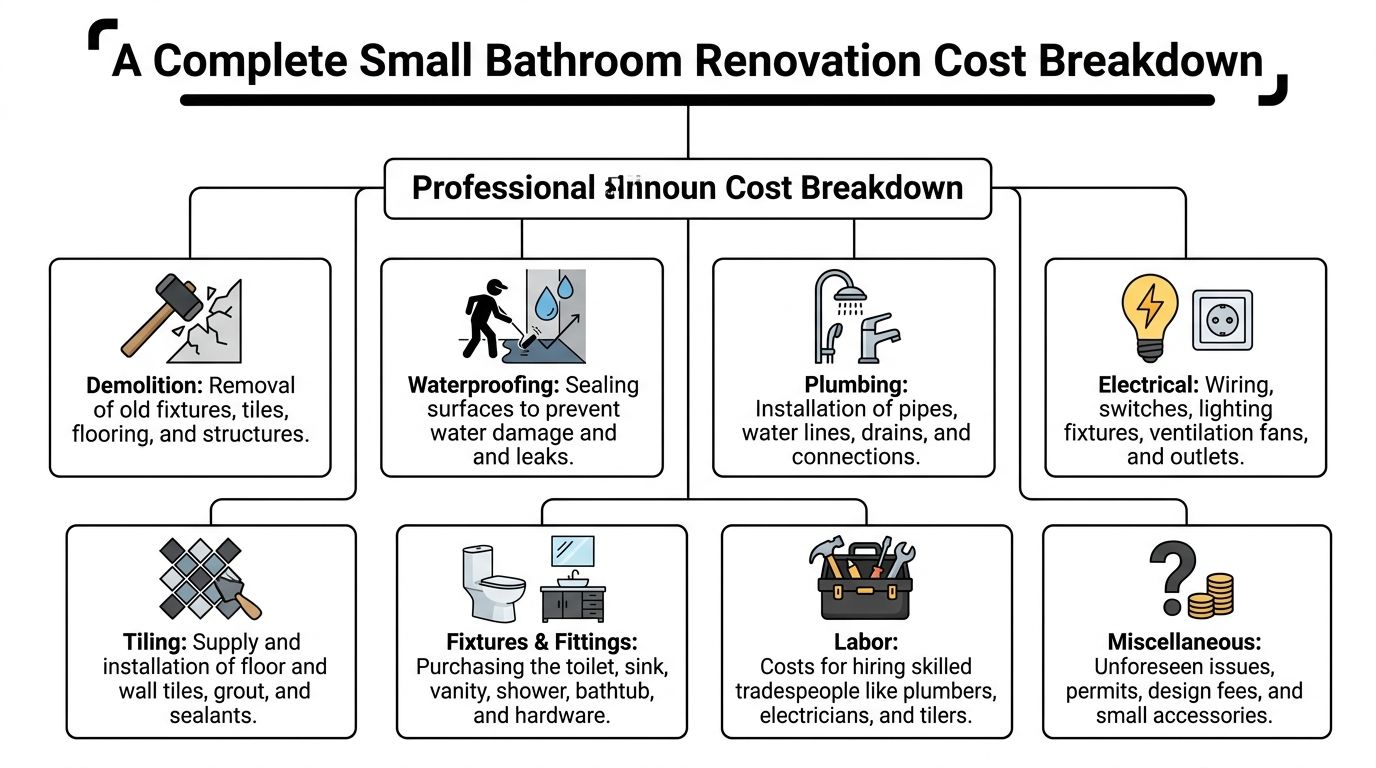
Why small rooms still cost real money
Labour is the main driver. Labour expenses account for 40% to 60% of the total cost to renovate a bathroom in Australia. For a $10,000 small bathroom project, roughly $4,000 to $6,000 goes to trades. Tiling labour costs $45 to $120 per square metre, excluding tiles, and plumbing hourly rates range from $100 to $150, based on Domain's bathroom renovation cost guide.
That matters because the fixed work still has to happen:
- Demolition and disposal: Old tiles, screed, sheeting, fittings, and waste removal.
- Plumbing: Disconnect, rough-in, fit-off, and any service adjustments.
- Electrical: Lighting, exhaust, power points, switches, and compliance.
- Waterproofing: The wet area has to be prepared and sealed correctly before tile goes down.
- Tiling and fit-off: The visible finish that everyone notices, but only after the hidden work is done properly.
A small room can feel less forgiving than a larger one. Every cut tile is visible. Falls to waste matter more. Tight tolerances show mistakes immediately.
Here's a visual walkthrough of how those stages come together in a real-world bathroom job.
Typical line-item costs
Below is a practical planning table. It's not a substitute for a formal quote, but it does show where the money usually goes in bathroom renovations.
| Item / Trade | Budget Range (AUD) | Mid-Range Range (AUD) |
|---|---|---|
| Waterproofing | $500 to $750 | $500 to $750 |
| Plumbing | $3,000 to $5,500 | $3,000 to $5,500 |
| Tiling | $3,500 to $6,000 | $3,500 to $6,000 |
| Shower screen installation | around $400 | up to $600 |
| Vanity, cabinetry and fixtures | $2,000 to $5,000 | $2,000 to $5,000 |
A few points matter more than the table itself.
The cheapest quote often looks cheaper because something has been left vague, excluded, or pushed into a provisional allowance.
What these allowances usually mean
Waterproofing is rarely where you want to chase the lowest number. If substrate prep is poor or detailing is rushed, the room may look fine at handover and fail later.
Plumbing costs jump when fixtures move. Keeping the shower, vanity, and toilet in their existing positions usually protects the budget better than any styling compromise.
Tiling isn't just tile laying. It includes set-out, cuts, edge details, surface prep, and working with walls and floors that are often not perfectly square.
Fixtures and fittings can considerably sway the project. One off-the-shelf vanity and a standard shower screen keep things controlled. Custom cabinetry, frameless glass, and premium tapware change the result and the spend.
Why a Registered Builder is Essential for Your Melbourne Renovation
In Victoria, one threshold changes the conversation completely. Once your bathroom renovation contract value goes over $10,000, the job must be handled by a Registered Builder. That's not a preference. It's a legal requirement for work scopes that regularly exceed that number.
The legal line homeowners miss
According to Baron Constructions' Victorian bathroom renovation cost guide, in Victoria, bathroom renovation projects must be undertaken by a Registered Builder if the total contract value exceeds $10,000. That same source notes that small bathroom work scopes often land between $15,000 and $22,000, which means many full bathroom renovations automatically sit above the threshold.
People often get caught when they compare quotes, see one that comes from an unregistered operator, and think they're saving money. What they're often doing is stepping outside the legal framework that protects the homeowner.
If the work isn't set up correctly, insurance can become a problem and liability gets murky very quickly.
What registered builders actually do
A proper renovation isn't one trade turning up with a ute and a tile cutter. It's coordination.
- Scope control: Registered builders pull the full scope together so demolition, rough-in, waterproofing, tiling, and fit-off happen in the correct sequence.
- Trade coordination: Plumbers, electricians, waterproofers, carpenters, and tilers need to work to the same plan.
- Compliance management: Wet areas need to be built to standard, and the paperwork matters as much as the visible finish.
- Contract clarity: Homeowners need a proper contract, not a vague text message list of inclusions.
For waterproofing in particular, this isn't a casual detail. If you want to understand why wet area compliance carries so much weight in Melbourne, this guide to bathroom waterproofing in Melbourne gives useful context around what proper work should include.
Hiring one person for a whole bathroom sounds simpler. In most full renos, it usually creates gaps between trades, responsibility, and compliance.
The practical difference is peace of mind. Registered builders don't just arrange the work. They own the process in a way that protects the project from becoming a patchwork of assumptions.
Uncovering Hidden Costs and Planning Your Contingency
The quote you receive before demolition is rarely the final financial story. Bathrooms hide problems well. Once tiles come off and the floor is opened up, defects that were invisible from the outside can become impossible to ignore.
That doesn't mean every project blows out. It means smart planning assumes some risk from the start.
What blows out a quote
One of the most overlooked parts of small bathroom renovation cost is the contingency. A hidden 10% to 20% buffer is recommended for Melbourne's moisture and compliance risks, and a $10,000 quote can realistically become $12,000 to $14,000 once issues such as subfloor rot are factored in, based on Site Pro Bathrooms' budget remodel guide.
The common triggers are usually found after demolition:
- Subfloor damage: Water may have travelled beyond the shower area.
- Wall straightening: Tiling over badly bowed walls creates visible problems later.
- Levelling and screeding: Small rooms still need proper falls and levels.
- Previous poor work: The old bathroom may have failed long before you saw obvious signs.
On-site reality: Hidden damage isn't a variation because someone got the quote wrong. It's work no one can price properly until the room is opened up.
How to budget without getting caught short
The safest approach is to separate your budget into two buckets. One is the planned renovation spend. The other is the contingency you don't touch unless the room demands it.
That buffer matters more in older Melbourne properties, where bathrooms have often been renovated more than once and not always to the same standard. A room can look serviceable and still have compromised substrate, poor falls, or failed membrane work underneath.
If compliance paperwork is part of your planning, this overview of a Victorian waterproofing compliance certificate is worth reading before you sign a contract. It helps you ask sharper questions about what is, and isn't, included in a quote.
A tight budget isn't the problem. A tight budget with no contingency is.
Three Tiers of Small Bathroom Budgets Explained
Most homeowners don't need more numbers. They need a clearer picture of what each price band buys.
For 2026, a small bathroom renovation in Australia for a 3 to 5 m² room typically costs $8,000 to $15,000 for basic, $15,000 to $25,000 for mid-range, and $25,000 to $40,000 for premium, with the tier mainly driven by finish and fixture quality rather than huge changes to the fixed trade cost base, according to What's The Damage's bathroom reno budget breakdown.
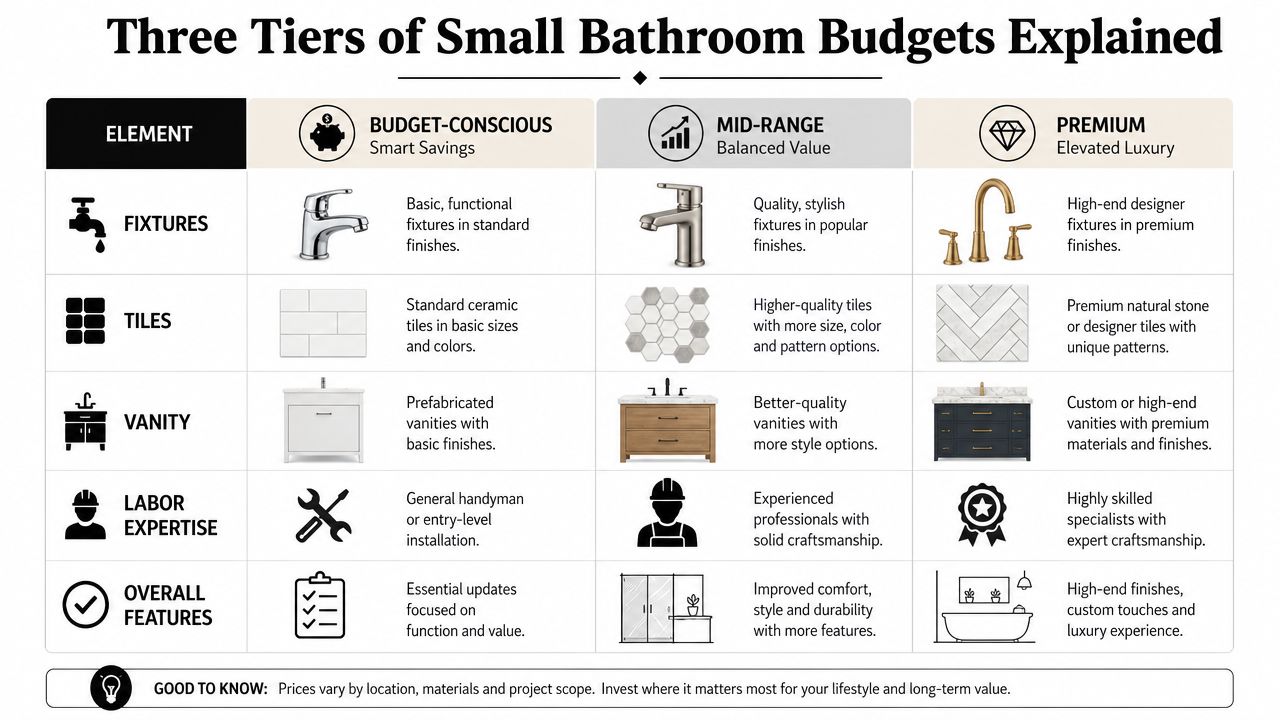
Budget-conscious
This tier is about restraint, not cutting corners. The best version keeps the existing layout, avoids custom joinery, and uses standard fittings that are easy to source and replace later.
Typical choices often include:
- Standard ceramic tiles
- Off-the-shelf vanity
- Basic shower screen
- Simple tapware and accessories
What works here is discipline. Pick clean, durable finishes and don't chase too many feature details in one small room.
What doesn't work is trying to make a budget renovation look premium by mixing in one or two expensive pieces while keeping everything else at the lowest spec. The room ends up visually uneven.
Mid-range
Most Melbourne homeowners opt for this level of renovation when they want a bathroom that feels properly renovated rather than merely updated. The finishes are more refined, the tile selection is stronger, and the overall fit-out feels intentional.
A mid-range job usually suits owners who want:
- Better tile choice and cleaner detailing
- A vanity that improves storage and proportion
- Nicer fittings in the areas you touch every day
- A result that still feels current years from now
You don't need extravagance to get a strong result. You need a cohesive palette, good set-out, and trades who know how to finish a wet area neatly.
Premium
Premium projects aren't defined by size. They're defined by finish level, detail, and often by how much custom work is involved.
Premium spend usually goes into the things homeowners notice every day. Better tile, cleaner glass, stronger vanity design, more precise detailing, and less compromise.
That can mean frameless glass, custom joinery, premium porcelain, feature niches, upgraded tapware, and a tighter architectural feel. It can also mean more labour because premium products often need more careful installation.
The mistake here is assuming premium only means expensive products. In reality, premium bathrooms are built on planning, proportion, and workmanship. If the detailing is poor, high-end fixtures won't rescue the room.
Smart Strategies to Save on Your Renovation Budget
Saving money on a bathroom isn't about finding the cheapest line on a quote. It's about protecting the parts that matter and simplifying the parts that don't.
The smartest budget reductions happen before work begins, when decisions are still cheap to change.
Savings that work
- Keep the plumbing layout where it is: If the shower, toilet, and vanity stay put, the project is usually much easier to control.
- Choose standard-sized fixtures: Standard vanities, shower screens, and mirrors are easier to source and easier to replace later.
- Use one hero finish, not five: A well-chosen tile or vanity can carry the room without layering every surface in a premium product.
- Simplify tile patterns: Straight lay or larger-format planning can reduce complexity compared with layouts that involve heavy cutting and intricate borders.
- Decide early: Late product changes create friction across multiple trades and often push labour time out.
A good budget bathroom doesn't feel cheap. It feels edited.
Savings that usually backfire
Some cost-cutting choices look sensible and then create avoidable problems.
- DIY in waterproofed areas: Wet areas are not the place for experimentation.
- Buying fittings without checking compatibility: Cheap online fixtures can create delays if rough-in requirements don't match the plan.
- Changing products mid-job: A discontinued tile, delayed vanity, or revised shower screen size can force rework.
- Choosing solely on quote total: If inclusions are thin, you'll pay later through variations or compromised finish quality.
Spend where failure is expensive. Save where appearance can be simplified without affecting performance.
The best conversations with builders are specific. Ask what happens if you keep the layout. Ask whether a standard shower screen works better than a custom one. Ask which tile sizes install cleanly in your room. Those questions usually save more money than haggling over a headline number.
From Timeline to Trowel How to Plan Your Project
The cleanest bathroom renovations are usually the best-planned ones. Not the most expensive ones. Not the most ambitious ones.
Once the scope is settled, the process becomes much easier to manage.
Get the scope right before work starts
Start with the essentials. Do you need a full strip-out or a lighter refresh? Are you keeping the layout? Are there any products you already know you want, such as frameless glass, a wall-hung vanity, or large-format porcelain?
Then get the project documented properly. That means a clear quote, a written scope, and product selections that match the budget you're willing to carry.
This kind of visual planning helps homeowners make better decisions before demolition starts.
Build decisions in the right order
The order matters more than people expect.
Lock the layout first
Every later choice depends on fixture positions.Confirm finishes second
Tiles, shower screen type, vanity style, and tapware affect both labour and lead times.Check compliance early
Builder registration, waterproofing scope, and documentation shouldn't be afterthoughts.Allow for site reality
Once demolition starts, the room may reveal work that wasn't visible beforehand.
A small bathroom can move quickly when the decisions are made upfront and the trades are coordinated properly. It drags when the design is still changing after the room has been stripped out.
If you want a smoother job, get the selections, scope, and legal setup right before the first tile comes off the wall.
If you're planning bathroom renovations in Melbourne and want straight advice from registered builders who handle the full scope from design through waterproofing, tiling, and fit-off, Melbourne Tiling Services P/L is worth contacting for a detailed quote. They offer practical planning support, transparent scopes, and the kind of on-the-ground experience that helps homeowners avoid expensive mistakes before the work begins.
Write a Comment