

You're probably at the point where the bathroom looks half-finished, the tiles are chosen, the tapware is locked in, and then someone asks a question that sounds minor but isn't: Do you want epoxy grout or cement grout?
That decision sits in a tiny joint between tiles, but it affects almost everything that matters in bathroom renovations. Cleaning. Staining. Waterproofing performance at the tile surface. How the room ages. Whether the shower still looks sharp a few years after handover or starts showing dark joints, patchy colour, and hard-to-shift grime.
In Melbourne, that choice deserves more thought than is typically given. A good Registered Builder will treat grout as part of the whole wet-area system, not a cosmetic afterthought. The tile, adhesive, substrate preparation, waterproofing membrane, movement joints, falls, drainage, and grout all need to work together. If one part is wrong, the finished room can still fail in service, even if it looked great on day one.
Table of Contents
- Choosing Your Grout The Critical Decision in Your Renovation
- Understanding the Contenders Cement and Epoxy Grout
- Performance and Durability Head to Head Comparison
- Suitability by Location Where to Use Each Grout Type
- Installation The Professional Tiler and Registered Builder's Role
- Lifecycle Cost Maintenance and Repair Considerations
- Your Final Verdict A Recommendation for Your Project
Choosing Your Grout The Critical Decision in Your Renovation
A common renovation moment goes like this. The wall tiles are already selected. The vanity is on order. The layout has been marked out. Then the grout discussion starts, and many homeowners assume it's just a colour card decision.
It isn't.
In a high-end bathroom, grout is one of the materials you'll notice every day without realising it. You see it when the shower dries unevenly, when soap residue hangs around in corners, when light-coloured joints start to darken, or when a floor still looks fresh because the grout hasn't absorbed half the room. That's why this choice belongs in the same conversation as waterproofing, tile specification, and the build method your Registered Builder signs off on.

In practical terms, most homeowners are choosing between cement grout and epoxy grout. Cement grout is familiar, easier to work with, and often suits dry or lower-demand areas. Epoxy grout is denser, less forgiving to install, and usually chosen where long-term performance matters more than keeping the initial material cost down.
The small decision isn't small at all. In a shower, grout choice affects how the room behaves under daily water, cleaning products, steam, and use.
For Melbourne homeowners, the answer shouldn't come from trend talk. It should come from the room itself. Is it a family bathroom used hard every day? A premium ensuite with large-format porcelain? A balcony detail where leak risk is already a concern? A heritage-style floor where the look of a traditional grout line matters?
A seasoned tiler and a Registered Builder will look at the same issue from slightly different angles. The tiler focuses on finish, joint performance, cleanability, and installation method. The Registered Builder focuses on system compatibility, wet-area compliance, coordination of trades, and whether the final assembly aligns with AS 3740 and the broader bathroom renovation scope. That's the right way to judge epoxy grout vs cement grout.
Understanding the Contenders Cement and Epoxy Grout
Grout is not a generic filler. In a bathroom renovation, it is part of the finished system, and the type you choose affects appearance, cleaning, maintenance, and how well the tiled surface holds up in service.
Cement grout in simple terms
Cement grout is the traditional product used between tiles after the adhesive has cured. It is cement-based, usually blended with fine sand, pigments, and additives to improve workability. On many Melbourne projects, it remains the standard choice because it is familiar to installers, easier to shape in the joint, and available in a wide range of colours and price points.
There are two main types:
- Sanded cement grout suits wider joints because the added aggregate gives it more body and helps reduce shrinkage.
- Unsanded cement grout is smoother and better suited to narrow joints or tile surfaces that can scratch easily.
That distinction matters on site. A grout that does not suit the joint width can finish poorly, wear unevenly, or become harder to maintain. I see this regularly on bathroom renovations where the tile has been chosen first and the grout specification left until late. A Registered Builder will usually push that decision earlier, because the tile, joint width, substrate movement, and wet-area detailing all need to work together, especially where the bathroom must comply with AS 3740.
If you're weighing up tile finishes, joint widths, and product compatibility, it helps to review the full range of tiling materials used in premium bathroom builds.
Epoxy grout in simple terms
Epoxy grout is a resin-based product made from epoxy resins and a filler component, mixed as a system before application. It does not behave like standard cement grout on the wall or floor. It is denser, less absorbent, and much more technique-sensitive during installation.
From a builder's perspective, that difference is not just technical. It affects who should install it, how quickly it must be cleaned off the tile face, and whether the selected tile is suitable for an epoxy system in the first place. On high-end bathrooms, epoxy grout is often specified because the owner wants stronger stain resistance and easier long-term cleaning, but it only delivers that result if the installation is done properly.
A simple comparison helps:
| Material type | Composition | General behaviour |
|---|---|---|
| Cement grout | Cement, fine aggregate, pigments, additives | More porous, easier to install, more traditional in appearance |
| Epoxy grout | Epoxy resin and filler components | Dense, low-absorption, harder to install, more resistant in use |
Why the composition matters
The material makeup drives the actual result. Cement-based grout can take up moisture, soap residue, and surface staining more readily. Epoxy grout resists that far better because the joint surface is much less absorbent.
That matters in Melbourne bathrooms, where steam, regular shower use, and inconsistent ventilation can expose weak points over time. It also matters in the broader renovation scope. A Registered Builder is not only looking at the grout line itself. The builder is checking whether the whole wet-area assembly, including waterproofing, tile selection, joint treatment, and finishes, is suitable for the room and aligned with AS 3740.
Tile type also changes the decision. Large-format porcelain, mosaics, textured tiles, natural stone, and handmade finishes all respond differently during grouting and clean-up. A product that performs well on a dense porcelain wall tile may be the wrong choice on a stone surface that can mark, stain, or react during installation.
In short, cement grout and epoxy grout are built differently, installed differently, and expected to perform differently. That is why the right selection should be made as part of the bathroom specification, not as an afterthought once the tiles are already on site.
Performance and Durability Head to Head Comparison
A premium bathroom can look sharp at handover and still disappoint two winters later. In Melbourne, that usually shows up in the shower first. Darkened grout lines, staining around niches, and joints that never seem to stay clean. For a Registered Builder or tiler specifying a wet area properly, performance has to be judged over years of use, not on installation day.
| Feature | Epoxy Grout | Cement Grout (Sanded/Unsanded) |
|---|---|---|
| Water resistance | Dense, very low absorption | Porous and more likely to hold moisture |
| Sealing | Doesn't require sealing | Requires sealing and periodic upkeep |
| Stain resistance | Strong resistance to common bathroom staining | More likely to absorb residue and discolour |
| Chemical resistance | Handles stronger cleaning regimes better | Needs more care with product selection |
| Installation | Technique-sensitive and less forgiving | Easier to place and wash off |
| Typical use | Showers, floors, niches, high-use bathrooms | Lower-demand areas or cost-conscious selections |
| Material cost | Higher upfront | Lower upfront |
A visual comparison makes the trade-offs easier to scan.
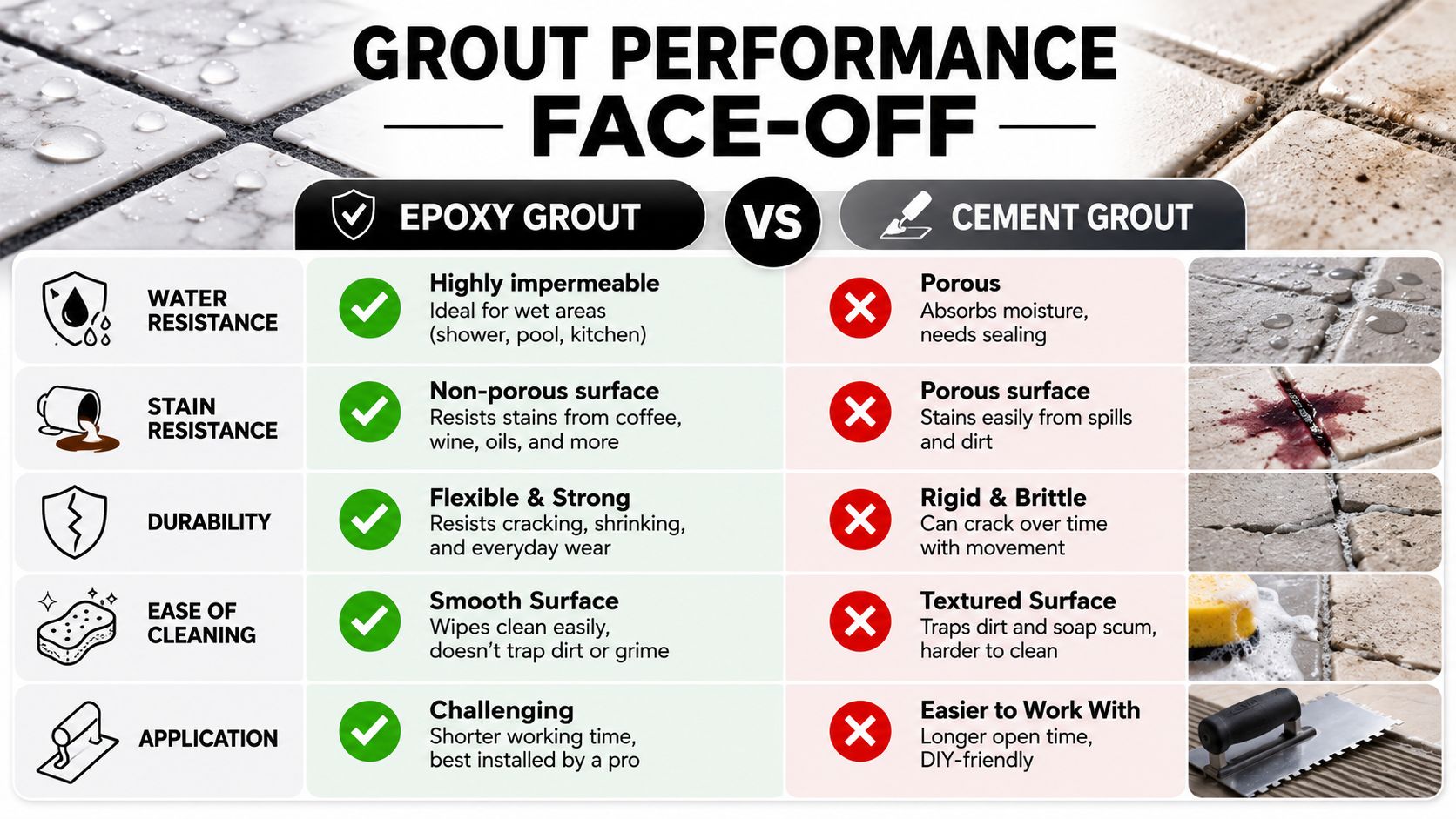
Moisture Performance and Porosity
In bathroom work, porosity is the dividing line.
As noted in Zephyr and Stone's epoxy grout overview, epoxy grout is non-porous, waterproof, stain-resistant, and does not require sealing, while cement grout remains porous. On site, that difference shows up in how the room handles daily shower use, steam, and slower drying conditions through Melbourne's colder months.
That surface performance still sits behind the primary compliance issue. Grout is not the waterproofing system. Under AS 3740, the waterproof membrane and wet-area detailing are what protect the structure. The grout choice affects how much moisture and residue the tiled surface holds, how easily it cleans up, and how well the finish presents over time. If you want the full wet-area assembly specified properly, this guide on how to waterproof a shower correctly is the right starting point.
In practical terms, epoxy gives water less chance to sit in the joint itself. Cement grout can still perform acceptably in a compliant bathroom, but it asks for more maintenance discipline from the owner.
In a shower, the membrane protects the building. The grout affects how the surface wears, stains, and cleans.
Later in this section, the video below shows the practical differences in handling and finish.
Stain and Chemical Resistance
Bathrooms cop more abuse than many owners expect. Shampoo, soap scum, fake tan, hair colour, makeup, cleaning sprays, and hard-water residue all end up on the joints.
Epoxy handles that environment better because contaminants stay closer to the surface instead of soaking in. That is why it is regularly specified in places with stricter hygiene demands, including some commercial and healthcare settings. For a high-end residential bathroom, the benefit is simpler. The grout line tends to keep its original colour and needs less coaxing to look clean.
Cement grout is more forgiving to install, but it is less forgiving in service. Pale joints around mixers, niches, and shower floors often show the age of the room well before the tiles do. Sealing helps, but it does not turn a porous product into a non-porous one.
Durability and Movement
Durability is not only about compressive strength or hardness. It is about how the joint holds its appearance under cleaning, foot traffic, heat, moisture cycling, and normal building movement.
Epoxy generally holds colour better and is less prone to the shrinkage and surface wear that can make cement joints look tired early. For clients spending serious money on porcelain, stone, custom joinery, and fixtures, that matters. A bathroom should still look considered after years of use, not just in the project photos.
There is a limit, though. No grout should be expected to act as a movement joint. Changes of plane, junctions between materials, and larger tiled areas still need correct movement accommodation and flexible sealant where required. A Registered Builder will look at those details because long-term performance depends on the full assembly, not one bag or bucket of grout.
Appearance and Colour Consistency
Many decisions get made, even if owners do not say it outright. They want the bathroom to keep the same look in year five that it had in week one.
Cement grout can suit a classic finish and can look excellent in the right hands. But the final colour is more vulnerable to variation from mixing water, wash timing, curing conditions, and general site control. On larger bathrooms, that can leave subtle patchiness between walls or between separate days of installation.
Epoxy usually delivers a more consistent finished colour, especially in wet zones built around rectified porcelain or mosaics where every joint is on display. The trade-off is workmanship tolerance. If the installer is slow on cleanup or leaves residue on the tile face, epoxy will expose that mistake quickly. In other words, epoxy often gives the better long-term finish, but only when the tiler and builder have allowed for the product properly in the specification and installation sequence.
Suitability by Location Where to Use Each Grout Type
A Melbourne bathroom can have a beautiful tile selection, a good membrane, and still become harder to live with than it should be if the grout choice is wrong for the room. I look at this the same way a Registered Builder should. By location, cleaning load, moisture exposure, and how the full assembly has been designed to perform over time.
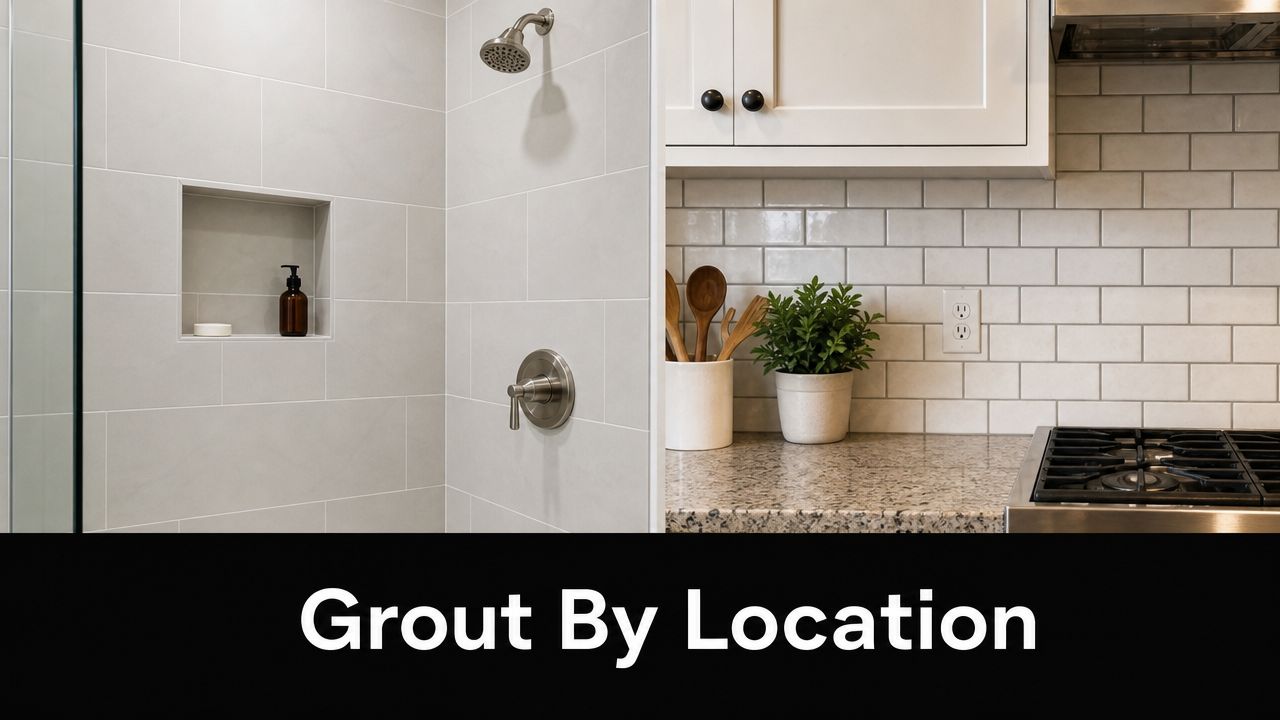
Showers and Other Wet Areas
For premium showers, epoxy grout usually makes the stronger case.
That applies in many Melbourne homes because bathrooms often dry slowly through winter, exhaust fans are not always used well, and family bathrooms see repeated daily use. Shower floors, lower wall sections, niches, and bench seats stay under the most pressure. Soap residue builds up there. Water sits longer there. Those are the locations where epoxy's lower absorbency and better stain resistance pay off in day-to-day use.
Under AS 3740, the waterproofing membrane remains the layer that protects the structure in internal wet areas. Grout sits above that system and affects serviceability, maintenance, and appearance. It does not replace compliant waterproofing. If you are planning a renovation, this guide on how to waterproof a shower correctly is a useful reference before tile and grout are specified.
Cement grout can still be used in some bathroom areas, but I would be more selective with it in high-end work. It suits lower-risk wall areas outside direct and repeated soaking, especially where the owner accepts sealing and more ongoing care. In a main shower used every day, epoxy is usually the better long-term decision.
Kitchen Splashbacks and Feature Walls
These areas are more about use pattern than water exposure alone.
Epoxy works well on splashbacks behind cooktops, coffee stations, and prep areas where oil, food splatter, and frequent wiping are expected. It also suits light-coloured grout joints where clients want the original look to hold up without gradual darkening around the busiest parts of the kitchen.
Cement grout remains a reasonable option on decorative walls with lighter service conditions. A powder room feature wall, a laundry wall above the trough, or a bathroom wall outside the wet zone does not face the same cleaning demand as a shower recess. In those locations, a quality cement grout can be the more balanced specification if budget, tile type, and finish all support it.
Floor Areas and Balconies
Floor decisions should follow traffic, moisture, and cleaning method.
On an internal floor in a guest bathroom or lower-use room, cement grout can perform well if the tile system has been built properly and the owner understands the maintenance involved. On a bathroom floor used by a family every morning, with wet feet, regular mopping, and hair or product residue around the vanity, epoxy generally holds up better and keeps the joints looking cleaner.
Balconies need a stricter assessment. A builder should be looking first at falls, drainage, membrane detailing, substrate movement, and perimeter junctions. Grout matters, but it is one part of a larger external waterproofing and drainage strategy. Epoxy can be a sensible choice on exposed tiled surfaces because it copes better with moisture and contamination than standard cement grout, yet it will not compensate for poor falls or bad detailing.
On balconies, grout supports the system. If the substrate, membrane, drainage, or movement detailing is wrong, the tiled finish remains at risk regardless of grout type.
That is the practical distinction Melbourne homeowners should keep in mind. Use epoxy where moisture, staining, and cleaning pressure are highest. Use cement grout where the area is lower risk, the aesthetic suits it, and the maintenance trade-off is acceptable.
Installation The Professional Tiler and Registered Builder's Role
A grout choice often looks simple on a quote. On site, it affects programming, workmanship, risk, and who carries responsibility if the bathroom does not perform as intended.
That matters more in Melbourne than many owners realise. Winter curing conditions, variable humidity, and the way wet areas are signed off under AS 3740 all put pressure on installation quality. From a Registered Builder's point of view, grout is not a cosmetic afterthought. It sits inside a wet-area system that has to be built, sequenced, and handed over properly.
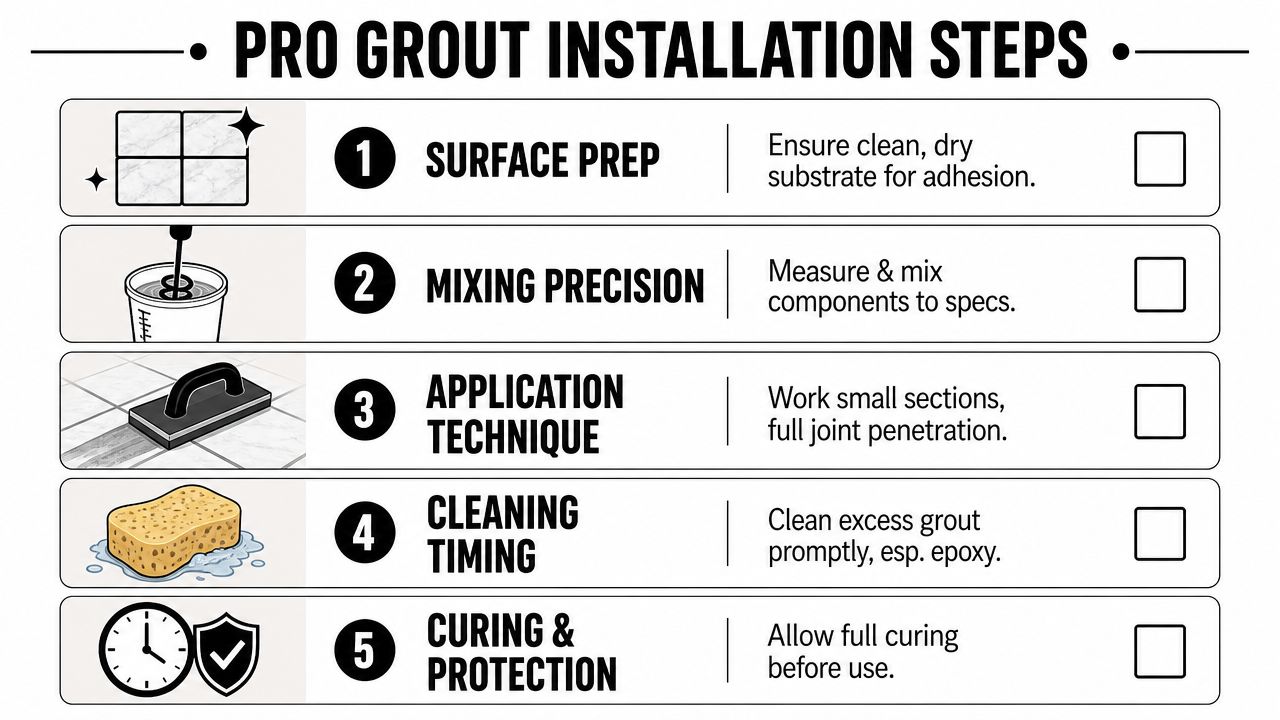
Why Epoxy Installation Demands More Control
Epoxy gives very little margin for delay. Once mixed, the installer has a short working window, and cleanup has to be controlled from the first section. If the tiler spreads too much, washes too late, or works over a tile with heavy texture without testing first, residue can become a serious defect rather than a minor snagging item.
I see the same pattern on higher-end renovations. The epoxy product itself is usually not the problem. Trouble starts when the crew treats it like standard cement grout, works too fast in the wrong places, or fails to coordinate with the builder on timing, access, and room conditions.
Common causes of a poor result include:
- Oversized mixes that begin to tighten before the area is finished
- Sections that are too large for proper wash-off control
- Residue left on matte, textured, or stone-look tiles
- Untidy finishing at drains, niches, junctions, and trim edges
- Poor site coordination around temperature, moisture, lighting, and trade access
Cement grout is more forgiving. It still needs a competent hand, but it allows more correction time and generally suits straightforward installations better.
What the Builder Should Be Checking
On a compliant bathroom build, the tiler and Registered Builder have different roles, but they should be working to the same plan.
The builder should already have the wet-area assembly under control before grout is discussed. That includes substrate condition, set-downs where required, falls, drainage layout, waterproofing, movement joints, and protection of finished work. Under AS 3740, the bathroom has to perform as a system. Grout selection needs to suit that system, not fight against it.
A proper installation usually includes the following:
Joint preparation
Adhesive squeeze-up, dust, and loose debris are cleared so the grout can fill the joint properly.Correct curing time after tile fixing
The tile bed must be stable before grouting starts. Rushing this step invites avoidable movement and bond issues.Accurate mixing and handling
Epoxy in particular needs disciplined proportioning and batch control.Tight work zones
Good tilers break the room into manageable sections and finish each one fully before moving on.Controlled cleanup and protection
The tiled surface is cleaned methodically, then protected from early traffic, water, and follow-on trades.
For owners comparing quotes, it helps to choose local tiling contractors with experience in high-spec wet areas rather than a general handyman who offers grouting as a side service.
What a Homeowner Should Expect on Installation Day
A professional crew should be able to explain the method in plain terms. They should know whether the selected grout suits the tile surface, the joint width, and the room's level of water exposure. They should also be clear about curing times, cleaning limitations, and when other trades can come back into the room.
That last part is often missed on renovation sites. A grout job can be technically sound and still be damaged by early use, wet testing at the wrong time, or another trade dragging gear across fresh joints.
Use this checklist when you review the job:
- Surface readiness: Joints are clean, tile faces are checked, and the room is ready for the specified grout.
- Product suitability: The grout matches the tile, joint width, and intended use of the bathroom.
- Application method: The installer works in controlled sections, especially with epoxy.
- Cleanup standard: Residue is managed immediately, not left until the end of the day.
- Post-install protection: The area is protected while the grout cures.
- Builder oversight: Responsibility is clear between tiler, waterproofer, builder, and other trades.
In a premium bathroom renovation, that coordination is what separates a finish that looks good at handover from one that still looks right years later.
Lifecycle Cost Maintenance and Repair Considerations
A Melbourne bathroom often looks perfect at handover. The true test starts six months later, after winter condensation, daily showers, cleaning products, and regular use have worked on every joint.
That is why grout selection should be judged on ownership, not just purchase price. For homeowners planning a high-end renovation, and for a Registered Builder carrying responsibility for the finished wet area, the better question is simple. Which grout will still perform, present well, and stay serviceable without avoidable callbacks?
Upfront Spend Versus Long-Term Ownership
Cement grout usually wins the first invoice. It can be a sensible choice in the right location, especially where the area is low risk and easy to maintain. But in a main bathroom, ensuite, or shower used every day, the cheaper starting point can lead to more cleaning, more maintenance, and earlier cosmetic decline.
That matters in Melbourne homes. Bathrooms here deal with cool mornings, steam build-up, and periods where moisture hangs around longer than clients expect. If joints stay damp or collect residue, cement grout tends to show it sooner. Sealing helps, but sealing is still a maintenance task that has to be done properly and repeated over time.
Epoxy changes that ownership pattern. It asks for more care in specification and installation, then usually asks less from the homeowner afterward.
Maintenance Reality in a Family Bathroom
In practical terms, maintenance is where the difference becomes obvious.
A sealed cement joint can perform well, but it still needs attention. The surface is more likely to hold soap residue, body oils, and general bathroom grime, particularly in shower floors, niches, and corners where airflow is poor. Once discolouration sets in, the room can look tired even if the tiles themselves are still in good condition.
Epoxy is easier to keep looking consistent. It resists staining better, does not require sealing, and generally stands up better to the cleaning routine that busy households realistically follow, not the ideal one written on a product sheet.
| Ownership factor | Epoxy grout | Cement grout |
|---|---|---|
| Routine cleaning | Wipes down more easily in wet areas | More prone to holding residue and dulling over time |
| Ongoing upkeep | No sealing required | Sealing and periodic refresh work may be needed |
| Visual consistency | Better colour stability in heavy-use bathrooms | More likely to show patchiness or staining with age |
| Best fit | Showers, ensuites, family bathrooms, premium wet areas | Dry walls, lower-use spaces, tighter renovation budgets |
A bathroom that is hard to keep clean often becomes the bathroom clients want redone first.
Repairability and Future Access
Cement grout still has one practical advantage. It is usually easier to rake out, patch, and refresh in a localised area. If a small section is damaged, the repair process is generally simpler and less specialised.
Epoxy is harder once cured. Spot repairs can be more noticeable, and removal takes more time and more care, especially around large-format porcelain, mitred edges, underfloor heating zones, and finished waterproof details. In other words, epoxy rewards accuracy at the start.
From a Registered Builder's point of view, that is a risk allocation issue as much as a product issue. Under AS 3740, the wet area system has to work as a system. Grout is not the waterproofing layer, but failures, staining, cracked joints, or careless repair work can still trigger invasive investigation, trade coordination, and disputes about responsibility. In a premium renovation, the cost of opening up a shower is rarely limited to the grout line itself.
The practical conclusion is straightforward. Cement grout is easier to repair, but more likely to need attention. Epoxy is harder to repair, but in the right location it is often less likely to become a maintenance problem in the first place.
That is usually the deciding trade-off for Melbourne homeowners who want the bathroom to keep its finish, meet the expectations of a high-end build, and stay out of the callback cycle.
Your Final Verdict A Recommendation for Your Project
If you want the shortest practical answer on epoxy grout vs cement grout, here it is.
If your project is a main shower, family bathroom, ensuite, niche, bench seat, or other wet area that will be used every day, epoxy grout is usually the stronger long-term choice. It suits homeowners who want less maintenance, stronger stain resistance, and a cleaner finish over time.
If your project is a dry wall area, a decorative feature, a lower-use room, or a renovation where budget is tight and the risk is low, cement grout can still make sense. It's familiar, more forgiving to install, and often appropriate where the room isn't under constant moisture pressure.
If you're planning high-end bathroom renovations with large-format porcelain, tight joint lines, and an expectation that the room should still look premium after years of use, epoxy is hard to ignore.
If you're renovating under the guidance of registered builders, the right question isn't “Which grout is better in general?” It's “Which grout fits this tile, this room, this waterproofing system, and this maintenance expectation?” That's how professionals make the call.
Choose epoxy when performance leads the brief. Choose cement when the location allows it and the trade-offs are acceptable. Don't choose either in isolation from the rest of the wet-area system, especially where AS 3740 compliance, waterproofing detail, and long-term durability are on the line.
If you're planning a bathroom renovation, ensuite upgrade, leak rectification project, or need advice on the right grout system for a wet area, Melbourne Tiling Services P/L can help you assess the full assembly, not just the tile surface. As Melbourne-based specialists in bathroom renovations and tiling, they coordinate the details that matter, from waterproofing and substrate preparation to premium tile installation and finish quality, so your grout choice supports a bathroom that looks right and performs properly.
Recent Comments