
A mid-range bathroom tiling and renovation project in Melbourne typically costs around $10,000, and waterproofing compliance under AS 3740 isn't optional if you want to avoid expensive leaks. If the room is already open, this is the moment to treat tiling as part of the whole wet-area system, not just the finish you see.
Most homeowners start with tile samples and end up dealing with falls, membranes, junctions, and registration rules they didn't expect. That's where a bathroom can shift from a cosmetic refresh to a regulated renovation, especially once you're working in a Victorian home with mixed substrate conditions, older framing, or a shower that's never been detailed properly.
Table of Contents
- Planning a Bathroom Renovation with Tiling in Mind
- Understanding Waterproofing Standards and Defect Risks
- The Step-by-Step Tiling Workflow from Substrate to Finish
- Choosing Between Large-Format Tiles and Traditional Formats
- When to Hire Registered Builders for Your Renovation
- Finishing Touches and Quality Checks for Long-Term Durability
Planning a Bathroom Renovation with Tiling in Mind
A typical Melbourne bathroom renovation starts with a simple question, what tiles look good? In practice, the core question is what the room needs beneath the finish so the bathroom stays dry, straight, and compliant for years. Melbourne Tiling Services P/L notes that a mid-range project is commonly around $10,000, which is a realistic figure when you factor in preparation, waterproofing, and labour rather than just the tile box itself.
Start with the room, not the sample board
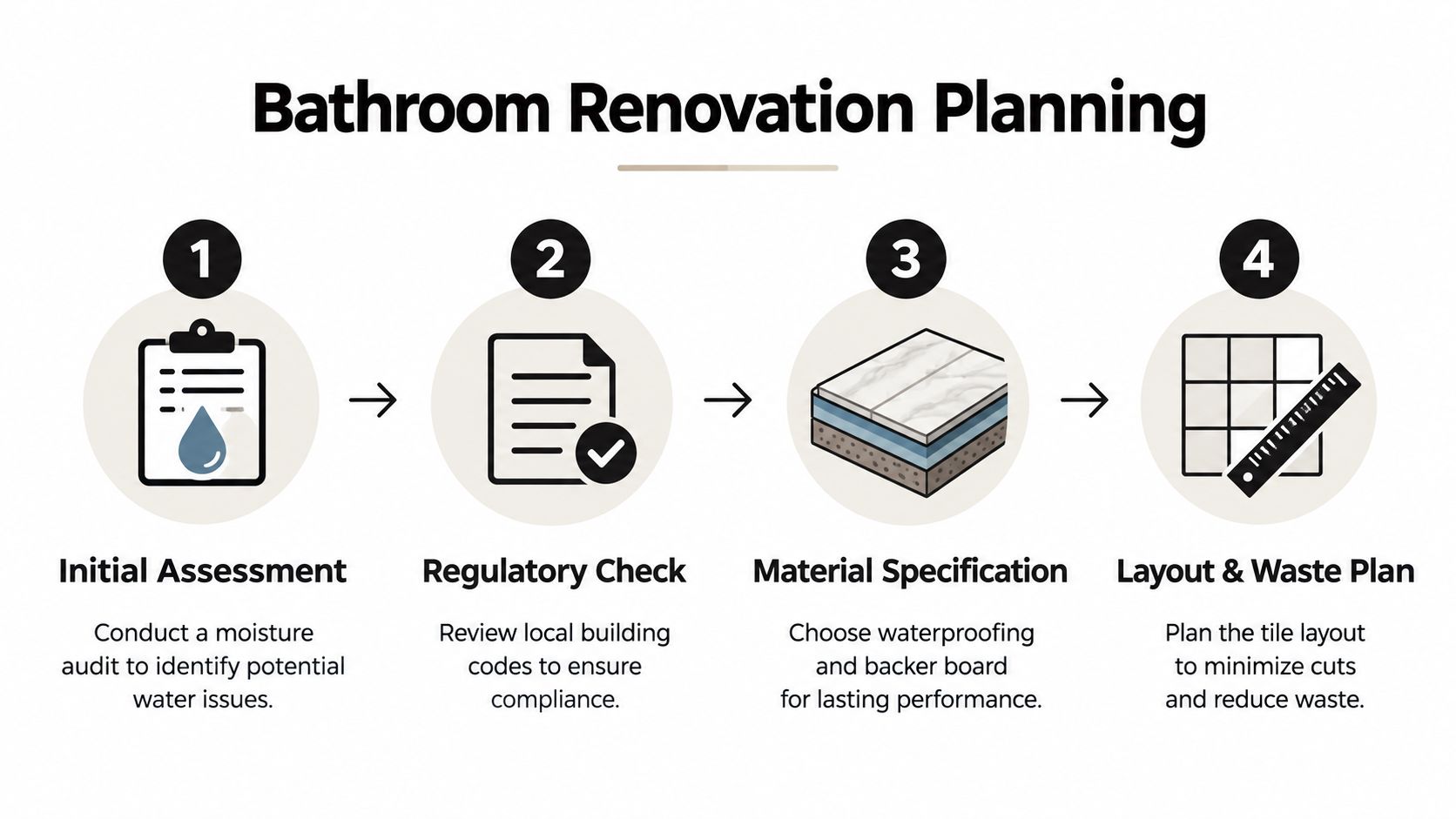
A good renovation begins with assessment. If the floor is out, the walls are bowed, or the shower recess has hidden moisture, tile choice comes second to rectification. That's why many practical renovation checklists begin with a moisture audit, then move to product selection and layout planning.
The best way to think about tiling a bathroom is as a sequence of linked trades. Screeding, waterproofing, tiling, plumbing, and sealing all rely on each other, so a shortcut in one stage usually shows up later as cracked grout, lippage, or leaks. For a useful overview of the renovation flow, the bathroom renovation process guide is a solid starting point before you lock in scope.
Practical rule: tile selection should follow substrate assessment, not the other way around.
A renovation also needs enough room in the budget for the hidden work. Waterproofing, levelling, and careful layout planning don't look dramatic on day one, but they're what stop the bathroom becoming a repair job two years later. If you're comparing ideas with other homeowners, the bathroom remodel projects page is useful because it shows how tile work sits inside the broader renovation process, not outside it.
Cosmetic refresh or compliant renovation
A cosmetic refresh can mean new grout, a few replacement tiles, or a surface-level update. A compliant renovation means the wet area is treated as a controlled system, with substrate preparation, membrane continuity, and correct detailing around doors, floors, and junctions. Those are not the same job.
In older Melbourne homes, this difference matters even more because old walls and floors often aren't ready for straight, large-format tile work without correction. If the room is being fully renewed, the tile budget should be set with contingencies for levelling and waterproofing, not just the decorative finish. That's what separates a neat-looking bathroom from one that can handle daily use.
Understanding Waterproofing Standards and Defect Risks
A bathroom can look finished while moisture is already moving behind the tiles. In Melbourne renovations, waterproofing is the part of the build that protects the structure, not a coating added for appearance. AS 3740:2021 sets the domestic wet-area benchmark, while the National Construction Code also includes waterproofing requirements. Tile installation is therefore one stage in a compliant wet-area system, not a substitute for membrane work AS 3740:2021 standard.
What the membrane has to do
The membrane must remain continuous beneath the tiles and connect correctly at wall-to-floor junctions, drains, pipe penetrations, and door frames. Australian technical guidance specifies waterproofing shower walls to 1500 mm above the shower floor or 25 mm above a fixed shower screen. The shower floor must be fully covered, the membrane must extend 150 mm beyond the shower threshold onto the bathroom floor, and adjacent walls must rise 100 mm above the bath rim technical waterproofing guidance.
These measurements control where water can travel. Grout is not the waterproof barrier, so a neat grout line cannot correct a gap, poorly sealed penetration, or broken membrane.
Wall-to-floor junctions and service penetrations deserve particular attention. Bond breakers, compatible tapes, and correct sequencing allow the membrane to move and seal as intended before adhesive is applied. Once tiles cover the surface, defective preparation becomes difficult to see and expensive to investigate.
If the membrane is wrong, the tile isn't the problem, it's the camouflage.
Inspection evidence supports that concern. Western Australia's General Inspection Report Six recorded compliance at only 58% of inspection points against the Building Code of Australia and AS 3740-2010 WA inspection report. For Victorian homeowners, the figure is a practical warning to document the membrane stage and use an appropriately qualified waterproofing contractor.
Why failure is expensive
Waterproofing defects often require more than replacing a few tiles. Demolition, drying, substrate repairs, membrane rectification, and retiling can affect adjoining rooms and delay the renovation. NSW strata defect research found waterproofing in 42% of buildings with serious defects, while Queensland Home Warranty data put bathroom claim rectification close to AUD 25,000 in 2024–2025 defect analysis.
That cost changes the renovation decision. Saving on membrane preparation can create a much larger legal and construction bill if water reaches framing, finishes, or neighbouring property. Complete the waterproofing, allow the system to cure as specified, and check the details before tiling proceeds. The bathroom waterproofing standards guide provides practical context alongside the standard.
The Step-by-Step Tiling Workflow from Substrate to Finish
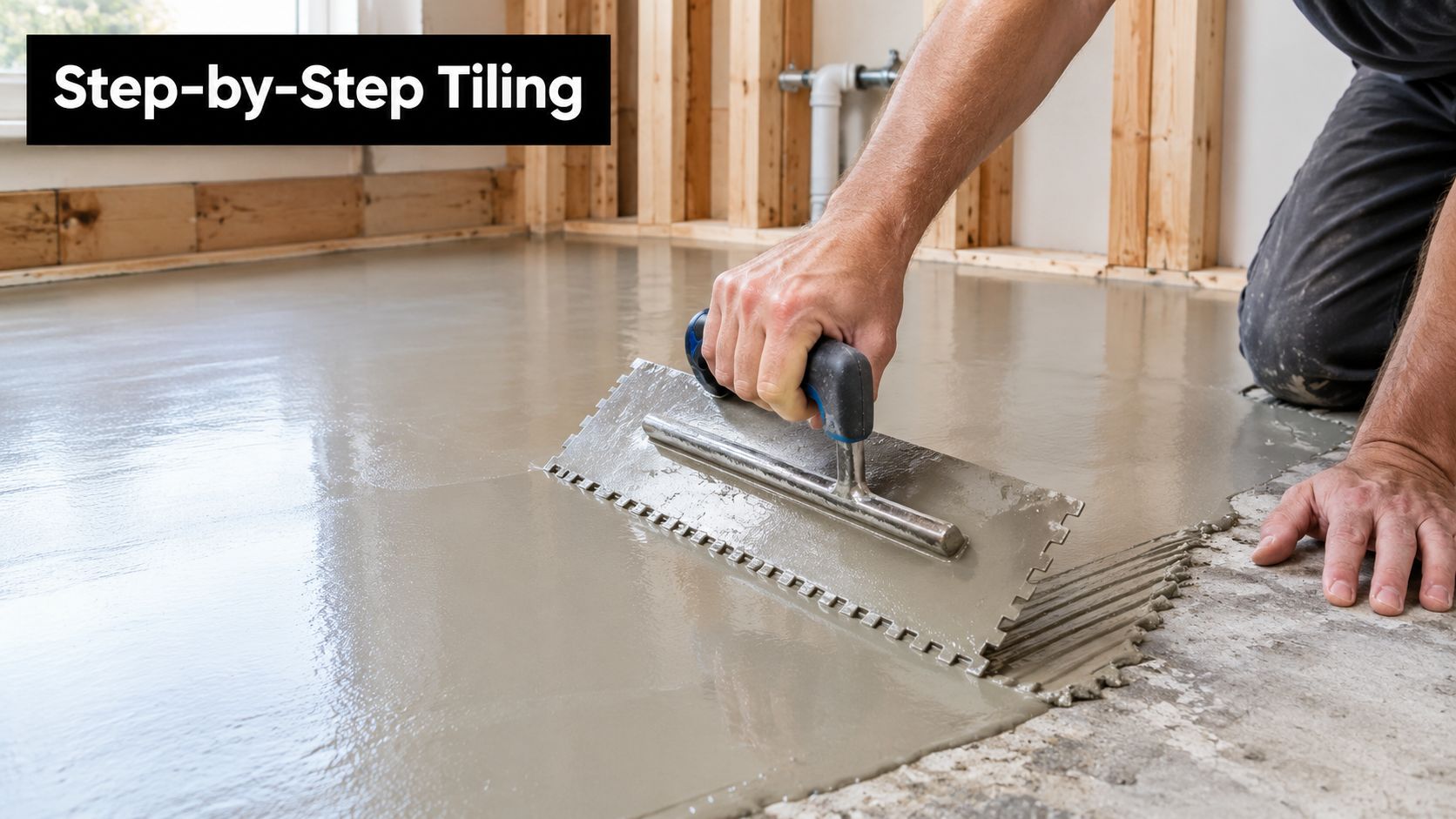
A bathroom can look ready for tiles while the work underneath is still unsuitable. The floor may need new falls, the walls may be out of plane, and the waterproofing may not yet form a continuous system. Follow the sequence carefully, because a tile finish cannot correct a moving substrate, poor drainage, or missing membrane details.
Prepare the substrate first
Start with the base required by the entire tile system, not just the surface visible beneath the tiles. Remove loose material, correct uneven areas, and establish the required falls before waterproofing begins. In a shower, water must run to the waste rather than collect in low spots.
Screeding and self-levelling set the plane for the room. They are practical preparation work, particularly with large-format tiles, which show humps and hollows more readily than smaller formats. Check the substrate for stability, cleanliness, and suitable moisture conditions before applying the membrane.
Waterproof before the first tile
Australian practice places waterproofing before tiling. AS 3740 is the domestic benchmark for wet areas, so the tiles must follow a compliant substrate rather than compensate for a weak one. The membrane provides the water protection, while the tile is the wearing surface.
Check bond breakers at wall-to-floor junctions and seal penetrations around taps, mixers, outlets, and wastes. Where the system allows it, complete a post-installation water test before tiling starts. A short verification stage is far less disruptive than removing finished tiles and repairing concealed damage.
Set out the tiles with the room in mind
Set-out determines whether the finished bathroom looks planned or improvised. Balance edge cuts, align visible joints with the room, and check how the pattern meets niches, shower entries, vanity splashbacks, and fittings. Review the layout from standing height, because a plan that looks tidy on paper can produce awkward narrow pieces in the room.
Adhesive selection and trowel technique also affect the result. Use a spread suited to the tile size, and work in sections small enough to prevent the adhesive skinning before the tile is bedded. Check coverage, keep faces aligned, and control lippage as you go. Do not leave all corrections until the grout stage.
For homeowners comparing formats or planning professional work, large-format tile information explains the preparation behind a clean finish. Melbourne Tiling Services P/L provides bathroom tiling, screeding, self-levelling, waterproofing, and wet-area renovation services. Those stages need to work together, because a neat surface finish depends on the substrate and waterproofing beneath it.
Choosing Between Large-Format Tiles and Traditional Formats
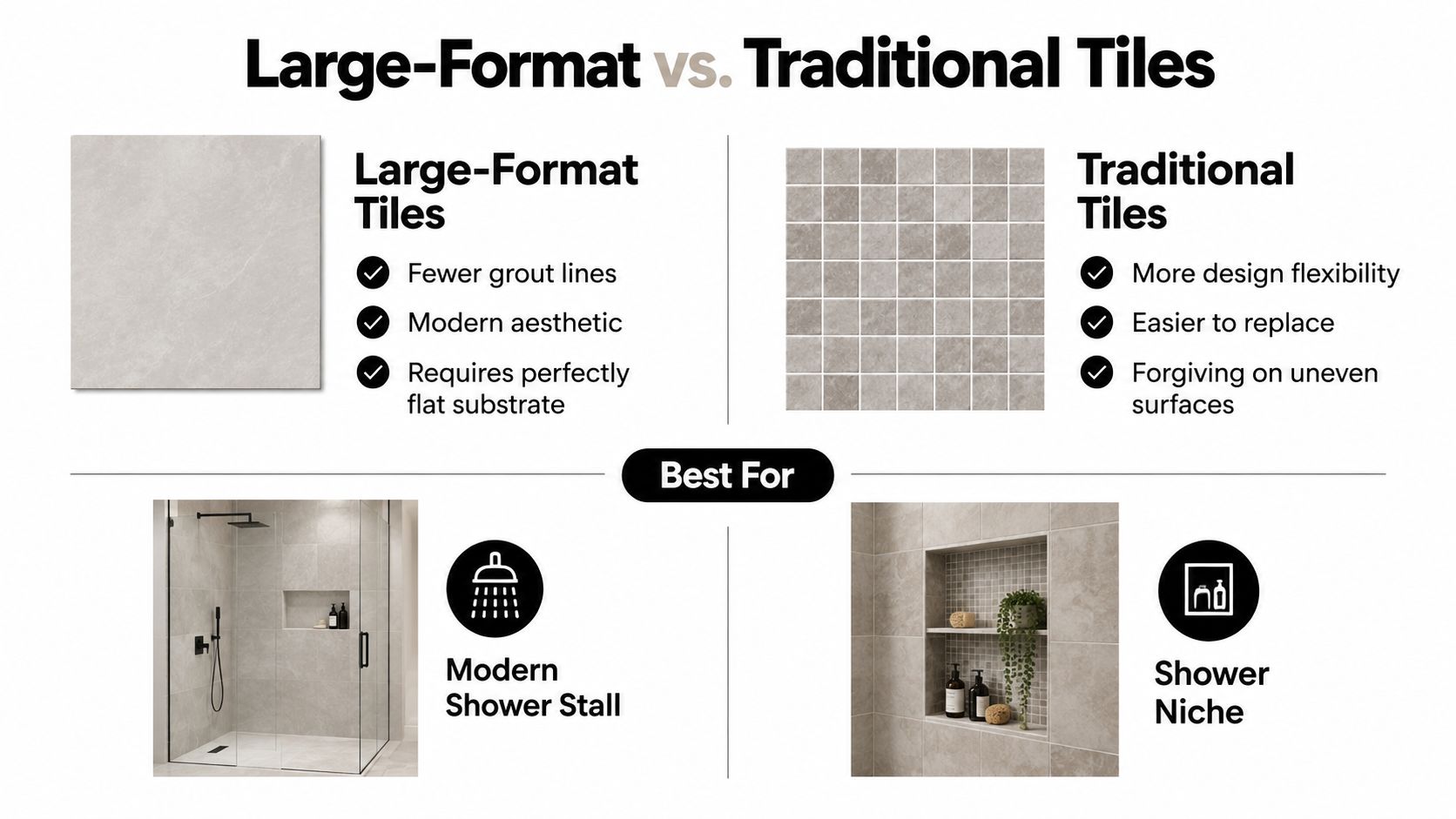
Large-format tiles look sharp because they reduce grout lines and create a cleaner visual field. Traditional formats feel more forgiving, especially in older homes where walls and floors are rarely perfectly true. The choice is less about style and more about the condition of the room you're tiling.
The trade-off is flatter surfaces versus easier handling
Large-format tiles demand flatter substrates and tighter handling tolerance. That means more time spent preparing the room before the tile setter even opens a box. In an older Victorian bathroom, that prep can be the difference between a clean finish and a frustrating patch-up.
Traditional ceramic and porcelain tiles are more forgiving on slightly uneven surfaces and easier to work around awkward geometry. They can also be simpler to replace if one section gets damaged. If the bathroom has lots of corners, a niche, or a tricky shower recess, smaller formats often give more control.
Cost and budget pressure in Melbourne
Victorian tiling prices vary widely. Reported installed bathroom-floor tiling is around $50 to $120 per square metre, shower tiling is $60 to $150 per square metre, and waterproofing adds another $30 to $60 per square metre Victorian tiling price benchmarks. Those figures help explain why tile size isn't a pure design decision, it changes the labour and preparation load as well.
Rule of thumb: if the room isn't flat, large-format tiles can make the problem more expensive, not more attractive.
That doesn't mean large slabs are a bad choice. It means they're a better fit for rooms where the substrate has already been corrected and the layout is planned with movement joints, waste, and cut positions in mind. If you want to compare how a specialist approaches this side of the job, hire a large tile installer in Cumming is a useful example of how professional installation is framed around handling tolerances rather than just the look of the tile.
When to Hire Registered Builders for Your Renovation
In Victoria, bathroom work gets serious fast once the price rises and the scope includes waterproofing, plumbing coordination, and structural interfaces. Bathroom renovation work valued at $5,000 or more must be carried out by a registered building practitioner, and the registration must be either Domestic Builder: Unlimited or Domestic Builder: Limited for bathroom work Victorian registration threshold. That's not bureaucracy for its own sake, it's the system that helps keep wet-area work accountable.
Why registration matters
A registered builder brings the right trades together in the right order. Tilers, plumbers, carpenters, electricians, and waterproofers need to coordinate around the membrane, the falls, and the finish layer. If one trade jumps ahead of another, the whole room can end up with a fault that only shows after the tiles are down.
Registered-builder status also matters for insurance, documentation, and sign-off. Industry listings in Melbourne routinely identify renovation firms as registered builders, which shows how concrete that credential is in the local market Melbourne bathroom company guidance and Melbourne renovation profiles. In practice, that credential is part of the risk control, not just the branding.
Where DIY ends
DIY can work for small, low-risk surface updates if the room is dry, stable, and already compliant. It stops making sense when the job involves waterproofing, falls, penetrations, or a full strip-out. Once the work moves into regulated wet-area construction, the cost of getting it wrong can outweigh the savings very quickly.
A simple way to judge it is this, if the project would be painful to demolish and redo, it's probably not a DIY candidate. Bathrooms are unforgiving because the final look hides the part that matters most. If you want that hidden work handled by one team, Melbourne Tiling Services P/L is one option for bathroom renovations, wet-area waterproofing, screeding, self-levelling, and full tiling coordination in Melbourne and greater Victoria.
Finishing Touches and Quality Checks for Long-Term Durability
Grout and sealant are the last line of defence, but they're not a substitute for good waterproofing. The finish should be checked for hollow spots, uneven joints, poor cuts, and any sign that the membrane or tile bed was disturbed during installation. If those issues show up early, they're still fixable without opening the whole bathroom again.
A practical finishing routine also means choosing products suited to wet areas and keeping maintenance simple. If you're unsure how to treat a porcelain surface or what needs sealing, Neasden Hardware sealer advice is a useful reminder that not every tile needs the same maintenance approach.
Keep the bathroom dry where possible, clean up grime before it settles into grout lines, and watch for movement around corners or shower edges. That kind of attention protects the room long after the final clean-up is done.
If you're planning tiling a bathroom in Melbourne and want the job handled as a proper wet-area renovation, Melbourne Tiling Services P/L can help with waterproofing, screeding, self-levelling, large-format tile work, and full bathroom renovations. Visit Melbourne Tiling Services P/L to discuss your room, your budget, and the right scope before the first tile is set.
Recent Comments