
I've pulled up to jobs where the owner loved the look of terrazzo, then changed their mind the moment I explained the floor build-up under a bathroom door. The material can be beautiful in a Melbourne home, but only if the finish, sealer, and substrate are chosen like a wet-area system, not a showroom sample.
Table of Contents
- Melbourne's Terrazzo Heritage and Modern Revival
- Understanding Terrazzo Types and Finish Options
- Weighing the Advantages and Practical Limitations
- Budgeting for Terrazzo Installation in Melbourne
- Installation Requirements and Substrate Preparation
- Long-Term Maintenance and Sealing Strategies
- Choosing Qualified Suppliers and Registered Builders
Melbourne's Terrazzo Heritage and Modern Revival
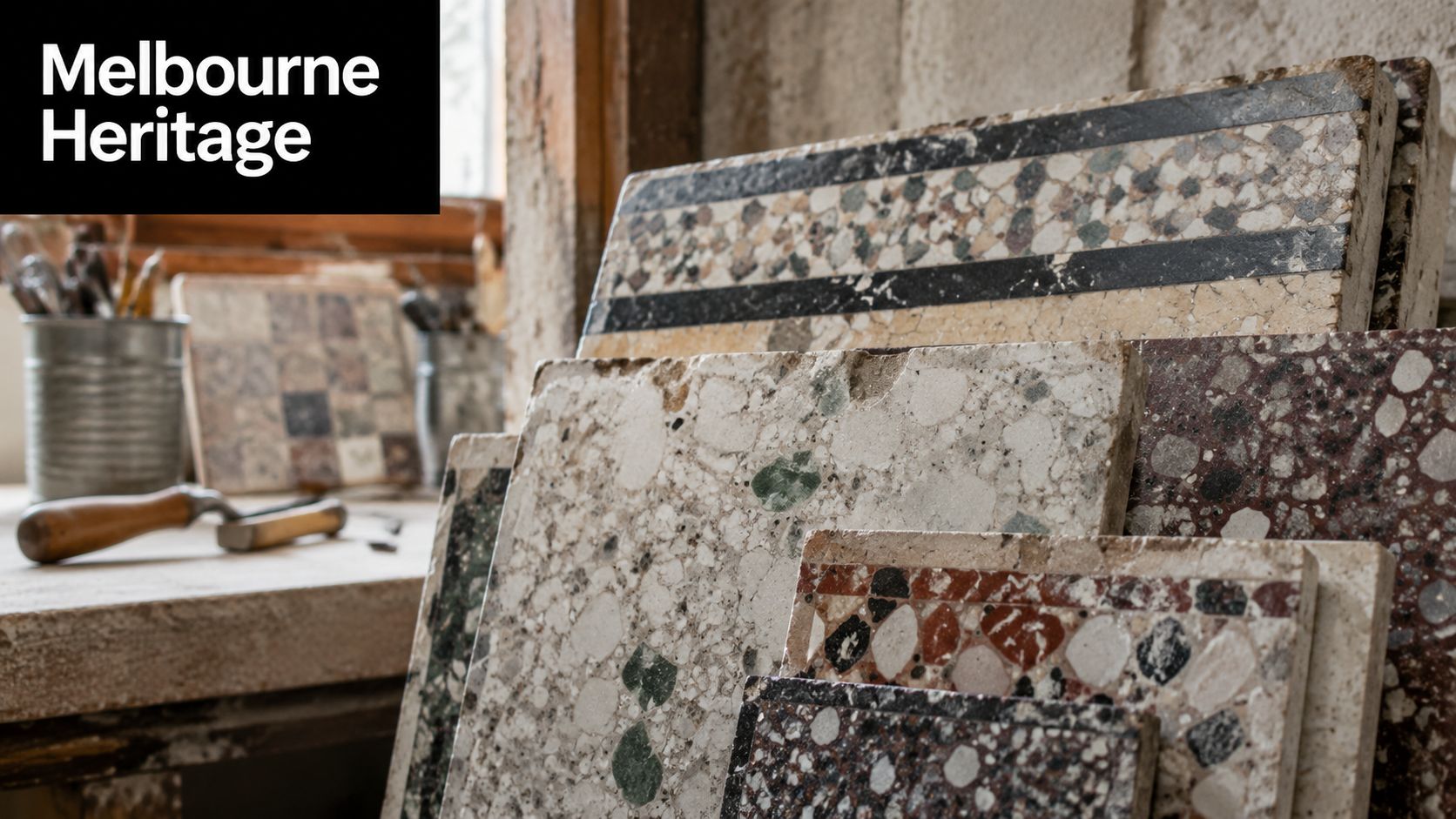
Melbourne didn't just import terrazzo, it helped make it local. Museum Victoria records the De Marco Brothers' Melbourne work from approximately 1914 to 1955, and notes that they introduced terrazzo to Australia while helping popularise it as a bathroom finish in eastern-suburbs homes, which ties the material to real Victorian renovation culture rather than a vague overseas trend Museum Victoria. That matters because terrazzo has already proved it can sit comfortably in Melbourne houses, not just in glossy design magazines.
The older story is even more specific. A Melbourne heritage source documents imported terrazzo tiles in the city by 1884–1885, including examples at St Kilda's Bundalohn house and the Safe House basement, and it notes that imported terrazzo tiles in Australia predated in-situ terrazzo heritage paving record. In other words, terrazzo wasn't recently discovered by Melbourne designers. It was already appearing in built examples in one of the city's oldest residential precincts.
Why Melbourne keeps coming back to it
What drives the modern revival is simple. Homeowners want a bathroom surface that looks intentional, carries some history, and can still be detailed properly in a wet area. Terrazzo gives you that mix, but only if the rest of the system is built with equal care.
The strongest terrazzo jobs in Melbourne are the ones where the heritage look is matched by modern wet-area detailing.
In bathroom renovations, that usually means the surface is only one part of the decision. The work sits underneath, in waterproofing, fall planning, sealers, and the way the finish handles water on a daily basis. That's why terrazzo has stayed relevant here, it suits a city that values period character, but it still needs the practical discipline of a contemporary renovation.
Understanding Terrazzo Types and Finish Options
Terrazzo in Melbourne usually comes down to two system families, cement-based and resin-based. Cement-based tiles and slabs are commonly offered at 15 to 20 mm, while resin-based systems can be supplied as thin as 12 mm in tile form, and heavier-duty concrete terrazzo systems can be much thicker, around 32 to 80 mm Bernini specification PDF. That thickness difference isn't trivia, it affects floor height, door clearances, transition strips, and the amount of load your substrate needs to carry.
Finish choice changes performance
The finish matters just as much as the body of the tile. A polished surface has a different look and different underfoot behaviour to a honed or sandblasted finish, and in a wet area that difference is practical, not cosmetic. Australian terrazzo floors are commonly specified in R9 to R13 slip-resistance classes, with R10 explicitly mapped to wet-area uses such as kitchens, toilets, changing rooms, and laundries, while R11 to R13 suit progressively higher-risk external or traffic areas EUVAL technical specifications.
Here's the decision rule I use on site. If the floor is for a bathroom or ensuite, the finish has to be chosen with water on it, not just a dry sample in a showroom. A more polished surface can lower slip resistance relative to honed or sandblasted finishes, so the pretty option isn't always the best option.
| Finish Type | Slip Rating | Best For | Maintenance Level |
|---|---|---|---|
| Polished | Lower practical grip in wet areas | Feature floors, low-splash spaces | Higher |
| Honed | Often preferred where wet-area performance matters | Bathrooms, ensuites, laundries | Moderate |
| Sandblasted | Stronger grip feel | Higher-risk wet areas, external transitions | Moderate to higher |
A lot of people start by asking which terrazzo looks best. The better question is which finish works with the bathroom's exposure, cleaning routine, and safety requirement. That framing saves mistakes later, especially when the same floor has to look refined and still behave properly when it's wet.
See one example of a terrazzo bathroom tile range
Weighing the Advantages and Practical Limitations
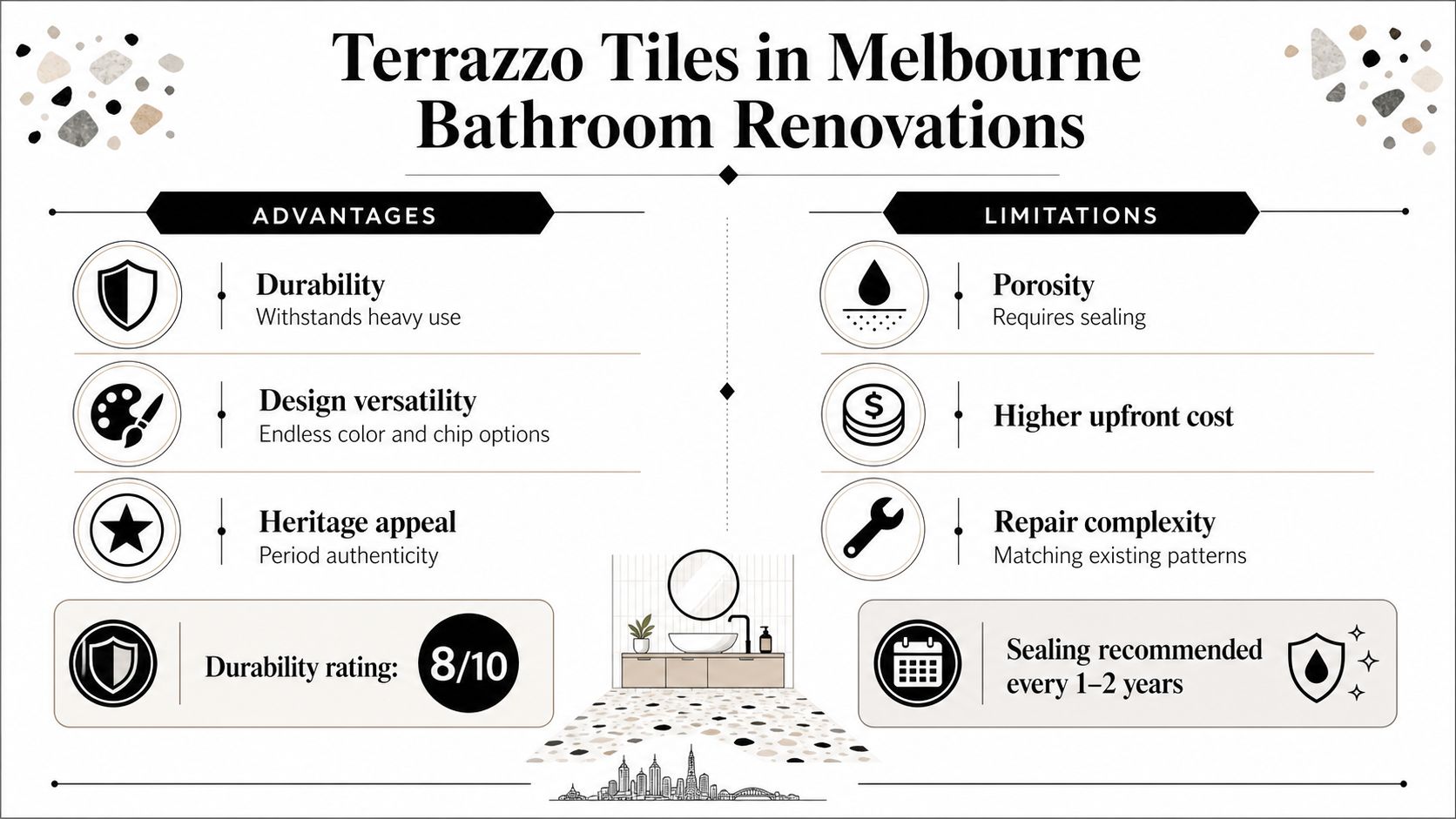
Terrazzo earns its place in Melbourne bathrooms because it does three things well. It brings durability, strong design versatility, and clear heritage appeal into one surface, which is why it keeps showing up in renovations where the owner wants something more distinctive than standard ceramic. In the right home, it can look period-correct in a Victorian terrace, cleaner and more architectural in a modern ensuite, or somewhere in between.
The part many guides leave out
The trade-off is maintenance and wet-area behaviour. Terrazzo is porous enough to need regular sealing, and polished finishes can be more slippery when wet, which is why the finish choice needs to be treated as part of safety planning. Weight also matters on upper floors, especially when the tile profile is thicker or the substrate already has limited capacity for build-up.
Practical rule: if the bathroom sees daily showers, choose the finish and sealer for traction and cleaning first, then worry about the gloss level.
Bathroom floors in Australia also need to satisfy wet-area waterproofing requirements under the National Construction Code and AS 3740, so the question isn't whether terrazzo is stylish. It's which finish, grout detail, and sealer system will be safest and easiest to maintain in a Melbourne bathroom. That's where terrazzo either becomes a smart renovation choice or a costly mistake.
The upside is that once the system is right, terrazzo can age gracefully. The downside is that it won't forgive lazy detailing, especially around showers, vanity edges, and changes in level. If you want the look without the upkeep, porcelain that mimics terrazzo will often suit better. If you want authentic terrazzo, accept the maintenance commitment and build it properly from day one.
Budgeting for Terrazzo Installation in Melbourne
A terrazzo quote usually looks tidy until the wet-area work is priced properly. The tile itself is only one part of the bill. Thickness, format, cutting, labour, substrate correction, waterproofing, adhesives, grout, sealing, and edge detailing all change the final number, and terrazzo tends to expose any shortcuts in those items faster than simpler finishes.
In Victoria, the contract side matters as much as the tile choice. A person must not carry out domestic building work valued over A$10,000 unless it is covered by a major domestic building contract, and the Victorian Building Authority says this applies to most renovation jobs above that amount, including bathroom renovations when they exceed the limit Victorian Building Authority information via renovation contract guidance. That affects how the job is set up, who coordinates it, and what consumer protections sit behind the work.
What that means in practice
If an ensuite passes that threshold once waterproofing and the full tiling scope are included, the contract needs to be treated as part of the renovation, not as an afterthought. The same applies to larger family bathrooms where tiling, plumbing coordination, and waterproofing are linked from the start.
Once the total work value crosses the contract threshold, do not treat the bathroom as a loose collection of trades. Treat it as a regulated domestic building project.
A registered builder matters because builder registration is the legal mechanism that lets the right person contract for and coordinate regulated domestic building work within the scope of that registration Victorian Building Authority builder registration guidance. Terrazzo jobs bring that issue into focus quickly, since the surface choice is usually tied to waterproofing, floor height, and plumbing coordination.
For homeowners, the cleanest way to budget is in layers. Price the tile and installation first. Then add substrate correction. Then waterproofing. Then sealing and finishing details. If the total creeps past the threshold, contract form and builder registration become part of the budget, not just the admin.
Installation Requirements and Substrate Preparation
Terrazzo fails fast when the base is wrong. The tile might look forgiving on a sample board, but once it's on a bathroom floor, every hump, dip, and awkward transition shows up under light and underfoot. That's why substrate prep matters more with terrazzo than with many cheaper finishes.
Start with flatness and load
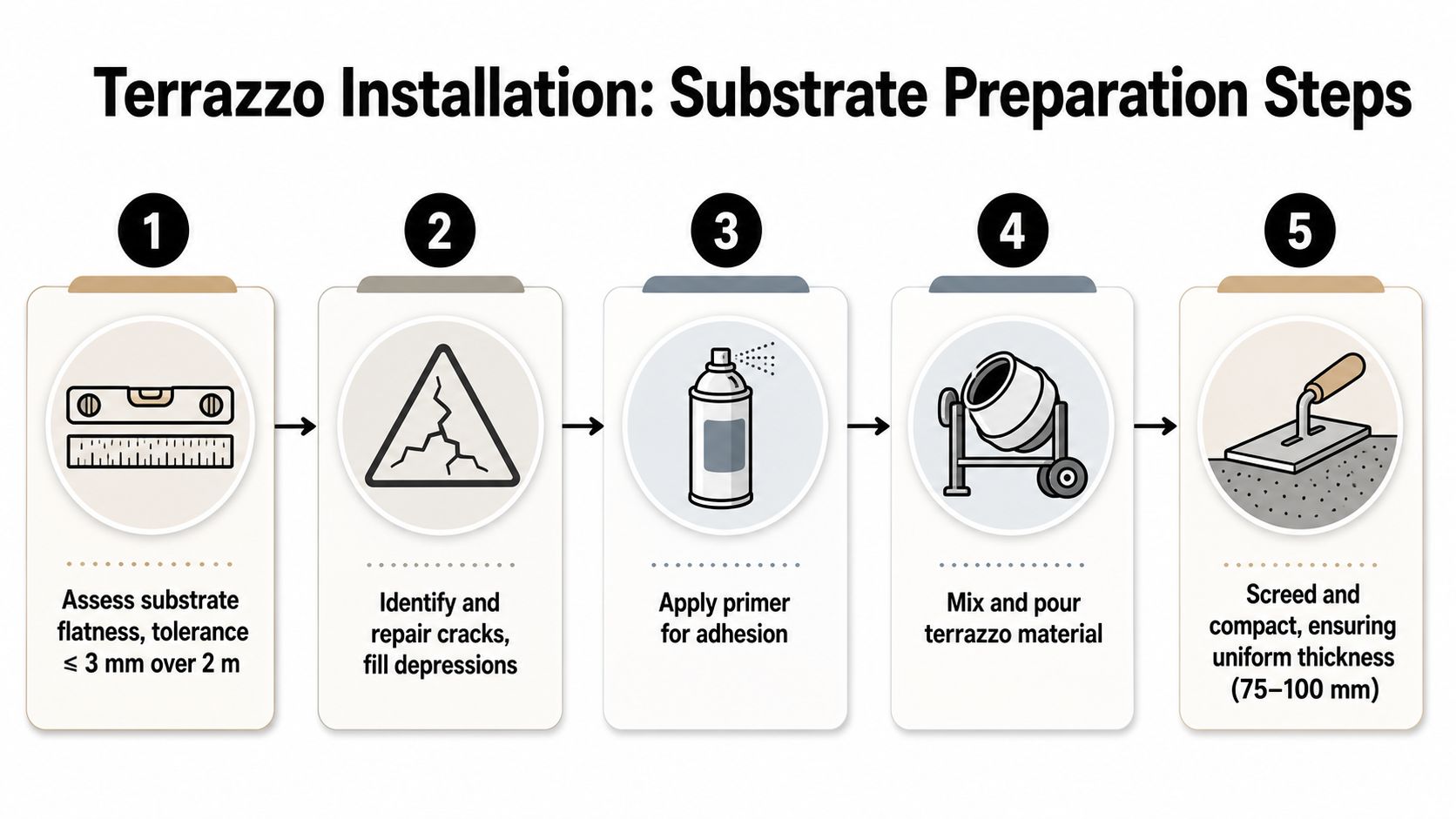
The first check is simple. Assess the substrate, repair cracks, and decide whether the floor needs levelling before any tile goes down. Large-format terrazzo is less forgiving of poor tolerances, and the thickness of the tile system affects door clearances, drainage points, and junctions to hallways or adjacent bedrooms.
For wet areas, waterproofing has to be integrated into the build, not patched in later. In Melbourne bathroom renovations, that means the membrane system and its application need to suit the room layout, shower set-out, and substrate condition, with the finished floor still allowing correct falls and clean transitions. If the floor needs levelling, that work has to sit inside the overall system, not compete with it.
The thickness-to-load trade-off matters here too. Thin resin tiles are easier to manage on height, while thicker concrete terrazzo profiles create a heavier build-up. That can be a real issue in older homes where the floor levels already fight every extra millimetre.
The practical sequence is usually:
- Check the slab or timber substrate for movement and defects.
- Correct the base so the finished floor won't telegraph high spots.
- Coordinate waterproofing with the tile set-out.
- Confirm adhesives and setting materials suit the tile type.
- Allow for lippage control, especially with large-format pieces.
Read more about screed in tiling
Skimp on substrate work, and terrazzo will remind you of it every day.
That's why self-levelling compounds, screeding, and careful waterproofing coordination are not optional extras. They're the difference between a floor that looks crisp and one that shows every mistake at the first clean.
Long-Term Maintenance and Sealing Strategies
Terrazzo looks best when it's treated like a maintained surface, not a set-and-forget one. In bathroom conditions, the sealer is the line between a handsome floor and one that stains, dulls, or starts to hold moisture where it shouldn't. The finish chosen at installation also affects the cleaning burden later, especially if the surface is polished rather than honed.
Keep the routine simple
A pH-neutral cleaner is the safest daily or weekly option for normal care, because acidic products can attack both the sealer and the stone elements in the mix. If water stops beading on the surface, or the floor starts to look hungry and harder to clean, it's time to inspect the seal rather than push through with harsher products. High-moisture bathrooms tend to show wear sooner than dry circulation areas.
Sealing frequency depends on the system and finish. Polished terrazzo generally needs resealing more often than honed surfaces, and the infographic guidance used on this page places polished terrazzo at every 1 to 2 years and honed finish at every 2 to 3 years. That's a sensible maintenance rhythm for wet-area use, especially when showers are used daily.
If a stain does get through, don't scrub aggressively first. Identify the source, remove surface residue gently, and let the sealer be tested before assuming the floor has failed. In many cases, the problem is a worn patch or a neglected grout line, not the terrazzo itself.
See sealing guidance for stone tiles
The lesson is that long-term performance starts at the finish decision. A lower-grip, higher-gloss surface may look dramatic on day one, but it often asks for more care later. A more modest honed surface can be easier to live with in a Melbourne bathroom, and that usually matters more after the first month than the first photograph.
Choosing Qualified Suppliers and Registered Builders
I've seen strong terrazzo work start with a supplier who understands wet areas and finish differences, then fall apart because the wrong crew handled the bathroom. A good supplier should talk plainly about slip ratings, sealing, grout choice, finish options, and whether the tile belongs in a shower zone or only in a drier part of the room. If the conversation stays on colour and pattern, and skips the practical side, that's a warning sign.
What to check before you buy
Start with the sample itself, then ask for technical details that matter on site. You want clear answers on availability, the finish recommended for bathrooms, how the tile performs in wet areas, and whether the product suits the floor build-up your renovation can allow. In a Melbourne bathroom, thickness, surface finish, and substrate height all affect the final result, so the supplier should be able to discuss those limits without hesitation.
The contractor side matters just as much. In Victoria, a registered builder is the legal route for coordinating regulated domestic building work within the scope of that registration, which becomes important when bathroom renovations involve waterproofing, plumbing coordination, or structural changes Victorian Building Authority registration guidance. If the job value goes over A$10,000, the major domestic building contract requirement also comes into play VBA contract threshold guidance.
Ask these questions before you sign anything:
- Registration status: Are you registered for the type of domestic building work this bathroom needs?
- Wet-area experience: How many terrazzo bathrooms have you coordinated, not just tiled?
- Subcontractor control: Who handles waterproofing, plumbing adjustments, and any floor levelling?
- Previous work: Can you show similar Melbourne bathrooms with terrazzo finishes?
- Maintenance advice: What sealer and care routine do you recommend after handover?
If the builder can't explain waterproofing, substrate prep, and finish selection in plain language, keep looking.
That point matters because terrazzo leaves little room for shortcuts. The right supplier helps you choose a suitable tile, but the right registered builder makes sure the whole wet-area system works together, from the slab or screed through to the final seal. For homeowners planning bathroom renovations, that combination is what turns terrazzo from a nice idea into a durable result.
If you're planning terrazzo tiles Melbourne wide, bring the wet-area details into the conversation early and don't leave them until the last site visit. Melbourne Tiling Services P/L handles bathroom renovations, waterproofing, screeding, and terrazzo-style tile installation with the practical coordination these jobs need, so visit Melbourne Tiling Services P/L to discuss your bathroom, ensuite, or renovation scope.
Write a Comment