

You're probably at the stage where the old bathroom has stopped being “good enough”. The grout looks tired, the shower feels dated, and every renovation photo you save seems to show the same clean lines, large-format tiles, and frameless glass. Then the practical concern hits. What if the new bathroom looks great for six months, but water gets behind the tiles and starts causing damage you can't see?
That concern is justified. In bathroom renovations, the visible finish and the hidden protection are not the same thing. Tiles are the surface you live with every day. Waterproofing is the part that protects the room, the framing, and the adjoining areas from moisture. If either side is handled badly, the project can fail for reasons that have nothing to do with how attractive the tiles looked on handover day.
Tiling has lasted for thousands of years. Ceramic floor tiles date back to the fourth millennium BCE, and modern porcelain production changed dramatically in 1980 with the fast-firing roller hearth kiln process, which made porcelain stoneware tiles commercially viable for broad use in wet areas, as outlined in this history of tile development. That long history is part of the appeal. A tiled bathroom should feel permanent. But permanence only happens when the system under the tile is right.
Table of Contents
- The Foundation of a Flawless Bathroom Renovation
- Why Integrated Waterproofing Is Non-Negotiable
- Key Materials for Tiling and Waterproofing
- Victorian Regulations and Builder Warranty Explained
- Your Bathroom Renovation Process and Timeline
- Budgeting for Your Melbourne Bathroom Renovation
- How Melbourne Tiling Services Delivers Your Vision
The Foundation of a Flawless Bathroom Renovation
A good bathroom renovation starts with one simple truth. The finish and the function are separate jobs.
Tiles deliver the look. They set the tone of the room, influence maintenance, and shape the overall feel underfoot. If you're choosing porcelain planks, mosaic floors, rectified wall tiles, or stone-look panels, you're deciding how the bathroom will present every day. If you want a better sense of what that finish layer can do, bathroom floor tiling options in Melbourne are worth reviewing before any final selections are made.
Beauty on the surface, protection underneath
The hidden part is less glamorous and far more important. Behind every bathroom that performs well over time, someone got the substrate, falls, membrane, junction treatment, and tile fixing method right. Homeowners often focus on tile colour, niche position, and tapware finish first. Builders look at those too, but they also check where the water will go, where it might sit, and how every junction will be sealed before a single tile is fixed.
A bathroom can look premium and still be vulnerable if the waterproofing system is incomplete.
That's why experienced registered builders don't treat tiling and waterproofing as separate cosmetic tasks. They treat them as one wet-area assembly. The tile layer has to suit the waterproofing layer beneath it, and the room has to be built in the correct order.
What homeowners usually regret
The regret is rarely, “I chose the wrong tile size.” It's usually one of these:
- They hired trades separately: one person demolished, another waterproofed, another tiled, and no one owned the whole result.
- They approved a layout without checking drainage and falls: the floor looked flat and modern, but water movement wasn't properly resolved.
- They assumed grout and tile would keep water out: they won't. They're part of the finish, not the full protection system.
Bathrooms fail unnoticed at first. Moisture gets into a corner junction, around a penetration, or behind a badly detailed shower base. Months later, the signs start showing up somewhere else. By then, the repair is larger than the original shortcut.
A flawless renovation doesn't come from expensive finishes alone. It comes from disciplined construction, proper sequencing, and a builder who understands that wet areas punish guesswork.
Why Integrated Waterproofing Is Non-Negotiable
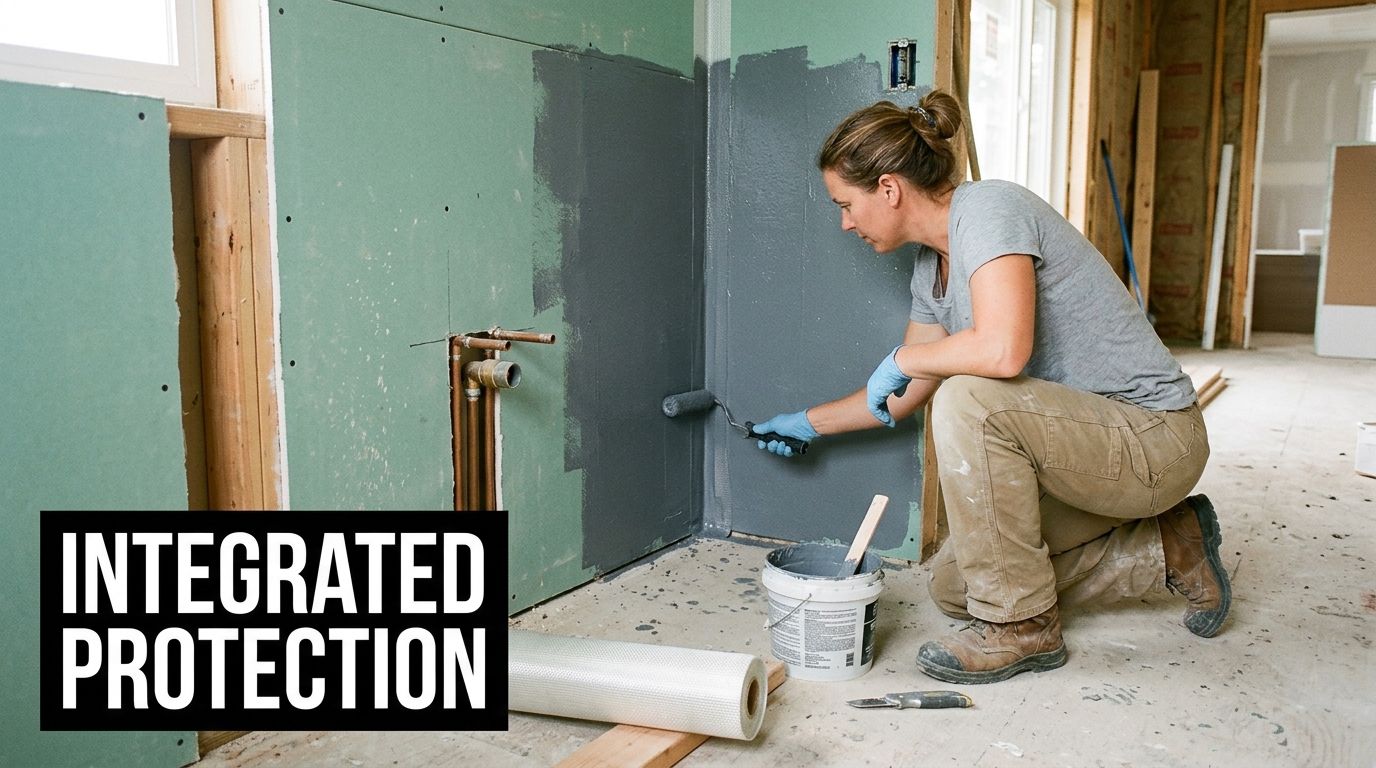
A bathroom waterproofing system works like a hull on a boat. If the hull is continuous, the structure stays protected. If there's one breach, water finds it. That's why partial waterproofing, rushed junction work, or improvised detailing is not a minor defect. It's a system failure waiting for pressure, movement, or time to expose it.
Tiles are not the waterproof layer
Often, homeowners are misled by the fact that tiles are water-resistant on the face. Grout fills joints, yet neither replaces a proper membrane system.
Waterproofing is a structural protection measure, and in Australia the National Construction Code treats it as a required building-control measure for wet areas because moisture failure can lead to substrate damage, mould, and expensive rectification, as discussed in this overview of waterproofing's evolution and building-control role. In practical terms, that means showers, bathroom floors, laundries, and similar wet zones can't be approached like ordinary wall and floor finishes.
The membrane is the actual barrier. Its job is to stop water before it reaches the parts of the building that deteriorate when they stay wet. If that layer is broken at a corner, drain connection, hob, niche, waste penetration, or wall-floor junction, water can move behind the tile assembly.
One weak junction can undermine the whole room
This is why integrated waterproofing matters. The membrane, sealants, bond breakers, tapes, adhesives, screed, and tile installation method all have to work together. Good installations don't rely on one miracle product. They rely on continuity.
A robust wet-area approach usually includes:
- Prepared substrate: clean, stable, suitable for the membrane system selected.
- Correct falls: water must move to the waste instead of lingering at the perimeter.
- Continuous membrane treatment: floor, wall junctions, corners, penetrations, and transitions all need deliberate detailing.
- Compatible tile fixing materials: the tile layer can't compromise the membrane's purpose.
Practical rule: If the waterproofing detail can't be clearly explained at a junction, it probably hasn't been properly resolved.
In Melbourne bathrooms, the failure points are often not the middle of the floor. They're the awkward parts. Internal corners. Around mixers and outlets. The shower entry. The connection between a screeded floor and a framed wall. A good builder slows down at those points instead of trying to speed through them.
That's also why “just patch the leak” advice often disappoints homeowners. If the leak source sits in the interface between trades, the fix has to address the assembly, not only the surface symptom.
Key Materials for Tiling and Waterproofing
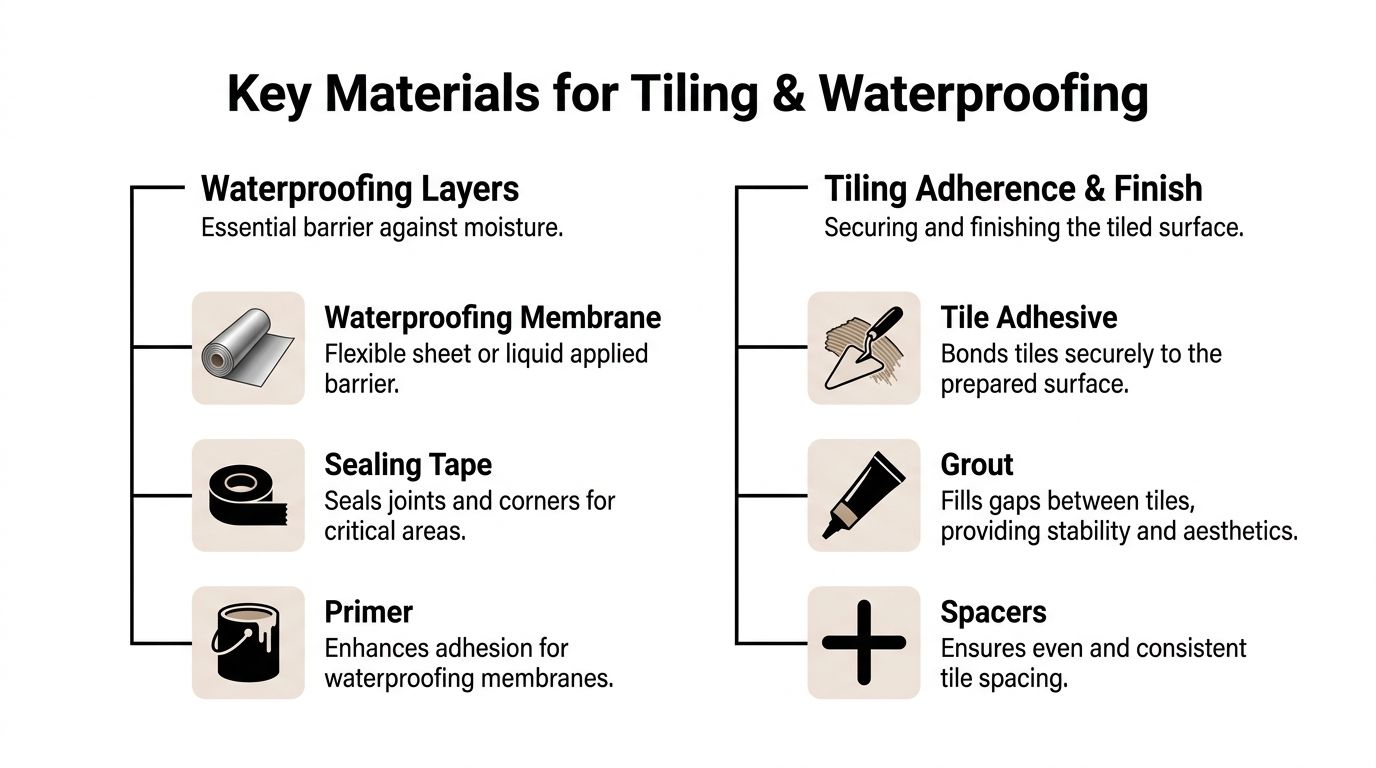
The wet-area build-up isn't one product. It's a stack of materials, and each layer has a job. When one layer is chosen in isolation, problems start. When the layers are selected as a system, the bathroom has a much better chance of staying sound.
The layers that actually matter
Start at the bottom. The substrate has to be stable and suitable for wet-area treatment. Over that, the room may need levelling or screeding to create the required falls, especially in shower areas. A flat room is not the same as a functional room. In showers, the floor has to guide water to the waste without birdbaths or reverse falls.
Then comes the membrane system. In tiled wet areas, guidance commonly places the waterproofing membrane directly beneath the tile bond coat so moisture is stopped before it reaches the substrate. Recognised system types include cementitious, liquid-applied, and sheet-applied membranes, and project specifications often require the membrane to continue up vertical surfaces in wet zones, with 48-hour ponding used as a watertightness check before tiling proceeds, as described in this technical shower waterproofing guide.
For homeowners, the takeaway is straightforward. The membrane type isn't chosen by habit alone. It depends on the substrate, the geometry, the programme, the drainage arrangement, and the finish materials above.
A practical materials list usually includes:
- Primer: used where the membrane system requires substrate preparation for adhesion.
- Membrane: liquid or sheet, depending on system design and detailing needs.
- Reinforcement accessories: tapes, bond breakers, corner pieces, collars, and sealants for transitions and penetrations.
- Screed or levelling compound: used to establish falls and support tile installation.
- Tile adhesive and grout: selected to suit tile type, movement, moisture exposure, and the membrane beneath.
Material compatibility decides whether the system works
Compatibility is where a lot of bad work starts to unravel. For tiled showers, wet-area guidance emphasises that the membrane and adhesive must suit each other, especially under low-porosity tiles. Adhesives that cure by hydration or chemical reaction are preferred because standard emulsion adhesives may not fully cure when trapped between a waterproof membrane and a dense tile, which can lead to failure, as set out in this internal wet-area membrane code of practice.
That matters more now because modern bathroom renovations often use porcelain with very low absorption. Large-format wall tiles, porcelain panels, and premium thin-surface products look sharp, but they also reduce forgiveness in the fixing system. If the adhesive is wrong, curing can be compromised. If the substrate prep is poor, the tile may debond. If the corners aren't detailed properly, movement and moisture can combine into a failure that shows up long after the installer has left site.
The best-looking tile in the showroom won't save a bathroom built on incompatible materials.
For owners comparing finish options, tile materials used in Melbourne wet-area projects can help clarify what suits bathrooms, ensuites, and feature walls. In practice, some projects also specify large-format porcelain systems such as Kerlite, which need careful handling, flat substrates, and a fixing method matched to the product's thickness and size.
Victorian Regulations and Builder Warranty Explained
Victoria is where generic bathroom advice starts to fall apart. Plenty of online guides explain membranes, adhesives, and tile selection in broad terms. They don't tell you what matters when the project has to satisfy local compliance expectations and when a leak has to be diagnosed after handover.
Compliance lives in the details
In Victorian bathroom renovations, the risky areas are usually the interfaces. Industry guidance highlighted for local audiences points to interfaces and penetrations, not the tile face itself, as the critical leak points. That aligns with what builders and rectification teams see on real jobs. The vulnerable spots are around wastes, tap penetrations, screen fixings, hob ends, door transitions, and changes in material or plane, as discussed in this Victorian waterproofing and leak-rectification video guidance.
That's where compliance becomes practical rather than theoretical. A membrane might be the correct product on paper, but the room still fails if junction sealing is poor, if the substrate wasn't ready, or if later trades puncture or compromise the waterproofed area.
For homeowners in Victoria, the big compliance questions are usually these:
| Question | Why it matters |
|---|---|
| Who is responsible for the wet-area scope? | Accountability gets blurry when trades are split. |
| Was the waterproofing installed and documented properly? | That affects defect response and confidence in the finished room. |
| Were junctions and penetrations treated as critical details? | That's where leak risk often sits. |
| Who coordinates rectification if something goes wrong? | A single responsible party simplifies the process. |
If you're checking documentation, waterproofing compliance certificate requirements in Victoria are worth understanding before work begins, not after a problem appears.
Why a Registered Builder changes the risk profile
A registered builder changes the conversation because they can take responsibility for the full renovation scope rather than only one trade package. That matters in bathrooms more than most rooms in the house. Plumbing, carpentry, sheeting, waterproofing, screeding, tiling, glazing, and fit-off all affect the final wet-area result.
When a homeowner coordinates separate trades, defects often land in the gap between them.
Using a single registered builder won't make a poor process good. But it does create a clearer chain of responsibility, better trade sequencing, and a more coherent warranty position. If there's an issue, the owner isn't left arguing about whether the fault belongs to the tiler, the waterproofer, the plumber, or the person who installed the screen after everyone else had left.
That's the local angle many generic blogs ignore. In Victoria, bathroom success isn't only about product selection. It's about compliant installation, traceable responsibility, and having one party own the finished room.
Your Bathroom Renovation Process and Timeline
Bathroom renovations go wrong when trades overlap badly or when someone rushes curing and prep because the owner wants the room back in service. A controlled timeline protects quality. It also protects the waterproofing system from being buried before anyone has confirmed the room is ready for tile.
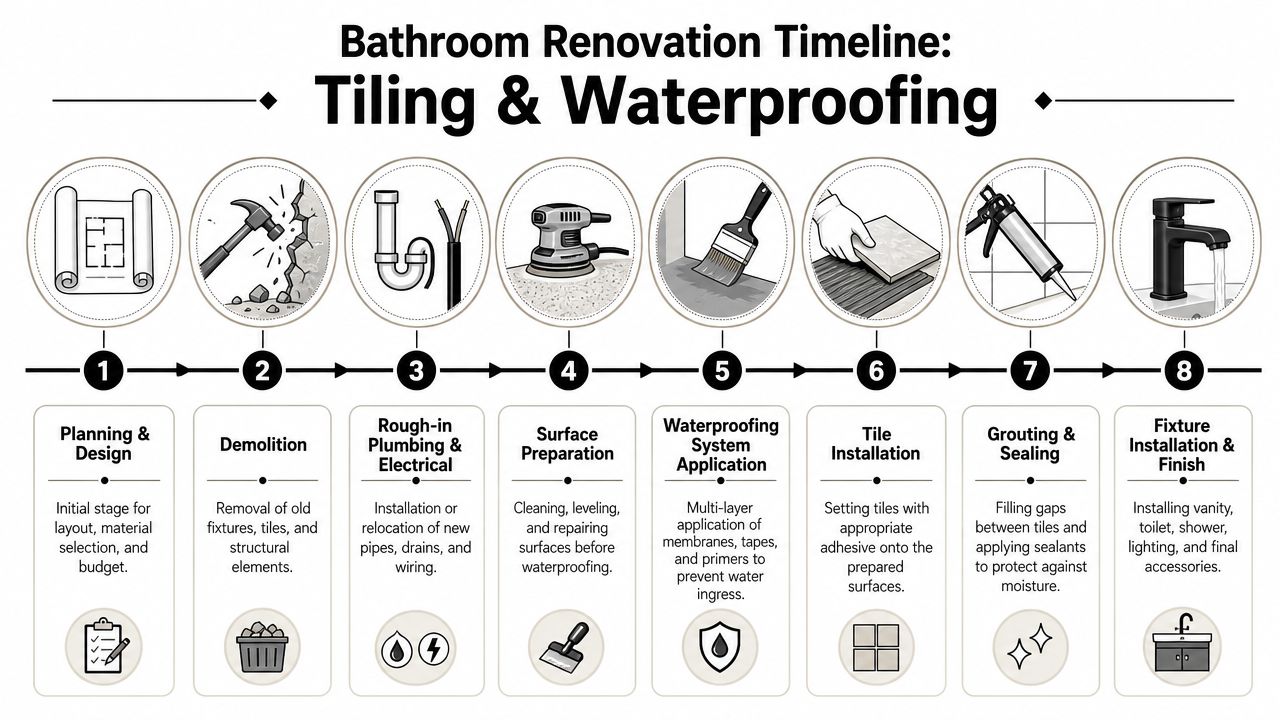
The overall flow is easier to understand visually.
The sequence that keeps wet-area work under control
A typical bathroom renovation usually follows this order:
Planning and selections
Layout, fixture choices, tile format, drainage intent, and material lead times are settled early. During this initial phase, unrealistic ideas often get corrected before they become site problems.Demolition
Old fixtures, tiles, and linings come out. Once the room is open, the builder can assess the substrate and framing condition.Rough-in works
Plumbers and electricians complete the hidden services. Waste positions, mixers, outlets, and lighting all need to be fixed before the room is closed in.Sheeting and preparation
Walls and floors are prepared for wet-area treatment. This stage often includes correcting surfaces so the membrane and tile system have a sound base.
After the room is prepared, the waterproofing stage becomes critical. Public guidance often ignores non-standard shower geometry, but in Melbourne renovations that's exactly where work gets technical. Neo-angle showers, mitred curb returns, and unusual corner conditions require membrane cutting and overlap detailing that goes beyond simple square-room demos, as shown in this practical video on waterproofing awkward shower geometry.
A useful visual walkthrough can help homeowners understand how these steps fit together.
Where projects usually go off track
The most common site mistakes are rarely dramatic. They're small decisions that stack up:
- Waterproofing before the room is ready: dusty surfaces, unresolved penetrations, or poor substrate condition.
- Tiling too soon: membrane systems need proper curing and inspection.
- Custom geometry handled like a standard shower: corners, entries, hobs, nib walls, and niches need deliberate detailing.
- Late changes after waterproofing: moving fittings or adding fixings can compromise the sealed system.
A registered builder is valuable here because sequencing isn't just project management admin. It affects technical performance. The plumber can't guess where the tiler wants the waste. The waterproofer can't do reliable work over unfinished prep. The shower screen installer shouldn't be creating avoidable penetrations or stressing finished edges after the fact.
Good bathrooms are built in order. That sounds simple, but on site it's one of the biggest differences between a smooth renovation and a rectification job.
Budgeting for Your Melbourne Bathroom Renovation
Budget pressure causes more wet-area mistakes than homeowners realise. Not because people want poor workmanship, but because the budget often gets consumed by visible items first. Vanity, tapware, feature tiles, and frameless glass are easy to compare. Screeding, membrane detailing, substrate preparation, and supervision are harder to “see”, so they're often where corners get cut.
That's a mistake. In tiling and waterproofing, the hidden work protects the visible investment.
Where the budget usually goes
A useful way to think about the spend is by trade package and function, not only by product. The exact cost depends on room size, access, demolition complexity, fixture selections, structural repairs, and finish level, but a mid-range Melbourne bathroom renovation often spreads across several key categories.
| Item / Trade | Estimated Cost Range | Percentage of Budget |
|---|---|---|
| Demolition and strip-out | Varies by site condition | Typically a smaller early-stage share |
| Plumbing works | Varies by fixture changes and drainage scope | Often one of the larger trade components |
| Electrical works | Varies by lighting, heating and fan upgrades | Moderate project share |
| Carpentry and wall/floor preparation | Varies by framing, sheeting and repairs | Significant where the room needs correction |
| Waterproofing | Varies by layout, shower design and detailing complexity | A defined wet-area protection cost that shouldn't be compressed |
| Tiling labour | Varies by tile size, pattern, cuts and access | Often a major labour component |
| Tiles and trims | Varies widely by material selection | Can range from restrained to premium |
| Fixtures and fittings | Varies by brand and specification | Often owner-driven and highly variable |
| Shower screen and glazing | Varies by customisation | Moderate to premium depending on design |
| Contingency | Owner allowance | Essential for hidden conditions |
The brief for this article requested a sample budget framed around a mid-range Melbourne bathroom renovation total of about $20,000 to $30,000. Treat that as a planning example only, not a fixed quote. Real projects move up or down depending on scope and selections.
How to budget without creating hidden risk
The smartest budgeting move is to separate wants from essentials.
- Protect the wet-area system first: don't downgrade preparation, waterproofing, or competent installation to afford a more expensive tile.
- Keep a contingency: once demolition starts, hidden issues can appear in framing, sheeting, or previous work.
- Be realistic about custom details: niches, feature patterns, mitred edges, large-format porcelain, and complex shower screens all add labour.
- Ask who owns the whole result: a cheaper fragmented trade arrangement can cost more later if defects appear and no one takes responsibility.
Spend carefully on finishes. Don't economise on what keeps water out of the building.
Homeowners usually feel the cost of proper work before handover. They feel the cost of bad work long after handover. The first is budgeting. The second is rectification.
How Melbourne Tiling Services Delivers Your Vision
For homeowners who want one party to manage the wet-area risk properly, the practical model is straightforward. Use a registered builder who can coordinate the entire bathroom renovation, align the licensed trades, and keep responsibility tied to the full finished room rather than one isolated task.
That matters because tiling and waterproofing are connected to everything around them. Drain set-out affects falls. Sheeting affects membrane performance. Tile choice affects adhesive selection. Screen design affects penetrations and finishing details. If those decisions are made in silos, the room becomes harder to build well.
Melbourne Tiling Services P/L operates as a Melbourne-based bathroom renovation and tiling specialist with registered builder capability, coordinating bathroom renovations, wet-area waterproofing, screeding, tile installation, leak rectification, and related trades from start to finish. The business also offers free quotes, 3D drawings, and planning tools that help owners understand scope before site work begins.
For a homeowner, that approach reduces guesswork. You can review the layout, confirm finish selections, clarify who is handling each stage, and understand how the wet-area work fits into the broader renovation. That's the right way to approach bathrooms in Victoria. Not as a stack of separate jobs, but as one controlled build with compliance, accountability, and durability built into the process.
If you're planning an ensuite update, a full bathroom renovation, or a leak-prone shower rebuild, the decision that matters most often isn't the tile you pick. It's who is responsible for making the whole room perform.
If you want practical advice on bathroom renovations, tiling and waterproofing, or compliance-focused wet-area work in Victoria, Melbourne Tiling Services P/L is a sensible next step. You can review your layout, materials, and scope with a registered builder before committing to demolition, which makes it easier to avoid the mistakes that turn a bathroom upgrade into a leak rectification job.
Write a Comment