

You're probably in the same spot as a lot of Melbourne homeowners when they start bathroom renovations. You want the clean, high-end look of marble on the walls or floor, but you've also heard the stories about staining, etching, sealing, and the stress of keeping it looking good once the room is in use.
That's exactly where marble look porcelain tiles make sense. They give you the visual language of marble without forcing you into the maintenance routine that comes with natural stone. In Melbourne projects, that matters even more because bathrooms aren't showroom spaces. They're wet areas, used every day, and they need to perform properly under real conditions.
Table of Contents
- The Marble Dream Without the Marble Drawbacks
- Porcelain vs Real Marble A Head to Head Comparison
- Choosing Your Perfect Tile Finishes Sizes and Formats
- Designing Your Melbourne Bathroom with Marble Look Porcelain
- Installation Essentials Waterproofing and Best Practices
- Budgeting Your Project Costs and Maintenance in Melbourne
- Why Your Tiler Should Be a Registered Builder in Melbourne
The Marble Dream Without the Marble Drawbacks
A typical conversation starts the same way. The client has saved images of bright bathrooms with soft grey veining, full-height shower walls, and floors that feel more like stone slabs than tiles. Then the practical questions come in. Will it stain. Will it need sealing. Will it be hard to clean. What happens in a family bathroom that gets used hard every day.
That's where porcelain changed the market. Marble-look porcelain tiles have gained prominence in the Australian building sector since the early 2000s, aligning with the rise of high-end bathroom renovation specialists such as Melbourne Tiling Services P/L, which has operated since 2003 across residential and commercial projects, as noted in this Australian glazed porcelain tile market outlook.
The important point is that porcelain isn't a second-choice material anymore. In a good renovation, it's often the smarter specification from the start. You still get the marble aesthetic, but you're pairing it with a surface built for wet areas, heavy use, and straightforward cleaning.
A better fit for Melbourne homes
In older Melbourne homes, bathrooms often sit over timber floors, uneven substrates, or dated wet area construction. In newer homes and apartments, the challenge is different. Tighter tolerances, cleaner detailing, and larger tile formats mean there's less room for sloppy work.
Marble look porcelain tiles suit both situations because they can be specified to match the design intent without introducing unnecessary maintenance headaches.
Practical rule: If you love the look of marble but don't want to treat your bathroom like a museum piece, porcelain is usually the right call.
Why clients keep choosing it
A few reasons come up again and again:
- Daily usability: You can clean it without the anxiety that comes with natural stone.
- Design flexibility: You can use the same look across floors, walls, niches, and feature panels.
- Consistent finish: Veining, tone, and sizing are more controlled than natural marble.
- Better project balance: Budget can go into waterproofing, layout changes, joinery, or fittings instead of stone upkeep.
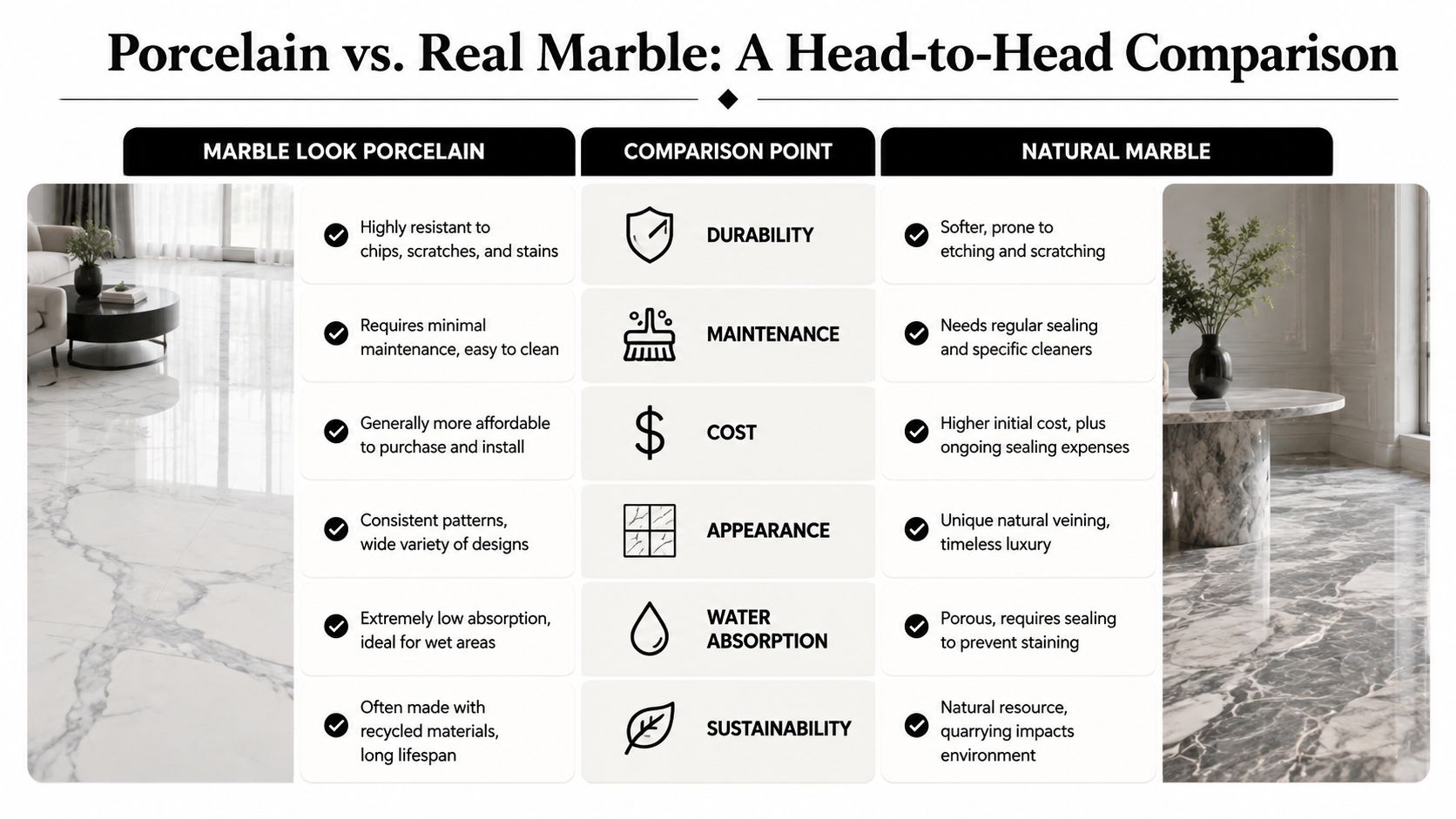
Porcelain vs Real Marble A Head to Head Comparison
Natural marble has presence. Nobody disputes that. But once you compare materials as a builder or tiler, the decision usually comes down to how the room will be used, how much maintenance the owner is willing to accept, and how much risk sits behind the finish.
What the material is actually doing
Porcelain wins on performance because of how it's made. Marble-look porcelain tiles are fired at 1200–1250°C, creating a density of more than 2.4 g/cm³ and a water absorption rate of less than 0.5%, according to this marble versus marble-look tile technical review. In practice, that means a denser, less porous surface that handles moisture and routine use far better in a bathroom.
Natural marble is different. It's stone, and stone varies. That variation is part of the appeal, but it also means the material can be softer, more reactive, and less forgiving when exposed to cleaners, cosmetics, water, and daily traffic.
| Attribute | Marble Look Porcelain | Natural Marble |
|---|---|---|
| Durability | Dense, hard-wearing manufactured tile for wet and high-traffic areas | Softer stone that can scratch and etch more easily |
| Maintenance | Low-maintenance surface with simple routine cleaning | Needs more careful cleaning and ongoing sealing attention |
| Cost-effectiveness | More predictable for bathroom renovations and day-to-day ownership | Higher upkeep burden over time |
| Aesthetic versatility | Consistent veining, wide format range, slab-look layouts | Unique natural variation and stone character |
| Water behaviour | Very low water absorption | More porous and more dependent on sealing |
A practical comparison usually comes down to these trade-offs:
- Durability: Porcelain is built to take wear. That matters on floors, ensuite entries, and family bathrooms.
- Maintenance: Marble needs more disciplined care. Porcelain is far less fussy in real households.
- Appearance control: Porcelain lets you plan vein flow, tile size, and layout more precisely.
- Wet-area suitability: Porcelain is the easier specification when the room has regular steam and splash exposure.
If you're still weighing materials, it helps to compare marble products and alternatives side by side with a supplier or installer who works across both. This marble tile range in Melbourne is one example of the type of reference point worth reviewing during selection.
Marble is beautiful. Porcelain is usually easier to live with.
Where marble still has a place
There are projects where real marble still makes sense. Powder rooms with lighter use. Feature walls away from direct water exposure. Homes where the client understands the maintenance and wants the stone for its natural variation above everything else.
But in bathrooms, especially the main bathroom or ensuite, I'd usually steer clients toward porcelain unless there's a very specific reason not to.
That's not because marble is inferior. It's because bathrooms punish materials. Steam, soaps, shampoo, body products, cleaning routines, and water left on surfaces all test the finish. Porcelain handles that environment with fewer compromises.
Choosing Your Perfect Tile Finishes Sizes and Formats
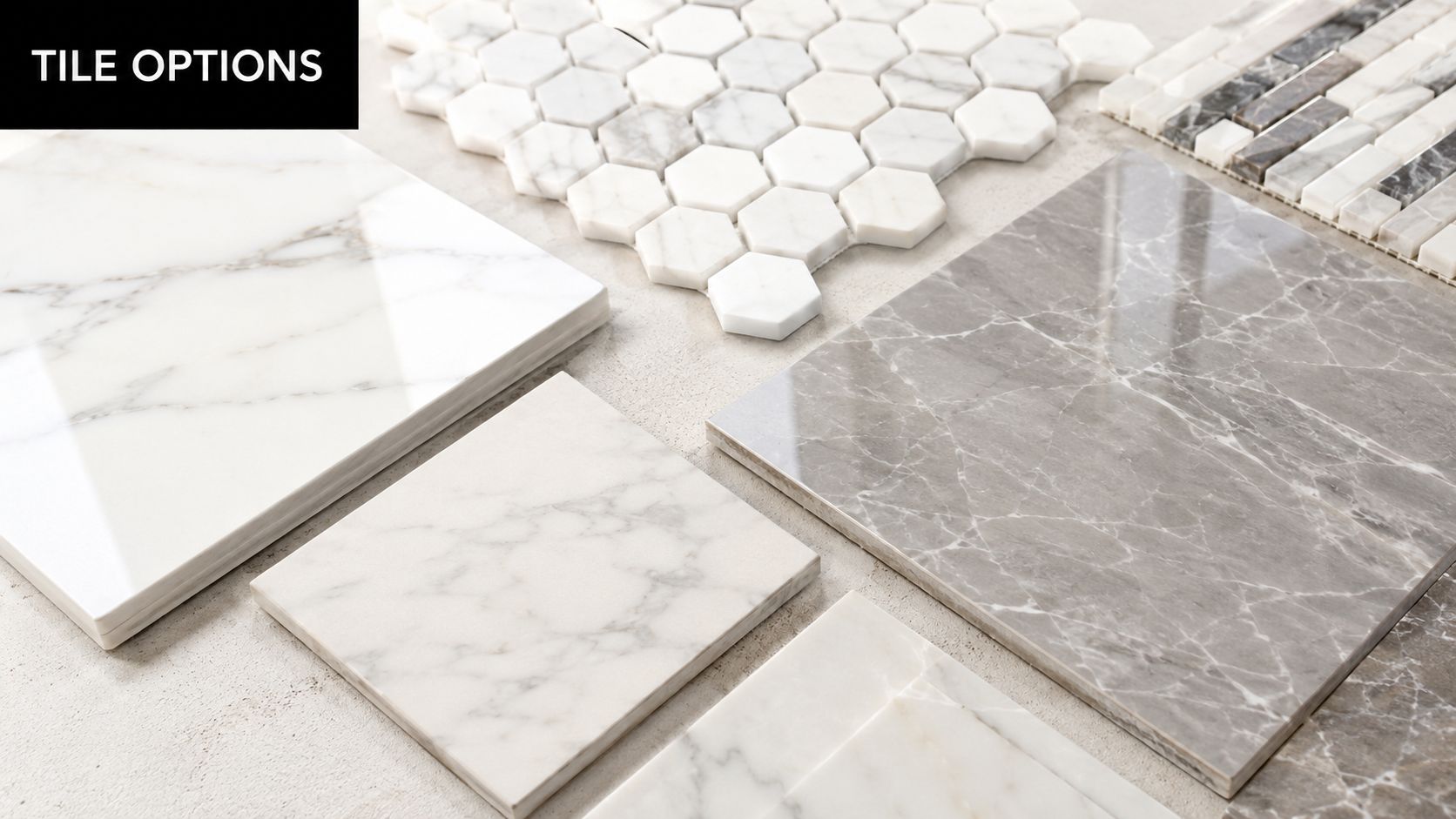
Specification matters more than commonly understood. Two marble look porcelain tiles can look similar in a showroom sample and perform very differently once they're installed on a floor, wrapped through a shower, or carried onto a feature wall.
Start with finish before you look at colour
Most clients start with veining and colour. I'd start with finish.
A polished tile gives you a sharper, more reflective marble effect. It works well on walls and in bathrooms where you want light bounce and a dressier look. On floors, though, you need to think carefully about slip, maintenance of the surface appearance, and how the room is used.
A matt finish is usually the safer all-rounder. It feels more grounded, it hides water spotting better, and it suits floors very well. Lappato sits in the middle. It gives some movement and sheen without the full reflectivity of polished porcelain.
Here's the practical way to sort it:
- For floors: Matt is usually the strongest choice.
- For shower walls: Polished or lappato can work well if you want more visual lift.
- For family bathrooms: Choose finishes that forgive water marks and daily wear.
- For small ensuites: A lighter tile with a restrained vein pattern often keeps the space calmer.
Size changes the whole room
Tile size isn't only a design decision. It changes the feel of the room, the number of grout joints, the amount of pattern interruption, and the level of installation skill required.
Large-format tiles usually produce the cleanest marble effect because the veining reads across a bigger surface. The room feels less chopped up. On walls, that can make a bathroom feel more architectural and less busy. On floors, it can help a modest footprint feel broader.
For clients considering oversized panels or slab-style porcelain, this large-format tile installation guide is worth reviewing because the handling, preparation, and fixing methods are different from standard tiling.
Rectified edges make a visible difference
Rectified porcelain is one of the details that separates an average job from a refined one. Rectified marble-look porcelain tiles in Australia are manufactured to an edge precision of ±0.3mm under AS/NZS 4402, allowing minimal 2mm grout joints, which is what gives that cleaner slab-like look in Melbourne conditions, as described in this rectified porcelain tile specification.
That matters because wide, uneven grout joints can kill the marble effect. If you're paying for a premium-looking tile, you want the installation to support that look, not interrupt it.
A good selection process usually comes down to three questions:
Where is the tile going
Floors, walls, niches, vanity splashbacks, and shower interiors all have different demands.How quiet or bold should the room feel
Some marble patterns are soft and cloudy. Others are high-contrast and dramatic.Do you want tile or slab visual language
If the goal is a more monolithic finish, larger formats and rectified edges matter.
The sample board doesn't tell the whole story. Ask to see how the tile looks over a larger area and how the grout joint will actually present.
Designing Your Melbourne Bathroom with Marble Look Porcelain
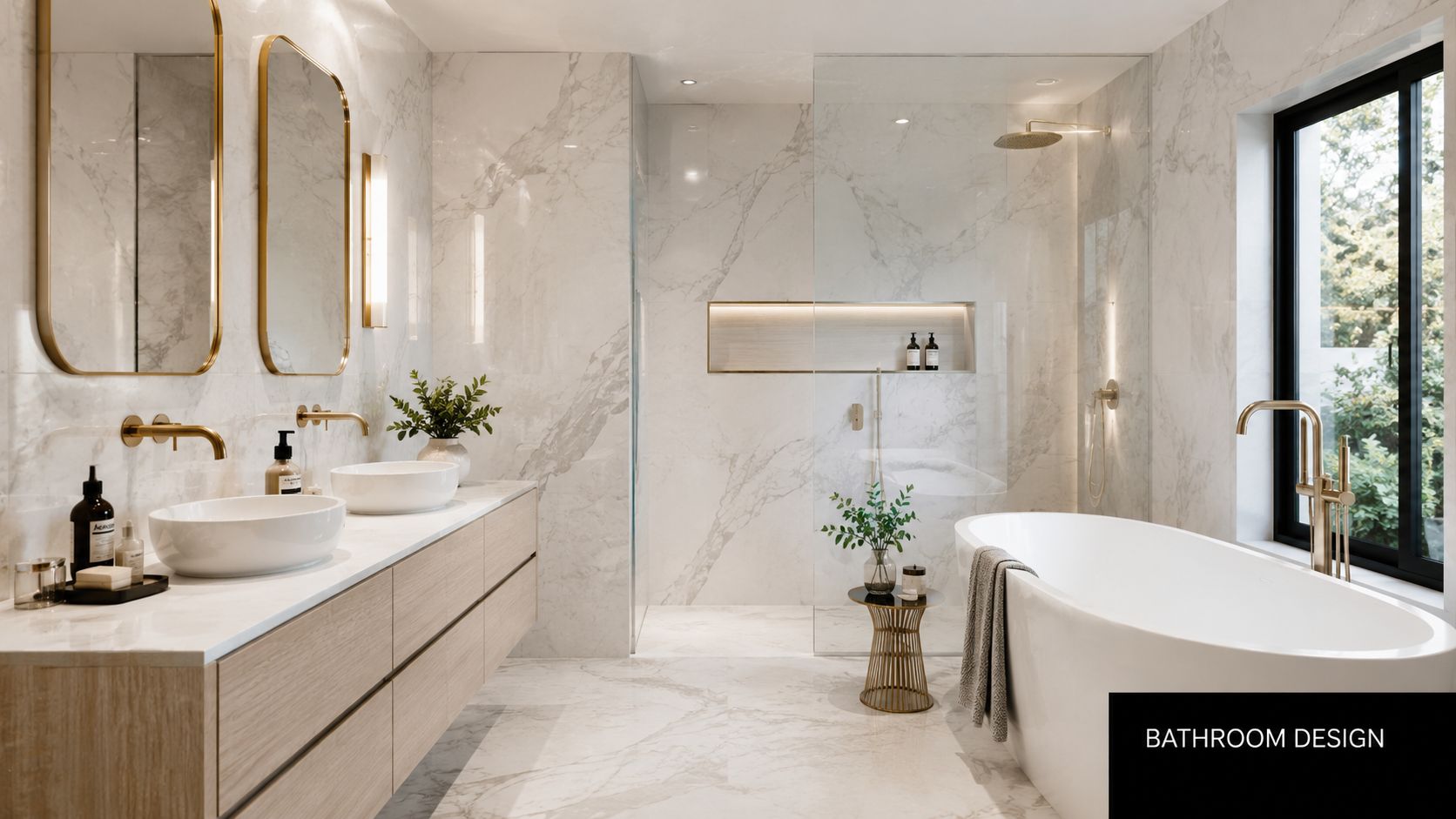
The biggest strength of marble look porcelain tiles is that they can carry the whole room. You don't need layers of competing finishes if the tile itself has enough movement and scale.
Using the tile as the main design element
One approach I like in Melbourne bathroom renovations is to let the tile set the tone, then keep everything else disciplined. A soft white marble-look porcelain with controlled grey veining can run from floor to shower wall to niche, while the joinery, tapware, and screen stay understated.
That's especially effective in ensuites where space is limited. Fewer material changes usually mean a calmer room. If the tile has enough scale, you don't need extra tricks.
A few layouts consistently work well:
- Full-height shower wall: This creates an obvious focal point without adding clutter.
- Floor-to-wall continuation: Using the same series ties the room together and reduces visual breaks.
- Feature vanity wall: A stronger vein pattern can sit behind the mirror and basin area.
- Indoor-outdoor continuity: On some projects, porcelain can help connect an adjoining balcony or similar exterior threshold if the specification is right for both zones.
Layouts that work in real bathrooms
The best designs are usually the ones that offer subtle solutions to problems. In a narrow bathroom, running larger marble look porcelain tiles with a clean joint pattern can reduce visual chopping. In a darker room, a lighter base colour helps bounce light without relying on glossy everything.
Bookmatching is another option people ask about. It can look excellent when done properly, especially on larger wall installations where opposing vein patterns create a symmetrical statement. But it only works if the tile series supports it and the installer plans the set-out carefully before fixing starts.
This video gives a useful visual reference for the kind of finish many clients are aiming for in modern bathrooms.
What doesn't work is forcing a dramatic tile into every surface and then adding busy tapware, patterned joinery, and strong feature lighting on top. The room starts fighting itself.
In a good bathroom, the tile should lead. The other finishes should support it.
For period homes in Melbourne, marble look porcelain can also bridge old and new nicely. You keep a classic material language, but the finish and installation feel sharper and more current. That balance is often what makes a renovation feel expensive without becoming overdone.
Installation Essentials Waterproofing and Best Practices
A premium tile won't rescue a poor build-up. If the substrate is out, the falls are wrong, or the waterproofing is incomplete, the room will fail long before the tile wears out.
That's why the installation side matters as much as the tile selection. In bathroom renovations, the visible finish gets the attention, but the hidden work determines whether the bathroom stays sound.
The substrate decides the result
Every tiled bathroom starts with the base. Floors need to be level where they should be level, and graded where they need falls. Walls need to be straight enough to take the format you've chosen. If they aren't, large-format porcelain will expose every defect.
The critical layers usually include:
- Demolition and inspection: Existing movement, moisture damage, and framing issues need to be identified early.
- Preparation: That might mean screeding, patching, or self-levelling depending on the substrate.
- Waterproofing: Wet areas must be treated as wet areas, not as a paint-on afterthought.
- Tile setting: Adhesive choice, coverage, and lippage control all matter more with larger formats.
For anyone assessing the wet-area side of a project, this Melbourne waterproofing page is a useful reference point because compliant waterproofing is essential in bathrooms.
Large format tiles raise the standard
Large marble look porcelain tiles demand cleaner work than smaller formats. There's less forgiveness in the set-out, less room to hide an uneven wall, and more risk if the substrate prep is rushed.
That doesn't mean they're difficult for the sake of it. It means the installer has to control more variables:
Set-out planning
Vein direction, joint alignment, fixture locations, and cuts around niches or tapware need to be planned before the first tile is fixed.Handling and support
Bigger porcelain pieces need proper handling to avoid edge damage and improper bedding.Adhesive coverage
Voids behind large tiles are asking for trouble, especially in wet areas.Movement accommodation
Bathrooms still move. Different materials expand and contract, and that has to be accounted for.
A lot of avoidable problems start when clients spend carefully on the tile and then treat installation like a commodity. That's the wrong order of priority.
Site advice: The more refined the finish you want, the less tolerance there is for average preparation.
The same applies to shower bases, niches, hobs, and junctions with frameless screens. These are not decorative details. They are failure points if they're badly built. In a proper bathroom renovation, waterproofing, falls, tile layout, and trim decisions all need to work together.
Budgeting Your Project Costs and Maintenance in Melbourne
Clients usually ask the wrong first question. They ask what the tile costs per square metre. That matters, but it's only one part of the budget.
In bathroom renovations, the bigger financial picture includes demolition, preparation, waterproofing, tiling labour, trims, fixtures, screens, plumbing, electrical, and whatever rectification work is needed once the old room is opened up.
What to allow for at the start
As a baseline, tile flooring installation in Australia averages $72 per square metre, and that benchmark applies directly to marble-look porcelain tiles used in residential renovations, according to this Australian tile flooring cost guide. That gives you a starting point for labour, but it doesn't represent the whole bathroom renovation cost on its own.
A bathroom budget usually shifts based on practical factors such as:
- Tile format: Larger tiles often require more exact preparation and handling.
- Existing condition: Rotten substrates, movement, and old water damage increase the scope.
- Layout complexity: Niches, herringbone inserts, mitred edges, and feature walls all affect labour.
- Access: Tight stair access, apartment rules, and parking can change site logistics.
- Coordination of trades: Plumbing and electrical changes often drive cost more than tile supply.
For homeowners, the useful mindset is this. Don't compare a bathroom renovation to a simple floor tiling rate. They're different scopes.
Where porcelain saves money later
The strongest value case for marble look porcelain usually shows up after handover, not before. Natural marble often asks for ongoing care, cautious cleaning, and intervention if the finish starts reacting to moisture or products.
Porcelain is easier to own because routine maintenance is simpler and the material is less temperamental in wet areas. That gives you more confidence using the room normally, especially in a main bathroom or busy ensuite.
A smart budget doesn't only chase the lowest install number. It protects the build-up, allows for proper waterproofing, and chooses materials that won't become expensive to babysit.
If you're trying to make the budget work, I'd usually suggest preserving money for the things that are hard to change later. Waterproofing, substrate preparation, drainage, tile layout, and clean installation all matter more than squeezing every last dollar out of the tile selection.
Why Your Tiler Should Be a Registered Builder in Melbourne
You choose marble look porcelain because you want a premium finish without the upkeep. Fair enough. But in Melbourne bathrooms, the finish is only half the job. If the substrate moves, the falls are wrong, the waterproofing is patchy, or the trades are out of sequence, even excellent tiles end up on a failed build.
That is why I recommend a registered builder for full bathroom renovations, especially where wet-area construction, multiple trades, and high-end materials are involved. A registered builder is responsible for the entire project: demolition, repairs, waterproofing, trade sequencing, compliance, and final fit-off. That changes the outcome.
A bathroom renovation is a build, not a tile supply and install package
Premium porcelain performs well in wet areas and is easier to live with than real marble. As noted earlier, porcelain has very low water absorption, generally less than 0.5%, and it does not need the polishing and resealing that often come with natural stone. In Victoria's climate, that usually means lower maintenance spend over the life of the bathroom and fewer material-related headaches in busy family homes.
But material savings only hold if the room is built properly.
The failures I see are rarely about the tile itself. They come from movement in the substrate, poor set-out, rushed waterproofing, bad drainage, and weak coordination between plumbing, electrical, carpentry, and tiling. Large-format marble look porcelain makes that even less forgiving because the layout has to be right, the surfaces have to be flat, and the edges and junctions need careful planning before the first tile goes down.
A registered builder handles those moving parts as one job instead of leaving the owner to manage separate trades and hope the details line up. That matters in Melbourne renovations, where older homes often hide out-of-level floors, damaged framing, legacy moisture issues, and wall surfaces that need correction before waterproofing starts.
One Melbourne option for that type of builder-led delivery is Melbourne Tiling Services P/L, which handles bathroom renovations, tiling, waterproofing, and trade coordination as a registered builder.
If your project includes wet-area construction, premium finishes, and more than one trade, treat it like a building job from day one.
Write a Comment