
Tile installation in Melbourne typically costs $45 to $150 per square metre, and a full bathroom retile usually lands between $2,500 and $7,000. If you're pricing a bathroom, ensuite, kitchen splashback, or full renovation right now, the number that matters isn't just the tiler's rate. It's the total cost once preparation, waterproofing, materials, and builder compliance are included.
That's where many budgets go wrong. A homeowner gets a low square metre rate, compares it to another low square metre rate, and assumes the cheaper quote is better value. Then the job starts, the floor isn't level, the walls need repair, the shower area needs compliant waterproofing, and the original budget no longer reflects the actual scope. In Melbourne, that gap between a simple tiling figure and the actual project cost is often the difference between a smooth renovation and an expensive cleanup.
For bathroom renovations especially, you need to separate a straightforward tiling job from a legally compliant project managed by registered builders. They are not the same thing, and they should never be budgeted the same way.
Table of Contents
- Planning Your Melbourne Tiling Project Budget
- Melbourne Tile Installation Cost Ranges in 2026
- Key Factors That Influence Your Final Quote
- Decoding Your Tiling Quote And Avoiding Hidden Costs
- Full Bathroom Renovation Costs With a Registered Builder
- The Tiling Process Timelines and Legal Essentials
- Start Your Melbourne Renovation With Confidence
Planning Your Melbourne Tiling Project Budget
A lot of Melbourne clients start the same way. They measure the room, find a square metre rate online, and assume the budget is just area multiplied by labour. That method is fine for a rough starting point. It falls apart once the existing floor is out of level, the walls are not plumb, or the bathroom needs waterproofing work before a single tile goes down.
That is why a per-metre figure on its own rarely reflects the full project cost. The tile is only the visible finish. The actual budget often shifts on what sits behind it, what has to be removed, and who is responsible for bringing the area up to a tile-ready standard.
The biggest mistake I see is treating all "bathroom tiling" quotes as if they cover the same scope. They do not. One price may allow for installation onto a prepared surface only. Another may include demolition, disposal, substrate repairs, set-out, trims, fall correction, and coordination with waterproofing or other trades. Cheap quotes often look sharp because the prep has been left out, then added later as variations.
Practical rule: Build your budget in layers. Allow for tile installation, tile supply, preparation of the substrate, waterproofing where required, and any demolition or builder-managed work.
Start with four decisions before you ask anyone to price the job:
- What are you renovating? A splashback, floor, shower area, laundry, or full bathroom renovation all price differently.
- What condition is the substrate in? A clean, flat surface is quicker and cheaper to tile than one that is cracked, drummy, out of level, or moisture damaged.
- What tile are you using? Standard ceramic is usually faster to lay than rectified porcelain, mosaics, large-format panels, or natural stone.
- Who is running the project? A straightforward tiling job is priced differently from a builder-managed renovation where multiple trades, sequencing, compliance, and defects liability have to be handled together.
If you are still comparing options, it helps to look at the different types of tiling jobs in Melbourne before you request quotes.
Get those four points clear first. The prices you receive will be easier to compare, and you are much less likely to get caught by costs that were always part of the job but never written into the first number.
Melbourne Tile Installation Cost Ranges in 2026
A client gets quoted $55 per m² for a bathroom floor, then wonders why the final invoice lands much higher. In practice, that first number often covers tile laying only. It may exclude floor levelling, sheet replacement, waterproofing, waste removal, trims, silicones, and the smaller items that still have to be supplied and installed for the job to pass and last.
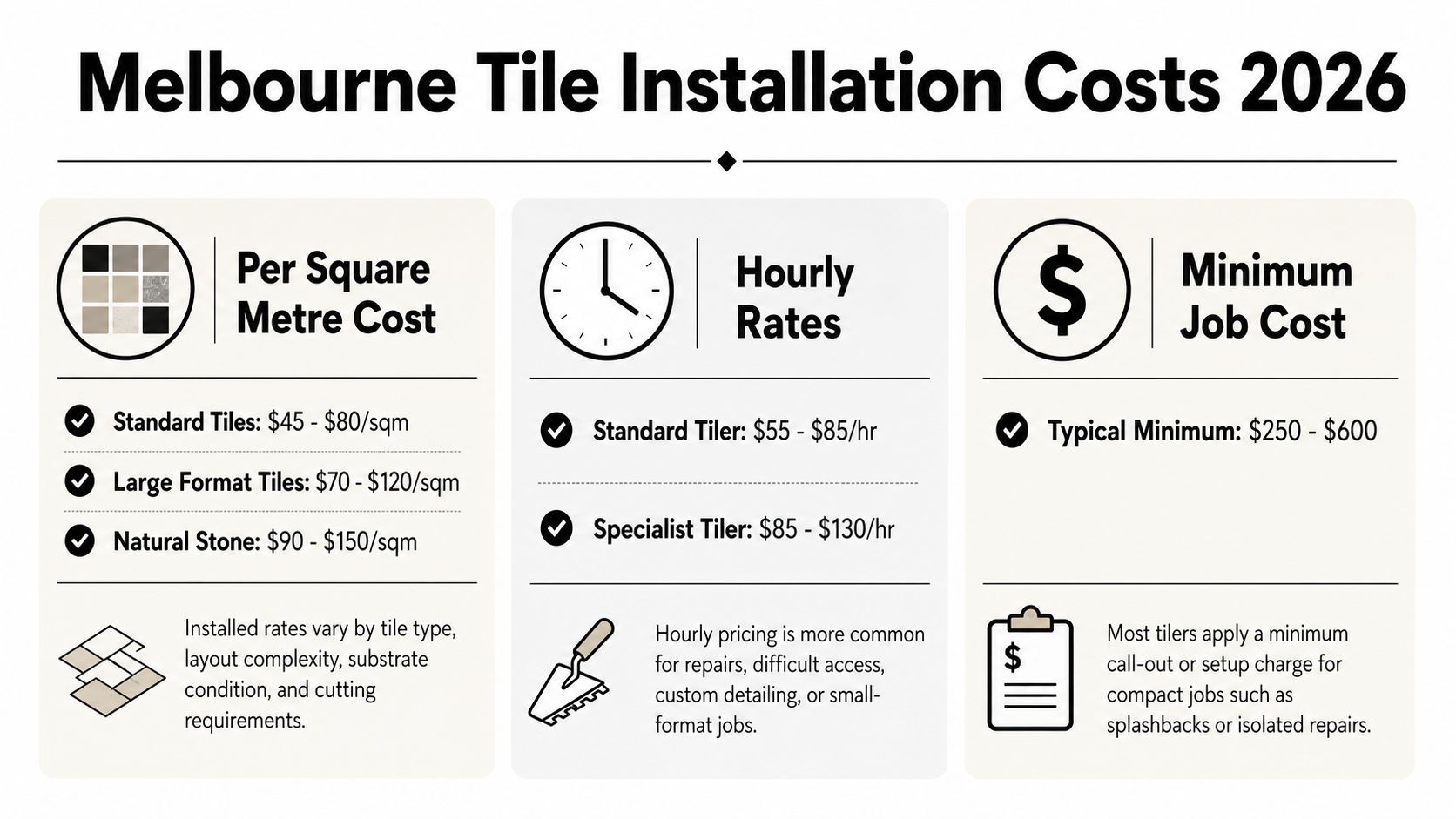
That is why Melbourne tiling prices are best read as price bands, not a single market rate. Quotes are usually built as per-square-metre labour, hourly charging for small or irregular work, or a supplied-and-laid rate that rolls materials into the figure. Those methods are all legitimate. The mistake is comparing them as if they include the same scope.
Labour only versus supplied and laid
For straightforward labour-only work, Melbourne tilers commonly price standard tile installation from about $45 to $70 per m², with more complex layouts and harder materials pushing labour into the $85 to $150 per m² range, as noted earlier. Those figures are useful for budgeting, but they do not represent the full project cost on their own.
A labour-only quote usually excludes tile supply and often excludes consumables as well. Adhesive, grout, trims, movement joints, sealers, silicone, and delivery can all sit outside the headline rate. On renovation work, preparation is the bigger omission. If the substrate is out of level, damaged, damp, or not suitable for bonding, someone has to rectify it before a tile goes down.
Supplied-and-laid pricing is broader because it combines installation with material selection. The installed rates in Melbourne commonly step up along these lines in the bathroom renovation cost guide by tile material:
- Basic ceramic tiles range from $80 to $120 per m² installed
- Porcelain tiles (600x600mm) range from $120 to $180 per m² installed
- Large-format porcelain (900x900mm+) ranges from $160 to $220 per m² installed
- Natural stone ranges from $180 to $280 per m² installed
The spread is wide for a reason. A 300×300 ceramic floor in a square room is quick to set out and lay. A large-format rectified porcelain tile on walls with tight joints takes longer, needs flatter surfaces, and usually creates more cutting and handling time. Stone adds sealing, edge treatment, and stricter substrate requirements.
Small jobs, repairs, and minimum callouts
Small jobs are priced differently because the setup time is almost the same whether the tiler lays 2 m² or 20 m². A cracked tile replacement, shower repair, laundry patch, or a half-day return visit is often charged hourly or as a minimum callout, rather than by square metre. As noted earlier, smaller-job rates in Melbourne often sit around $60 to $120 per hour.
This is also where cheap comparisons go wrong. A repair may look expensive on an hourly basis, but it can involve tile matching, careful demolition, drying time, waterproofing repair, and a second visit to grout and silicone. The area is small. The labour is not.
For a clearer sense of how pricing changes between repairs, floors, feature walls, and wet areas, review these common tiling job types in Melbourne.
A usable quote states the pricing basis, the included scope, and the exclusions. If it only gives a square metre rate without mentioning preparation, waterproofing, trims, or waste, it is not showing the total cost of the project.
Key Factors That Influence Your Final Quote
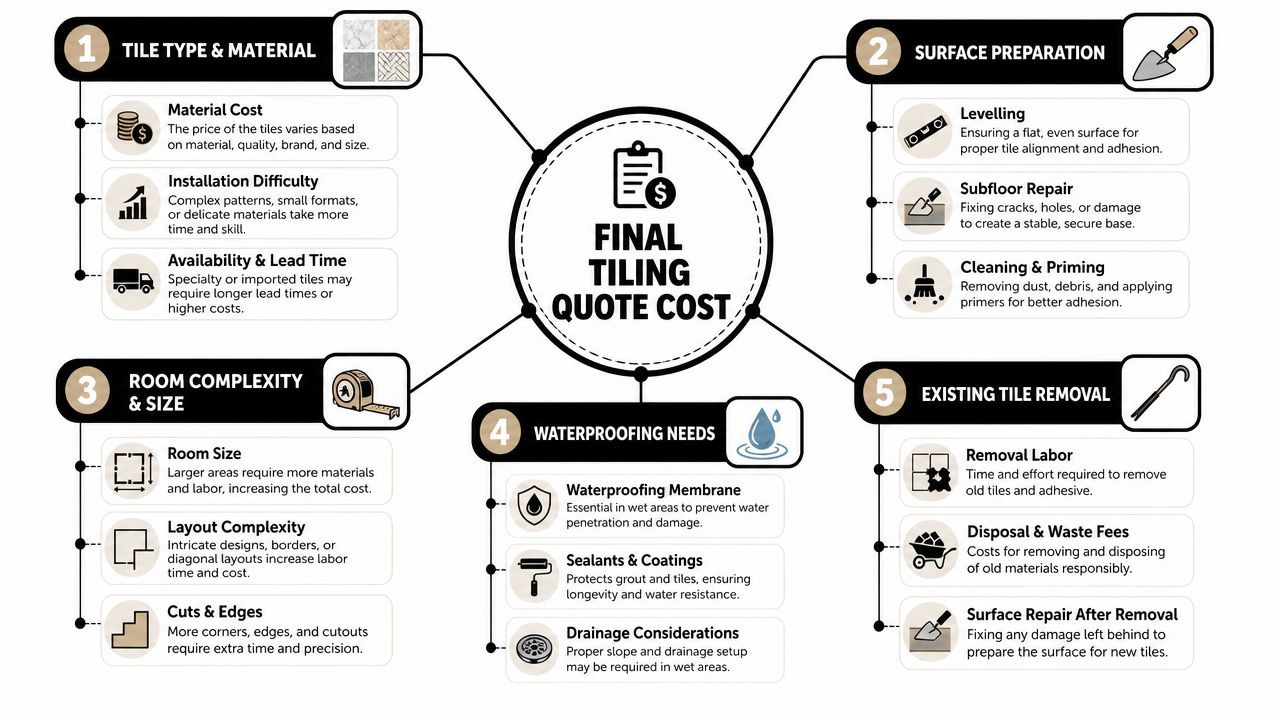
A tiling quote works like a recipe. The base rate is only the flour. The final price depends on everything else you add to the mix. The same square metre area can be cheap, reasonable, or expensive depending on the surface, tile, pattern, and wet-area requirements.
For medium-complexity bathroom renovations in Melbourne, experienced tilers charge $80 to $110 per square metre, and mandatory waterproofing adds $30 to $60 per square metre, according to the Melbourne bathroom tiler cost guide. That's why bathroom work sits above a simple open floor.
Surface condition changes everything
A flat concrete slab that's clean and ready is the easiest starting point. Old bathrooms are rarely that cooperative. You might be dealing with damaged sheeting, an uneven floor, old adhesive, movement in the substrate, or walls that are out enough to throw every tile line off.
Tilers can only finish as well as the surface allows. If the substrate is poor, someone has to correct it before installation starts. If that work is skipped, the finished job will show it in lippage, poor falls, hollow spots, and weak adhesion.
Tile type and tile size affect labour
Material cost is only part of the story. Large-format porcelain often looks cleaner and more modern, but it usually needs better substrate accuracy and more careful handling. Natural stone brings another level of detail, especially where sealing, edge finishing, and pattern variation matter.
Layout matters too. A straight lay is simpler than a diagonal pattern. A clean grid is quicker than a herringbone or a feature wall with tight visual alignment. Once you add niches, mitred corners, insets, strip drains, and small returns, the labour climbs because the cutting and setting become slower and less forgiving.
Wet areas cost more for good reason
Bathrooms and shower areas require tighter workmanship than a plain floor in a living zone. Waterproofing has to integrate properly. Falls need to work. Junctions around wastes, corners, and penetrations have to be handled carefully.
Here's the practical difference:
- Open floor tiling is usually more repetitive and faster to lay
- Bathroom floor tiling often involves more cuts, falls, and drainage detail
- Shower recess work demands precision because even small errors can create long-term problems
- Wall tiling in bathrooms slows down further when feature walls, niches, trims, and fixture alignment are involved
Cheap rates usually rely on one assumption. The room is perfectly prepared and nothing awkward will be discovered once work begins.
Decoding Your Tiling Quote And Avoiding Hidden Costs
A cheap quote often looks attractive because it keeps the visible number low. The problem is that low numbers can hide missing scope, and missing scope always comes back later as a variation, delay, or defect.
Most online cost guides don't separate substrate preparation and waterproofing from the tile figure. According to the Melbourne floor tiling cost analysis, that omission leads homeowners to underestimate total expenses by 20–30%. The same source notes that waterproofing runs $30–$60/m², and 60% of Melbourne bathroom leaks come from improper prep.
That's the number many people never see when they compare quotes line by line. They look at the tile rate and miss the work that makes the tile system last.
What a vague quote usually leaves out
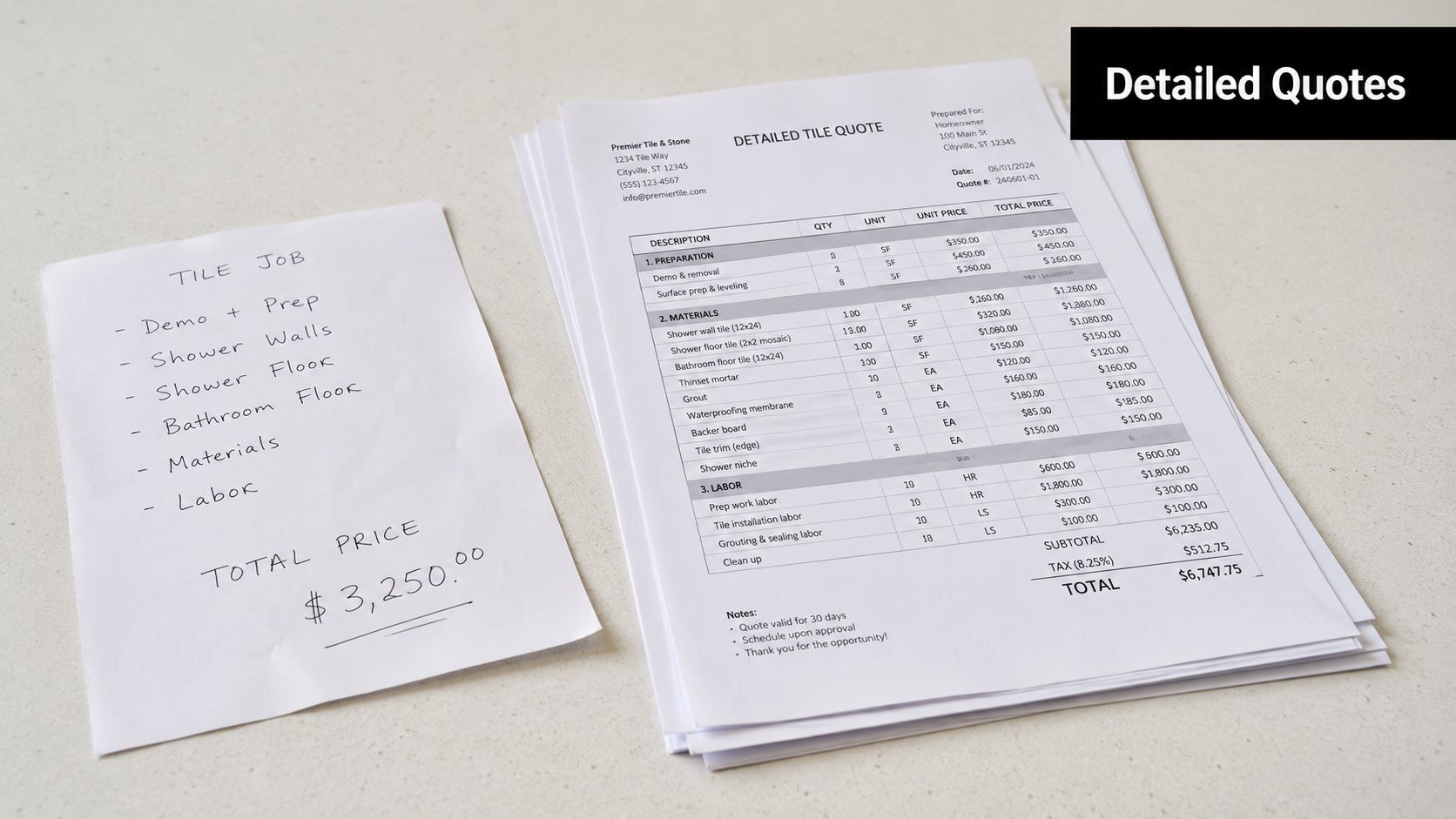
If a quote is one sentence long, treat it carefully. “Bathroom tiling, supplied and laid” doesn't tell you enough. It may not include removing old finishes, repairing the base, levelling the floor, adjusting walls, waterproofing, trim selection, grout colour, silicone work, or rubbish removal.
A proper quote should make it obvious whether these items are included:
- Demolition and removal of old tiles or sheeting
- Substrate preparation such as levelling, patching, or correcting falls
- Waterproofing scope and who is responsible for it
- Tile supply details including material type and size
- Finishing items like trims, grout, silicone, and movement joints
If they aren't listed, ask before the job starts, not after the first invoice arrives.
The cheapest quote often wins on paper because it excludes the work that prevents failures.
What to ask before you accept any quote
When a client asks how to compare two prices properly, the answer is simple. Don't ask only “how much”. Ask “what exactly is included”.
That means asking who is handling prep, whether waterproofing is included, what happens if the substrate is out of tolerance, and whether the quote is labour only or supplied and laid. If the answer stays vague, the quote is still incomplete.
This walkthrough helps show the difference between visual appeal and technical accuracy in bathroom tile work:
A good quote may not be the lowest one. It's the one that makes the full scope visible before the project begins.
Full Bathroom Renovation Costs With a Registered Builder
Bathroom tiling and bathroom renovations are related, but they are not the same service. A tiling job can be one trade working on a prepared space. A full renovation means demolition, waste removal, carpentry, plumbing, electrical, sheeting, waterproofing, tiling, fit-off, and coordination across the whole job. That's where registered builders come in.
In Melbourne, a legally compliant full bathroom renovation performed by a registered builder has a bare minimum cost of about $15,000, while standard mid-range projects average $18,000 to $28,000, according to the Melbourne bathroom renovation cost guide for registered builder projects.
A tiling job and a renovation are priced differently
Homeowners often mix numbers from different categories. They read a bathroom retile price and assume it applies to a full renovation. It doesn't.
A retile usually focuses on surfaces. A renovation covers the whole room. That includes all the work required before any tile goes down and after the tiles are finished. For a practical benchmark, this guide to bathroom renovation cost in Melbourne is useful when you're planning beyond tiles alone.
For a standard $25,000 mid-range bathroom renovation in Melbourne, labour by trades accounts for $8,000 to $12,000, or 35% to 45% of the total, according to the registered builders Melbourne bathroom scope article. That's a good reminder that tiling is a major part of the room, but never the whole project.
Here's the difference in plain terms:
| Project type | What you're paying for |
|---|---|
| Retiling only | Tile removal if required, substrate checks, waterproofing coordination where relevant, tile installation, grout, silicone, finishing |
| Full bathroom renovation | Builder management, demolition, carpentry, plumbing, electrical, waterproofing, certification, tiling, fixture installation, defect rectification, compliance |
Installed tile costs by material
If you're pricing the finishes inside a broader renovation, material selection has a direct effect on the supplied-and-installed figure.
| Tile Material | Average Installed Cost per m² |
|---|---|
| Ceramic | $80 to $120 per m² |
| Porcelain 600x600mm | $120 to $180 per m² |
| Large-format porcelain 900x900mm+ | $160 to $220 per m² |
| Natural stone | $180 to $280 per m² |
Those installed material rates are drawn from the earlier 2026 Melbourne material guide already cited in this article. The practical lesson is simple. A client can keep the room layout almost identical and still shift the budget noticeably just by changing from ceramic to large-format porcelain or stone.
If your project includes moving fixtures, changing waterproofed areas, or rebuilding the bathroom structure, you're budgeting for a renovation, not just a tiling job.
The Tiling Process Timelines and Legal Essentials
Most clients don't just want a price. They want to know what happens on site, in what order, and what paperwork matters at the end. That's especially important in wet areas, where appearance and compliance have to work together.
How a project usually runs on site
A straightforward tiling job moves in stages. First comes inspection and measuring. Then the existing surface is checked for level, strength, and moisture issues. If demolition is part of the scope, that has to be completed and cleared before prep starts.
After that, the work usually follows this order:
- Preparation. Levelling, patching, or correcting the substrate.
- Waterproofing in wet areas. This has to be done correctly and allowed to cure.
- Tile set-out. Good set-out prevents awkward cuts in the wrong places.
- Tile installation. Floors and walls are laid according to the agreed pattern.
- Grouting and silicone. Final junctions and movement points are finished.
- Clean-up and handover. The site is cleaned and any compliance documents are issued where required.
A full bathroom renovation takes more coordination because trades overlap. Demolition has to happen before plumbing rough-in. Sheeting and waterproofing need to be in place before tiling. Fittings and screens come later. When registered builders manage the sequence well, the room flows properly from one trade to the next instead of stalling between handovers.
Legal checks that matter in Victoria
In Victoria, legal compliance isn't optional on bathroom renovations. Victorian law requires any builder undertaking a bathroom renovation to hold a valid Victorian Domestic Builder licence, and homeowners should verify that licence before signing contracts, according to this Victorian bathroom renovation licensing explanation.
That check matters because bathroom work isn't just cosmetic. Waterproofing, structural alterations, and trade coordination carry legal and practical consequences. If the job falls under builder-managed renovation work, make sure the person running it is authorised to do so.
For wet-area work, homeowners should also make sure the project includes the right compliance records. This guide to a waterproofing compliance certificate in Victoria is a useful reference point when you want to understand what should be documented.
A professional team should be able to answer these questions clearly:
- Who holds the builder licence
- Who is responsible for waterproofing
- What compliance documents will be provided
- How defects or rectification are handled if discovered during the build
If those answers are fuzzy, the risk sits with the homeowner.
Start Your Melbourne Renovation With Confidence
If you've made it this far, you already know more than many do before requesting quotes. The main takeaway is simple. Don't budget from a tile rate alone.
For tile installation cost Melbourne, the useful starting range is $45 to $150 per square metre for labour, with bathroom retiles commonly sitting between $2,500 and $7,000. But that's only part of the picture. Project cost depends on what's under the tiles, whether waterproofing is required, what tile you choose, and whether the work is a tiling package or a full bathroom renovation under registered builders.
That's where homeowners save themselves trouble. They ask for line-item clarity. They compare scope, not just headline price. They treat waterproofing, substrate preparation, and compliance as mandatory parts of the budget rather than optional extras.
If you're planning a bathroom, ensuite, laundry, or wet-area upgrade, the smartest next step is to turn rough ideas into an itemised scope. That's how you get from “What does tiling cost?” to “What will my project cost, and why?”
If you want a clear path forward, Melbourne Tiling Services P/L can help you plan the job properly from the start. Use their renovation calculator, request a free quote, or ask for 3D drawings so you can see the layout, understand the scope, and budget for the full project instead of guessing from a square metre rate alone.
Write a Comment