Porcelain Tile Installation Cost: 2026 Melbourne Guide

Standard porcelain tile installation labour in Melbourne averages around $66 to $83 per square metre, but the true cost for a fully prepped, waterproofed bathroom project typically ranges from $75 to $150 per square metre once all wet-area requirements are included. The final invoice depends less on the tile alone than on the condition of the substrate, the format selected, access, waterproofing, and the level of finish expected.

You may be comparing two Melbourne tilers' quotes for the same bathroom and wondering why one appears far cheaper. One price may cover labour on a clean, flat surface, while the other includes demolition, levelling, waterproofing, cutting, trims, grout, silicone, and waste removal. Both figures can be accurate, but they aren't pricing the same scope.

A porcelain bathroom should be budgeted as a complete wet-area project, not as a simple square-metre exercise. That approach gives you a more reliable figure, protects the finished surface from movement and moisture damage, and reduces the risk of variations after demolition begins.

Table of Contents

Understanding the True Porcelain Tile Installation Cost

You've chosen the tile, measured the room, and multiplied the area by an advertised installation rate. Then the quote arrives with separate charges for preparation, waterproofing, adhesive, trims, and disposal. This is a common point of confusion because the headline rate often describes only one stage of the work.

Australian installed flooring benchmarks commonly sit around A$50 to A$150 per square metre, with porcelain specifically listed at about A$83 per square metre in one national guide. The same guide places the overall Australian average for tile flooring installation at A$72 per square metre. These figures are useful starting points, but they don't automatically describe a completed Melbourne bathroom. Trade Heroes' Australian tiler cost guide explains the distinction between broad flooring averages and the more demanding requirements of porcelain work.

Labour-only and fully installed pricing

A labour-only quote assumes the installer can begin on a suitable substrate. That generally means the floor or wall is sound, flat enough for the selected tile, clean, dry, and ready to receive adhesive. It may exclude demolition, grinding, self-levelling, screeding, waterproofing, tile supply, grout, silicone, trims, and removal of building waste.

A fully installed price should connect all the necessary stages. In a bathroom, that can include stripping the existing finishes, inspecting the substrate, correcting falls, preparing wall junctions, waterproofing the required areas, setting the porcelain, grouting, sealing movement joints, and cleaning the site. If the quote doesn't identify these tasks, you can't compare it fairly with a more detailed proposal.

Porcelain usually costs more to install than basic ceramic because it is denser and harder to cut. Rectified edges also demand a more precise set-out, while narrow grout joints make uneven walls and floors easier to see. A small error at the start can carry across an entire wall, so an experienced installer spends more time checking lines, levels, cuts, and transitions before fixing tiles.

Practical rule: A low square-metre rate isn't a saving until you know what condition the substrate must be in and which wet-area tasks are excluded.

A realistic Melbourne baseline

The right question isn't just, “What does porcelain cost per square metre?” Ask instead, “What has to happen before the first tile can be fixed, and what remains after the last tile is laid?” That change in wording exposes the overall budget.

For a straightforward, prepared floor, the rate may be relatively easy to estimate. A Melbourne bathroom with old adhesive, uneven masonry, shower recesses, penetrations, niches, or difficult access needs a broader allowance. Large-format selections increase the consequences of substrate movement and unevenness, while intricate layouts increase measuring and cutting time.

A cost calculator can help you separate labour, materials, preparation, and contingency instead of hiding them inside one total. The JobsiteStack cost calculator is useful at this planning stage because it encourages a true-cost view before you request final trade quotes.

Standard Porcelain Versus Large-Format Kerlite Panels

A standard porcelain tile and a large-format Kerlite panel may both be described as porcelain, but they create very different installation conditions. Smaller tiles are easier to carry, position, replace, and cut around corners. Large panels reduce grout lines and create a calm architectural appearance, yet they leave much less room for an imperfect wall or floor.
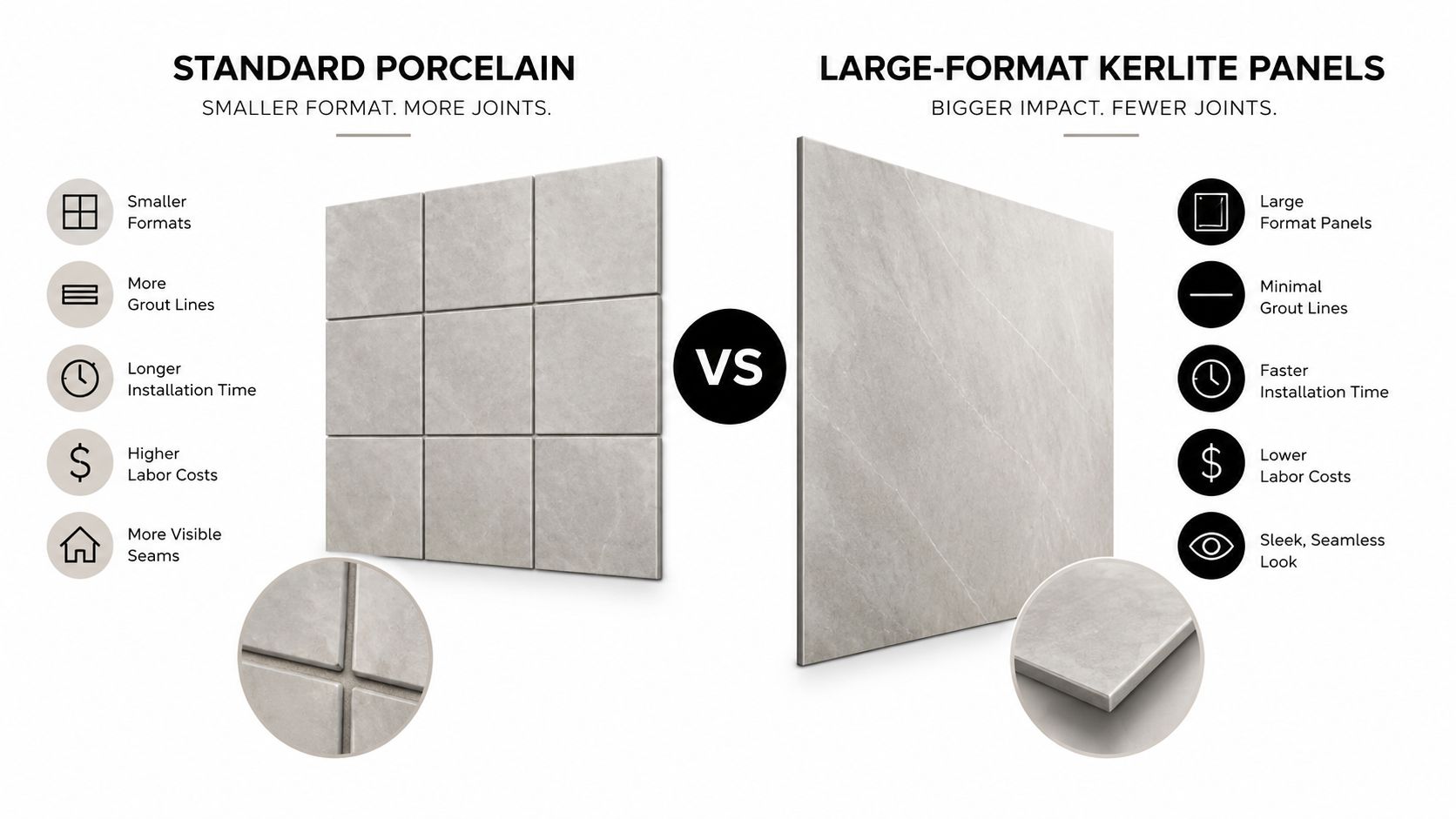
A comparison graphic showing standard porcelain tiles with many grout lines versus large-format Kerlite panels.

Why the format changes the labour

Standard porcelain can suit a conventional straight-lay floor or wall when the substrate is already stable and reasonably flat. The installer still needs to plan the starting point, distribute cuts, maintain consistent joints, and protect finished edges, but each individual tile remains comparatively manageable.

Kerlite-style panels require a more controlled process. The substrate must be exceptionally flat because a large panel can't easily follow local hollows or ridges. Installers may use panel lifters, suction equipment, carefully prepared adhesive coverage, and coordinated handling to reduce flexing and breakage. Cutting openings for wastes, niches, mixers, windows, and power points also requires accurate measurement and specialised tools.

Rectified edges sharpen the visual result, but they also expose lippage. With a smaller tile, a slight variation may be distributed across several pieces. With a large panel, a small deviation can remain visible along a long edge. That makes checking the wall plane and floor plane an essential part of the job, not an optional refinement.

Comparing the price bands

Australian 2026 pricing guidance places large-format porcelain labour around $60 to $120 per square metre in some NSW-style guides and roughly $80 to $180 per square metre in some Australian service guides. Straightforward floor tiling is listed at about $45 to $85 per square metre. These ranges are labour comparisons, so they shouldn't be mistaken for a complete wet-area project total. Yakka Labour's tiler rate guide provides the relevant comparison between standard and large-format work.

The premium reflects handling, preparation, layout control, cutting risk, and the experience needed to achieve a flat, aligned finish. It is not just a charge for a fashionable appearance. If the design depends on a continuous stone-look surface, saving on specialist installation can result in visible lippage, chipped edges, cracked panels, or expensive replacement work.

For a closer look at the practical scope behind this format, review this guide to large-format tile installation costs. It helps homeowners assess whether their room, access route, substrate, and installer are suitable for panels before they order materials.

Large-format panels should be selected early, because the choice affects framing, niche placement, wall preparation, delivery, storage, and sequencing with other trades.

The Hidden Costs of Substrate Prep and Waterproofing

The tile is the visible finish, but the substrate determines whether that finish stays sound. Older Melbourne bathrooms often reveal uneven floors, damaged plasterboard, loose screed, movement cracks, previous leak damage, or walls that were never built to receive large-format porcelain.

Australian guidance places standard porcelain installation at around $40 to $80 per square metre on a prepared substrate. Labour can rise to $100 to $150 per square metre for large-format porcelain, complex layouts, mosaics, or difficult access. Grinding, levelling, and waterproofing can add another $20 to $60 per square metre. BuildPilot's tile cost guidance sets out these differences clearly.

What preparation involves

Preparation isn't one universal task. The installer needs to inspect the existing surface and choose the correction that matches the defect.

  1. Grinding removes high points, old adhesive, and surface contamination where the base is generally sound but uneven.

  2. Self-levelling corrects suitable floor irregularities where a consistent plane is required before tile fixing. It won't solve every structural or drainage problem, and it must be applied over an appropriately prepared base.

  3. Screeding forms or corrects a graded surface, particularly where a bathroom floor needs controlled falls towards a waste.

  4. Substrate replacement may be necessary when the existing sheet material, plasterboard, screed, or affected backing has deteriorated through moisture exposure.

  5. Waterproofing seals the wet-area system around floors, shower walls, junctions, penetrations, and other required details. It needs compatible products, correct curing, and careful treatment of changes in plane.

A tiled surface can look perfect while the waterproofing beneath it is incomplete. Water can then reach framing, adjacent rooms, or lower-level ceilings. Rectifying that failure usually means removing finishes that were recently installed, so waterproofing should be treated as a core part of the scope.

Melbourne wet-area cost breakdown

Project Phase Standard Dry Area Bathroom Wet Area
Surface inspection Confirm the base is sound and ready for fixing Check for moisture damage, movement, falls, and failed previous work
Surface correction Local grinding or minor patching where required Grinding, levelling, screeding, or replacement may be needed
Moisture protection Usually not a wet-area waterproofing scope Waterproofing and sealing of required wet-area details
Tile installation Set-out, fixing, cuts, grout, and finishing Set-out plus penetrations, junctions, falls, niches, and wet-area detailing
Final finishing Clean-up and edge treatment Silicone movement joints, waste interfaces, trims, and leak-conscious detailing

The exact scope depends on what demolition exposes. A quote that lists only “tile floor and walls” leaves too much open to interpretation. Read this explanation of what substrate preparation involves before approving a bathroom tiling proposal, especially if the home is older or the new tile is large-format.

Waterproofing is not cosmetic preparation. It is part of the system that protects the building behind the porcelain.

Budgeting for Complete Bathroom Renovations

Porcelain rarely sits on its own in a bathroom renovation. Once demolition, plumbing, electrical work, cabinetry, fixtures, shower screens, painting, waterproofing, and tiling are combined, the tile decision affects the whole sequence and not just one line on the estimate.

Australian bathroom renovations average around A$26,000, with common project ranges of about A$8,000 to A$35,000 or more, depending on scope, materials, and labour. Canstar's bathroom renovation cost guide provides that broader context.

Match the tile ambition to the renovation tier

A budget renovation is commonly placed around A$8,000 to A$15,000, a standard renovation around A$15,000 to A$35,000, and a major renovation above A$35,000. These tiers are outlined in Savings.com.au's bathroom renovation cost guide.

The lower tier may suit a limited replacement where plumbing stays in place, the layout remains simple, and standard porcelain is fixed to a serviceable base. That doesn't mean compromising on waterproofing. It means controlling the number of moving parts and avoiding a tile format that requires extensive correction or specialist handling.

A standard renovation gives more room for upgraded porcelain, new cabinetry, improved lighting, a replacement shower screen, and better finishing details. The tile may still be laid in a straightforward pattern, but the overall room receives a coordinated upgrade rather than a surface-only change.

A major renovation can involve layout changes, new plumbing positions, custom niches, structural adjustments, premium fixtures, large-format panels, and extensive substrate work. The porcelain may represent an important visual investment, but it must be supported by the construction budget. High-end panels fixed over an unstable or poorly prepared base are false economy.

Scope drives the final result

A homeowner may prefer a continuous stone-look panel because it reduces grout lines. Another may choose a smaller format to control handling and cutting costs. Neither choice is automatically right. The suitable option depends on access, wall dimensions, waste locations, desired joint layout, drainage, maintenance preferences, and the capability of the installation team.

Plumbing changes can also affect tile cost indirectly. Moving a shower mixer or waste creates new penetrations and may require additional substrate repairs and waterproofing detailing. A freestanding bath, wall-hung vanity, or recessed niche needs accurate coordination before the tile setter begins.

Build the renovation budget in this order:

  • Define the layout: Confirm whether plumbing, walls, doors, niches, and shower locations are changing.
  • Choose the tile format: Decide whether standard porcelain or large-format panels suit the room and substrate.
  • Allow for the base: Include demolition, repairs, levelling, screeding, and waterproofing before comparing finishes.
  • Coordinate the trades: Make sure plumbing, electrical, carpentry, waterproofing, and tiling responsibilities are clear.
  • Specify the finish: Record grout colour, joint size, trims, silicone colour, thresholds, and cleaning expectations.

The most reliable quote reflects the entire room, not just the area covered by porcelain.

Why Registered Builders Are Essential for Compliance

A bathroom renovation involves several trades working on one connected system. The tiler depends on the waterproofer, the waterproofer depends on the substrate and plumbing penetrations, and the final finish depends on every trade completing its part in the correct order. A low tiling rate doesn't protect you if the wider project lacks proper coordination.
A professional construction inspector in a hard hat and safety vest checking porcelain tile installation progress.

The Victorian threshold

In Victoria, a practitioner can't carry out or contract for domestic building work valued over A$10,000 unless they are registered or licensed in the relevant category. Consumer Affairs guidance also identifies bathroom renovations as domestic building work. The legal position is summarised in this Victorian bathroom renovation cost and compliance guide.

That threshold matters when a porcelain installation forms part of a wider bathroom renovation. A standalone tiling discussion can obscure the fact that the project may also include demolition, carpentry, waterproofing, plumbing, electrical work, and installation of fixtures. The person contracting for that combined work needs the appropriate registration or licensing.

Why coordination protects the finish

Registered building oversight provides a clearer point of responsibility. It can help organise licensed plumbers and electricians, confirm that waterproofing is completed before tiling, manage inspections and documentation, and control variations when demolition reveals hidden damage.

Ask prospective contractors:

  • Who holds the contract: Identify the party responsible for the overall domestic building work.
  • Who performs each trade: Confirm that plumbers, electricians, waterproofers, and carpenters hold the relevant licences.
  • How waterproofing is documented: Request the product system, preparation requirements, and completion records where applicable.
  • How changes are approved: Make sure variations are written, priced, and agreed before extra work proceeds.
  • What warranty applies: Clarify who is responsible if a leak, loose tile, cracked grout, or failed finish appears later.

A tiler can deliver excellent porcelain work without being the right person to contract an entire bathroom renovation. Conversely, a registered builder still needs qualified tilers and waterproofers with the skills suited to the selected format. Compliance and craftsmanship are related, but they aren't interchangeable.

How to Audit Your Tiling Quote for Exclusions

Two quotes become comparable only when they describe the same work. A proposal that says “supply and install porcelain tiles” may omit the most expensive decisions, particularly in a bathroom where the existing substrate isn't visible until demolition.

Australian pricing guidance distinguishes between standard tiling labour of around $45 to $90 per square metre and large-format or intricate porcelain labour of about $70 to $150 per square metre. Waterproofing, screeding, epoxy grout, and other wet-area additions can push the fully installed total higher. Webblend's tiler rates guide is a useful reference for separating labour from project add-ons.
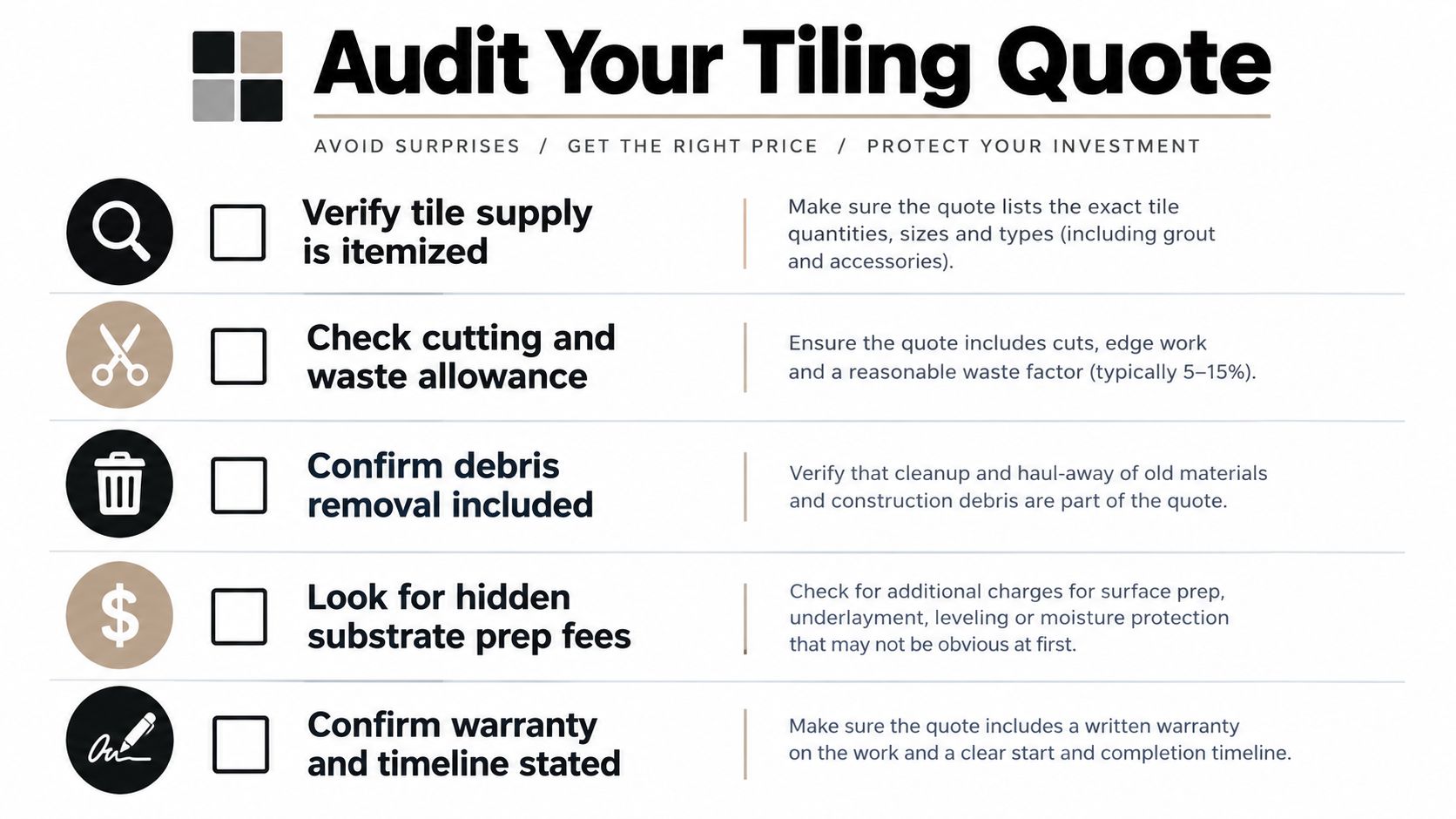
A checklist infographic titled Audit Your Tiling Quote designed to help homeowners evaluate professional tiling estimates.

Read the inclusions line by line

Start with the tile itself. The quote should state whether the price includes supply, delivery, batch inspection, cuts, breakage allowance, and any special pieces. If you're supplying the tile, confirm who checks quantities and who carries responsibility for defects or shade variation.

Then examine the installation scope:

  • Substrate condition: Does the quote include grinding, patching, levelling, screeding, or backing-board replacement?
  • Waterproofing: Identify the areas covered, the preparation required, the system used, and whether penetrations and junctions are included.
  • Adhesive and grout: Confirm product type, coverage, colour, and whether epoxy grout is specified where you require it.
  • Cuts and penetrations: Ask whether cuts around wastes, niches, outlets, mixers, windows, and door jambs are included.
  • Trims and edges: Check the material, finish, profile, thresholds, and exposed tile edges.
  • Silicone work: Make sure movement joints and changes of plane are identified rather than assumed.
  • Removal and disposal: Confirm who removes existing tile, packaging, rubble, and unusable material.
  • Access and protection: Clarify parking, stairs, narrow hallways, lifting requirements, floor protection, and site cleaning.
  • Programme and warranty: Require a stated start window, anticipated sequence, completion conditions, and warranty terms.

The phrase “subject to site conditions” isn't automatically a problem. It becomes a problem when the quote gives no method for pricing those conditions. Ask what happens if the floor needs levelling, the wall backing is damaged, or old waterproofing has failed.

Compare like with like

A good comparison table might have separate columns for tile supply, demolition, substrate preparation, waterproofing, installation, grout, silicone, trims, waste removal, and exclusions. If one contractor combines all of these into a single total while another lists them individually, ask the first contractor to clarify the components before deciding.

You can also use a detailed bathroom renovation quote guide to structure the questions you send to each contractor. The aim isn't to force every contractor into identical wording. It's to ensure that a cheaper quote isn't relying on unpaid assumptions.

The strongest quote is specific about uncertainty. It tells you what is included, what may change, who decides, and how an approved variation will be priced.

Securing a Premium Finish in Melbourne Homes

A premium porcelain bathroom doesn't begin with the first visible tile. It begins when the installer measures the room, checks the substrate, confirms the drainage and waterproofing sequence, and resolves the layout before adhesive reaches the wall.

Consider a typical Melbourne ensuite with a stone-look porcelain selection. The homeowner wants large panels, a recessed niche, minimal grout lines, and a frameless shower screen. A rushed contractor may start with the most visible wall and discover later that the niche cuts don't align, the floor needs a different fall, or the panel delivery can't reach the room without extra handling. The tile may be expensive, but the real failure is poor sequencing.

A careful team develops the set-out before fixing begins. It coordinates the niche with grout lines, positions cuts away from focal points, checks the relationship between the floor tile and shower waste, and confirms where silicone and trims will be visible. When the substrate requires correction, that work happens before the finish is placed, not after cracking or lippage exposes the problem.

Precision saves more than it costs

Experienced porcelain installers know when a format doesn't suit the substrate or access conditions. They can recommend a practical alternative, adjust the layout, or identify preparation work before the project is committed. That advice may change the initial quote, but it gives the homeowner a clearer choice between appearance, installation risk, maintenance, and budget.

3D drawings can help confirm tile direction, niche proportions, fixture locations, and transitions before demolition. A transparent renovation calculator can separate the visible finish from the less visible work beneath it. These tools don't replace a site inspection, but they make the scope easier to discuss and reduce decisions made under pressure.

The most durable result comes from combining:

  • A suitable tile format for the room and access.
  • A properly corrected substrate with appropriate falls and stability.
  • A complete waterproofing system installed and allowed to cure correctly.
  • A coordinated trade sequence that protects finished surfaces.
  • A written quote that identifies inclusions, exclusions, variations, and warranties.

The cheapest porcelain tile installation cost is rarely the lowest number on a first quote. It is the cost of completing the work correctly without paying twice for failed preparation, damaged panels, or leak rectification.


Melbourne Tiling Services P/L offers start-to-finish bathroom and ensuite renovations, waterproofing, screeding, self-levelling, porcelain and Kerlite installation, leak rectification, 3D drawings, and transparent renovation quoting across Melbourne and greater Victoria. Visit Melbourne Tiling Services P/L to discuss your bathroom scope, substrate condition, tile format, and a practical installation budget.
Tiling Cost Per Square Metre Melbourne Guide 2026

For standard Melbourne bathroom tiling in 2026, allow $75 to $150 per square metre for combined floor and wall tiling using 300 x 600 mm or 600 x 600 mm rectified ceramic or porcelain tiles. An 8 to 12 m² bathroom generally lands around $1,800 to $4,500 for tiling labour and adhesive.

You're probably looking at a bathroom quote that seems reasonable until you notice that one tiler has priced labour only, another has included adhesive and grout, and a third has allowed for waterproofing and surface repairs. All three may use a price per square metre, but they're not pricing the same job.

That's why searching for tiling cost per square metre Melbourne gives you a useful starting point, not a final budget. The rate changes with the tile, the layout, the substrate, access, wet-area requirements and the amount of finishing work around drains, niches and fixtures.

Table of Contents

Introduction to Tiling Costs in Melbourne Right Now

A homeowner in Melbourne might measure a compact bathroom, multiply the floor area by a tiler's rate and expect the answer to be straightforward. The problem is that bathroom tiling includes walls, shower areas, floors and sometimes feature surfaces, so the actual tiled area can be much larger than the room's footprint.

For a standard Victorian bathroom, the practical 2026 benchmark is $75 to $150 per m² for combined floor and wall tiling with standard 300 x 600 mm or 600 x 600 mm rectified ceramic or porcelain tiles. A complete bathroom with 8 to 12 m² of tiled surface can cost approximately $1,800 to $4,500 for tiling labour and adhesive, according to this Victorian tiling cost guide.

That figure is most useful when the bathroom has reasonably sound surfaces and a conventional layout. It isn't a promise that every Melbourne bathroom will fit inside the range. A shower niche, uneven wall, difficult apartment access or a premium tile can change the quote quickly.

Start with the type of price

A labour-only rate covers the tiler's work, but may leave you supplying tiles, adhesive, grout, trims and sealants. A supply-and-lay quote usually combines the tiles and installation, while a fully scoped bathroom renovation may also include demolition, waterproofing, screeding, plumbing, electrical work and carpentry.

Those categories explain why two prices per square metre can sit far apart. One may describe only the visible laying work, while another includes the preparation needed to make the finished surface stable and water-resistant.

Practical rule: Never compare the number alone. Compare the scope attached to the number.

The rest of your quote should answer five basic questions. How much surface will be tiled? Which tiles are included? Is preparation listed separately? Does waterproofing form part of the bathroom renovation? Who supplies and removes materials and waste?

Once those details are clear, the per-m² figure becomes a measuring tool rather than a misleading headline.

How Per Square Metre Tiling Pricing Actually Works

Think of a tiling quote as a layered cake. The finished surface is only the top layer, and each layer underneath affects what you pay.

The first layer is labour. The tiler sets out the room, cuts tiles, applies adhesive, places tiles, checks alignment and completes grouting and silicone detailing. Australian tiling labour is commonly priced by square metre. Independent 2026 guides place standard floor tiling around AUD 35 to 90 per m², wall tiling around AUD 40 to 100 per m², and detailed work such as mosaics or feature tiles around AUD 60 to 120 per m² in labour, as outlined in this Australian tiler rate guide.

The second layer is materials. Depending on the agreement, this can include tiles, adhesive, grout, primer, trims, silicone and other installation products. If the quote says “labour only”, don't assume those items are included.

The third layer is surface preparation. A tiler can't create a flat, durable finish on a wall that is loose, uneven or contaminated. Preparation might involve patching, removing old adhesive, screeding or self-levelling.

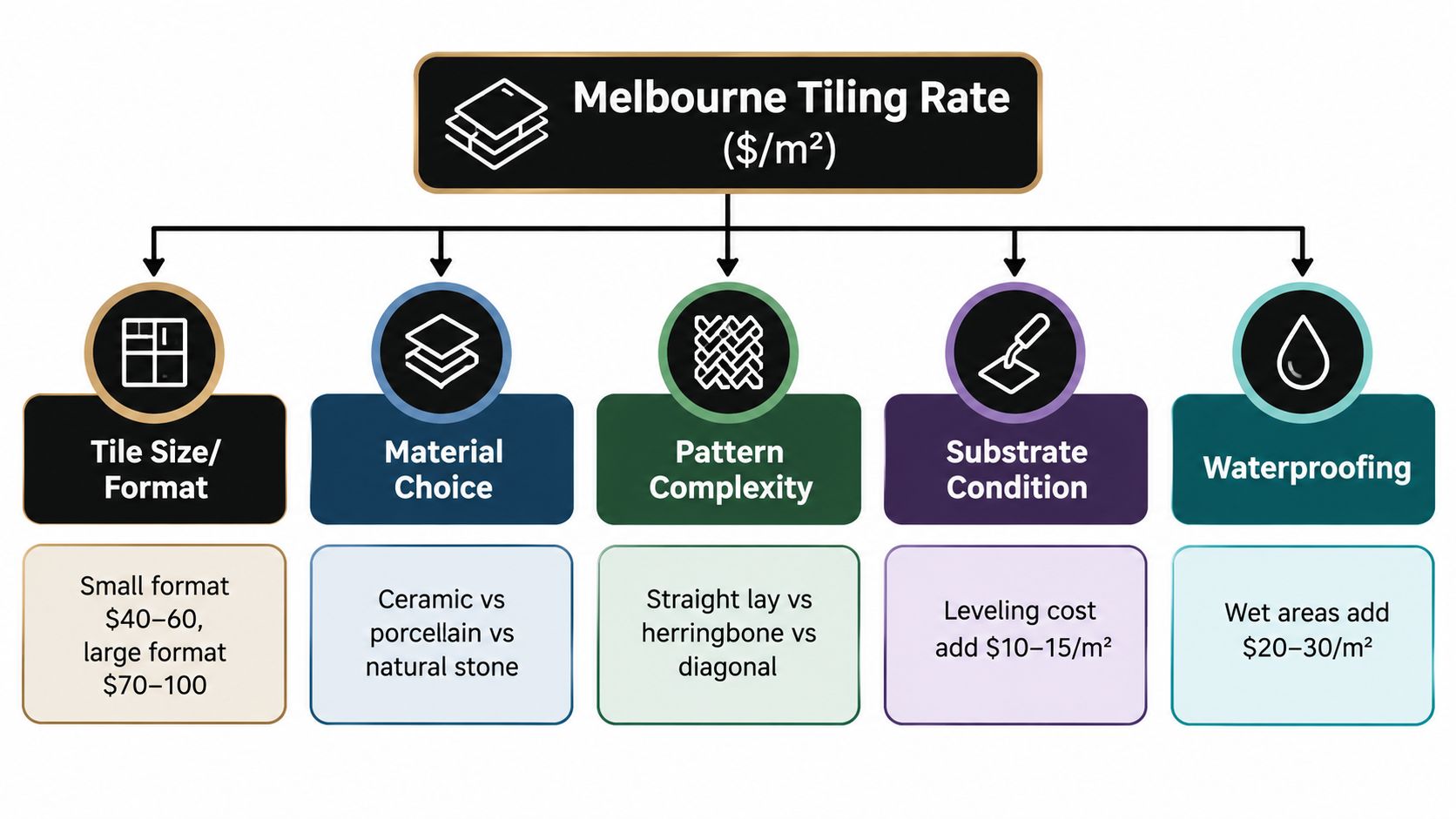
An infographic showing factors influencing the cost of tiling per square meter in Melbourne, Australia.

What the headline rate may leave out

Waterproofing is another separate layer in wet areas. A tiler may price the visible tiling while a waterproofing contractor or builder prices the membrane system independently. Removing existing tiles, transporting waste, fitting edge trims and working around plumbing penetrations may also sit outside a basic rate.

Tilers generally use square metres because the amount of surface directly affects tile setting, cutting and grouting time. That method is easier to estimate than an hourly figure when the room has a clear scope, although small jobs can still attract a minimum charge or travel component.

A small ensuite may have limited square metre coverage but still require a site visit, preparation, set-out, cutting and clean-up. The fixed effort doesn't disappear just because the room is compact.

Read the quote like a recipe: identify the labour, materials, preparation, waterproofing and exclusions before judging whether the price is fair.

Key Factors That Change Your Melbourne Tiling Rate

A Melbourne homeowner may receive different installation rates for the same porcelain tile. A narrow bathroom, for example, takes more time per square metre than an open living area because the tiler works around corners, fittings and limited access. The price is built from the work around the tile, not only the tile itself.

Format and material

A regular 300 x 600 mm wall tile is usually easier to carry, cut and position than a slab-like format. Large tiles can reduce grout lines, yet they need careful handling and a flatter substrate. Natural stone may require more precise cutting and finishing than standard ceramic.

The Melbourne floor guide places standard ceramic or porcelain installation at $50 to $100 per m², before tile supply. Supply may add $20 to $180 per m², depending on the selected material, as shown in this Melbourne floor tiling price guide. Ask whether a quote includes the tile, adhesive, grout and trims, because “installed” can cover different items.

Pattern and setting out

A straight grid allows the installer to repeat the same cuts and movements. Diagonal layouts, herringbone patterns and mosaics create more cut lines, more planning and more waste. The layout also has to finish neatly around corners, floor wastes and fittings.

One Victoria and Melbourne pricing guide lists basic tiling at AUD 40 to 60 per m², complex patterns at AUD 65 to 90 per m², and heritage restoration at AUD 100 to 150 per m². These ranges illustrate why decorative work can sit above a simple installation, particularly when an existing character surface must be preserved. For large formats, review this large-format tile installation cost guide and check whether extra handling or preparation is included.

Substrate and room conditions

Tiles copy the surface beneath them. A bowed wall can make grout lines look uneven, while an unlevel floor may require levelling before laying begins. The quote should identify patching, adhesive removal, screeding or self-levelling rather than hiding those tasks inside a single rate.

Bathrooms add floor wastes, shower falls, pipe penetrations, vanities and tight junctions. Each interruption reduces uninterrupted working space. Carrying materials through a narrow terrace, up stairs or across an occupied home also takes more organisation than working in a cleared ground-floor room. Travel across greater Melbourne can affect how a contractor schedules a small project.

Wet-area compliance

Waterproofing protects the substrate and adjoining rooms from moisture. It may be priced separately from visible tiling, particularly when another contractor or builder installs the membrane system.

If the renovation includes structural, waterproofing, plumbing or electrical changes, it may fall within domestic building work and require a registered practitioner. Settle that responsibility before tiling starts, and confirm who provides documentation and warranties. That prevents a low square metre rate from becoming an incomplete quote.

Tile Types and Sizes Compared for Melbourne Homes

A tile quote is a build-up, not a single product price. The tile affects material cost, while its weight, size, pattern and cutting requirements affect labour. Two bathrooms with the same tiled area can therefore receive very different quotes.

Tile Type and Format Typical Installed Range per m² Why Cost Varies
Standard ceramic or porcelain floor tiles $50 to $100 The Melbourne installation range changes with substrate condition, layout and access.
Large-format porcelain, 600 x 600 mm and above $80 to $130 Larger pieces need careful handling, accurate set-out and a flatter base.
Natural stone such as marble or bluestone $100 to $180 Stone is heavier, may need more detailed cutting and can require additional finishing care.
Standard ceramic wall tiles $55 to $90 supplied and laid A straightforward wall layout is usually less demanding than detailed feature work.
Large-format porcelain wall tiles $85 to $180 supplied and laid Size, substrate preparation and material handling have a stronger effect on labour.

The listed Melbourne ranges place large-format porcelain at $80 to $130 per m² installed for tiles measuring 600 x 600 mm and above. Natural stone such as marble or bluestone sits at $100 to $180 per m². These figures show why a premium finish can move the project well beyond a basic labour rate. The complete local Melbourne floor tiling guide is useful for checking what an installation range may cover.

Ceramic for practical wall coverage

Ceramic wall tiles suit a straightforward bathroom with clean, repeatable lines. They can cover broad wall areas efficiently, leaving a more expensive product for a niche or feature wall.

The cheapest tile does not always create the cheapest job. Small formats, uneven edges and intricate patterns increase the number of cuts and grout joints. A plain, larger tile may take less time to set out and install, even if its purchase price is higher.

Porcelain for floors and larger surfaces

Porcelain is denser and is often chosen for floors or other areas requiring a hard-wearing finish. Large-format porcelain gives a quieter visual field because it uses fewer grout lines. Handling each piece safely, setting it accurately and placing it on an even base can require more preparation and labour.

Ask the tiler to separate the tile supply, installation and base preparation in the quote. The tile price may be clear while levelling, adhesive changes or extra handling remain unspecified.

Mosaics and natural stone

Mosaics suit niches, shower floors and feature areas, but the sheets still need careful alignment. Many small pieces create more grout joints and more opportunities for the pattern to drift, so labour can outweigh the apparent simplicity of the product.

Marble and bluestone add distinctive character. Their quote should identify cutting, sealing and finishing requirements, along with any care needed after installation. Compare the complete installed system, including maintenance, rather than comparing only the price of one tile against another.

Worked Examples and Sample Quotes for Melbourne Bathrooms

A useful estimate starts with the tiled surface, not the room's floor footprint. Measure the floor, the walls being tiled and the shower surfaces, then separate the installation rate from waterproofing and preparation.

Example one, compact ensuite

Assume an 8 m² tiled surface using standard rectified ceramic or porcelain tiles. Applying the Victorian bathroom benchmark of $75 to $150 per m² gives $600 to $1,200 for the combined rate calculation, but the broader standard-bathroom benchmark places total tiling labour and adhesive at about $1,800 to $4,500 for an 8 to 12 m² bathroom. The difference shows why a small room can still carry set-up, cutting, adhesive, grout and finishing costs that a simple multiplication doesn't capture. See this bathroom renovation calculator for a way to organise the room measurements and scope before requesting quotes.

A quote for this ensuite should identify whether waterproofing, demolition and substrate repairs sit outside the tiling line. If the walls are sound and the layout is uncomplicated, the final figure should be easier to control than a bathroom with multiple niches and feature cuts.

Example two, family bathroom with large-format porcelain

Now consider a 12 m² tiled surface with 600 x 600 mm or larger porcelain. The local installed guide places this format at $80 to $130 per m², producing a rate-based installation range of $960 to $1,560 before any separate preparation, waterproofing or unusual access costs.

The practical question is whether the floor and walls are flat enough for the selected product. If not, the installer may need to price additional preparation, and the project can move beyond the apparent per-m² calculation.

Example three, premium ensuite with a stone feature wall

A premium ensuite may combine standard porcelain across the main surfaces with a natural-stone feature wall. The stone portion should be measured separately because the guide places marble or bluestone at $100 to $180 per m² installed, while the surrounding surfaces may use another rate.

Room-level Australian bathroom guides place a typical bathroom with 10 to 15 m² of tile surface at about $1,500 to $3,000 fully supplied and installed, with waterproofing adding approximately $500 to $1,000. Another benchmark places a medium bathroom's lower-to-mid tiling cost around AUD 1,200 to 2,000, so the final scope matters more than the label “medium”. These figures are detailed in the Australian bathroom tiler cost guide.

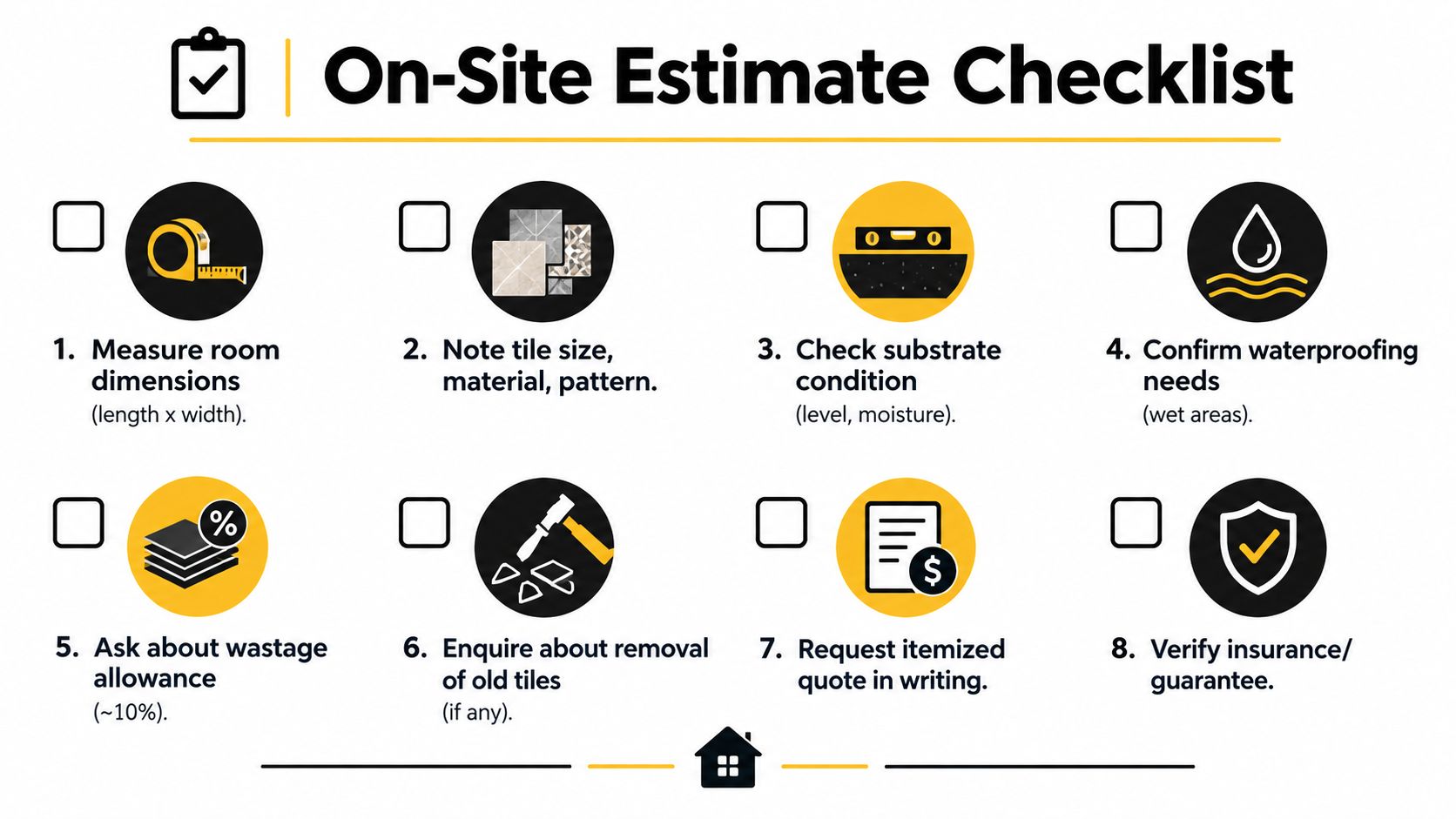
A checklist for homeowners to use when getting an on-site tile installation estimate from professional contractors.

Estimator's habit: Ask for the tiled area, tile rate, preparation, waterproofing and exclusions as separate lines. That makes the arithmetic visible.

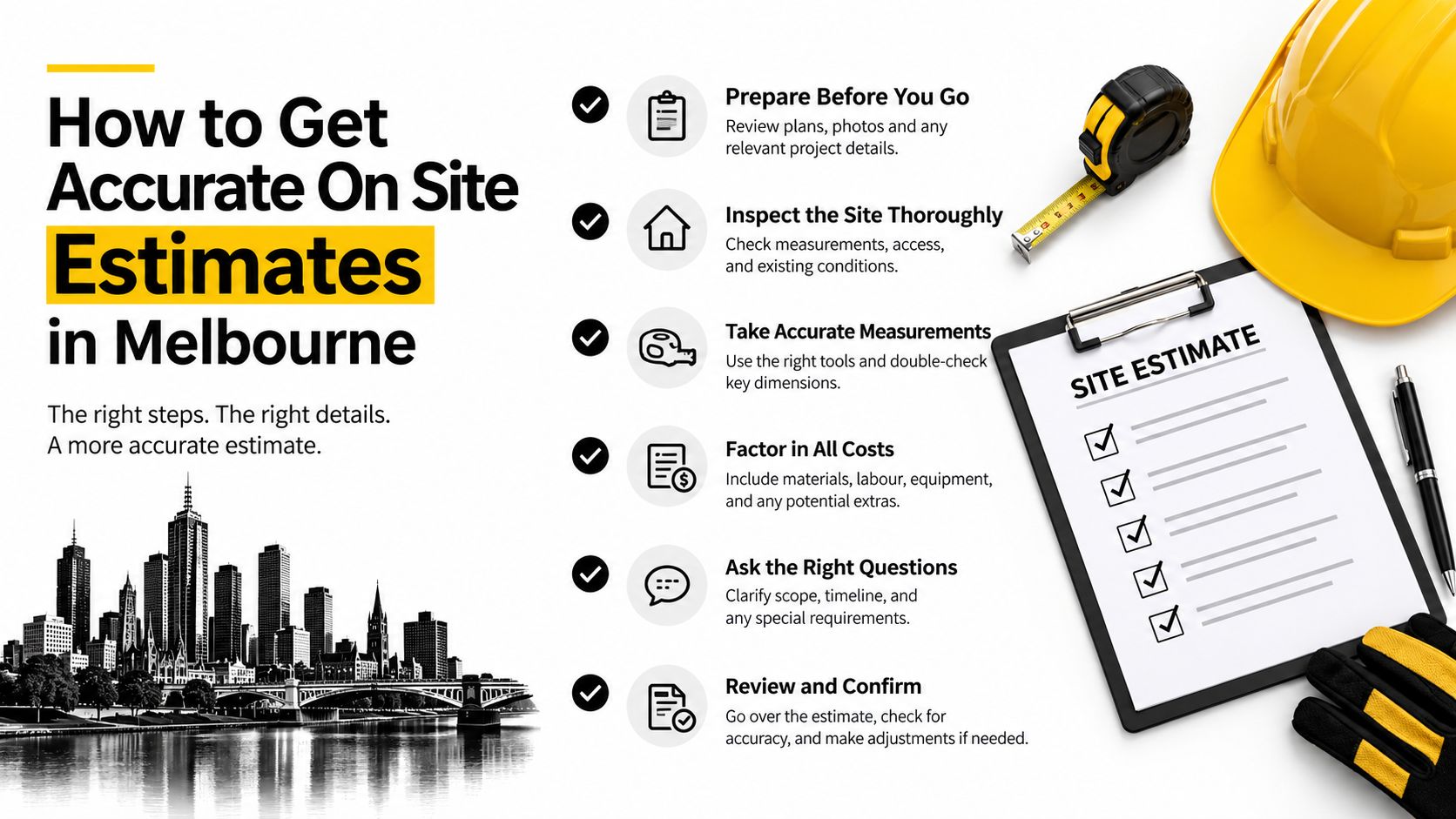
How to Get Accurate On Site Estimates in Melbourne

Online ranges help you decide whether a project deserves a modest, mid-range or premium budget. An on-site estimate tells the contractor what the room requires.

Start by preparing the information a tiler or builder needs. Record the room dimensions, take photos of walls and floors, note the tile size and material, and mark any niches, benches, windows, floor wastes and pipe penetrations. If you already have a tile selected, provide its product name and format rather than describing it only as “porcelain”.

Ask for a scope that can be checked

A reliable quote should show:

  • Measured tiled area: Confirm how the contractor calculated floor and wall coverage.
  • Tile supply: Check whether the price includes the exact tile, delivery and reasonable cutting waste.
  • Preparation: Ask how patching, removal, screeding or self-levelling will be treated.
  • Waterproofing: Confirm who performs it, what areas are covered and whether it is a separate line.
  • Installation finish: Look for grout, silicone, trims, mitred edges and clean-up.
  • Variations: Ask what site discoveries could change the price and how approval will work.

A professional construction infographic guide for getting accurate site estimates in Melbourne, featuring essential checklist steps.

Check the building pathway

In Victoria, domestic building work over AUD 10,000 generally requires a registered builder. Bathroom renovations commonly fall under domestic building work when they involve structural, waterproofing, plumbing or electrical changes, so the compliance threshold can affect whether you need a registered unlimited builder or another registered practitioner. The relevant threshold and scope are outlined in this Victorian tiling and domestic building cost guide.

Tiling alone may not tell you who should coordinate the project. If the renovation changes waterproofing, plumbing or structure, ask who holds responsibility for the complete work, not only who lays the tiles.

For a practical starting point, compare two or more site quotes using the same tile schedule and the same room drawings. Melbourne Tiling Services P/L offers free quotes, 3D drawings and a transparent calculator, while other local contractors may use different estimating tools. You can also review tiling contractors near me when building a shortlist, then verify insurance, registration and workmanship terms directly.

Planning Your Budget and Next Steps With Confidence

Use $75 to $150 per m² as a practical 2026 starting benchmark for standard Melbourne bathroom floor and wall tiling, not as a promise of the final invoice. Adjust your expectations for large-format porcelain, natural stone, mosaics, complex patterns, uneven substrates and wet-area compliance.

Before approving a quote, take these steps:

  1. Measure the full tiled surface, including walls and shower areas.
  2. Choose the tile and layout before asking contractors to price the work.
  3. Request an itemised quote that separates labour, materials, preparation and waterproofing.
  4. Confirm the building pathway if the renovation includes structural, waterproofing, plumbing or electrical work.
  5. Use a renovation calculator and site visit to test whether the written scope matches the room.

If you're researching broader project-planning resources, this guide to websites for building construction can help you assess what information a professional building business should present clearly online.

A good bathroom renovation quote should leave you knowing what will be installed, who is responsible for each trade and which conditions could create a variation. Price matters, but so do waterproofing, clean detailing, durable materials and a finish that suits the way your household uses the room.


Melbourne Tiling Services P/L can measure your bathroom, prepare a transparent tiling and renovation quote, and provide free 3D drawings to help you compare tile choices and scope. Visit Melbourne Tiling Services P/L to arrange a quote for your Melbourne or greater Victoria project.

Tiling Cost Per Square Meter: Melbourne Guide 2026

Melbourne tiling costs typically land around A$65 to A$135 per square metre for standard ceramic and porcelain once you factor in labour and installed materials, but bathroom wet areas often push higher once waterproofing and substrate preparation are included. The popular advice that a single rate tells you everything is wrong, because the cheapest number on a quote is usually the one that leaves out the work that matters.

Table of Contents

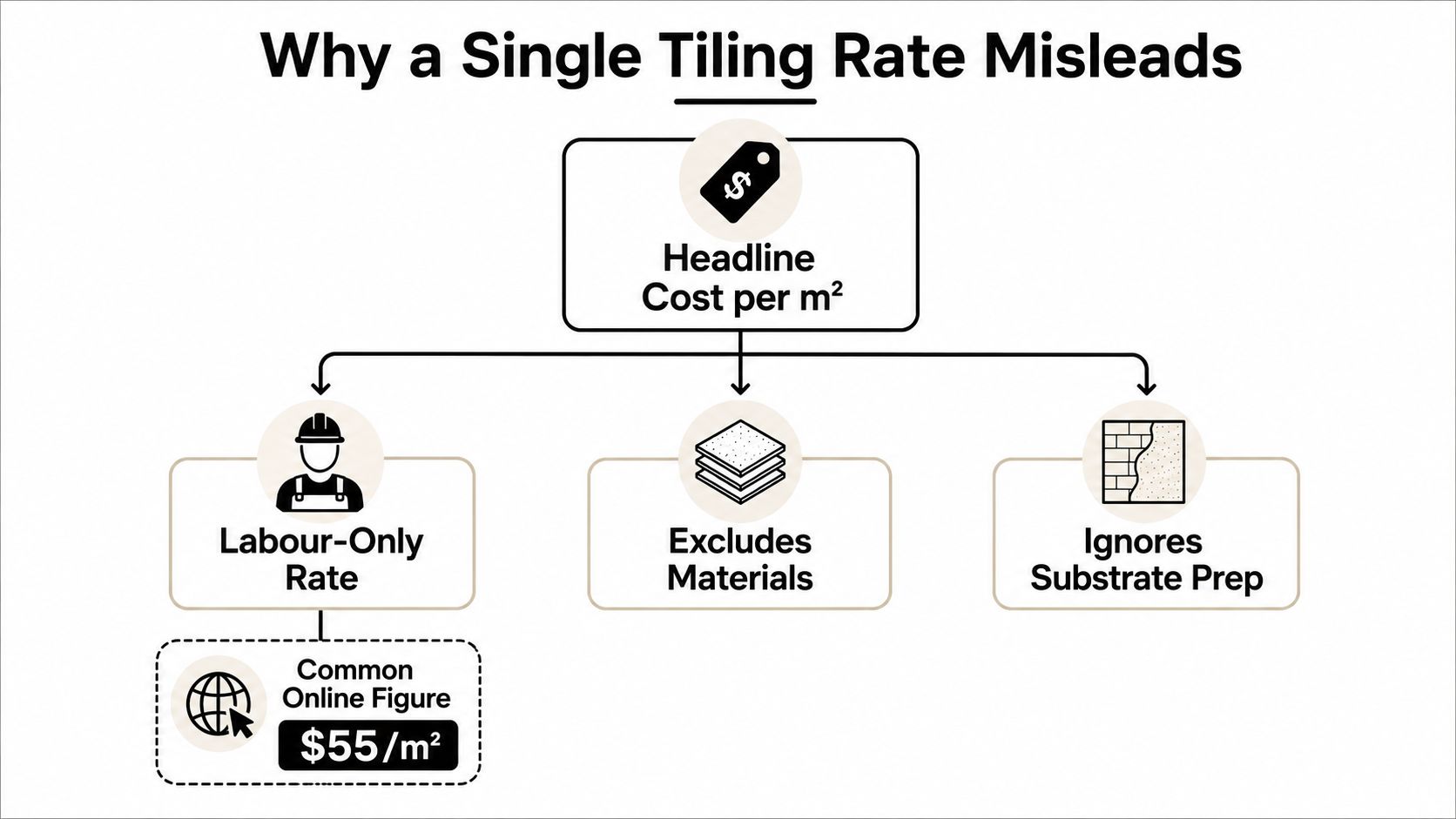
Why a Single Tiling Rate Misleads Most Homeowners

An infographic explaining why a single tiling cost per square meter rate is misleading for customers.

A headline tiling cost per square metre rate sounds tidy, but it hides the budget drivers. In practice, the final figure changes depending on whether the job is a simple straight-set floor, a bathroom wet area, or a renovation that needs levelling, waterproofing, and compliance work.

Labour-only rates are only part of the story

Australian cost guidance puts labour-only straight-set floor tiling at A$45–A$70 per square metre, while more complex patterns rise to A$80–A$120/m² for herringbone or chevron and A$100–A$150/m² for mosaic work (Australian tiling benchmark). That range is useful, but only if you know what it includes.

A cheap quote often looks attractive because it's scoped tightly. It may cover laying tiles on a clean, ready surface, then leave out the things that blow out real bathroom budgets, like membrane work, substrate correction, adhesive, grout, or removal of old finishes.

Practical rule: compare quotes only after you've confirmed whether they're labour-only or fully installed.

Why bathroom quotes shift so much

Bathrooms punish vague quoting. Wet areas bring compliance costs that aren't optional, and that's why a bare floor rate doesn't hold up once the job includes a shower recess, a balcony fall issue, or a cracked slab that needs rectification. The Australian benchmark notes that tile supply can add A$20–A$200/m², and waterproofing under AS 3740 adds another A$20–A$45/m² (Australian tiling benchmark).

That's the trap. A homeowner compares two numbers, picks the lower one, and then discovers that the “cheaper” quote didn't include the work that makes the bathroom watertight or level enough to tile properly.

An infographic comparing the cost factors between standard ceramic tiles and large-format porcelain tile installation projects.

Breaking Down Every Cost Component in a Tiling Quote

A proper quote splits the job into separate line items. That matters because a tile price alone says very little about the installed cost, especially in Melbourne bathrooms where prep and compliance can outweigh the tile itself.

The main items you should expect

The first layer is tile supply. Australian quotation tools commonly place installed pricing around A$35–A$60/m² for budget ceramic, A$50–A$95/m² for mid-range porcelain, and A$65–A$135/m² for large-format tile once labour is included (installed cost benchmark). The tile itself is only part of that number, and the more visually impressive the product, the more carefully the substrate has to be prepared.

Setting materials come next. That includes adhesive and grout, which aren't glamorous, but they're what hold the whole system together. If a quote lumps them into a vague allowance, ask for a breakdown, because cheap materials usually show up later as hollow spots, weak bond strength, or inconsistent joints.

A clean quote names the tile, the prep, the waterproofing, and the labour separately.

What often gets missed

The most common omissions are the ones that are hardest to spot on paper. Surface preparation can add cost because levelling, priming, and substrate correction are usually charged separately (installed cost benchmark). In wet areas, the quote should also include membrane work, because that's not a decorative extra, it's part of making the room compliant and durable.

Here's the practical checklist I use when reading a quote for a bathroom or ensuite:

  • Tile supply: Is the tile price based on budget ceramic, porcelain, or large-format product?
  • Setting materials: Are adhesive and grout included, or treated as extras?
  • Labour: Does the rate assume straight-set work, or a pattern that slows installation?
  • Waterproofing: Is the membrane included for wet areas?
  • Preparation: Does the quote allow for levelling, priming, or repairs?
  • Removal: Are old tiles, adhesive, and waste disposal included?

The difference between a tidy quote and a realistic one often comes down to those details. For a practical Melbourne reference point, see this tile installation cost overview for Melbourne.

How Tile Type and Format Change the Final Price

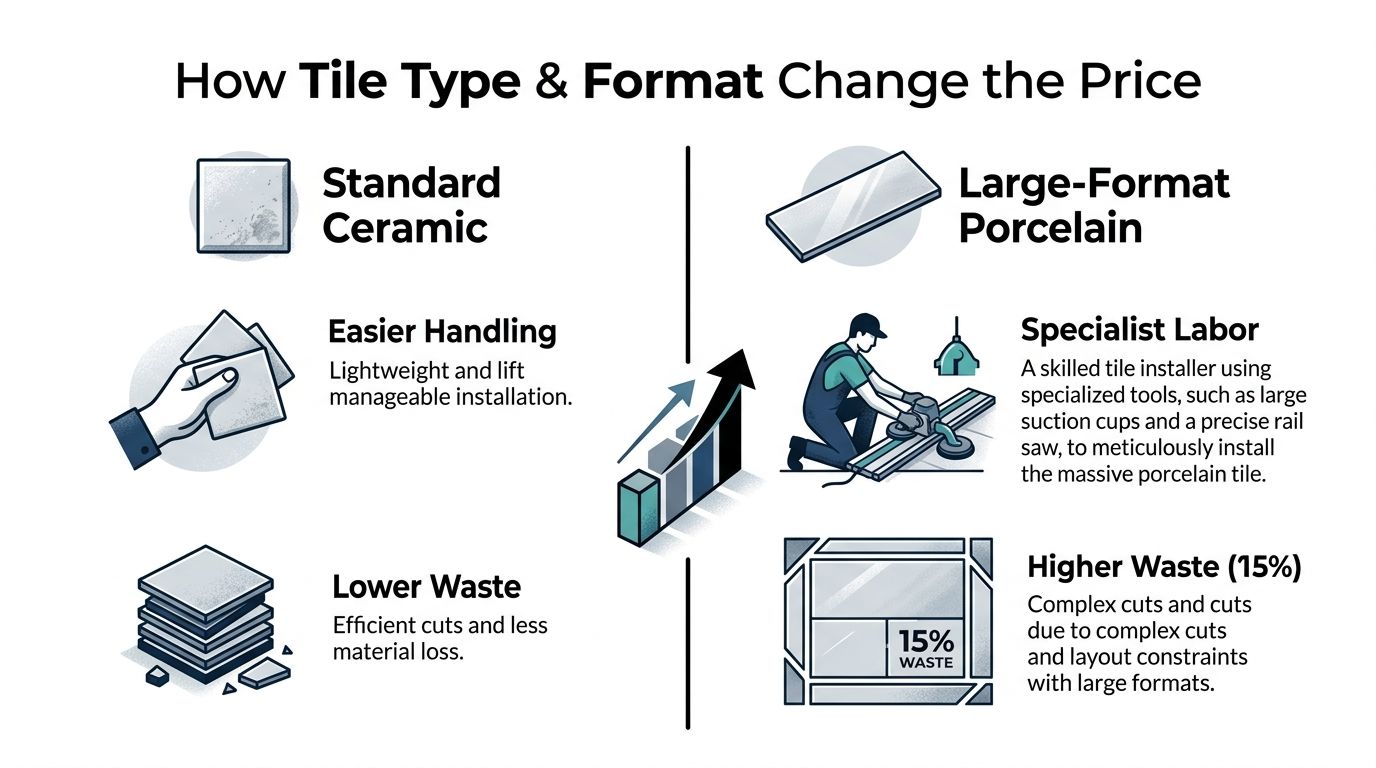
Tile selection changes the budget faster than many expect. The shape, size, and material all affect how long the installer spends on site, how much preparation is needed, and how much waste gets cut off the sheet or the board.

Standard ceramic versus larger formats

Budget ceramic is usually the easiest to install. It's lighter, simpler to handle, and more forgiving of minor substrate imperfections. Mid-range porcelain costs more to supply in many cases, but the bigger budget swing often comes from the labour side, especially if the tile is large enough to demand tighter tolerances and more careful set-out.

Large-format tile is where quotes climb. Bigger tiles need more adhesive coverage, flatter substrates, and slower placement. The result is a more precise finish, but not a quicker one. That's why a straight tile price understates the installed cost unless the quote also includes adhesive, grout, and prep allowances.

Pattern and format matter as much as material

Complex patterns slow work down. Australian labour benchmarks put herringbone and chevron at A$80–A$120/m², while mosaics sit at A$100–A$150/m² (Australian tiling benchmark). Those rates aren't about the tile label on the box alone, they reflect how much more time the pattern takes to set out, cut, and align.

Large-format Kerlite and similar thin panels are popular in high-end Melbourne work because they look crisp and modern, but they reward careful planning rather than optimism. A bad substrate or a rushed layout can turn a premium product into a messy one fast.

The most useful question isn't “What does the tile cost?” It's “How much time will this tile take to install properly?”

For more detail on complex jobs, the large-format tile installation cost guide is the right place to start.

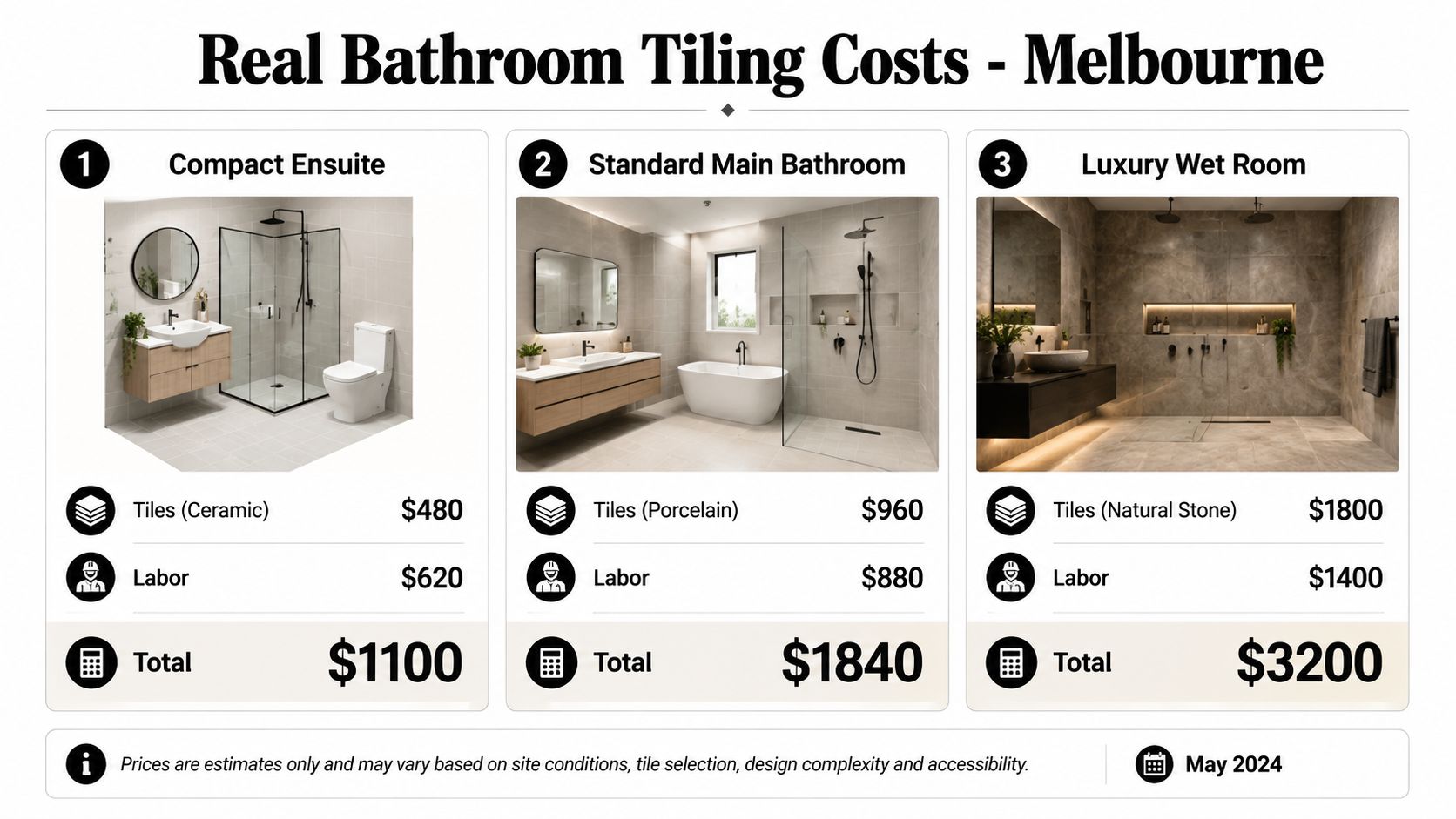
A price breakdown table showing tiling costs in Melbourne for a compact ensuite, standard bathroom, and luxury wet room.

Real Bathroom Tiling Cost Calculations for Melbourne Homes

Bathroom pricing gets clearer when you stop chasing one magic number and start measuring the room properly. The tile rate, waterproofing, prep, and labour each need their own allowance, otherwise you end up with a quote that looks affordable until the extras land.

A compact ensuite can still add up quickly

For a small ensuite, the surface area may be modest, but the fixed components still bite. A labour-only floor rate can look manageable, yet the moment you add supply, waterproofing, and prep, the number moves into a very different band. That's why compact rooms often feel expensive relative to their size, even when they use standard finishes.

A full bathroom tiling job in Australia is estimated at $3,000 per bathroom on the low end, $6,000 per bathroom on average, and $10,000 per bathroom on the high end (Australian bathroom tiling estimate). Those figures are useful because they capture the combined cost of floors and walls, not just one surface.

Use the quote as a calculation tool

Start with the measured floor and wall areas, then add the allowances that apply to the job. If the bathroom includes a shower recess, waterproofing becomes part of the base scope. If the slab or wall substrate is uneven, prep must be included before the first tile goes down.

Budget from the substrate outwards, not from the tile showroom inwards.

A practical way to think about it is this. A mid-range bathroom with porcelain tiles will not price like a dry laundry. A high-end renovation with large-format panels and remediation work will not price like a simple splashback either.

The right budget range is the one that reflects your actual room, not a generic square-metre headline. That's the only way to avoid the classic surprise where the quote is “cheap” until the waterproofing, levelling, and labour are added back in.

Why Registered Builders Matter for Bathroom Renovations

Bathroom work is not just about getting tiles on the wall. In Victoria, compliance matters, and the person managing the job can affect your insurance position, contract structure, and the quality of the coordination across trades.

Registration isn't paperwork, it's risk control

The Victorian Building Authority states that a Domestic Building Contract is required for work over $10,000, and it also distinguishes registered builders from other domestic building practitioners, who must be appropriately registered or licensed for the work they perform (Victorian Building Authority). That matters because bathroom renovations often sit right on the edge where formal contract and builder obligations kick in.

A registered builder is more likely to coordinate the moving parts properly. Bathroom jobs can involve waterproofing, plumbing, electrical work, carpentry, and tiling. If one trade slips or the sequence is wrong, the tile layer ends up building over a problem instead of solving it.

Why that matters in real bathrooms

The risk isn't abstract. A cheap quote from someone outside the right framework can leave you with gaps in insurance cover, unclear responsibility if something fails, and expensive rectification work later. Once a bathroom leaks, the cost of fixing the substrate and rebuilding finishes can swamp whatever looked like a saving at the start.

For waterproofing-focused work, this waterproofing guidance for Melbourne projects is worth reading before you sign anything.

A compliant renovation also tends to be calmer on site. The builder coordinates the sequence, the trades know when they're expected, and the homeowner isn't left trying to manage who comes first, who signs off, and who owns the problem if the room fails inspection or starts leaking.

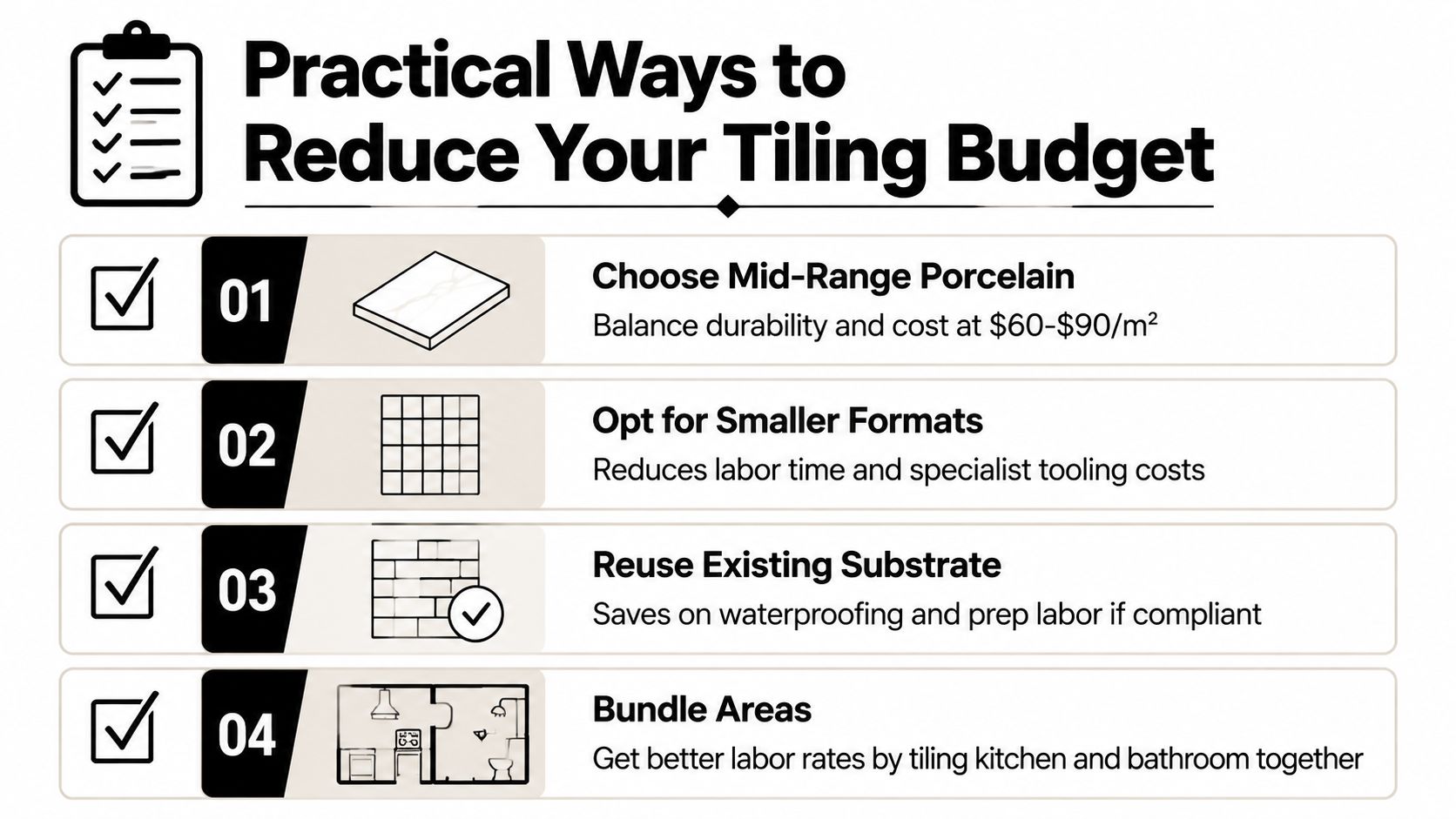
Practical Ways to Reduce Your Tiling Budget

Cutting tiling costs doesn't mean cutting corners. The best savings come from simplifying decisions that add labour, not from buying the cheapest product in the showroom and hoping the rest works itself out.

Spend where it protects the room

Mid-range porcelain is often a sensible choice for busy floors, because it balances durability and cost better than chasing premium natural stone everywhere. Complex patterns also add cost quickly, so a straight layout usually makes more sense in secondary spaces where the design brief doesn't demand a feature floor.

Reuse of an existing substrate can help too, but only if it's structurally sound and compliant. If the floor or wall already needs correction, pretending otherwise is a false economy. Saving a little on prep rarely survives the first sign of movement or moisture.

Ask sharper questions before you sign

A quote should tell you more than the price. If it doesn't, you're comparing numbers without context.

  • Registration: Is the contractor a registered builder or appropriately licensed for the scope?
  • Insurance: What cover is in place for the project?
  • Inclusions: Do waterproofing, levelling, adhesive, grout, and removal of old tiles appear on the quote?
  • Warranty: What's covered if a tile lifts or a membrane fails?
  • Timing: How long will the project take, and what trades are involved?

The cheapest quote is often the one that leaves out the most.

One more thing. Bundling work can sometimes make sense when the same substrate, waterproofing, or labour setup applies across areas. It's not always cheaper, but it's often cleaner and easier to manage than splitting a small job into multiple visits.

A four-point infographic guide displaying practical strategies to lower costs for home tiling projects.

How Melbourne Tiling Services P/L Delivers Transparent Pricing

Opaque quotes create most of the frustration around tiling costs. A transparent process fixes that by showing the scope, the materials, and the compliance work before anyone starts on site.

What a clear quoting process should look like

Melbourne Tiling Services P/L has been operating since 2003, works from Highett, VIC, and offers start-to-finish bathroom and ensuite renovations with free quotes, 3D bathroom drawings, and a transparent renovation calculator. The company is described as Registered Unlimited Builders, and it coordinates licensed carpenters, plumbers, electricians, tilers, and waterproofers.

That combination matters because it makes the pricing legible. Instead of guessing whether the quote includes waterproofing, levelling, or premium finishes, the homeowner can see where the money is going and what the scope covers.

Why transparency solves the real budgeting problem

The best renovation process doesn't just produce a nicer bathroom. It removes the hidden-cost problem that makes comparison shopping so frustrating. If the quote is itemised, the homeowner can tell whether a higher number reflects better materials, more preparation, or a more honest scope.

Melbourne Tiling Services P/L also works with large-format Kerlite installations, leak rectification for showers and balconies, and premium marble and porcelain finishes. That mix matters for complex projects because those jobs usually need more than a tile setter, they need proper coordination from the start.

If you're budgeting a bathroom or ensuite and want a quote that shows the full cost rather than a stripped-back headline number, visit Melbourne Tiling Services P/L to organise a free quote and plan the work with proper scope, proper compliance, and no guesswork.