
A balcony leak can be a local repair, or it can involve damage hidden beneath the tiles. Minor joint and drainage work may cost a few hundred dollars, while a full strip, screed, membrane and retile often runs into the mid thousands. Concealed damage can also require several trades, pushing the job well beyond a simple reseal.
The scope matters more than the visible stain. A leak at a joint or outlet may be localised if the membrane still holds and water drains correctly. If water has reached the slab or a room below, the repair may involve more than the balcony finish.
Cracked grout is not a waterproofing failure you can fix by sealing the surface. Grout is a finish, not a waterproofing system. Sealing it does not repair a failed membrane, and moisture can remain trapped beneath the tiles while the leak continues.
Table of Contents
- Melbourne Costs to Repair a Leaking Balcony
- Why a Small Leak Becomes Structural Damage
- Waterproofing Systems That Actually Stop the Leak
- What Changes the Price on a Melbourne Balcony
- How Long Each Repair Takes in Practice
- Bathroom Renovations That Share the Same Water Rules
- Choose a Registered Builder Before You Sign
Melbourne Costs to Repair a Leaking Balcony
Start with the row that matches your symptom, not the price you'd prefer. A failed joint, blocked outlet or tired door threshold seal is a localised leak only if the membrane still bonds and the surface still drains. Ponding, drummy tiles across a wide area, rust stains under the slab or water in a room below points to a concealed defect, and concealed defects don't price like reseals.
2026 Melbourne indicative costs by balcony repair scope
| Repair scope | Indicative cost |
|---|---|
| Sealant, joints and outlet tidy | A few hundred to about $1,500 |
| Localised membrane repair | About $1,500 to $4,500 |
| Full strip, screed, membrane and retile (about 8 to 15 m2) | About $6,000 to $15,000 |
| Concealed multi-trade rectification | AUD 23,895 national average |
| Structural concrete and reinforcement | $15,000 to $40,000+ per balcony |
| Building-level water damage | $1 million to $5 million |
| Access add-ons (scaffold, hoist, balustrade removal) | $1,500 to $8,000 extra |
The concealed multi-trade figure in that table is an Australian national average, not a Melbourne price for a simple job. Use it to understand escalation, not to budget a reseal.
Read the Bands the Right Way
The $1,500 to $4,500 localised band only works for a defined failed patch on a balcony that already falls to its outlet. If the patch keeps growing during demolition, you're no longer in that row. The $6,000 to $15,000 full strip band covers removing tiles and bedding, rebuilding falls in a screed, installing a new external membrane and retiling an 8 to 15 square metre apartment balcony.
Premium stone, large-format porcelain, a thick old mortar bed or awkward access pushes you toward the top of that band. Spalling concrete, rusted reinforcement or loose balustrade fixings moves the cost to repair a leaking balcony into structural territory, because the builder has to repair the substrate before anyone waterproofs it. Get the scope wrong and the cheapest quote is just the first instalment.
Practical rule: If water sits on the balcony 30 minutes after rain, don't buy a sealant-only fix. Standing water means the fall, the outlet or both need correcting.
Australian external waterproofing provisions in the Western Australian guidance on waterproofing external above-ground building elements reference AS 4654 Parts 1 and 2 for balconies, covering membrane design, installation, junctions, penetrations, door thresholds and drainage. That guidance states finished surfaces must drain to outlets, with falls generally no flatter than 1:100, formed in the substrate or a screed. It also cites the Australian industry average rectification cost of AUD 23,895 per balcony or podium water defect.
A flat balcony holds water against membrane laps and wall and door junctions. That sustained pressure accelerates debonding, so a durable repair corrects water movement instead of painting over cracked grout. Rectification can mean removing tiles and screed, rebuilding falls, detailing upturns and penetrations, water testing, then reinstating compatible finishes.
What a Usable Quote Names
Reject a single lump sum that says "waterproof and retile" and nothing else. A usable quote names the proposed fall, the membrane system, termination details at walls and doors, the testing method, the demolition allowance and whether balustrades or scaffolding come off. If those lines aren't there, you can't compare two prices, because one builder may have allowed for a new screed and flood test while the other plans to tile over what's already failed.
Why a Small Leak Becomes Structural Damage
Think of a balcony as a shallow tray tipped toward an outlet. Tiles sit in the tray, the membrane lines it, and the walls and door threshold form its raised edges. If the tray is flat or tips the wrong way, water doesn't leave. It sits on membrane laps, creeps at wall upturns and gathers at the door until it finds a crack, a poorly sealed penetration or a failed joint into the slab.
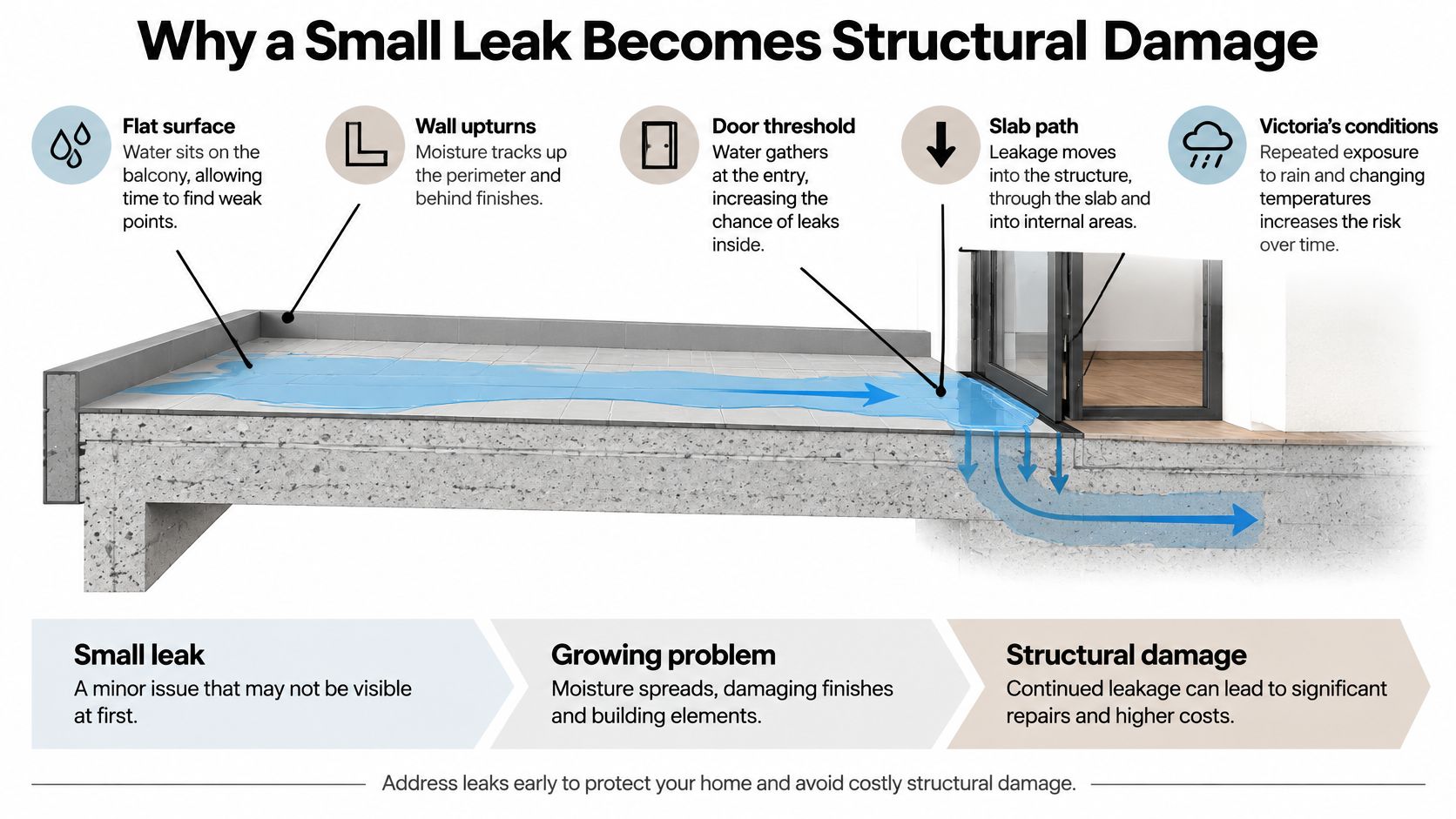
Once water reaches concrete and steel reinforcement, the problem changes category. Steel rusts and expands, concrete cracks and spalls, and balustrade fixings corrode at their bases. You end up repairing structure, not just stopping a leak.
Victoria's Numbers Show a Pattern
The Victorian Government's Research Analysis of Non-cladding Building Defects found that in a 2023 analysis of buildings supported through the Victorian Cladding Rectification Program, 168 of 339 funded buildings, 50%, had non-cladding defects. Within that group, 84 buildings, 25% of all funded buildings, had leaking balconies, balustrades or terraces causing structural damage. The same research identified more than 550 defective balconies left unaddressed by owners and found defective balconies represented approximately 38% of the total construction-contract value in the relevant rectification works.
Among affected buildings, 52% had balcony defects caused by water ingress, while 19% had insufficient or missing waterproofing as the primary cause. Many low-rise buildings with water-ingress problems required between $1 million and $5 million to rectify at building level. That's the gap between fixing one membrane early and funding a multi-apartment remediation later.
Delay doesn't keep a balcony defect private. Once water crosses into another lot or common property, you lose control of timing, scope and who pays for access.
Signs That Separate the Two Jobs
A stained soffit below, one drummy tile near the outlet or a cracked perimeter joint can still be localised. Spalling concrete, exposed or rust-streaked steel, a soft balustrade post and leaks into the apartment below point deeper. Professional balcony leak detection uses moisture readings, water testing and selective opening up to place your balcony in the right category before demolition commits you.
Before you spend anything, answer three questions in writing.
- Where does water appear: Note the exact room, wall or soffit and photograph it after rain.
- Does the surface pond: Check for puddles that survive after the outlet is cleared.
- Who owns the element: Confirm whether the balcony structure, membrane and tiles are private lot property or common property, because that decides approvals and cost sharing.
Early investigation is cheaper than certainty bought through damage. Get those answers first.
Waterproofing Systems That Actually Stop the Leak
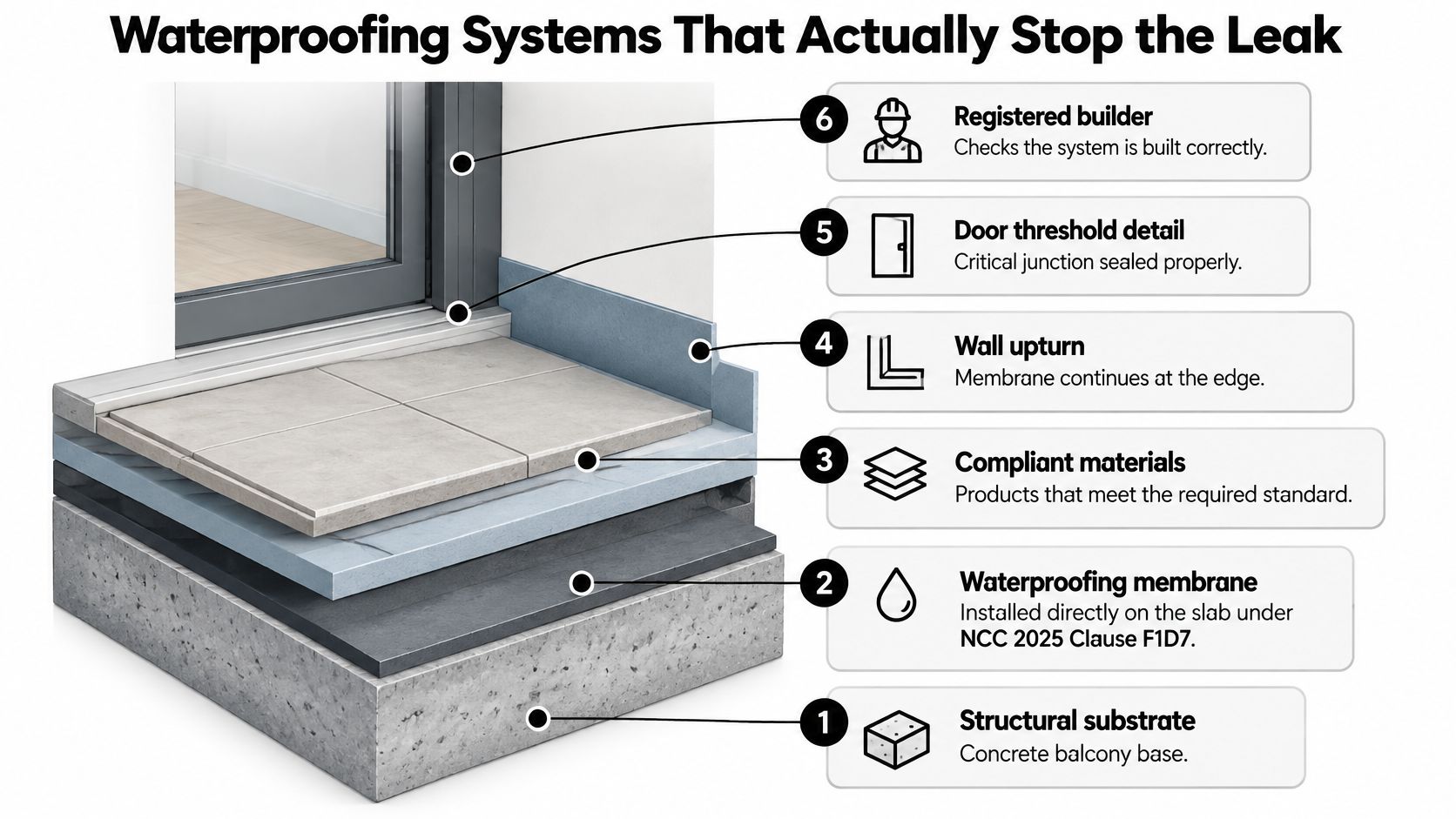
Build a balcony repair from the slab upward, not from the tile catalogue down. The Australian Building Codes Board's NCC water management guidance states that under NCC 2025 Clause F1D7, a waterproofing membrane on a concrete balcony must be installed directly on the structural substrate. It must comply with AS 4654.1 for materials and be designed and installed in accordance with AS 4654.2. A new tile finish over a dirty, saturated or flat surface doesn't recreate that system.
The Layer Stack in Order
The sequence matters because each layer protects the one under it. The contractor removes failed finishes and bedding, repairs the concrete, forms falls in the structure or a bonded screed, then applies a sheet or liquid balcony waterproofing membrane with upturns at walls and door thresholds. Penetrations for balustrade posts, outlets and pipes get sealed as part of the membrane detailing, not with a bead of silicone at handover.
After the membrane cures, the builder flood tests or controlled water tests it before tiling hides it. Only then does the tiler reinstate a compatible finish using adhesive and movement joints that don't puncture or stress the membrane. Ask which layer is being replaced, not only which tile is coming back.
Balcony repair options and what each one fixes
| Option | What is replaced | Use it when | It does not fix |
|---|---|---|---|
| Sealant and drainage tidy | Joints, outlets, threshold seals | Membrane and falls are sound | A failed or missing membrane |
| Localised membrane repair | A defined failed patch and its laps | Damage is small and the balcony still drains | A flat slab or widespread debonding |
| Screed, membrane and retile | Falls, full membrane, finishes | Ponding or failed sheet or liquid membrane | Rusted reinforcement or spalled concrete |
| Structural remediation | Concrete, steel, then the waterproofing system | Spalling, exposed steel or unsafe fixings | A cosmetic stain with no substrate damage |
Choose by Failure, Not by Product
Sealant suits an intact membrane with tired joints. A local membrane repair suits a defined debonded patch where surrounding membrane still tests sound. Full screed and membrane work is the answer for ponding or widespread debonding, because patching a flat balcony leaves water sitting on your new work.
Structural remediation comes first when steel is rusting or concrete is spalling. A membrane can't bridge unsafe concrete, and tiling over it hides ongoing corrosion. Where an existing building's constraints make the Deemed-to-Satisfy balcony provisions impracticable, compliance may be shown through a Performance Solution that still demonstrates the building and occupants are protected from adverse effects of water. Insist on seeing that documented, not just hearing that it's "close enough".
What Changes the Price on a Melbourne Balcony
Access moves price more often than area does. A ground-floor courtyard balcony lets workers barrow demolition waste straight to a skip. A third-storey balcony in a tight South Yarra block may need a scaffold, a materials hoist and protection through common areas before a single tile comes up.
Removing a glass balustrade to turn the membrane up the edge adds glazier time, temporary safety barriers and refixing. If your quote doesn't mention the balustrade, ask how the membrane terminates at the edge. That junction is where cheap scopes often fall apart.
Falls Are the Hidden Line Item
Screed depth rises when the slab is flat and the door threshold leaves little height to build a compliant fall. The builder may need to grind high spots, adjust the outlet, or rework the threshold detail so the new finished level doesn't breach the door. Sliding door tracks, hob walls, planter boxes and tap penetrations each add membrane corners and labour.
Those details explain why two balconies of the same size price differently. A plain rectangle with one outlet is a weekend of membrane detailing. An L-shaped terrace with planters, two doors and post penetrations every metre is not.
Finishes, Demolition and Body Corporate Rules
Terracotta on a thick mortar bed takes longer to jackhammer out than thin porcelain on adhesive, and it fills more skip volume. Large-format porcelain or stone costs more to reinstate without lippage and needs tighter substrate tolerances. For a reference point when testing a low price, one 2024 Australian quoted balcony waterproofing project priced removing terracotta tiles and bedding, waterproofing and retiling approximately 10.5 m² at $4,000.
Treat a 2026 Melbourne quote near that figure for a similar scope as a prompt to ask what's missing. Owners corporation rules can also require an engineer, a common property vote and restricted working hours, which lengthen the program even when you pay for one balcony. Before comparing totals, work through how much it costs to waterproof a balcony and make each builder separate demolition, substrate repair, screed, membrane, tiling, access and making good.
A written breakdown stops a low lump sum hiding a missing fall or water test. If a line is absent, assume it isn't included.
How Long Each Repair Takes in Practice
Curing time, not tiling speed, sets most balcony programs. Membranes and screeds need dry weather and manufacturer cure periods, and tiling over a green screed or uncured membrane is how new work fails early. Apartment access rules, lift bookings and wet winter weeks in Melbourne sit between every stage.
Typical balcony repair timelines
| Job | On-site time | What sets the clock |
|---|---|---|
| Sealant and drainage tidy | 1–3 days | Dry weather and access |
| Local membrane repair | 3–7 days | Substrate drying and membrane cure |
| Full screed, membrane and retile | 1–3 weeks | Screed cure, membrane cure and water test |
| Structural repair then waterproofing | Several weeks to months | Engineer, concrete cure and balustrade refit |
A Sound Balcony That Ponds
Say a Highett apartment has a 10 square metre tiled balcony with water pooling at the sliding door, but the concrete underneath is sound. The program runs protection and demolition in the first days, substrate preparation and a new screed fall next, then the external membrane with wall upturns and a door threshold detail. After cure and a clear water test, the tiler reinstates porcelain and grout.
Allow about two weeks of site work for that sequence, plus lead time for tiles, membrane and any balustrade parts. Rain during the membrane window can add days, because a damp substrate won't take the system properly. Book around curing and a passed test, not around the day the last tile goes down.
A Balcony With Rust Under the Slab
Contrast that with rust stains on the soffit below and a balustrade post you can wobble by hand. Stop at investigation. An engineer needs to assess concrete and reinforcement, specify the repair and confirm the balcony is safe to use before anyone talks about tiles.
If a contractor wants to waterproof over spalling concrete to save a week, you're paying to conceal corrosion, not stop it.
Structural work then runs in its own sequence. The repairer breaks out unsound concrete, treats or supplements steel, reinstates repair mortar and lets it cure before the waterproofing system goes on. Balustrade removal and refixing bookend the job, and owners corporation approval can add weeks before site work starts.
That's why structural jobs stretch from weeks into months. The waterproofing follows the concrete repair rather than leading it, and any program that reverses that order is a warning sign. Ask for the program by stage, with cure and test days shown, so you can see where weather and approvals sit.
Bathroom Renovations That Share the Same Water Rules
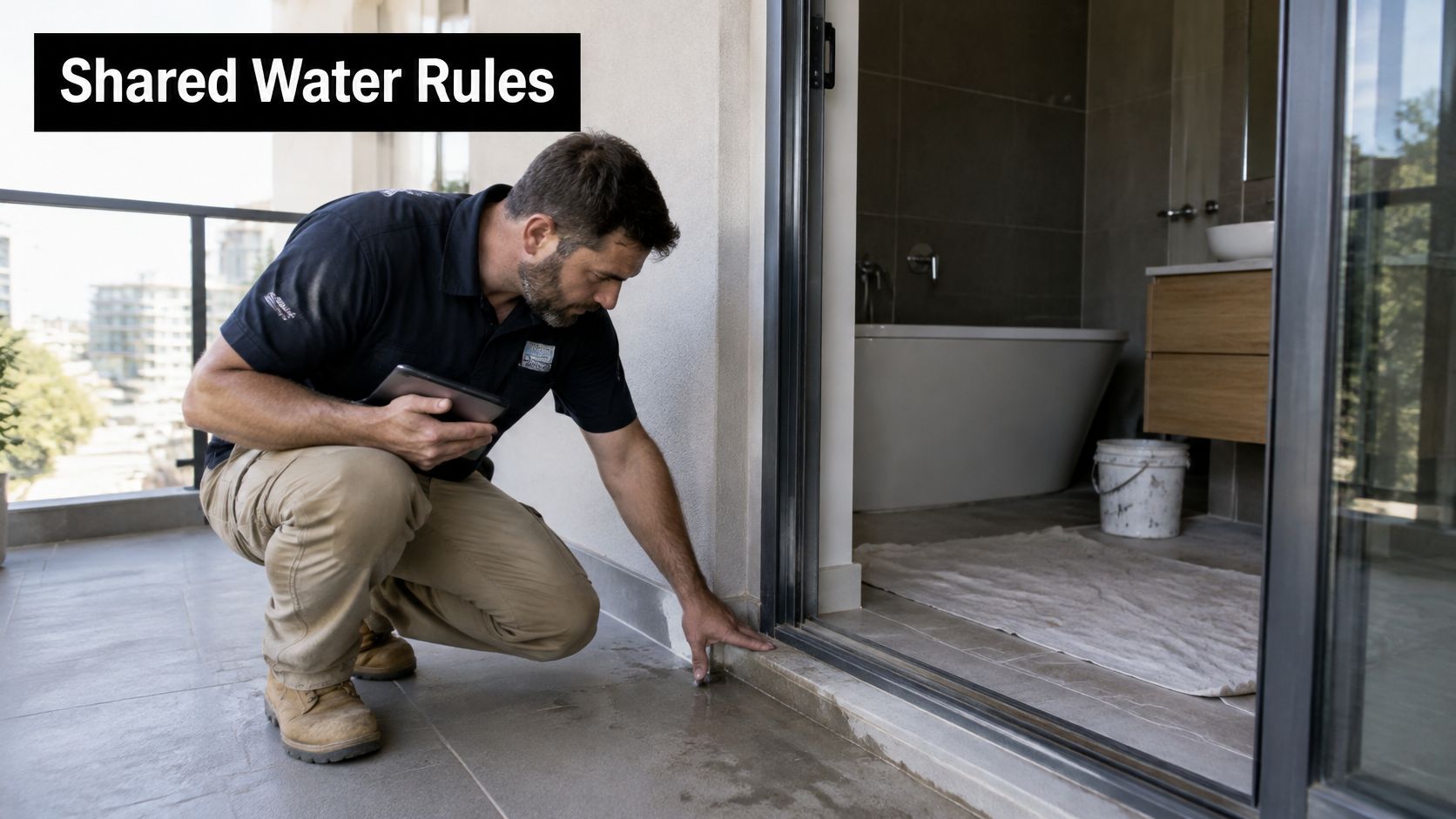
Water at a sliding door doesn't announce which side failed. It can come from the external balcony membrane, from a bathroom or ensuite on the other side of the wall, or from both systems meeting badly at the threshold. That's when the same water rules pull bathroom renovations into a balcony job.
Different Standards, One Doorway
The National Construction Code's wet area waterproofing provisions require building elements in wet areas to be protected by a waterproofing system. In a shower with a hob, step-down or level threshold, the shower floor, including the hob or step-down, must be waterproof, and shower walls must be waterproof to at least 1,800 mm above the floor substrate. Wall junctions, wall-to-floor junctions and penetrations within the shower must also be waterproof.
The NCC distinguishes waterproof from water-resistant surfaces, so treatment depends on the fixture, substrate and location. A bathroom renovation is therefore more than new tiles, because a failed membrane can wet framing, substrates and adjoining rooms. Don't let one liquid membrane specification cover both sides of the door. Internal wet areas and external balconies run to different standards and different detailing.
This walkthrough of wet area construction shows why the membrane and junction work happens before tiles ever reach the wall.
Split the Quote at the Threshold
For an ensuite opening onto a leaking balcony, make the quote split the two systems. Internal lines should name membrane preparation, junction treatment, penetrations and inspection, plus the shower waterproofing height. External lines should name the balcony membrane on the structural substrate, falls, upturns and water test as their own scope.
If you're already stripping the bathroom, coordinate screeding, waterproofing and tiling in one program. That avoids cutting into a new internal membrane six months later to chase a balcony leak. It also lets one team set floor levels and the threshold detail once, instead of two trades blaming each other at the door.
Demand four bathroom lines before you sign.
- Shower waterproof height: Shown against the 1,800 mm requirement.
- Junction treatment: Wall-to-floor and wall-to-wall junctions named, not assumed.
- Penetrations: Mixers, wastes and screen fixings listed.
- Separate balcony scope: External membrane priced apart from internal wet area work.
Choose a Registered Builder Before You Sign
Registration is a price filter, because a low quote from someone who can't legally carry the full scope isn't a saving. Consumer Affairs Victoria's guide to builders, tradespeople and other building practitioners states a practitioner must be registered with the Building and Plumbing Commission for work worth more than $10,000. It lists exemptions for work involving only certain categories, including wall and floor tiling, electrical work, plumbing, glazing and painting.
That exemption doesn't remove the registration requirement when a project includes broader building work or multiple scopes outside a single exempt category. Demolition, structural repair, screeding, waterproofing and reinstatement, or a bathroom renovation spanning several trades, is broader building work. Consumer Affairs Victoria also advises checking a builder is registered and authorised for the work in a major domestic building contract, because if the builder isn't properly registered, you can't obtain Home Warranty insurance.
A Six Step Check Before Price
Work through this order. Don't start at step six.
- Confirm the scope: Balcony only, bathroom only, or both on one program, with the threshold detail assigned to one party.
- Verify registration: Check the builder directly with the Building and Plumbing Commission and confirm the authorisation covers the described work, so you're dealing with a properly registered builder, not a single-trade exemption stretched too far.
- Name the coordinator: Confirm who engages and supervises carpenters, plumbers, electricians, waterproofers and tilers under that registration.
- Ask about permits: Structural, balustrade and balcony edge work may need a building permit, so confirm with council or a registered building surveyor.
- Clear common property: Get owners corporation approval in writing and confirm who holds insurance for shared areas and access routes.
- Compare like for like: Price two or three quotes built from the same separated line items, fall, membrane, test and access included.
Decision test: If a builder can't show registration for the full scope, stop comparing their price. The risk you're accepting isn't priced into their number.
A tiler working alone can be the right hire for tiling only. A combined balcony and bathroom rectification needs one registered builder accountable for the sequence, the membranes and the warranty. That's the hire that keeps a leak repair from becoming a dispute about whose trade caused it.
If your balcony ponds at the door, leaks into the room below or needs a full strip, screed, membrane and retile priced by scope rather than guesswork, talk to Melbourne Tiling Services P/L for a free quote on balcony leak rectification across Melbourne. As Registered Unlimited Builders, the team coordinates waterproofing, screeding, tiling and bathroom renovation work in one program, so the balcony and wet area on either side of your threshold get fixed together.
Recent Comments