
A standard frameless shower screen for a straightforward Melbourne ensuite is commonly AUD 1,200–2,500 supplied and installed. That band is a planning benchmark for a typical rectangular opening, while some national estimates reach AUD 2,800 and curved or highly customised screens can sit well above it.
The figure that should reset the budget conversation is not the hinge finish. A frameless panel is one line in a wet-area job. Glass compliance, the condition of the waterproofing, and Victorian contract thresholds move the total further than a swap from chrome to matte black. A screen-only price and a full bathroom renovation are different contracts, and only the larger job reliably pulls in registered builders, coordinated trades and the paperwork that goes with them.
Table of Contents
- Frameless Shower Screen Prices at a Glance
- What Pushes the Installed Price Up or Down
- Glass Thickness and Safety Rules That Set the Spec
- Quote Checklist and Hidden Wet-Area Costs
- Victorian Thresholds That Change Your Budget
- Confirm Your Scope and Budget Before You Sign
Frameless Shower Screen Prices at a Glance
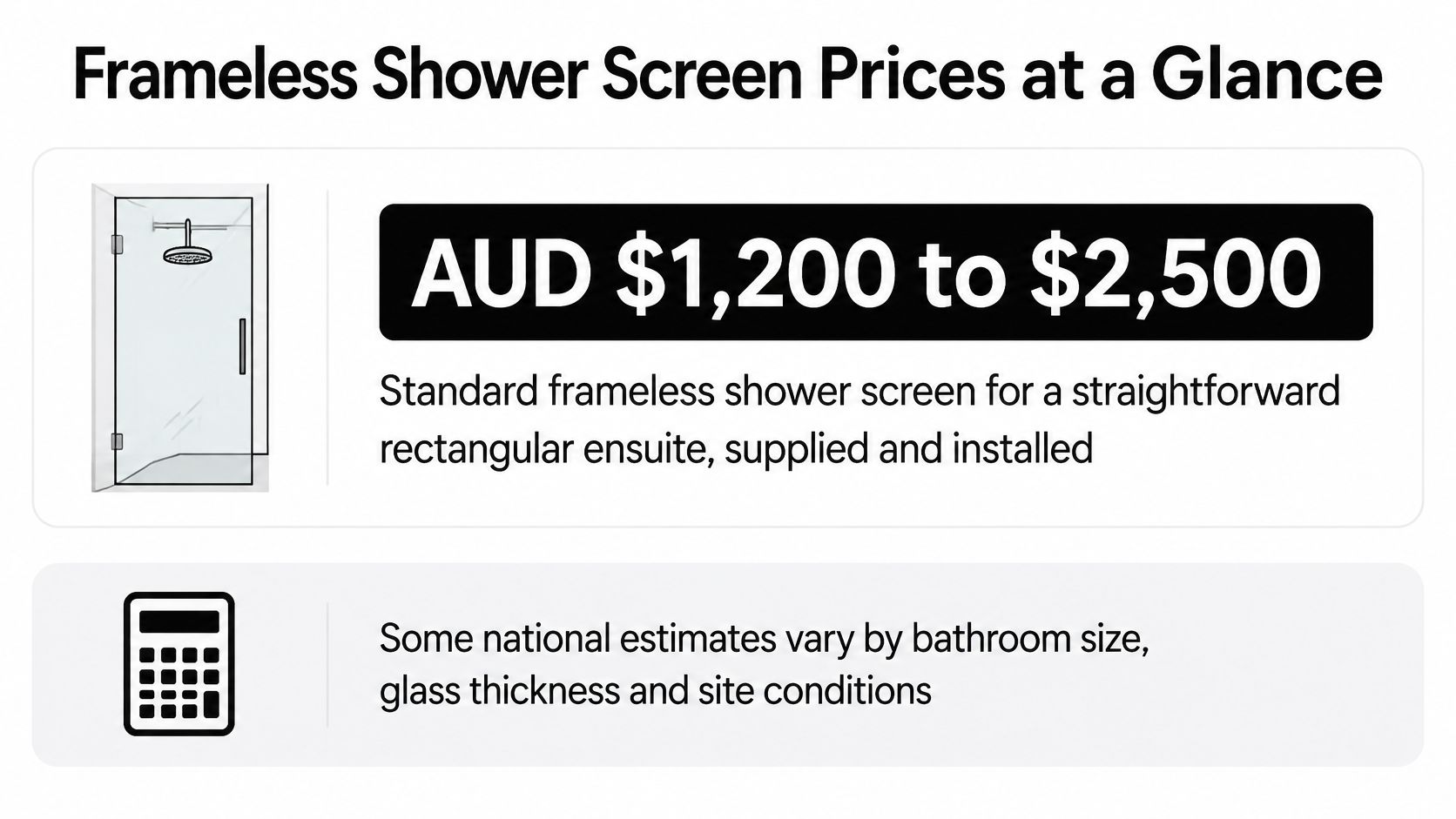
A standard frameless shower screen for a straightforward rectangular ensuite is commonly priced at AUD 1,200–2,500 supplied and installed, and some national estimates reach AUD 2,800, according to Australian shower screen cost guidance. Framed or semi-frameless screens are commonly estimated at about AUD 500–900 installed, so the frameless step-up is large before anyone debates hardware colour.
| Screen type | Typical installed price | What the figure reflects |
|---|---|---|
| Standard frameless, rectangular ensuite | AUD 1,200–2,500 | Benchmark for a straightforward Melbourne ensuite |
| Frameless, upper national estimate | Up to AUD 2,800 | Some national estimates extend to this figure |
| Framed or semi-frameless | AUD 500–900 | Commonly estimated installed price |
These are supplied-and-installed benchmarks, not a rate per square metre. A single-panel opening with easy access sits nearer the lower end. Multi-panel layouts and difficult access sit higher. On the same guidance, curved, oversized or highly customised screens can exceed AUD 3,500.
Custom or non-rectangular openings need a site measure and an individual quote. Out-of-square walls change templating even when two bathrooms look the same on a sketch.
The screen is usually one line inside a wider bathroom renovation. A full bathroom renovation scope we list is offered for a median price of $10,000, which already shows the glass can be a fraction of the wet-area total once waterproofing, tiling and fittings are in the job.
Practical rule: If a frameless quote falls far below AUD 1,200, check what is excluded before you accept it. Older published component prices run lower and often leave out substrate, waterproofing and compliance items.
Removal of an existing screen, disposal, silicone finishing, waterproofing repairs and GST can each change the installed cost. While you compare finishes, it helps to explore architectural shower fixtures so the screen, tapware and waste read as one wet-area design rather than three separate purchases.
What Pushes the Installed Price Up or Down
A quote is a bundle of glass, hardware, templating, delivery and labour. Read it as a stack of lines, not as a single product price.
Drivers in order of impact
Heavier 10 mm toughened glass comes first. It costs more to make, carry and set, and every hinge and clamp has to be rated for that weight. Our shower screens are custom or frameless, high quality, Australian made and certified, so the hardware has to match the panel, not the other way around. How frameless shower screen hinges are fixed matters more than the colour of the cover plate.
Custom measurement for out-of-square openings is next. Many Melbourne ensuites, especially in older houses, are not square. The extra cost is templating and adjustment, not a prettier bracket.
Premium hinges and brackets follow glass and measure. Finish changes the look. Capacity and anchor type change whether the panel stays true after a year of use.
Corner or multi-panel layouts add another sheet, another joint and another alignment. Difficult access in a tight ensuite or an upper-floor bathroom adds handling time for the same glass. Stairs, small landings and a shower tucked beside a vanity all slow the set.
What older component prices still show
Earlier Australian pricing published by hipages split supply from installation. Treat the table as a way to see that split, not as a current Melbourne quote.
| Screen type | Supplied price | Installation | Combined |
|---|---|---|---|
| Two-panel frameless screen | AUD 410 | AUD 195 | AUD 605 |
| Rectangular frameless screen | AUD 550 | About AUD 195 | About AUD 745 |
| Three-panel sliding frameless system | AUD 690 | AUD 400 | AUD 1,090 |
Installation rises with panel count because each panel needs its own fixing and alignment. The two-panel and rectangular jobs were listed near AUD 195 to install. The three-panel sliding system was listed at AUD 400.
A three-panel sliding system at about AUD 1,090 combined is the glass and the hang, before anyone removes an old screen or repairs waterproofing. Add those and the old component total is no longer the job.
Our shower screen, fittings and appliance work includes installing the shower screen, plumbing and electrical fittings, cabinets, baths and mirrors. That is why a screen-only number and a fittings package should not be compared as if they were the same line.
Glass Thickness and Safety Rules That Set the Spec
Safety compliance sets the spec, and the spec sets a large part of the frameless shower screen installation cost. Australian shower-screen glazing must use Grade A safety glass compliant with AS/NZS 2208, while AS 1288 governs selection and installation in buildings. As Quote Yard's shower screen guidance notes, that applies to frameless, semi-frameless, fixed-panel and framed enclosures, with no general exemption for small or fixed panels.
People often assume a frameless screen is a framed screen with the aluminium taken off, so a thinner sheet should do. The standards don't work that way. Frameless systems commonly use 10 mm toughened glass, and Australian building guidance identifies 10 mm as the minimum thickness for frameless screens, compared with 5–6 mm for fully or partly framed systems.
| Case | Glass thickness cited | Standards that apply |
|---|---|---|
| Frameless toughened screen | 10 mm, the common minimum in Australian building guidance | AS/NZS 2208 and AS 1288 |
| Frameless application under one NSW guidance | At least 6 mm toughened glass | AS/NZS 2208 and AS 1288 |
| Exposed-edge panel | Minimum 6 mm nominal toughened safety glass | AS 1288-related guidance |
| Fully or partly framed system | 5–6 mm | AS/NZS 2208 and AS 1288 |
Where the thickness advice splits
One line of guidance treats 10 mm as the frameless minimum. Another, including cited NSW guidance, puts frameless applications and exposed-edge panels at a minimum of 6 mm toughened safety glass. Both still sit under AS/NZS 2208 and AS 1288. The practical step is to ask the installer which thickness this opening needs, and why that thickness is on the quote. Frameless shower screen regulations are the right checklist for that conversation, not a showroom photo.
Thicker glass adds weight. Weight demands compatible hinges, clamps, anchors and wall support. Inadequate substrate strength, poor alignment or too much movement transfers stress into the glass or the hardware.
Cheaper-looking hardware doesn't save money if it is under-rated for the panel. Unsafe loading shows up later as a replacement, not as a discount on day one.
A practical Melbourne quote should verify glass certification, thickness, hardware capacity, fixing locations, and whether waterproofing remains intact. The screen is not a substitute for a compliant waterproofed base or wall. On the certificate, check the Grade A mark, the stated thickness, and that the hardware schedule matches the weight of that sheet.
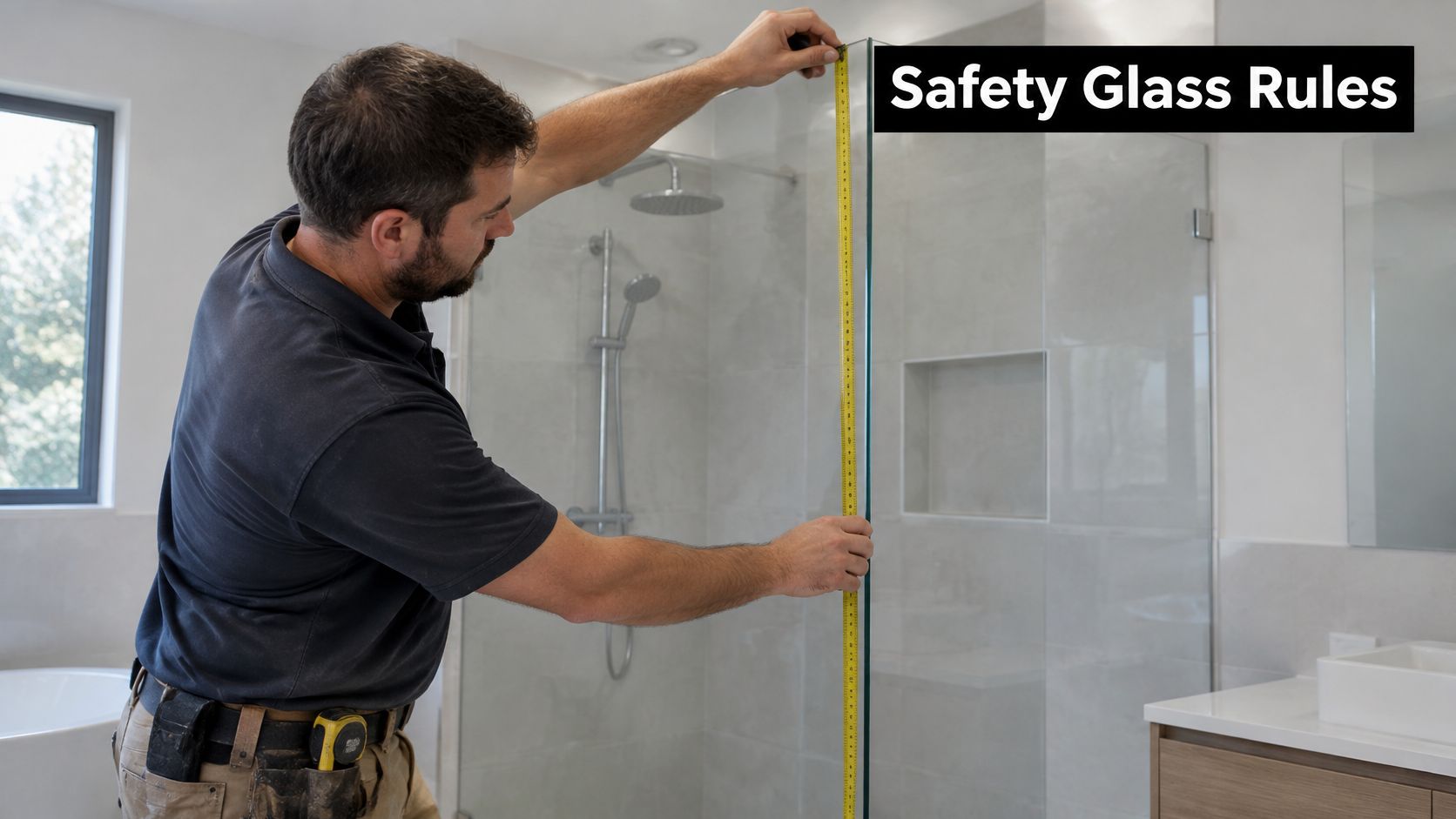
The measuring step in the clip below is the part quotes often compress into a single labour line. Templating errors can't be trimmed out after the glass is toughened.
Quote Checklist and Hidden Wet-Area Costs
Two quotes can carry the same headline figure and still be different jobs. The difference sits in what is left out: substrate repairs, damaged tiles, silicone removal, or existing glazing that cannot stay. Match those lines before you compare the totals. The screen is only one line in a wet-area budget. Documented glass compliance, the condition of the waterproofing, and whether the job stays a screen swap or turns into a coordinated bathroom package move the total further than the hinge finish.
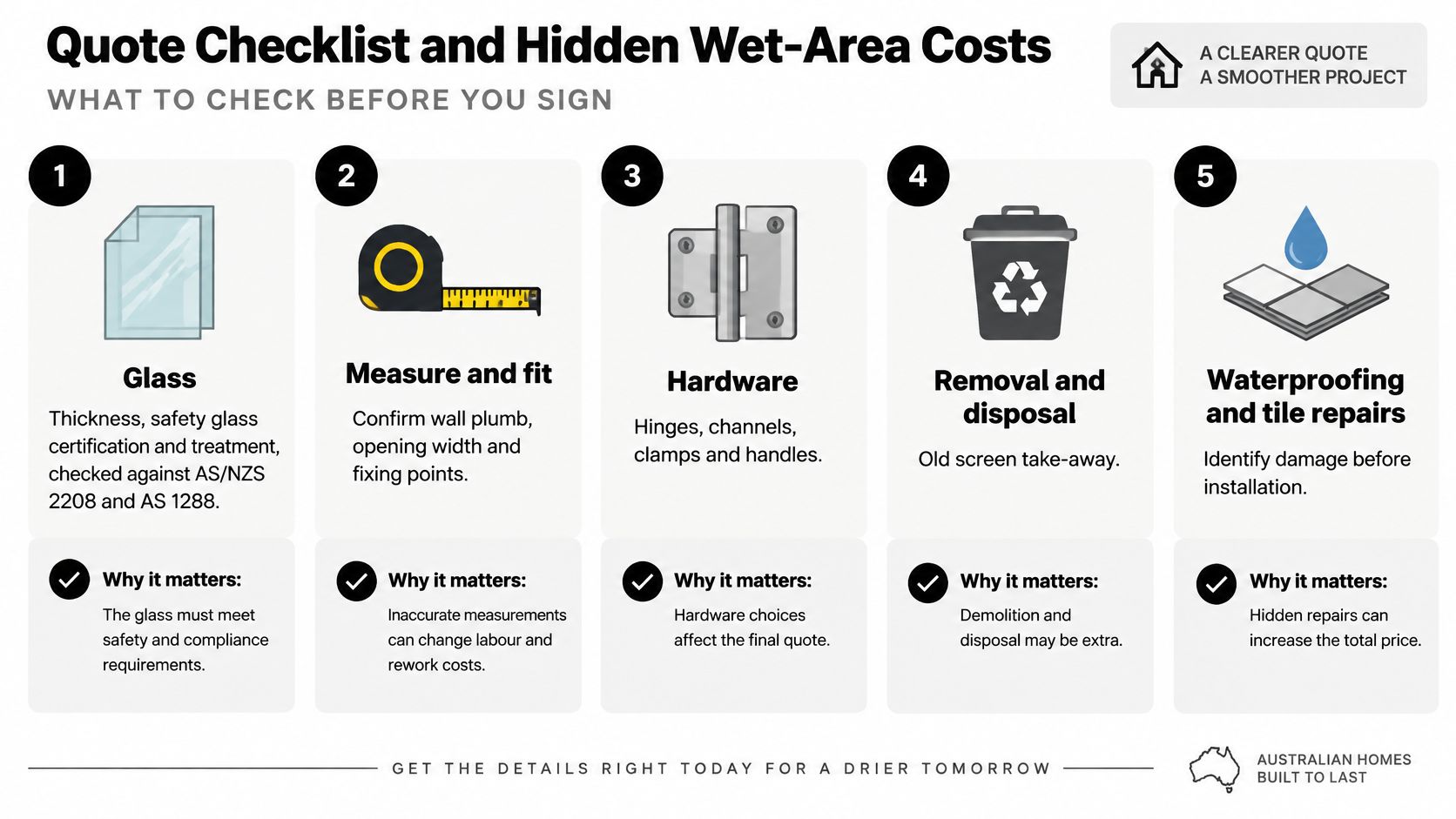
Ask these questions, in this order. A missing answer is a missing cost.
- Glass. Does this quote include compliant glass, the thickness, any treatment, and certification you can keep? AS 1288 covers human-impact safety, not the look of the bathroom. Imported glass still has to meet the Australian glazing requirements.
- Hardware. What finish, hinge and bracket type, and fixing method are included, and are they rated for this glass weight? Engineering-grade fixings and drilling into the substrate belong on the page. Finish is the smaller variable. An under-rated hinge is the one that comes back as a replacement.
- Site. Is there a measure on site, not a phone estimate, and are out-of-square walls included? In Melbourne renovations the screen often goes in after waterproofing and tiling, so access, tile condition and wall construction are cost drivers. Door configuration, delivery and compliance documentation belong in the same itemised scope.
- Old screen. Who removes it, who disposes of it, and who makes good tile or wall damage? Bathroom demolition that includes the old screen, fittings and wall tiles is a separate scope from supplying new glass.
- Sealing. Is old silicone removed, and is new silicone finishing included?
- Waterproofing. Is the existing membrane inspected, and who pays if it needs rectification?
- Tax. Is GST included in the figure you are comparing?
- Warranty. What do the glass, hardware and installation warranties each cover, and where do they stop?
- Design. Are sketches or plans part of the price, and will changes be agreed in writing before work starts? Melbourne Tiling Services includes sketches, plans and discussions in bathroom design, and modifications are agreed before work commences.
A low quote usually omits one of items 4 to 6. Until those lines match, the headline figures are not comparable. Plumbing labour beside the screen is easier to compare when each exclusion is its own line, which is how take-off tools such as Exayard plumbing estimating software are used on the trade side.
Faults that appear when the glass arrives
A screen can be priced cleanly and still need extra work where tiles are hollow, walls are out of plumb, fixings cannot reach framing, or old penetrations need repair. Those faults show up when the glass is on site, after toughening, when the panel can no longer be trimmed to suit the opening.
The base is a built assembly, not a tray the glass stands on. Melbourne Tiling Services installs shower bases with a hob, screed to form the fall, a puddle flange and a shower grate such as smart tile, grill or square waste. The screen then fixes into the surrounding walls. If the fall, the flange or the wall fixings are wrong, the fault shows up at installation, and the glass price does not correct it.
Waterproofing from the same contractor covers walls and floors, interior or exterior, shower walls and floors, balconies and retaining walls. Replacing an existing enclosure carries more risk than setting glass during a full renovation, because the old membrane is exposed when the old screen comes off. Hold the screen price separate from a contingency for substrate and waterproofing investigation. Dropping the base substrate or building a stud wall should appear as its own item in the written scope, not inside the glass line.
For landlords and property managers, the cheap install can become the larger liability if a leak, a glass failure or a non-compliant product causes damage. Put one question in writing. Who pays if the investigation finds a fault, and does the installer coordinate waterproofing rectification or stop at the glass?
Victorian Thresholds That Change Your Budget
A frameless screen quote looks self contained. The budget rarely is. Glass compliance sets the specification, while the condition of the waterproofing and the total value of the domestic building work decide the paperwork, the contract form and the insurance position.
Victorian consumer guidance places two money figures on that paperwork. Work worth more than $10,000, including renovations, extensions and repairs, generally requires a written major domestic building contract and a builder registered with the Building and Plumbing Commission, as set out in Consumer Affairs Victoria's guidance on builders and tradespeople. Victoria's renovation checklist for work costing more than $10,000 requires domestic building insurance before a deposit is taken or work begins when the work costs more than $16,000.
| Work value or type | What to allow for in the budget |
|---|---|
| Up to AUD 10,000 | Terms still need confirmation in writing with the builder, even where a major domestic building contract is not used |
| Above AUD 10,000 | Written major domestic building contract and builder registration, per Consumer Affairs Victoria's guidance on builders and tradespeople |
| Above AUD 16,000 | Domestic building insurance provided before a deposit is taken or work begins, per Victoria's renovation checklist for work costing more than $10,000 |
| Structural work, any price | Builder registration required, and a building permit may apply |
Screen-only versus a full renovation
A screen-only replacement can sit under both money thresholds. A complete renovation that combines demolition, plumbing, waterproofing, tiling and structural change often crosses them. Apply the test to the project value, not the glass line alone.
The distinction matters because bathroom work counts as domestic building work when it involves building, renovating or repairing a bathroom without extending beyond the existing external walls, floor or ceiling, and the Building and Plumbing Commission treats selecting and applying suitable waterproofing as part of that scope. A building surveyor must not issue a building permit for domestic building work under a major domestic building contract unless a builder registered in the appropriate class is carrying out the work. The same guidance lists exceptions for some single-skill jobs, including tiling and glazing. A coordinated bathroom renovation does not necessarily fall inside a single-skill exception.
The registration application for a builder limited to bathroom, kitchen and laundry renovations lists shower screens in the technical scope, alongside wet-area substrates, waterproofing to manufacturers specifications, and wall and floor tiling, in the Victorian registration application. We deliver bathroom renovations with in-house carpenters, plumbers, waterproofers and tilers, which reflects that coordinated sequence. Keep the guide to waterproofing compliance certificates in Victoria in the same file as the contract and the insurance. Confirm registration, the written contract and the insurance documents before a deposit or a start date, and make sure the quote states how hollow tiles, out-of-plumb walls and aged membranes are investigated before the glass is ordered.
Confirm Your Scope and Budget Before You Sign
Lock the scope before you compare prices. A headline figure without these five steps is a guess.
- Define the screen. Panel count, configuration and glass thickness come first. Those three choices set the glass order.
- Name the project type. Say whether the screen sits inside a full bathroom renovation or replaces an existing enclosure. Replacement jobs need a waterproofing contingency. New wet areas fold the screen into the build sequence.
- Ask for an itemised written quote. Use the glass, hardware, site, removal, silicone, waterproofing, GST, warranty and design questions so two quotes can be lined up row by row.
- Book a site measure. Confirm whether a waterproofing inspection is inside the price or held as a separate contingency. Phone estimates miss out-of-square walls.
- Match the paperwork to the value. Check the builder's registration, the contract form and domestic building insurance against the Victorian thresholds for the price of your project, not the price of the glass alone.
Free quotes and 3D drawings are offered for a bathroom renovation, and the website has a bathroom renovation calculator if you want a first pass on scope before anyone visits. Melbourne Tiling Services P/L can provide an itemised written scope covering the wet-area sequence, so you can request one quote with a site measure and compare it against that checklist. You can phone 1300 661 658.
Compare every quote line by line. The frameless shower screen installation cost that looks cheapest on the first page is often the one that left out the membrane, the make-good and the contract you need.
Melbourne Tiling Services P/L supplies and installs Australian-made frameless shower screens as part of bathroom renovations, with waterproofing, tiling and the related wet-area trades coordinated in-house. If you are pricing a Melbourne ensuite, an itemised scope with a site measure will show whether the screen, the membrane and the Victorian contract rules belong in one figure. Visit Melbourne Tiling Services P/L to request a quote and line it up against your checklist.
Recent Comments