

Search "tilers near me small jobs" and the advice that comes back is almost always the same. Get three quotes, compare the hourly rate, pick the cheapest. That advice breaks down on precisely the small jobs people need done.
A small job is small in area, not in risk. Two square metres of shower floor sits inside a waterproofing system that governs the whole repair, and a two-square-metre patch on a balcony can involve a membrane, a fall to a waste and a waterstop. Price is the last thing worth comparing, because the cheapest quote is usually the one with the least scope written into it.
This isn't a niche corner of the market. In the September quarter of 2024, the Australian Bureau of Statistics recorded $3.246 billion of seasonally adjusted chain-volume work completed on residential alterations and additions, down 1.2% on the June quarter and 6.1% on September 2023, as reported in the ABS building activity release for September 2024. Small repairs and retiling form a routine part of that spend, and they deserve the same discipline as a full renovation.
Table of Contents
- Which Small Tiling Jobs Stay Simple
- Why a Small Wet-Area Repair Is Rarely Just Tiles
- When a Registered Builder Is Needed
- What a Clear Small-Job Quote Itemises
- How to Check a Tiler's Credentials
- Send a Written Scope and Book With Confidence
Which Small Tiling Jobs Stay Simple
Some of what gets called a small job is one. A cracked wall tile in a hallway, set over dry and sound wall lining, gets replaced and the joint regrouted. Crumbled grout on a dry kitchen splashback gets raked out, regrouted and sealed. Neither needs a waterproofer, a permit or a second trade, and both are a morning's work.
The jobs that catch people out are the ones where the failure isn't in the tile. A hollow-sounding tile isn't a tile problem, it's a bond problem, and the bond fails because the substrate has moved or stayed wet. Sealant that keeps letting go at a bath edge is telling you something about the junction behind it.
| Job | Typical scope | Check before quoting |
|---|---|---|
| Single cracked wall tile over dry, sound wall | Replace the tile and regrout the joint | Confirm the substrate is sound and the area isn't near a shower or bath |
| Crumbled grout on a dry kitchen splashback | Regrout and seal the joints | Look for movement cracks and confirm the surface stays dry |
| Loose or hollow-sounding tiles | Lift and relay the affected tiles | Check for substrate movement or moisture before quoting replacement |
| Failed sealant at a bath or shower edge | Remove and replace the sealant | Check the membrane and junction, since failed sealant can hide a leak |
| Recurring mould or damp behind tiles | Investigation first, then repair | Assume a waterproofing or leak issue until proven otherwise |
| Shower floor or wall leak | Waterproofing repair, possibly strip-out | Assess the membrane, falls and waste; a licensed waterproofer may be needed |
| Balcony or terrace tile replacement | Tile replacement with membrane check | Check water entry and falls; broader remediation may be required |
| Shower screen or waste change | Plumbing and tiling coordination | Confirm the change doesn't alter falls, waste or layout without a permit check |
Two dimensions decide where a shower job lands. Victorian Building Authority technical guidance requires waterproofing to extend 1.5 metres from the shower rose connection, a waterstop at a minimum horizontal distance of 1,500 millimetres from the shower rose, and, where a floor waste is installed, a continuous fall to the waste of at least 1:80, as set out in the VBA technical and regulation FAQs. A job that "just" replaces three shower floor tiles sits inside those dimensions, whether or not the homeowner realised it.
Place your own job by asking two questions. Can water reach it, and is the damage on the tile or behind it. If the answer to either is yes, it isn't a small job, and the quote should show a wider assessment rather than a tile count.
Why a Small Wet-Area Repair Is Rarely Just Tiles
A tile that looks intact from the doorway is sometimes the only sound layer in the assembly. The tile is a finish. Behind it sit adhesive, a substrate, a waterproof membrane, and whatever framing or masonry carries the weight and keeps the water out.
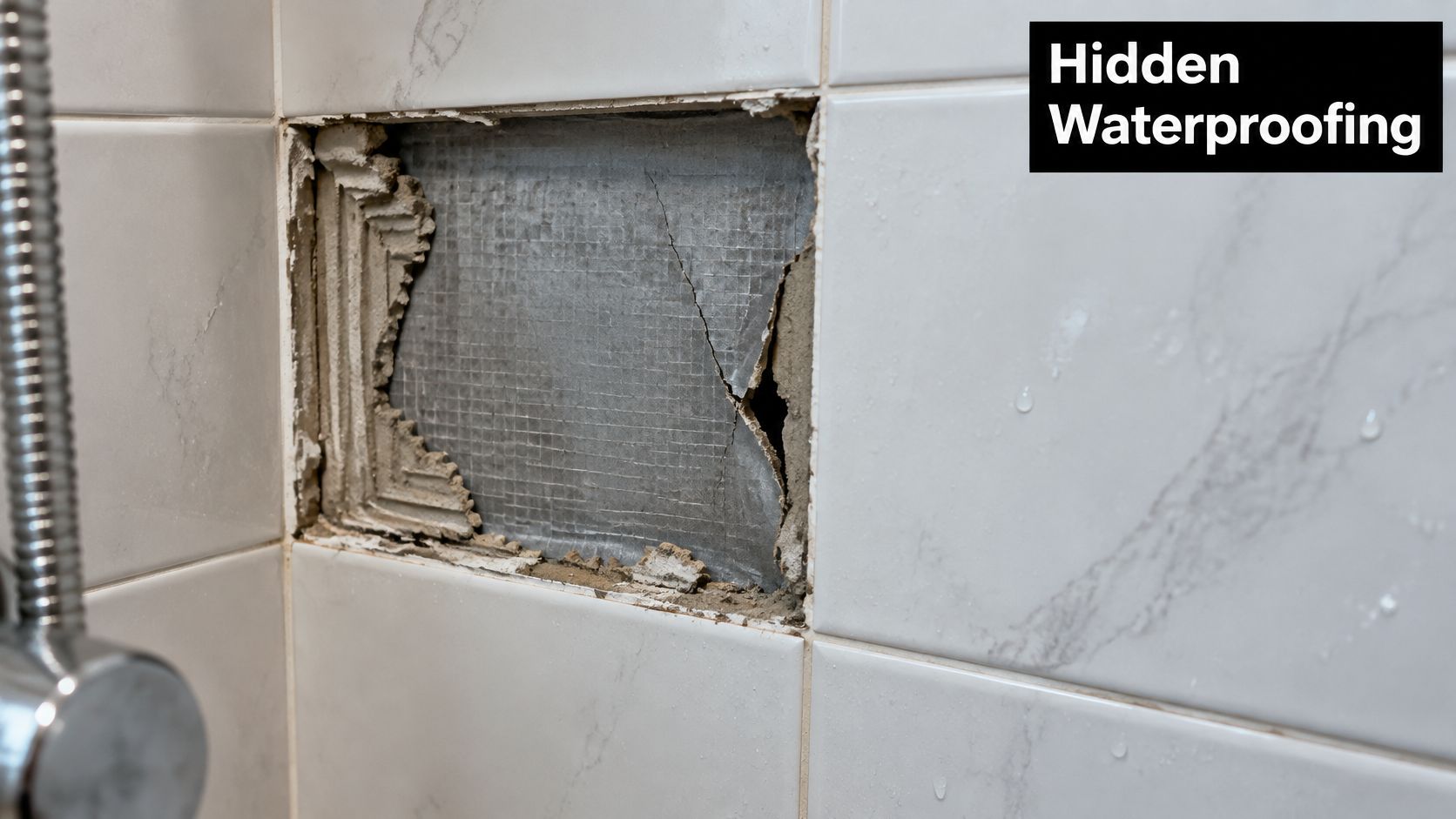
Pry out a damaged tile near a shower and the membrane can come with it. Set a new tile over a membrane that has already failed and the leak hasn't been fixed, it's been covered. The National Construction Code is specific about the wet zone: a shower floor must be waterproof, shower walls must be waterproof to at least 1,800 mm above the floor substrate, and wall junctions, wall-to-floor junctions and penetrations must also be waterproof, with AS 3740 available as a Deemed-to-Satisfy pathway under the NCC Housing Provisions on wet area waterproofing.
An assessment before quoting should cover grout cracking, loose tiles, movement at corners, failed sealant, plumbing penetrations, substrate damage and the membrane edge. That's a physical inspection, not a photo estimate.
Here's how that inspection turns into a repair sequence once the membrane is compromised.
The three quote levels you might be handed
- Tile-only replacement. The substrate and membrane have been verified as sound, so the job really is lift, fix and grout. Cheapest, and only valid when someone has checked what's underneath.
- Localised repair. A patch of failed screed, a regrout of a wet zone, or a section of membrane reinstated before tiling. Priced between the other two, and the most commonly skipped step.
- Strip-out with waterproofing remediation. Tiles off, substrate repaired, membrane renewed, falls corrected, then tiled. Repairs, fixing shower leaks and tiling are among our areas of expertise, and this is the level most recurring leaks turn out to need. You can read more about our wet area waterproofing process.
Waiting has a price that never appears on a quote. Water that gets behind a finish swells framing, feeds mould, rots sheeting and keeps finding the same path back out. The second repair usually costs more than the first because there's more to remove.
Victoria's building guidance also notes that NCC 2025 is scheduled for adoption on 1 May 2026, with additional water-management measures for exposed surfaces such as balconies, according to the Victorian Building and Plumbing Commission guidance on waterproofing of wet areas. That's a scheduled change, not current law, but it's a direction worth knowing if a balcony or terrace repair is on your list.
Ask at the door: what will you check before you replace this tile, and will a licensed waterproofer be involved?
When a Registered Builder Is Needed
The figure that decides which contractor you need is $10,000, and the size of the room has nothing to do with it. In Victoria, domestic building work generally requires registration with the Building and Plumbing Commission when the contract value exceeds $10,000, labour and materials included, and that applies to renovations, extensions and repairs alike. You can check a practitioner's current registration, permitted categories and any conditions through the BPC practitioner search, set out in Consumer Affairs Victoria's guidance on becoming a registered building practitioner.
Registration has to be in place before work starts. Lodging an application does not count.
A tile-only repair of a few hundred dollars sits well under the line. A bathroom refresh that strips out, screeds, waterproofs, retiles and shifts a vanity or shower wastes passes it fast, because five trade inputs stack up inside one small room.
| Option | Scope it covers | Registration | Choose when |
|---|---|---|---|
| Tiler-only contract | Single-trade wall or floor tiling | Generally not required for tiling alone | One trade and contract value under $10,000 |
| Registered bathroom builder | Tiling, waterproofing, carpentry and plumbing coordination | Required before work starts when contract exceeds $10,000 | Several trades in one room or any structural or drainage change |
A narrow exception exists for certain single trades, including wall or floor tiling. It does not stretch to a broader bathroom renovation, where structural work, waterproofing, carpentry and trade coordination all sit under one contract.
Permits sit on a separate track from registration. Victorian guidance directs homeowners to work out whether a renovation or repair needs a planning or building permit, with a registered building surveyor or council able to advise, as outlined in Consumer Affairs Victoria's plans and permits guidance. Waterproofing must comply with current NCC requirements, and the relevant building surveyor decides whether permitted work complies before signing it off.
This scenario comes up constantly. HIA figures reported by News.com.au put renovation demand at approximately 244,000 bathrooms in 2024–2025, and a fair share of those start life as a small repair enquiry.
Sort your job into one of three boxes before you call anyone.
- One trade, under the threshold. A tiler working alone on wall or floor tiling. Check registration and insurance, then book.
- Several trades, one room. Use a registered builder. Our bathroom renovations are delivered with in-house carpenters, plumbers, waterproofers and tilers, so the coordination sits in one contract instead of three.
- Structure, drainage or layout changes. Speak to a building surveyor before anyone swings a hammer, because that's the point where a permit question and a registration question arrive together.
Add up the labour and materials before you decide which contractor type you're hiring.
What a Clear Small-Job Quote Itemises
Read a quote as a checklist, not a price. The first thing to confirm is which of the three repair levels the price covers: supply and lay only, supply and lay plus making good, or a full wet-area repair with the membrane reinstated.
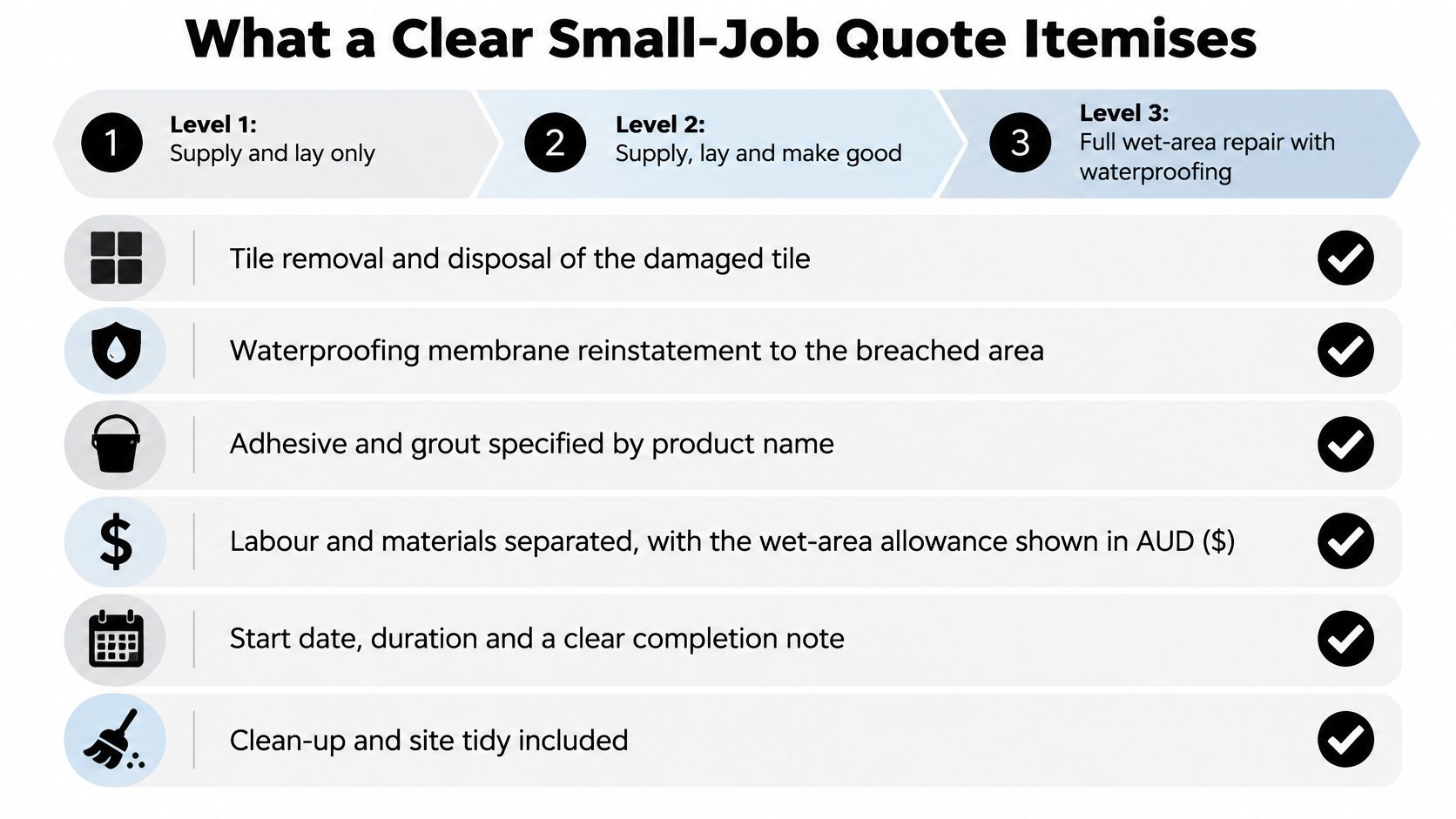
Reading the quote from the tile outwards
Material compatibility and substrate preparation are the technical controls on a small repair, not colour matching. Australian Standard AS 3958:2023 covers preparation of backgrounds and bonded fixing and grouting for ceramic, stone, mosaic and panel tiles, including internal and external wet areas, per the AS 3958:2023 standard listing. A replacement tile can fail behind a sound-looking adhesive if the substrate is damp, contaminated, uneven or incompatible with the selected adhesive. The assessment should record tile type, thickness, porosity, existing adhesive, substrate material, movement joints, and whether the repair faces water or thermal movement. Large-format and stone pieces need flatness, full adhesive coverage and curing control, and a patch often needs local levelling rather than extra adhesive.
| Quote line | What it should state | Red flag |
|---|---|---|
| Tile details | Type, size, count, supplier and who supplies the tile | Only a total price with no tile details |
| Substrate preparation | Levelling, cleaning and adhesive method to the relevant standard | No mention of the substrate at all |
| Waterproofing repair | Area repaired, membrane product and whether it is included | Waterproofing excluded without explanation |
| Grout and sealant | Grout width, colour and flexible sealant at junctions | Rigid grout proposed at changes of plane or fixtures |
| Curing time | Number of days before the area can be used | No timeline given |
| Strip-out and disposal | Who removes old tile and rubbish | Left unclear or assumed |
| Evidence and warranty | Photos, product details, warranty period and scope | Warranty promised verbally only |
Grout and sealant choice deserves its own line. Flexible sanitary sealant, not rigid grout, belongs at changes of plane and around fixtures where movement is expected, and grout width and colour should suit the tile edges and the joint movement.
Then come the practical lines people forget to ask about. Curing time before the shower or floor can be used. Who strips out and disposes of the old tile. Whether you receive photos, product details and any moisture readings, which matters most to landlords and property managers who need records rather than a before-and-after shot. And the warranty: its period, what it covers, and whether it's in writing.
If you're comparing this against a full renovation quote, our guide to how to quote a bathroom renovation shows how the same line items scale up.
Ask for every missing line in writing before you accept a price. A tiler who can supply them has thought about the job.
How to Check a Tiler's Credentials
Fifteen minutes of verification is the cheapest insurance you'll buy on this job.
- Search the practitioner register. Look up the person or company on the Building and Plumbing Commission register for current registration, permitted work categories and any conditions. A weak answer is "I'm fully licensed" with no registration number attached.
- Confirm the class of work. Ask whether they hold, or work under, the registration class that covers bathroom work. Vague covers a lot of ground.
- Ask for a certificate of currency for public liability insurance. Check the dates and that the policy covers the work being done. An expired certificate is worse than none, because it shows nobody is checking.
- Ask about qualifications and the standard they install to. A tiler should be able to name AS 3958 and say which adhesive and membrane system they use. If every answer is a brand name and no standard, press further.
- Request two recent references from similar small jobs. Ask those customers whether the work finished on time and whether anyone had to come back. A tiler with nothing to show from the last six months is a risk.
- Ask who does the waterproofing. It may be the tiler, or a separate waterproofer. Either is fine. "Whoever's on site" is not. All of our workers are qualified and certified waterproofers or tilers.
Victoria recognises a domestic-builder registration class limited to bathroom, kitchen and laundry renovations, covering work inside existing homes that can include wet-area substrates, shower bases, wall and floor tiling, shower screens and waterproofing. The application requires evidence of industry qualifications, project work, a technical referee report, identity and criminal-history documentation, and relevant insurance, according to the VBA registration application for that class. A registered bathroom builder should be able to produce those documents on request. A tiler-only contractor may be exempt when performing tiling alone, which doesn't make the exemption a shortcut for a wider renovation.
If you're widening the search beyond one trade, this overview of tiling contractors near me explains how the roles divide.
File the register result and the insurance certificate with the quote. If the work is ever disputed or claimed on, that folder answers the first three questions an insurer asks.
Send a Written Scope and Book With Confidence
A clear scope helps a tiler assess the job and identify what needs checking before work begins. Record the room, the problem's exact location, visible signs such as cracks, loose tiles, staining or mould, when it began, and any earlier repairs or waterproofing. Add well-lit photos, a rough measurement and a note on whether the area is usually wet or dry.
Send the details through the website or by email to sales@melbournetiles.com.au. Ask what the quote covers, including any investigation of the substrate or waterproofing, and whether a site visit is needed before the price can be confirmed.
Prefer to arrange the booking by phone? The guide to booking service jobs by phone explains what information to have ready for the call.
Before accepting a quote, check that it describes the work, materials, preparation and any waterproofing included. Keep the quote and related documents together. If the job may involve more than tiling, confirm whether it falls within registered building work.
Melbourne Tiling Services P/L has been an established tiling business since 2003. Repairs and shower leak fixing are among its areas of expertise, and qualified waterproofers and tilers are available for the work. Send photos and a scope through the website or email sales@melbournetiles.com.au, or call 1300 661 658 Monday to Saturday, 7.00 to 18.00.
Recent Comments