
For standard Melbourne bathroom tiling in 2026, allow $75 to $150 per square metre for combined floor and wall tiling using 300 x 600 mm or 600 x 600 mm rectified ceramic or porcelain tiles. An 8 to 12 m² bathroom generally lands around $1,800 to $4,500 for tiling labour and adhesive.
You're probably looking at a bathroom quote that seems reasonable until you notice that one tiler has priced labour only, another has included adhesive and grout, and a third has allowed for waterproofing and surface repairs. All three may use a price per square metre, but they're not pricing the same job.
That's why searching for tiling cost per square metre Melbourne gives you a useful starting point, not a final budget. The rate changes with the tile, the layout, the substrate, access, wet-area requirements and the amount of finishing work around drains, niches and fixtures.
Table of Contents
- Introduction to Tiling Costs in Melbourne Right Now
- How Per Square Metre Tiling Pricing Actually Works
- Key Factors That Change Your Melbourne Tiling Rate
- Tile Types and Sizes Compared for Melbourne Homes
- Worked Examples and Sample Quotes for Melbourne Bathrooms
- How to Get Accurate On Site Estimates in Melbourne
- Planning Your Budget and Next Steps With Confidence
Introduction to Tiling Costs in Melbourne Right Now
A homeowner in Melbourne might measure a compact bathroom, multiply the floor area by a tiler's rate and expect the answer to be straightforward. The problem is that bathroom tiling includes walls, shower areas, floors and sometimes feature surfaces, so the actual tiled area can be much larger than the room's footprint.
For a standard Victorian bathroom, the practical 2026 benchmark is $75 to $150 per m² for combined floor and wall tiling with standard 300 x 600 mm or 600 x 600 mm rectified ceramic or porcelain tiles. A complete bathroom with 8 to 12 m² of tiled surface can cost approximately $1,800 to $4,500 for tiling labour and adhesive, according to this Victorian tiling cost guide.
That figure is most useful when the bathroom has reasonably sound surfaces and a conventional layout. It isn't a promise that every Melbourne bathroom will fit inside the range. A shower niche, uneven wall, difficult apartment access or a premium tile can change the quote quickly.
Start with the type of price
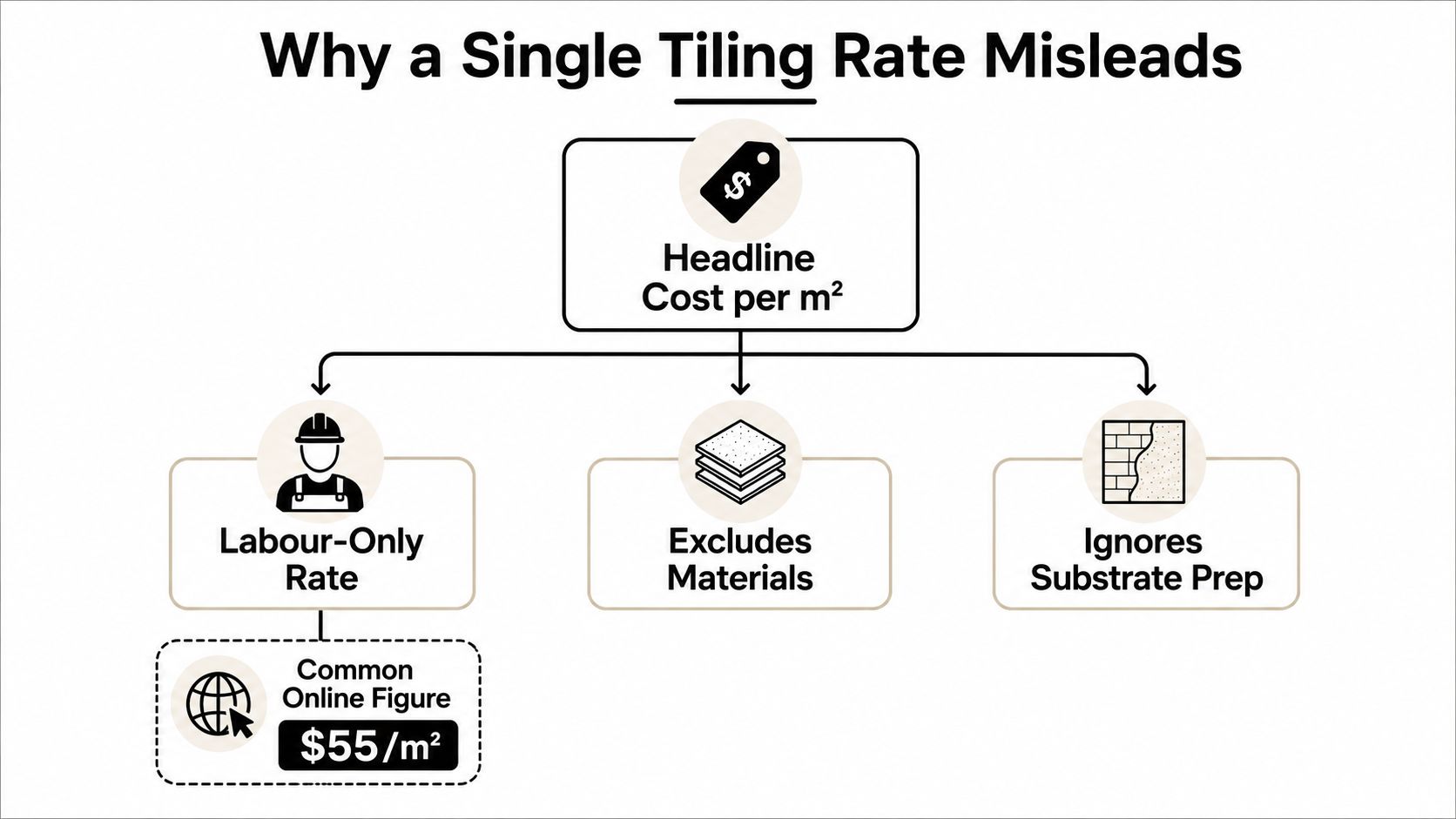
A labour-only rate covers the tiler's work, but may leave you supplying tiles, adhesive, grout, trims and sealants. A supply-and-lay quote usually combines the tiles and installation, while a fully scoped bathroom renovation may also include demolition, waterproofing, screeding, plumbing, electrical work and carpentry.
Those categories explain why two prices per square metre can sit far apart. One may describe only the visible laying work, while another includes the preparation needed to make the finished surface stable and water-resistant.
Practical rule: Never compare the number alone. Compare the scope attached to the number.
The rest of your quote should answer five basic questions. How much surface will be tiled? Which tiles are included? Is preparation listed separately? Does waterproofing form part of the bathroom renovation? Who supplies and removes materials and waste?
Once those details are clear, the per-m² figure becomes a measuring tool rather than a misleading headline.
How Per Square Metre Tiling Pricing Actually Works
Think of a tiling quote as a layered cake. The finished surface is only the top layer, and each layer underneath affects what you pay.
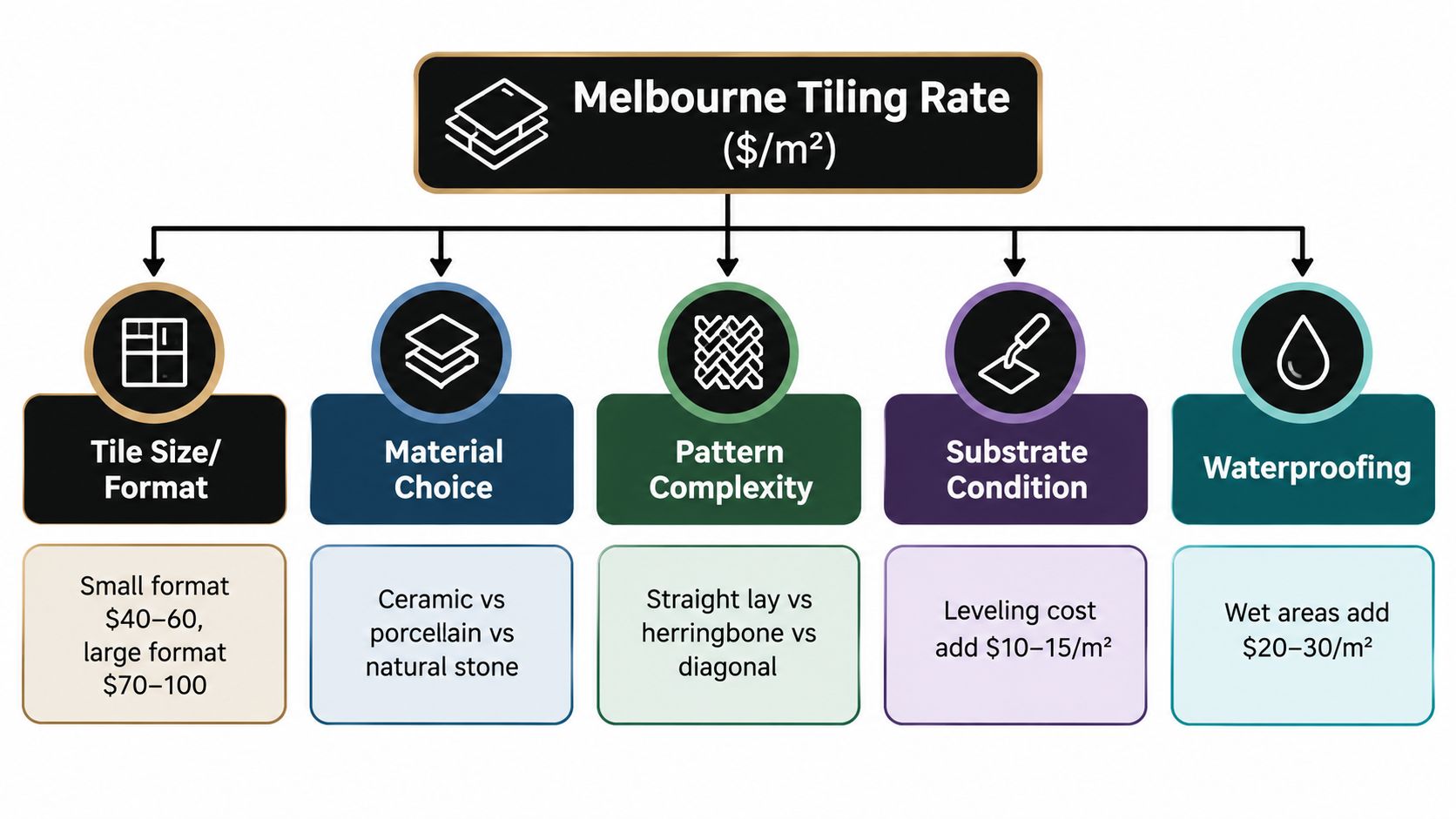
The first layer is labour. The tiler sets out the room, cuts tiles, applies adhesive, places tiles, checks alignment and completes grouting and silicone detailing. Australian tiling labour is commonly priced by square metre. Independent 2026 guides place standard floor tiling around AUD 35 to 90 per m², wall tiling around AUD 40 to 100 per m², and detailed work such as mosaics or feature tiles around AUD 60 to 120 per m² in labour, as outlined in this Australian tiler rate guide.
The second layer is materials. Depending on the agreement, this can include tiles, adhesive, grout, primer, trims, silicone and other installation products. If the quote says “labour only”, don't assume those items are included.
The third layer is surface preparation. A tiler can't create a flat, durable finish on a wall that is loose, uneven or contaminated. Preparation might involve patching, removing old adhesive, screeding or self-levelling.
What the headline rate may leave out
Waterproofing is another separate layer in wet areas. A tiler may price the visible tiling while a waterproofing contractor or builder prices the membrane system independently. Removing existing tiles, transporting waste, fitting edge trims and working around plumbing penetrations may also sit outside a basic rate.
Tilers generally use square metres because the amount of surface directly affects tile setting, cutting and grouting time. That method is easier to estimate than an hourly figure when the room has a clear scope, although small jobs can still attract a minimum charge or travel component.
A small ensuite may have limited square metre coverage but still require a site visit, preparation, set-out, cutting and clean-up. The fixed effort doesn't disappear just because the room is compact.
Read the quote like a recipe: identify the labour, materials, preparation, waterproofing and exclusions before judging whether the price is fair.
Key Factors That Change Your Melbourne Tiling Rate
A Melbourne homeowner may receive different installation rates for the same porcelain tile. A narrow bathroom, for example, takes more time per square metre than an open living area because the tiler works around corners, fittings and limited access. The price is built from the work around the tile, not only the tile itself.
Format and material
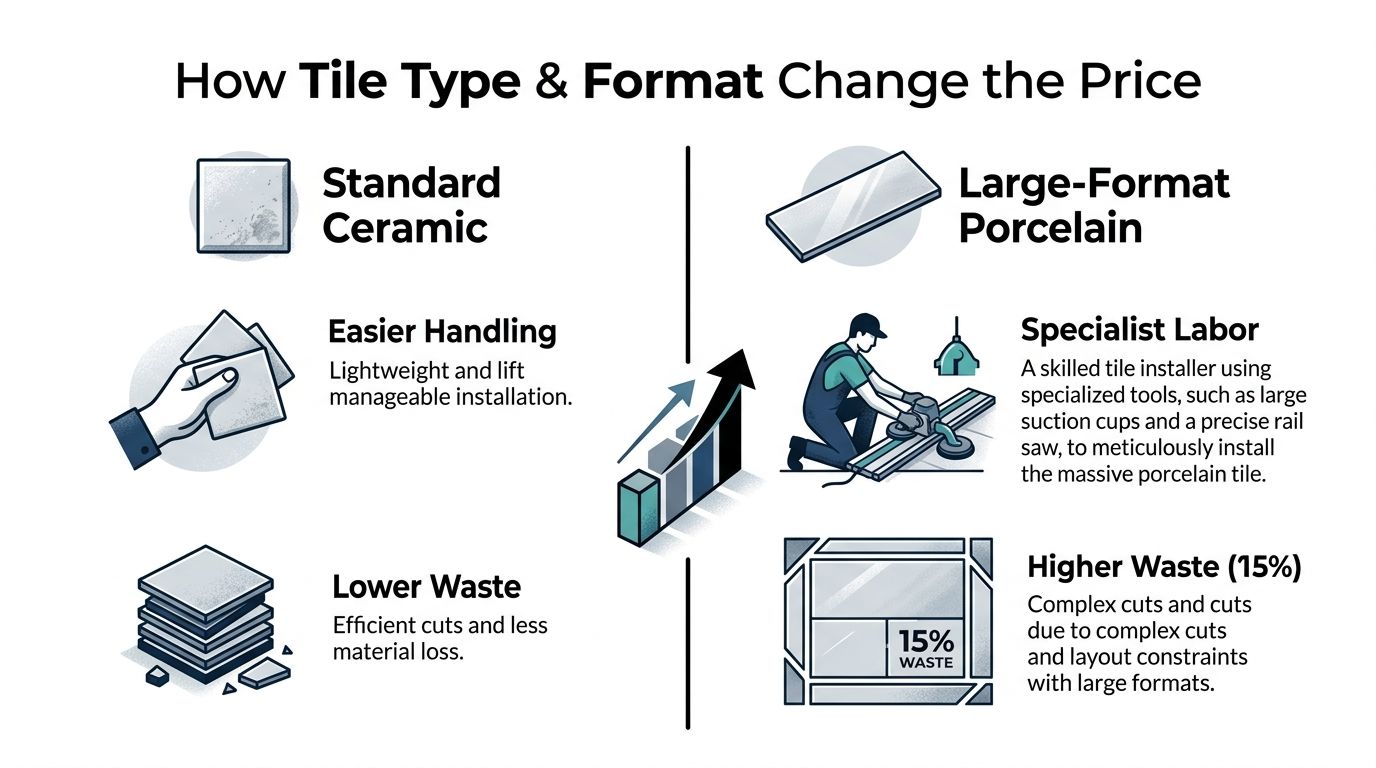
A regular 300 x 600 mm wall tile is usually easier to carry, cut and position than a slab-like format. Large tiles can reduce grout lines, yet they need careful handling and a flatter substrate. Natural stone may require more precise cutting and finishing than standard ceramic.
The Melbourne floor guide places standard ceramic or porcelain installation at $50 to $100 per m², before tile supply. Supply may add $20 to $180 per m², depending on the selected material, as shown in this Melbourne floor tiling price guide. Ask whether a quote includes the tile, adhesive, grout and trims, because “installed” can cover different items.
Pattern and setting out
A straight grid allows the installer to repeat the same cuts and movements. Diagonal layouts, herringbone patterns and mosaics create more cut lines, more planning and more waste. The layout also has to finish neatly around corners, floor wastes and fittings.
One Victoria and Melbourne pricing guide lists basic tiling at AUD 40 to 60 per m², complex patterns at AUD 65 to 90 per m², and heritage restoration at AUD 100 to 150 per m². These ranges illustrate why decorative work can sit above a simple installation, particularly when an existing character surface must be preserved. For large formats, review this large-format tile installation cost guide and check whether extra handling or preparation is included.
Substrate and room conditions
Tiles copy the surface beneath them. A bowed wall can make grout lines look uneven, while an unlevel floor may require levelling before laying begins. The quote should identify patching, adhesive removal, screeding or self-levelling rather than hiding those tasks inside a single rate.
Bathrooms add floor wastes, shower falls, pipe penetrations, vanities and tight junctions. Each interruption reduces uninterrupted working space. Carrying materials through a narrow terrace, up stairs or across an occupied home also takes more organisation than working in a cleared ground-floor room. Travel across greater Melbourne can affect how a contractor schedules a small project.
Wet-area compliance
Waterproofing protects the substrate and adjoining rooms from moisture. It may be priced separately from visible tiling, particularly when another contractor or builder installs the membrane system.
If the renovation includes structural, waterproofing, plumbing or electrical changes, it may fall within domestic building work and require a registered practitioner. Settle that responsibility before tiling starts, and confirm who provides documentation and warranties. That prevents a low square metre rate from becoming an incomplete quote.
Tile Types and Sizes Compared for Melbourne Homes
A tile quote is a build-up, not a single product price. The tile affects material cost, while its weight, size, pattern and cutting requirements affect labour. Two bathrooms with the same tiled area can therefore receive very different quotes.
| Tile Type and Format | Typical Installed Range per m² | Why Cost Varies |
|---|---|---|
| Standard ceramic or porcelain floor tiles | $50 to $100 | The Melbourne installation range changes with substrate condition, layout and access. |
| Large-format porcelain, 600 x 600 mm and above | $80 to $130 | Larger pieces need careful handling, accurate set-out and a flatter base. |
| Natural stone such as marble or bluestone | $100 to $180 | Stone is heavier, may need more detailed cutting and can require additional finishing care. |
| Standard ceramic wall tiles | $55 to $90 supplied and laid | A straightforward wall layout is usually less demanding than detailed feature work. |
| Large-format porcelain wall tiles | $85 to $180 supplied and laid | Size, substrate preparation and material handling have a stronger effect on labour. |
The listed Melbourne ranges place large-format porcelain at $80 to $130 per m² installed for tiles measuring 600 x 600 mm and above. Natural stone such as marble or bluestone sits at $100 to $180 per m². These figures show why a premium finish can move the project well beyond a basic labour rate. The complete local Melbourne floor tiling guide is useful for checking what an installation range may cover.
Ceramic for practical wall coverage
Ceramic wall tiles suit a straightforward bathroom with clean, repeatable lines. They can cover broad wall areas efficiently, leaving a more expensive product for a niche or feature wall.
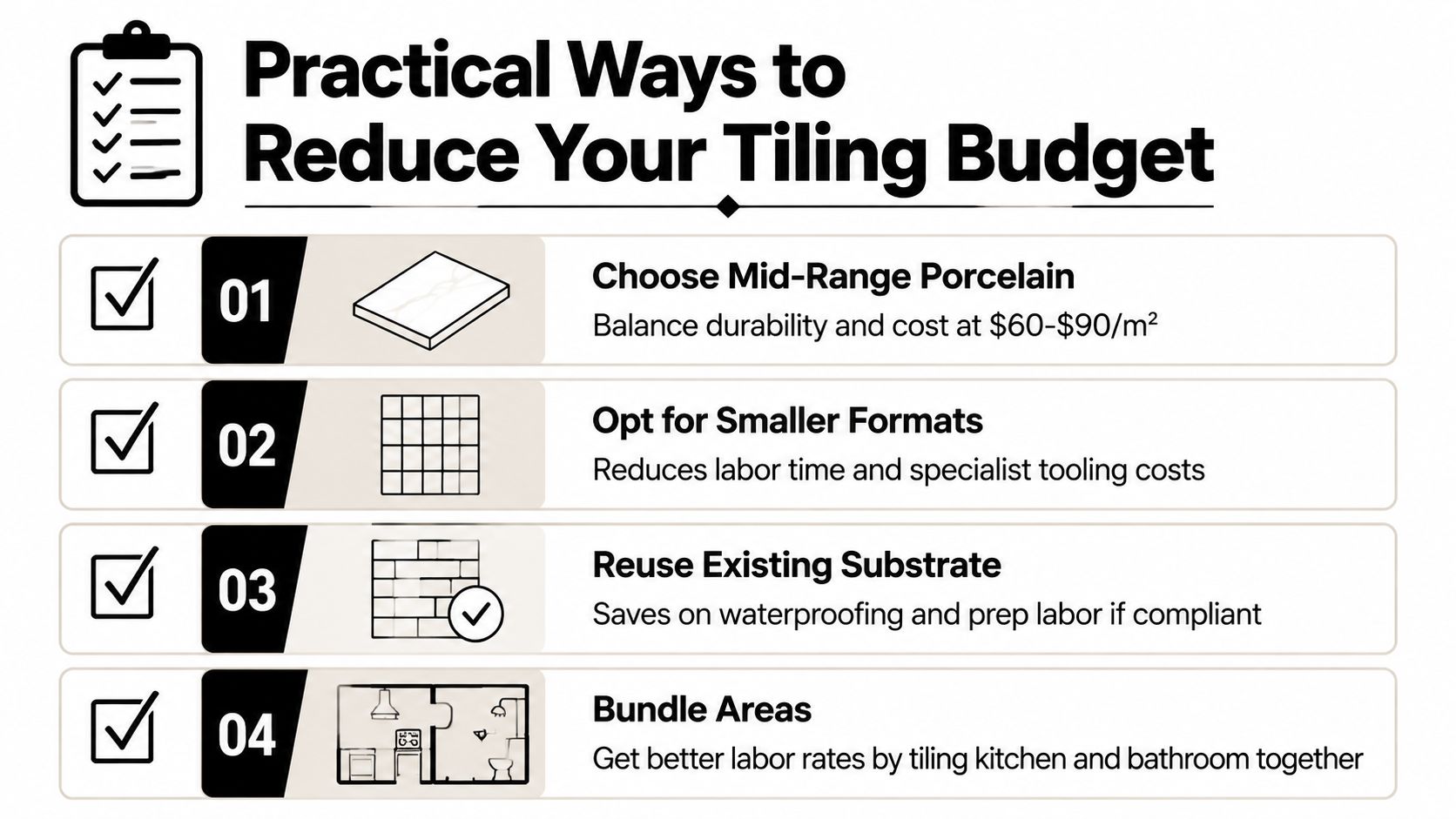
The cheapest tile does not always create the cheapest job. Small formats, uneven edges and intricate patterns increase the number of cuts and grout joints. A plain, larger tile may take less time to set out and install, even if its purchase price is higher.
Porcelain for floors and larger surfaces
Porcelain is denser and is often chosen for floors or other areas requiring a hard-wearing finish. Large-format porcelain gives a quieter visual field because it uses fewer grout lines. Handling each piece safely, setting it accurately and placing it on an even base can require more preparation and labour.
Ask the tiler to separate the tile supply, installation and base preparation in the quote. The tile price may be clear while levelling, adhesive changes or extra handling remain unspecified.
Mosaics and natural stone
Mosaics suit niches, shower floors and feature areas, but the sheets still need careful alignment. Many small pieces create more grout joints and more opportunities for the pattern to drift, so labour can outweigh the apparent simplicity of the product.
Marble and bluestone add distinctive character. Their quote should identify cutting, sealing and finishing requirements, along with any care needed after installation. Compare the complete installed system, including maintenance, rather than comparing only the price of one tile against another.
Worked Examples and Sample Quotes for Melbourne Bathrooms
A useful estimate starts with the tiled surface, not the room's floor footprint. Measure the floor, the walls being tiled and the shower surfaces, then separate the installation rate from waterproofing and preparation.
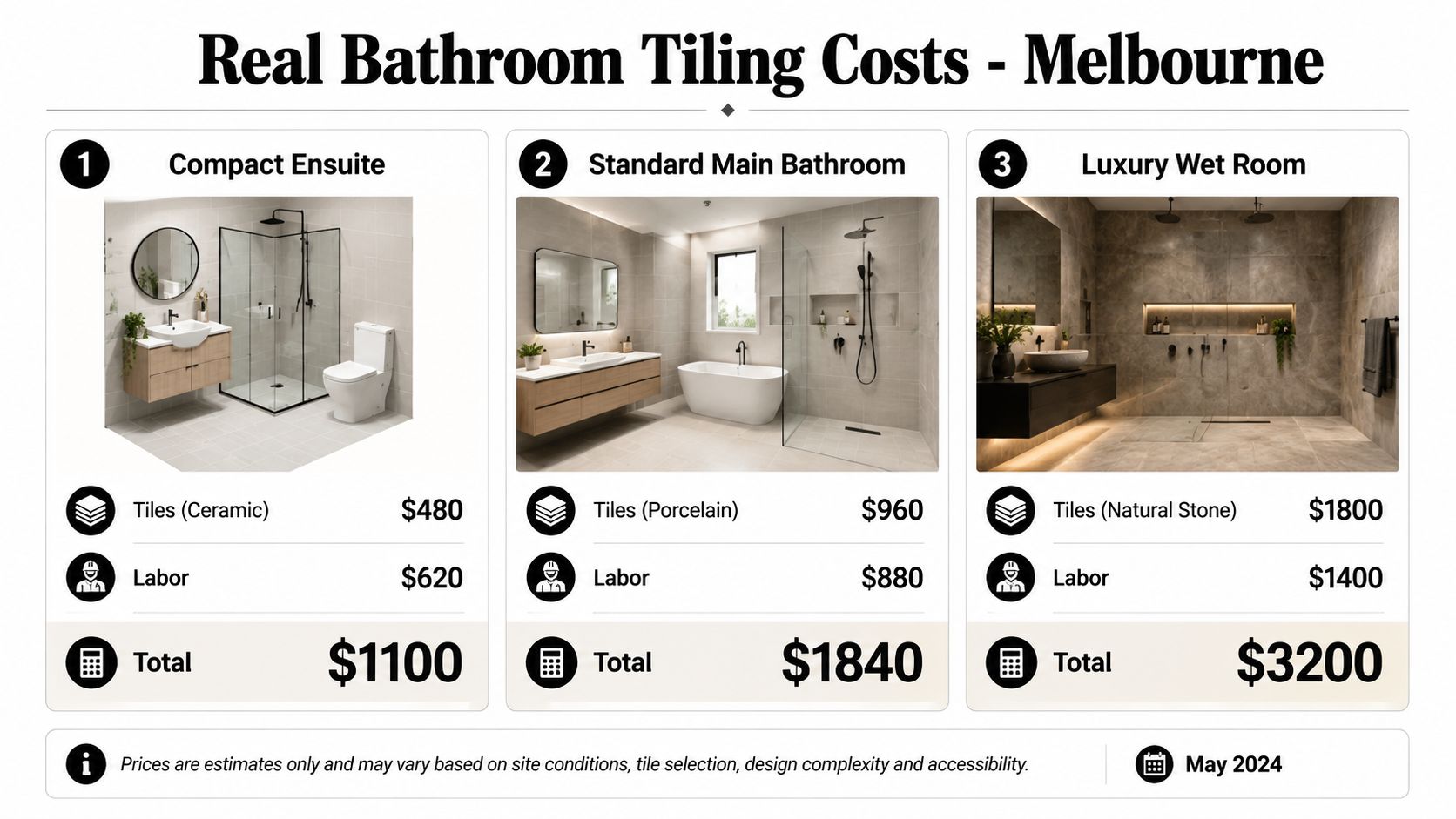
Example one, compact ensuite
Assume an 8 m² tiled surface using standard rectified ceramic or porcelain tiles. Applying the Victorian bathroom benchmark of $75 to $150 per m² gives $600 to $1,200 for the combined rate calculation, but the broader standard-bathroom benchmark places total tiling labour and adhesive at about $1,800 to $4,500 for an 8 to 12 m² bathroom. The difference shows why a small room can still carry set-up, cutting, adhesive, grout and finishing costs that a simple multiplication doesn't capture. See this bathroom renovation calculator for a way to organise the room measurements and scope before requesting quotes.
A quote for this ensuite should identify whether waterproofing, demolition and substrate repairs sit outside the tiling line. If the walls are sound and the layout is uncomplicated, the final figure should be easier to control than a bathroom with multiple niches and feature cuts.
Example two, family bathroom with large-format porcelain
Now consider a 12 m² tiled surface with 600 x 600 mm or larger porcelain. The local installed guide places this format at $80 to $130 per m², producing a rate-based installation range of $960 to $1,560 before any separate preparation, waterproofing or unusual access costs.
The practical question is whether the floor and walls are flat enough for the selected product. If not, the installer may need to price additional preparation, and the project can move beyond the apparent per-m² calculation.
Example three, premium ensuite with a stone feature wall
A premium ensuite may combine standard porcelain across the main surfaces with a natural-stone feature wall. The stone portion should be measured separately because the guide places marble or bluestone at $100 to $180 per m² installed, while the surrounding surfaces may use another rate.
Room-level Australian bathroom guides place a typical bathroom with 10 to 15 m² of tile surface at about $1,500 to $3,000 fully supplied and installed, with waterproofing adding approximately $500 to $1,000. Another benchmark places a medium bathroom's lower-to-mid tiling cost around AUD 1,200 to 2,000, so the final scope matters more than the label “medium”. These figures are detailed in the Australian bathroom tiler cost guide.
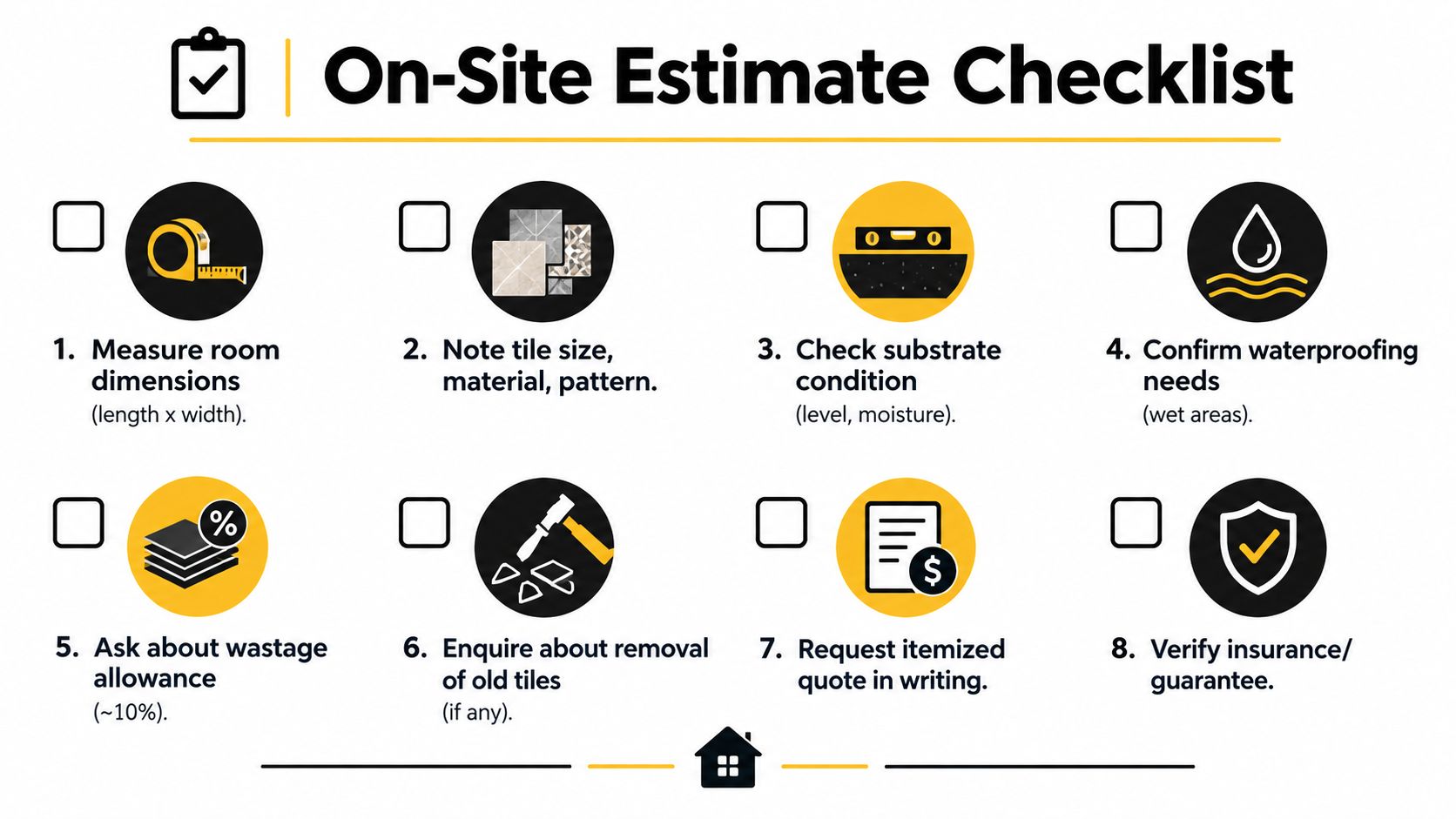
Estimator's habit: Ask for the tiled area, tile rate, preparation, waterproofing and exclusions as separate lines. That makes the arithmetic visible.
How to Get Accurate On Site Estimates in Melbourne
Online ranges help you decide whether a project deserves a modest, mid-range or premium budget. An on-site estimate tells the contractor what the room requires.
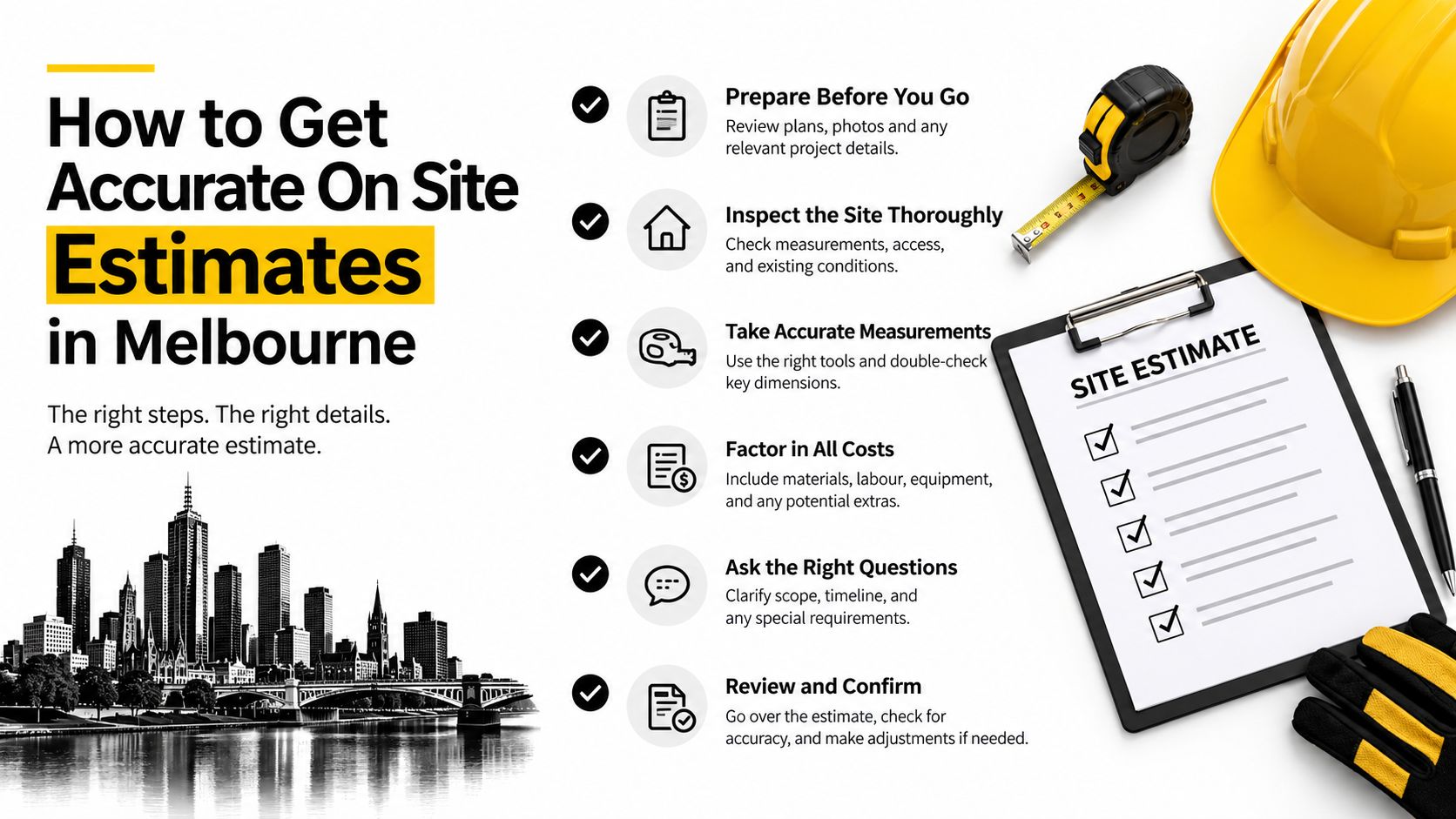
Start by preparing the information a tiler or builder needs. Record the room dimensions, take photos of walls and floors, note the tile size and material, and mark any niches, benches, windows, floor wastes and pipe penetrations. If you already have a tile selected, provide its product name and format rather than describing it only as “porcelain”.
Ask for a scope that can be checked
A reliable quote should show:
- Measured tiled area: Confirm how the contractor calculated floor and wall coverage.
- Tile supply: Check whether the price includes the exact tile, delivery and reasonable cutting waste.
- Preparation: Ask how patching, removal, screeding or self-levelling will be treated.
- Waterproofing: Confirm who performs it, what areas are covered and whether it is a separate line.
- Installation finish: Look for grout, silicone, trims, mitred edges and clean-up.
- Variations: Ask what site discoveries could change the price and how approval will work.
Check the building pathway
In Victoria, domestic building work over AUD 10,000 generally requires a registered builder. Bathroom renovations commonly fall under domestic building work when they involve structural, waterproofing, plumbing or electrical changes, so the compliance threshold can affect whether you need a registered unlimited builder or another registered practitioner. The relevant threshold and scope are outlined in this Victorian tiling and domestic building cost guide.
Tiling alone may not tell you who should coordinate the project. If the renovation changes waterproofing, plumbing or structure, ask who holds responsibility for the complete work, not only who lays the tiles.
For a practical starting point, compare two or more site quotes using the same tile schedule and the same room drawings. Melbourne Tiling Services P/L offers free quotes, 3D drawings and a transparent calculator, while other local contractors may use different estimating tools. You can also review tiling contractors near me when building a shortlist, then verify insurance, registration and workmanship terms directly.
Planning Your Budget and Next Steps With Confidence
Use $75 to $150 per m² as a practical 2026 starting benchmark for standard Melbourne bathroom floor and wall tiling, not as a promise of the final invoice. Adjust your expectations for large-format porcelain, natural stone, mosaics, complex patterns, uneven substrates and wet-area compliance.
Before approving a quote, take these steps:
- Measure the full tiled surface, including walls and shower areas.
- Choose the tile and layout before asking contractors to price the work.
- Request an itemised quote that separates labour, materials, preparation and waterproofing.
- Confirm the building pathway if the renovation includes structural, waterproofing, plumbing or electrical work.
- Use a renovation calculator and site visit to test whether the written scope matches the room.
If you're researching broader project-planning resources, this guide to websites for building construction can help you assess what information a professional building business should present clearly online.
A good bathroom renovation quote should leave you knowing what will be installed, who is responsible for each trade and which conditions could create a variation. Price matters, but so do waterproofing, clean detailing, durable materials and a finish that suits the way your household uses the room.
Melbourne Tiling Services P/L can measure your bathroom, prepare a transparent tiling and renovation quote, and provide free 3D drawings to help you compare tile choices and scope. Visit Melbourne Tiling Services P/L to arrange a quote for your Melbourne or greater Victoria project.
Recent Comments