

You're probably at the stage where the bathroom still looks simple on paper. Pick a tile, book a tiler, get it done. In practice, bath tile installation in Melbourne is rarely just about the tile. The finish you see on day one only lasts if the work underneath it was handled properly.
As a Melbourne-based Registered Builder and master tiler, I can tell you the same thing I tell homeowners at quoting stage. The expensive mistakes in bathroom renovations usually happen before the first tile is laid. Poor substrate prep, rushed waterproofing, bad falls, and sloppy junction detailing create the leaks and failures that cost the most to fix later.
Table of Contents
- Planning Your Bathroom Renovation and Tile Selection
- The Critical Foundation Substrate Prep and Waterproofing
- Tile Layout Adhesives and Setting Your Tiles
- Grouting Sealing and Installing Fixtures
- Common Tiling Mistakes and Melbourne Regulations
- Bringing It All Together Your Bathroom Renovation Checklist
Planning Your Bathroom Renovation and Tile Selection
The best bathroom renovations start with decisions that most homeowners can't see. Before you compare colours, you need to know whether you're doing a cosmetic re-tile, a full wet-area rebuild, or a broader renovation involving plumbing, waterproofing, fixtures and layout changes. That scope determines cost, sequencing, who needs to be involved, and whether a Registered Builder should manage the job.
Start with scope, not samples
If the room has movement, an old screed, patched surfaces, or a history of leaks, tile selection is not the first conversation. The first conversation is whether the existing base is suitable to tile over at all. In many Melbourne bathrooms, it isn't.
Use these early planning checks:
- Confirm the wet-area condition: Look for cracked grout lines, drummy tiles, swollen skirtings, stained ceilings below, or movement around shower bases and corners.
- Define the renovation level: A simple surface refresh is very different from a strip-out that includes screeding, waterproofing, plumbing adjustments and fixture replacement.
- Decide who coordinates trades: Bathroom renovations often need a builder to sequence tilers, plumbers, electricians, carpenters and waterproofers properly.
Practical rule: If you're changing waterproofed areas, drainage, wall linings, or the bathroom layout, treat it as construction work first and decorating second.
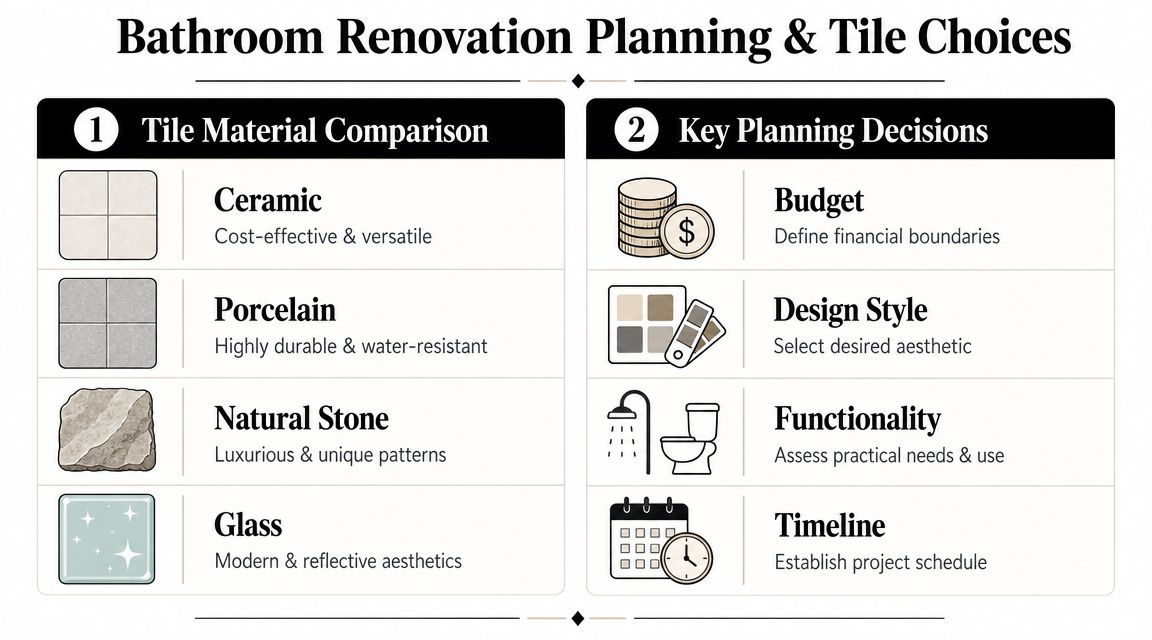
Choose tile by performance first
Homeowners often choose on appearance, then try to force the room to suit the tile. That's backwards. Tile size, material and edge profile all affect labour, substrate tolerance and installation difficulty.
Here's a practical comparison.
| Tile Type | Durability | Water Resistance | Average Cost (Supply) | Best For |
|---|---|---|---|---|
| Ceramic | Good | Good | Lower entry point | Budget-conscious wall and floor updates |
| Porcelain | High | High | Mid to higher range | Family bathrooms, floors, showers |
| Natural Stone | Varies by stone | Varies, often needs sealing | Higher | Premium bathrooms and feature areas |
| Glass | Good in the right application | High | Varies | Feature strips, splashbacks, decorative walls |
For style ideas, many homeowners start by browsing modern bathroom tiling options and then narrow choices based on cleaning, slip resistance, edge detail and how much movement the room is likely to see.
Large-format tiles can look sharp, but they're less forgiving. If the walls are out, the floor has poor falls, or the corners aren't true, a large porcelain tile will expose every flaw. Natural stone gives a premium look, but it asks more from the installer and from the owner after handover.
Budget for the hidden work
A realistic budget needs to separate visible finishes from technical preparation. Australian renovation guides commonly report bathroom tiling costs of about A$50 to A$150+ per m² for standard ceramic or porcelain, with higher-end stone, mosaics or complex layouts rising above that range, according to Angi's tile installation cost guide.
That spread tells you something important. Labour intensity changes dramatically when the room needs levelling, screeding, tighter set-out, shower detailing, niche work, or difficult cuts around fixtures.
DIY can work for a dry, simple, low-risk area. A bathroom is different. Wet-area work has compliance implications, and once waterproofing, falls and penetrations are involved, cutting corners stops being a styling issue and becomes a defect issue.
The Critical Foundation Substrate Prep and Waterproofing
The success or failure of bath tile installation depends heavily on the preparation. A bathroom can look perfect at handover and still be heading for failure if the base under the tiles wasn't sound. Tiles don't waterproof a bathroom. They protect and finish the surface. The actual defence sits below them.
Why the substrate decides the outcome
Australian wet-area work is governed by AS 3740:2021, and in domestic bathrooms the membrane must be installed before tiles are laid. That's part of why compliant bathroom work in Victoria is primarily about waterproofing and substrate preparation, not just appearance, as outlined in this explanation of AS 3740:2021 and bathroom tile installation.
Before any membrane goes down, the substrate has to be checked for stability, flatness, cleanliness and movement risk. On renovation projects I regularly see old bathrooms with patched screeds, mixed materials, previous repair work and surfaces that were never flat to begin with. If you tile over that without correcting it, the room may still leak, pond, crack or produce lippage.
The common weak points are predictable:
- Wall and floor junctions
- Pipe penetrations
- Shower recess transitions
- Drain detailing
- Changes between old and new substrates
What compliant waterproofing actually involves
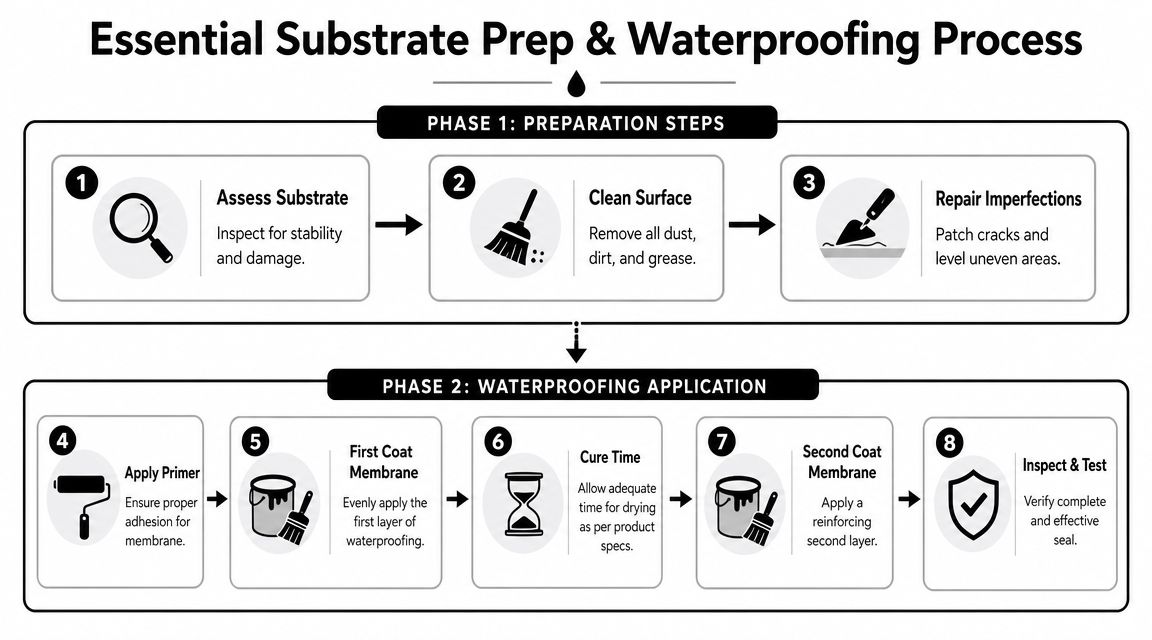
A proper system starts with substrate prep, then primer where required by the product system, then membrane application, reinforcement and detailing at critical junctions, followed by curing and project-specific verification before tile setting starts. If you're comparing contractors, ask them to explain the sequence in plain language. If they skip straight to tile choice, that's a warning sign.
For homeowners reviewing system options, one useful reference point is this page on bathroom waterproofing systems, because it reflects the fact that membranes, primers, detailing and tile adhesives need to work as a coordinated assembly rather than as isolated products.
Waterproofing failures rarely begin in the middle of the wall. They begin at edges, joins, penetrations and places where one trade assumed another trade had handled it.
What goes wrong when this stage is rushed
The hardest defects to fix are the ones hidden behind finished surfaces. If a tiler lays over a substrate that still moves, you can get cracking, drummy tiles and broken grout lines. If falls are wrong, water sits where it shouldn't. If the membrane is poorly detailed, moisture finds the path.
Consumer advice often reduces prep to “make sure the surface is clean.” In real bathroom renovations, that's nowhere near enough. The room needs a base that is true, stable and ready for a membrane that remains continuous through corners, edges and penetrations.
A premium tile doesn't rescue poor prep. In fact, high-end porcelain, stone and large-format panels tend to punish bad prep more severely because they reveal unevenness and demand better coverage and tighter movement control.
Tile Layout Adhesives and Setting Your Tiles
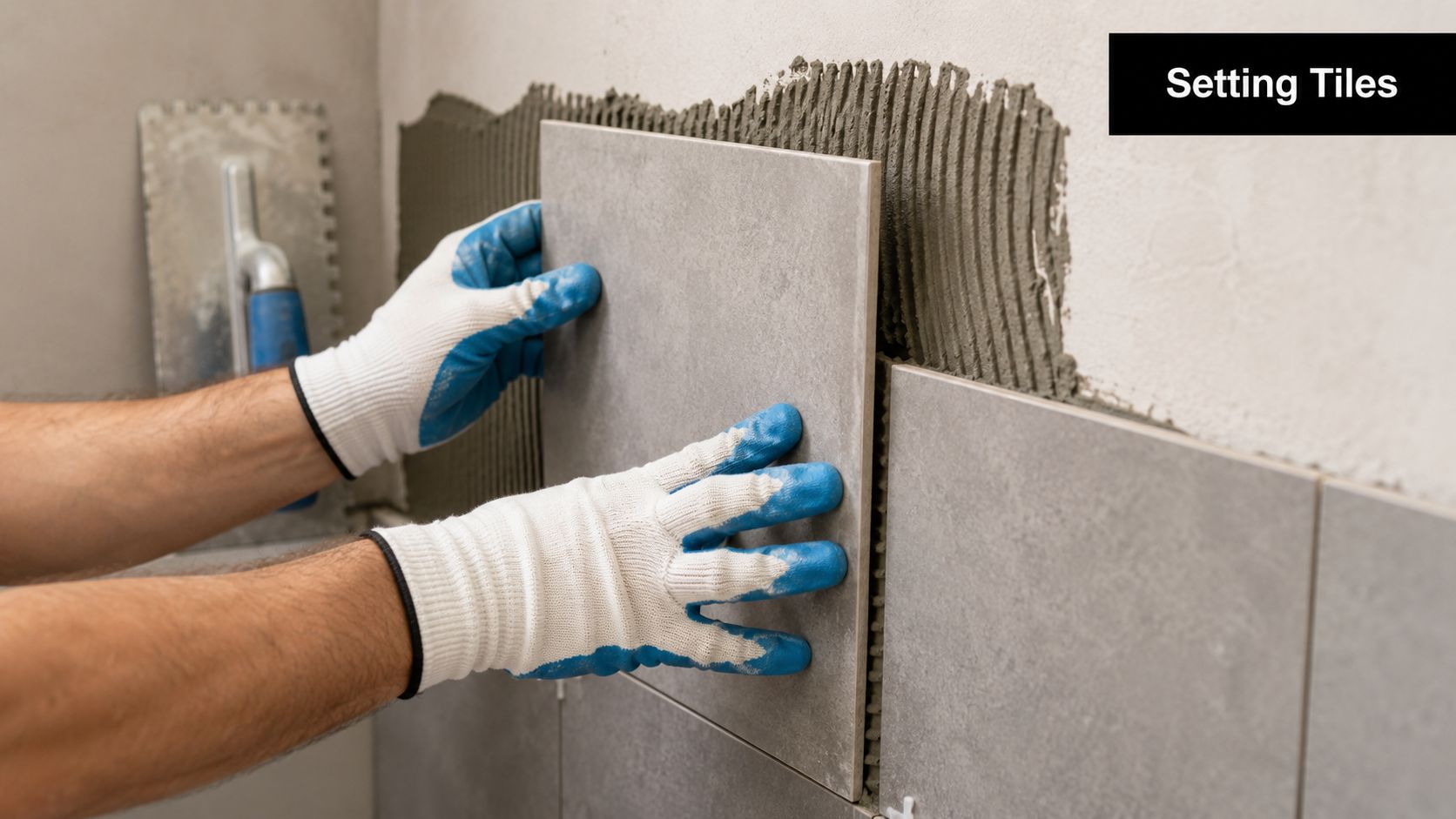
Once the room is properly prepared, the visible craft begins. This is the stage most homeowners think of when they hear bath tile installation, but the method matters more than speed. A neat finish comes from planning cuts, controlling lines and maintaining coverage, not from pushing tiles onto adhesive as fast as possible.
A clean layout prevents a messy finish
Professional workflow starts with a dry layout. That means working out where full tiles land, where cuts fall, how the room centres visually, and whether niche edges, corners and floor wastes will look balanced. Industry installation guidance commonly recommends laying full tiles first and leaving perimeter cuts until last, with movement gaps maintained at walls. Mortars typically need about 24 hours before grouting, and ordering about 15% extra tile is a sensible allowance for cuts, breakage and future spares, based on Daltile's floor tile installation guidance.
The room should dictate the set-out, not the packet size. In a small ensuite, for example, a centred wall can still produce ugly slivers at an external edge if nobody thought through the sightlines from the doorway.
Adhesive choice and coverage matter
The right adhesive depends on the tile, the substrate and where the tile is going. Porcelain, natural stone, vertical applications and large-format pieces all ask more from the adhesive system than a basic ceramic wall tile in a low-stress area.
A few things matter on every job:
- Coverage: Hollow spots come from poor transfer and bad technique.
- Trowel selection: Notch size needs to suit tile size and substrate condition.
- Working time: Spread only what can be tiled while the adhesive remains workable.
- Movement allowance: Hard-setting every edge tight against walls invites later stress.
If you're comparing products for porcelain, stone or large-format work, this overview of tiling materials for bathroom and renovation projects is a practical starting point.
Here's a short visual demonstration of controlled tile setting technique in action:
Set in control zones, not in a rush
Good installers don't try to cover the whole room in one go. They work in smaller zones, check plane continuously, and keep adjusting as they go. On walls, that helps maintain clean lines around niches and tapware. On floors, it keeps falls readable and prevents drifting joints.
If the set-out is right, the room feels calm. If the set-out is off, even expensive tiles look second-rate.
Large-format work often benefits from levelling clips and wedges, but those are aids, not solutions. They don't replace a flat substrate, proper adhesive coverage or a well-planned layout.
Grouting Sealing and Installing Fixtures
A lot of bathrooms are spoiled at the finish line. The tiles are straight, the cuts are clean, then the grout is inconsistent, the haze isn't removed properly, or fixtures are installed with too much pressure on fresh tilework. Finishing trades need restraint.
Grout is part of the system
Grout choice should suit the location and maintenance expectations. Cement-based grout remains common and works well when correctly mixed, packed and cleaned. Epoxy grout can be a sensible option in areas where stain resistance and lower absorption matter more, but it needs more skill to install neatly.
What matters most is technique:
- Pack the joints fully: Shallow joints don't protect edges well and often look patchy.
- Clean in stages: Overwashing weakens colour consistency and can drag material from the joint.
- Watch the timing: Cleaning too early smears grout. Too late, and haze becomes much harder to remove.
In showers and splash-prone areas, movement joints and junctions should be handled appropriately rather than being treated like ordinary field joints. That's one of the details that separates durable work from work that only photographs well.
Seal where the material calls for it
Not every tile needs sealing. Porcelain often doesn't. Many natural stones and other porous finishes do. The key is matching the sealer to the material and applying it at the correct stage.
Homeowners often assume sealing makes a bathroom waterproof. It doesn't. Sealing helps protect porous tile or grout from staining and moisture absorption at the surface. It does not replace the waterproofing system beneath.
Fixtures must be installed without compromising the tilework
The final stage includes shower screens, tapware trim-outs, wastes, mirrors, accessories and silicone finishing. This is where coordinated bathroom renovations matter. The tiler, plumber, glazier and builder all affect the final outcome.
A few details deserve close attention:
- Frameless shower screens: Fixings need to respect waterproofed zones and finished tile lines.
- Tap penetrations: Escutcheons should sit cleanly without forcing uneven cuts or leaving messy gaps.
- Floor wastes: The grate position should align with the tile layout and still allow proper drainage.
- Silicone joints: Neat flexible joints at changes of plane matter for movement and appearance.
Melbourne Tiling Services P/L is one example of a contractor that handles bathroom renovations with coordinated tiling, waterproofing and fixture integration under Registered Builder oversight, which is often the cleanest path when several trades need to work in sequence.
Common Tiling Mistakes and Melbourne Regulations
The most expensive assumption in bathroom work is that tiling is just a finish trade. It isn't. In a wet area, tiling sits on top of construction decisions that affect durability, leak risk and compliance.
The mistakes I see most often
The failures are rarely mysterious. Most can be traced back to basic shortcuts.
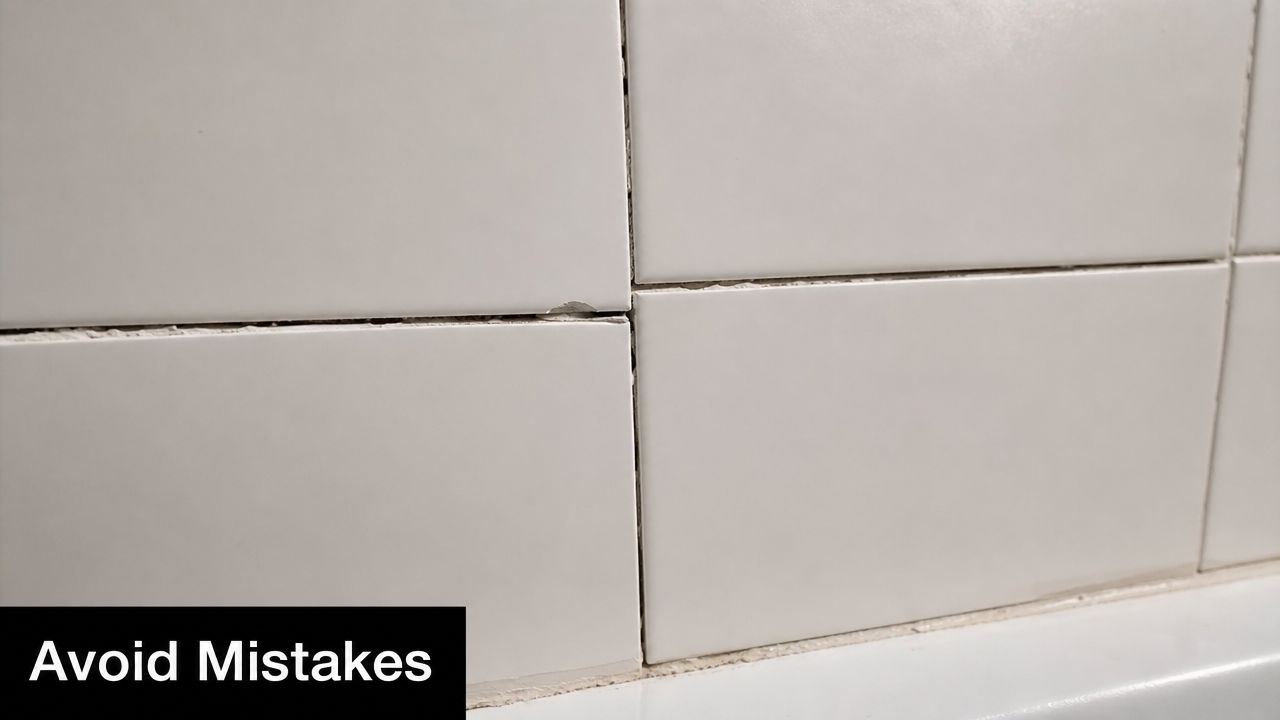
Common examples include:
- Tiling over uncured waterproofing: That traps risk into the room before the finish is even complete.
- Ignoring substrate movement: Cracks, hollow spots and lippage often start here.
- Bad junction detailing: Corners, penetrations and waste areas are frequent failure points.
- Chasing appearance over drainage: Nice tile lines don't help if water doesn't fall correctly to waste.
- Using premium tiles to hide poor prep: Expensive material usually makes defects more obvious, not less.
A recognised failure mode is tiling over uncured or discontinuous waterproofing, especially at junctions and penetrations. Guidance tied to Australian wet-area practice notes that AS 3740 requires these areas to be systematically sealed and cured before tiling starts, as explained in this article on how bathroom tile is laid over waterproofed areas.
A bathroom can survive a dated colour scheme. It won't survive failed waterproofing for long.
Why builder oversight matters in bathroom renovations
Melbourne homeowners sometimes split a bathroom job between separate trades without anyone taking full responsibility for sequencing. That's where defects get born. The plumber assumes the substrate issue has been fixed. The waterproofer assumes the carpentry is final. The tiler assumes penetrations are complete. Nobody owns the junction between trades.
That's why many bathroom renovations benefit from Registered Builder oversight. A builder doesn't just hire people. A competent builder coordinates the order of work, checks whether the room is ready for each trade, and prevents one shortcut from being buried by the next layer.
The homeowner benefit is practical. You get one scope, one sequence and one accountable party managing the room as a wet-area build, not as a patchwork of individual tasks.
Bringing It All Together Your Bathroom Renovation Checklist
A lasting bathroom isn't built by starting with the prettiest tile. It's built by getting the hidden work right and then finishing it with care. This is the difference between a bathroom that still performs years later and one that starts showing defects far too early.
Use this checklist before you commit:
- Scope the job properly: Re-tile, rebuild, or full renovation.
- Match the tile to the room: Don't choose large-format or stone without checking substrate suitability.
- Verify the base: Flatness, movement, falls and junction condition all matter.
- Treat waterproofing as essential: The membrane system has to be complete before tiling.
- Plan the layout: Good set-out prevents poor cuts and awkward visual balance.
- Use the right adhesive and curing sequence: Don't rush grouting or traffic.
- Finish carefully: Grout, seal where required, and install fixtures without compromising the tilework.
- Use qualified trades: Bathroom renovations work best when a Registered Builder coordinates the room as one system.
If you're spending money anywhere, spend it on the work you won't see once the room is complete. That's what protects everything you will see every day.
If you're planning a bathroom renovation and want practical guidance on tile selection, waterproofing, layout, or full project coordination, Melbourne Tiling Services P/L handles bathroom tiling and renovation work across Melbourne with Registered Builder oversight.
Recent Comments