

In Australia, a straightforward vanity installation typically lands between A$400 and A$2,500 depending on whether the existing plumbing stays in place, and Melbourne bathroom renovations often move past A$10,000 once regulated work is included. Once you factor in plumbing, waterproofing, tiling and finish repairs, the vanity stops being a cabinet purchase and becomes a small coordination job.
That's the part most homeowners don't see at first. You're standing in a showroom, comparing two quotes that both say “vanity install”, and one looks cheap enough to sign on the spot. The other is higher, but it's often the one that includes the work older Melbourne bathrooms tend to need.
Table of Contents
- Why a Vanity Quote Is Never Just About the Vanity
- What a Typical Vanity Installation Costs in Australia
- An Itemised Breakdown of Where the Money Goes
- The Factors That Quietly Change the Price
- Melbourne Case Studies Across Three Budget Tiers
- DIY Versus Professional Installation
- How to Get an Accurate Quote You Can Trust
- Smart Ways to Reduce Cost and Avoid Hidden Fees
Why a Vanity Quote Is Never Just About the Vanity
A couple walked into a bathroom showroom in Melbourne with two quotes in hand and the same question every builder hears. One quote was bare bones, the other had a longer breakdown and a noticeably higher total. The cheaper one looked cleaner on paper, but it didn't say much about plumbing movement, wall repairs or disposal, which is exactly where bathroom jobs start to drift.
That's why vanity installation cost in Australia is rarely a single line item. A vanity touches cabinetry, tapware, waste plumbing, waterproofing interfaces, tiling edges and, in many older homes, the wall structure behind the unit. If the rough-in lines up perfectly, the job stays simple. If it doesn't, the price changes quickly.
For Melbourne homeowners, the regulatory side matters too. Once a bathroom renovation includes wet-area work, the project sits inside the world of bathroom renovations and registered builders, not just a cabinet swap. Victorian projects that involve multiple trades need proper sequencing and compliance, which is why a quote that ignores scope is often the one that causes grief later. The practical test is simple, if a tradesperson can't explain how the old vanity comes out, how the new one connects, and what happens if the wall is damaged, the quote probably isn't complete.
Practical rule: the cheapest quote is only the cheapest if it includes the same scope.
The other reason this article exists is the gap between showroom pricing and site reality. Bathroom pricing in Australia is usually discussed as part of a broader renovation budget, because cabinetry, joinery and wet-area labour are where costs tend to move. For homeowners, that means the primary question isn't “What does a vanity cost?”, it's “What does this specific bathroom need to make the vanity fit properly?”
See the compliance angle in more detail at Victorian waterproofing certificate requirements.
What a Typical Vanity Installation Costs in Australia
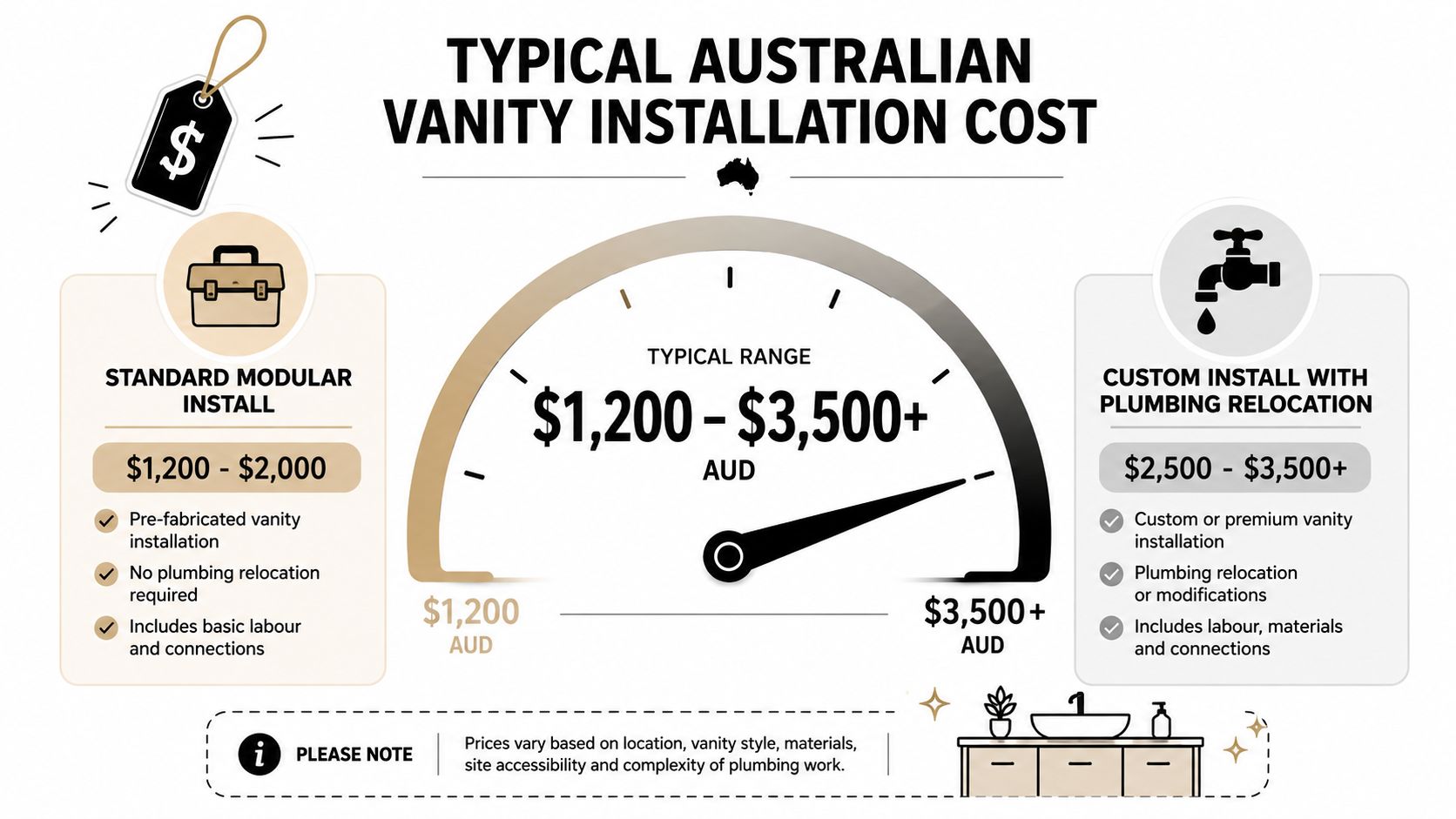
A vanity install is priced as a range because the cost is largely determined by the site conditions, not just the cabinet. In the AU market, a simple vanity swap is usually far cheaper than a full bathroom strip-out if the installer can leave the existing rough-in and waste position alone. Current trade pricing references put standard vanity installation at about A$400 to A$2,500, with basic freestanding units around A$400 to A$900 and larger or custom units climbing above A$2,500 Trusted Tradie Network.
Older Melbourne bathrooms rarely stay in the simple end for long. Once the existing vanity has to come out, the job can expose uneven walls, tired pipework, damaged tiles and awkward clearances that were hidden behind the old unit.
What the low end really assumes
The lower end generally assumes the plumbing stays in place, the vanity matches the existing footprint, and the wall finish behind it needs little or no repair. That is the sort of install where the cabinet arrives ready to fit, the old unit comes out cleanly, and the new one goes back without chasing pipes or reworking tiles. Newer bathrooms with predictable layouts make that job straightforward, but a lot of older homes do not give you that luxury.
Why the upper end climbs fast
Wall-hung cabinetry, stone tops, off-centre tapware and custom widths push the job into a different category. The installer is no longer only fitting a cabinet, the work can also involve carpentry, plumbing adjustment, wall reinforcement and extra labour to get all the details aligned. That is why the same vanity can sit near the bottom of the range in a newer apartment and near the top in a renovation with ageing services.
The quote also sits inside the wider bathroom budget, because vanity installation often triggers related work that sits outside the cabinet price. NSW Government Renovate or Build guidance notes that bathroom renovations can run from about $10,000 for a basic cosmetic refresh to more than $35,000 for a full renovation, with cabinetry and joinery as major drivers NSW Government Renovate or Build guidance. If you want a clearer picture of how vanity work sits inside a larger job, see typical bathroom renovation cost in Melbourne.
An Itemised Breakdown of Where the Money Goes
A proper quote separates the vanity from the work around it. That matters because the cabinet itself is only one part of the job, and in Melbourne bathrooms, the hidden scope often costs more than people expect. Older homes especially tend to need patching, plumbing adjustment and tidy-up work once the old unit comes out.
The best way to read the quote is to trace each cost bucket back to a trade task. That's also where a serious builder or installer earns trust, because itemisation tells you what's included and what isn't. A lump sum with no breakdown is usually the quote that leaves room for disputes later.
| Cost Bucket | What It Covers | What Pushes Cost Up |
|---|---|---|
| Vanity unit | Cabinet carcass, doors, drawers, finish | Custom sizing, wall-hung design, premium materials |
| Benchtop and basin | Laminate, stone, integrated or drop-in basin | Stone tops, integrated basins, non-standard cut-outs |
| Plumbing labour and fittings | Disconnecting, reconnecting, traps, wastes, tap alignment | Plumbing relocation, awkward rough-ins, licensed plumbing work |
| Waterproofing interfaces | Sealing disturbed wet-area joins | Any wall opening, membrane disruption, old shower-adjacent damage |
| Demolition and removal | Taking out the old vanity | Heavy built-in units, tight access, stone tops |
| Disposal | Haul-away and waste handling | Large units, stone tops, difficult site access |
| Tiling patch or repair | Repairing splashback edges or wall finishes | Mismatched tiles, large footprint changes, damaged substrate |
| Electrical adjustments | Shaver points, lighting, nearby outlets | New mirror cabinets, moved outlets, compliance work |
| Builder coordination | Sequencing trades and checking finish quality | Multi-trade jobs, heritage homes, regulated renovation work |
The removal side is worth watching closely. Disposal costs are often bundled, but not always, and vanity removal pricing can vary depending on size and material. Professional removal and disposal is commonly quoted separately from install work, which is why you should ask whether the old unit is being carted away or left onsite vanity removal cost guidance.
For a wider renovation quote that includes surrounding work, see Melbourne bathroom renovation cost guidance.
A clear quote should show how the vanity, the plumbing and the wall finish connect. If one of those pieces is missing, the final bill usually gets larger, not smaller.
The Factors That Quietly Change the Price
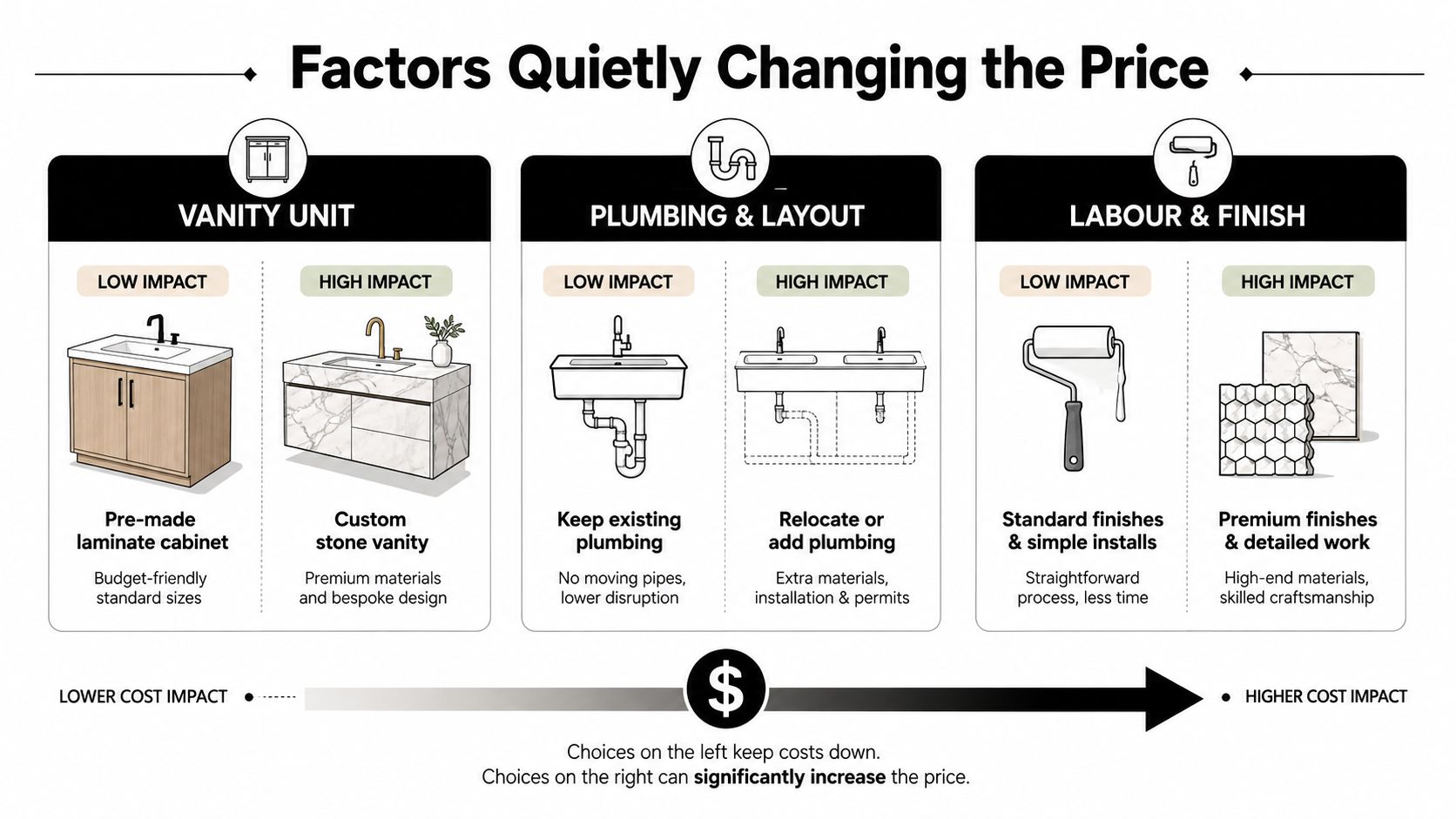
The number on the quote moves fastest when the homeowner changes the geometry of the job. A vanity can look small on a plan and still create a lot of extra labour if the basin shifts, the tap centre changes or the cabinet no longer fits the old opening. That's why two cabinets that look similar in a showroom can produce very different installation totals.
Size, material and cabinet style
A wider vanity costs more to move, more to fix in place and more to line up with the surrounding wall finishes. Materials matter too, because laminate is easier to handle than a stone top, and a custom cabinet usually needs more careful measuring than an off-the-shelf modular unit. Wall-hung vanities also add work because the wall has to carry the load properly.
Plumbing location and wall structure
Keeping the existing plumbing rough-in in place is the simplest path. Move the waste or water lines, and the job becomes a plumbing coordination exercise, not a swap. In many older Melbourne bathrooms, that also means patching tiles, fixing the substrate and sometimes reinforcing the wall behind a floating vanity so the fixings land where they should.
Here's the rule I use when quoting:
- Low scope: same size, same style, same plumbing position.
- Mid scope: different vanity or basin, minor plumbing changes, small wall repairs.
- High scope: wall-hung unit, plumbing relocation, tiling patching, reinforcement or electrical changes.
That's the practical difference between a quick installation and a project that needs trade sequencing. The more the new vanity differs from the old one, the more the job spreads across carpentry, plumbing, tiling and finishing. In older homes, the hidden cost is usually not the cabinet, it's the correction work around it.
Matching the install type to the room
A floor-mounted unit in a neat apartment bathroom is one thing. A floating vanity in a tight heritage room with old services is another. If the layout is changing at all, expect the quote to reflect labour, not just product. That's normal, and it's also why low headline pricing can be misleading when the worksite isn't new.
Melbourne Case Studies Across Three Budget Tiers
A newer apartment in Melbourne's inner suburbs usually gives you the cleanest vanity installation. The cabinet is often a like-for-like replacement, the waste line stays put, and the wall finish may only need a small repair where the old unit came off. In that kind of job, the quote sits near the lower end because the work is mostly removal, refit, and connection, with little hidden scope.
Budget-friendly swap in a newer apartment
This version usually uses a standard modular vanity, a basic basin, and the existing plumbing position. The job stays straightforward because the new cabinet matches the old footprint and the install does not force other trades into the room. If the wall and floor are in decent condition, the price is driven by clean labour rather than repair work.
Mid-range ensuite refresh with custom joinery
A mid-range ensuite often brings in a custom vanity, a stone top, and a more exact basin position. That adds coordination because the cabinet maker, plumber, and installer all need the same measurements to line up properly. In practice, the job stops being a simple cabinet change once splashback tiles or nearby fittings need touch-ups. If the room also needs associated finishing, tile installation services can become part of the scope.
Higher-scope heritage bathroom
Heritage bathrooms are where the quote often grows fastest. Old pipe positions rarely suit a modern wall-hung unit, and the surrounding wall finish usually needs repair after the old vanity comes out. If waterproofing or tile edges are affected, the job turns into a sequence of trades, and registered builders have a clear role in keeping that sequence coordinated.
That coordination is reflected in the total cost, not just the cabinet line. Bathroom renovations in Australia are labour-heavy because plumbing, waterproofing, tiling, and cabinetry all interact, and the Housing Industry Association commentary, as summarised in the Australian renovation context, reflects how sensitive wet-area work is to specification changes Housing Industry Association commentary, as summarised in the Australian renovation context. The lesson is simple, the more the room changes, the less useful a flat vanity price becomes.
A trustworthy Melbourne quote should show each tier clearly. If the installer talks only about the cabinet and leaves out the surrounding trades, the job is probably not being priced at the depth the bathroom needs.
DIY Versus Professional Installation
A DIY vanity swap can work when the job is simple. If the cabinet is the same size, the plumbing lines are already in the right place and you're not opening up wet areas, a competent homeowner can handle removal and refit with basic tools. The moment you touch plumbing alterations or waterproofing, the risk profile changes fast.
The biggest reason to hire a professional in Victoria is compliance. Once the work crosses into plumbing, membrane disturbance or broader bathroom renovation scope, the project stops being a casual weekend job and starts looking like regulated building work. That's where registered builders and licensed trades matter, because they coordinate the sequence and keep the work in the right legal lane.
If you can remove a cabinet without touching the plumbing or the wall finish, DIY can be sensible. If you need a plumber or a waterproofing repair, it usually stops being a DIY saving.
There's also the insurance and resale side. Non-compliant work can create problems later if a pre-purchase inspection flags it, and homeowners don't want to explain an unlicensed bathroom fix when selling. A professional install also carries the practical advantage of accountability, because if something leaks or lifts later, you're dealing with an accountable trade rather than your own weekend patch-up.
For readers comparing a swap with a larger bathroom scope, tile installation services become relevant as soon as splashback repairs or edge tiles need to be matched back in.
How to Get an Accurate Quote You Can Trust
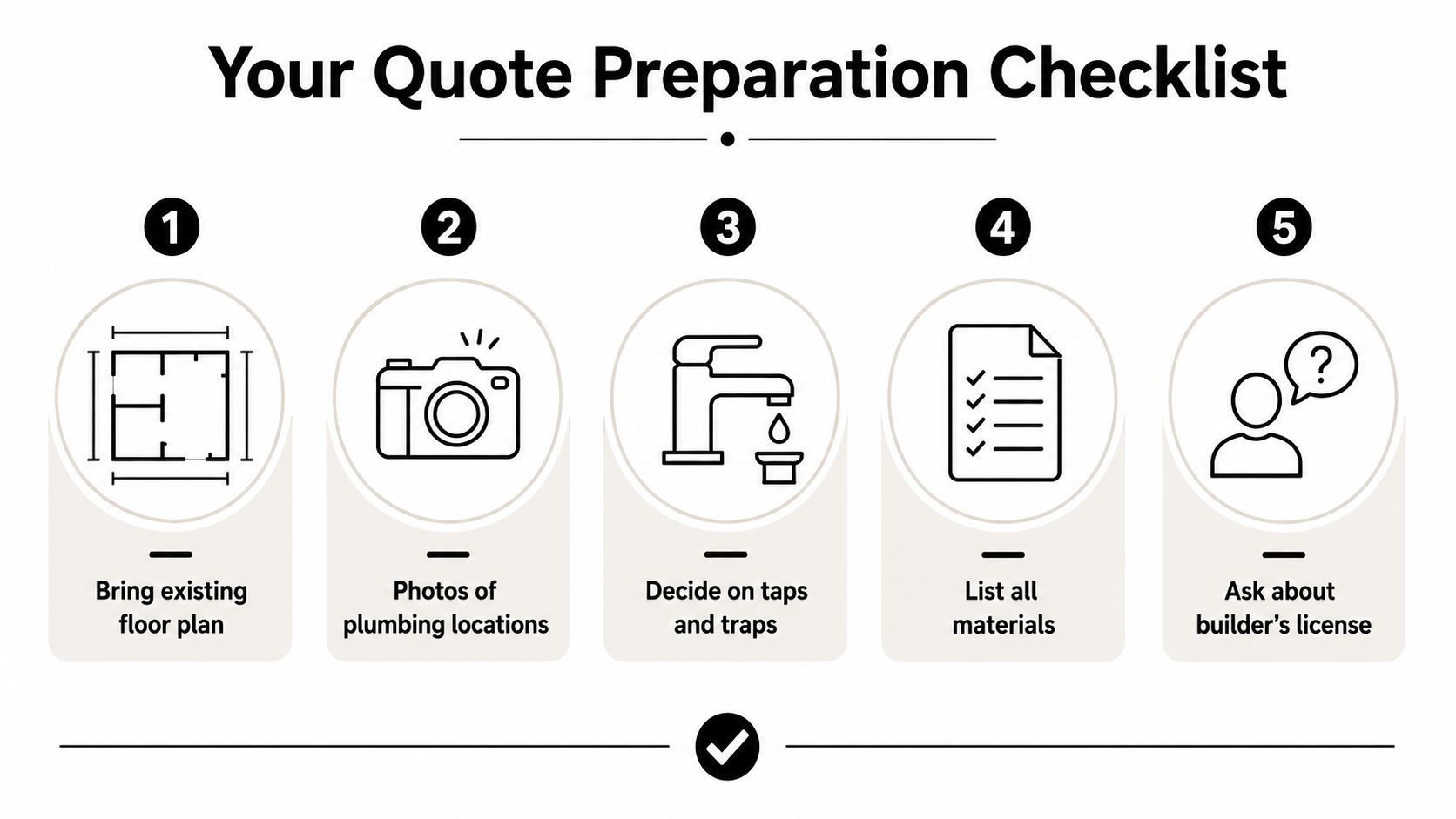
Good quotes start with good information. Before you call anyone, take photos of the bathroom from several angles, note where the taps and waste sit, and keep the existing floor plan handy if you have it. If you know the vanity size, basin type and whether the wall is masonry or framed, include that too.
A serious tradesperson will want to know what's already behind the old cabinet. If you can tell them whether the waterproofing has been recently redone, whether the existing plumbing is centred, and whether the wall is being opened up, they can price the install much more accurately. That saves you from the false economy of the cheapest number on the page.
What to ask every quote giver
- Scope clarity: Ask whether removal, disposal, plumbing reconnects and patching are included.
- Compliance proof: Ask who will carry the plumbing or builder responsibility where needed.
- Fixing method: Ask how the vanity will be anchored if it's wall-hung.
- Finish work: Ask what happens to the splashback edge, the silicone lines and any broken tile.
- Exclusions: Ask what's not included, and have them write it down.
A quote without a labour breakdown is a warning sign. So is one that ignores waterproofing, disposal or any mention of wall repair. Those omissions are exactly what create change orders halfway through the job, especially in older Melbourne bathrooms where nothing behind the old vanity is guaranteed to be neat.
The best quotes line up with the itemised buckets earlier in this article. If the scope list and the price structure don't match, the lowest number probably isn't comparing the same job. Ask for like-for-like quotes, then compare the details line by line instead of chasing the cheapest total.
Smart Ways to Reduce Cost and Avoid Hidden Fees
The cleanest way to save money is to reduce change, not cut corners. Keep the existing plumbing position where you can, choose a vanity width that suits the current opening and avoid custom work unless the room needs it. Those choices limit the chance of extra labour, disposal charges and emergency plumbing call-outs halfway through the project.
Material selection matters too. A simple modular cabinet with a compatible basin is cheaper to install than a heavily customised setup, because the installer spends less time adjusting around it. Bundling the vanity with other planned bathroom works can also help, since the setup and coordination happen once instead of being repeated later.
The hidden fee trap is the quote that sounds cheap because it excludes the hard bits. Disposal, wall repair, tile patching and waterproofing touch-ups are exactly the items that tend to appear once the old vanity is removed. A properly scoped quote from a registered builder usually costs less in total than the lowest headline install price, because it prices the work that has to happen.
If you want help turning a vanity change into a properly scoped bathroom plan, Melbourne Tiling Services P/L handles bathroom renovations, tiling and waterproofing across Melbourne and greater Victoria, with the coordination needed when vanity work crosses into a larger bathroom job. Visit Melbourne Tiling Services P/L to compare your room, your scope and your quote before you sign anything.
Recent Comments