
You're probably in the same spot as a lot of Melbourne homeowners. You want a bathroom that feels sharper than the standard white box, but you don't want to spend good money on something that dates quickly, stains easily, or starts showing movement cracks after a couple of winters and a few hot showers.
That's where terrazzo bathroom tiles come into the conversation. They've got character, they work in both older Victorian homes and newer apartments, and they can look either quiet and refined or bold enough to carry the whole room. But terrazzo only performs well when the renovation is handled properly from the framing and substrate through to waterproofing, slip resistance, tile selection, and final finishing.
In Melbourne, that matters more than most style-led blogs admit. Bathroom renovations here often involve uneven floors, old timber structures, moisture issues, and compliance requirements that can't be left to guesswork. A registered builder who understands the whole assembly, not just the tile face, is what separates a polished result from an expensive rectification job.
Table of Contents
- Why Terrazzo Is the Timeless Choice for Melbourne Bathrooms
- What Exactly Are Terrazzo Tiles?
- Is Terrazzo a Good Choice for Your Bathroom?
- Designing Your Dream Bathroom with Terrazzo
- Getting the Terrazzo Installation Right
- Budgeting and Caring for Your Terrazzo Bathroom
- Your Next Steps for a Perfect Terrazzo Bathroom in Melbourne
Why Terrazzo Is the Timeless Choice for Melbourne Bathrooms
You see it most clearly five or ten years after the renovation. The bathroom still looks current, the floor still feels solid underfoot, and the tile choice has not dated the room.
That long life is why terrazzo keeps turning up in well-planned Melbourne bathroom renovations. It has visual movement, so it does not read flat or cheap, but it also avoids the short shelf life that comes with many highly patterned trends. A good terrazzo selection can blend into the background or carry the whole design, depending on the chip size, base colour, and finish.
Melbourne homes benefit from that flexibility. In an Edwardian or Californian bungalow, terrazzo can pick up the softer, heavier character of the house without feeling faux-heritage. In a new apartment or townhouse, the same material can look sharp and restrained. If you are still comparing options, it helps to understand how terrazzo sits alongside stone, porcelain, and ceramic in a bathroom renovation. This guide to bathroom tiling materials and finishes is a useful starting point.
It suits both period homes and modern apartments
The material gives you range without losing durability. Fine-chip terrazzo in warm white, pale grey, or muted beige works well in bathrooms where the joinery, tapware, or lighting is doing the heavy lifting. Larger aggregate, stronger contrast, or coloured chips bring more energy and suit powder rooms, feature walls, and bolder schemes.
That matters in Melbourne, where many renovations are trying to balance resale, daily use, and the character of the existing home.
Practical rule: If you want a bathroom to hold up visually, choose a finish that gives you design flexibility without creating maintenance headaches. Terrazzo usually does that better than trend-driven decorative tiles.
It rewards a full renovation approach
Terrazzo performs best in bathrooms that are rebuilt properly, not patched around old problems. In Melbourne, that often means dealing with uneven subfloors, tired wall linings, out-of-level framing, and wet area details that no longer meet current expectations.
As a registered builder and tiler, I look at terrazzo as part of the whole bathroom build. Floor waste position, falls, sheet set-out, waterproofing build-up, movement joints, and transition heights all affect whether the finished room looks premium or disappointing. The tile may be the feature people notice first, but the result depends on the structure and preparation underneath it.
That is one reason terrazzo has stayed relevant. It rewards good design, but it also rewards proper construction, which is exactly what a full bathroom renovation should deliver.
What Exactly Are Terrazzo Tiles?
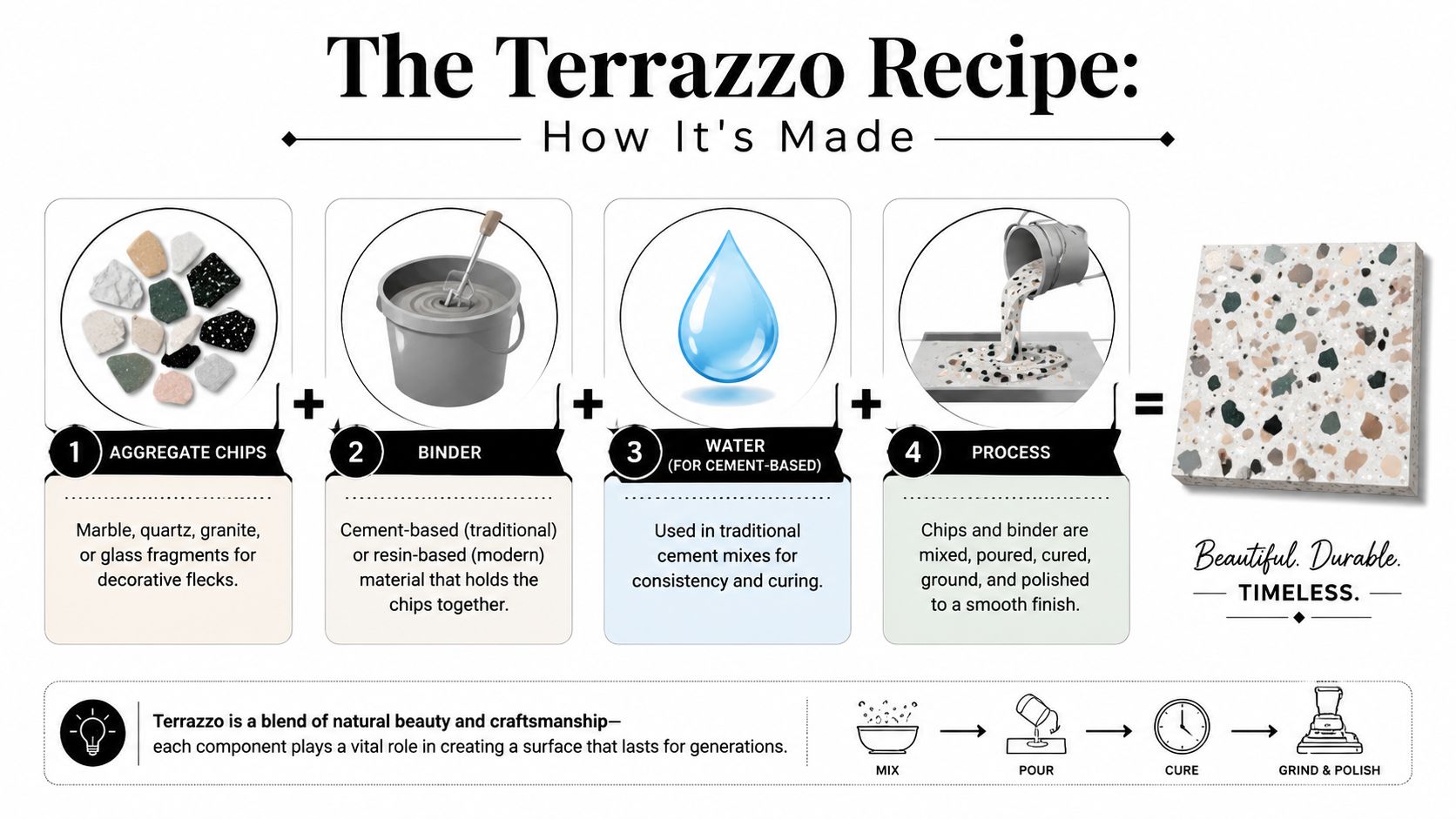
Terrazzo is easiest to understand as a recipe. You've got decorative chips, called aggregate, and you've got a binder that holds those chips together. Once the mix cures, the surface is ground and polished or honed to expose the pieces and create the finished pattern.
The basic recipe
The aggregate is where the look comes from. That can include marble, quartz, granite, or glass fragments. The binder is what changes the behaviour of the tile.
Most homeowners will come across three categories:
- Cement-based terrazzo uses a cement matrix with aggregate mixed through it. It has a more traditional feel and more natural variation.
- Epoxy-based terrazzo uses a resin binder. It's commonly chosen where a more uniform, less porous finish is wanted.
- Terrazzo-look porcelain isn't true terrazzo, but it reproduces the look on a porcelain body and is often the simpler option for standard residential bathrooms.
If you're comparing materials for a renovation, it helps to understand the broader differences between stone, porcelain, ceramic and specialty tile products before locking anything in. This guide to bathroom tiling materials and finishes is useful for that early selection stage.
Comparison of terrazzo tile types
| Attribute | Cement-Based Terrazzo | Epoxy-Based Terrazzo | Terrazzo-Look Porcelain |
|---|---|---|---|
| Composition | Cement binder with stone or glass aggregate | Resin binder with decorative aggregate | Porcelain tile with terrazzo-style printed surface |
| Look | Natural, solid-body, traditional depth | Cleaner, more uniform, often more seamless in appearance | Highly consistent and easier to match across batches |
| Best use | Floors and feature areas where mass and authenticity matter | Commercial-style wet areas and low-maintenance surfaces | Standard residential walls and floors |
| Maintenance | May need more ongoing attention depending on finish and sealing | Lower maintenance in many wet-area applications | Straightforward everyday care |
| Installation demands | Heavier and more dependent on sound substrate prep | Demands proper system selection and adhesion | Usually the most familiar format for residential tilers |
| Budget position | Often premium | Often premium | Usually the easier entry point |
Terrazzo isn't one single product. Clients often use one word for three very different materials, and that's where bad selections start.
The important part is this. If you change the binder, the tile body, or the way the face is made, you also change weight, installation method, maintenance, and cost. That's why the selection shouldn't be based on appearance alone.
Is Terrazzo a Good Choice for Your Bathroom?
A client walks into a period home in Melbourne, points at a terrazzo sample, and says they want that same finish across the floor, shower, and vanity wall. The right answer depends on more than the sample board. It depends on the structure under the room, the slip rating of the selected tile, the waterproofing build-up, and whether the product suits the way the bathroom will be used.
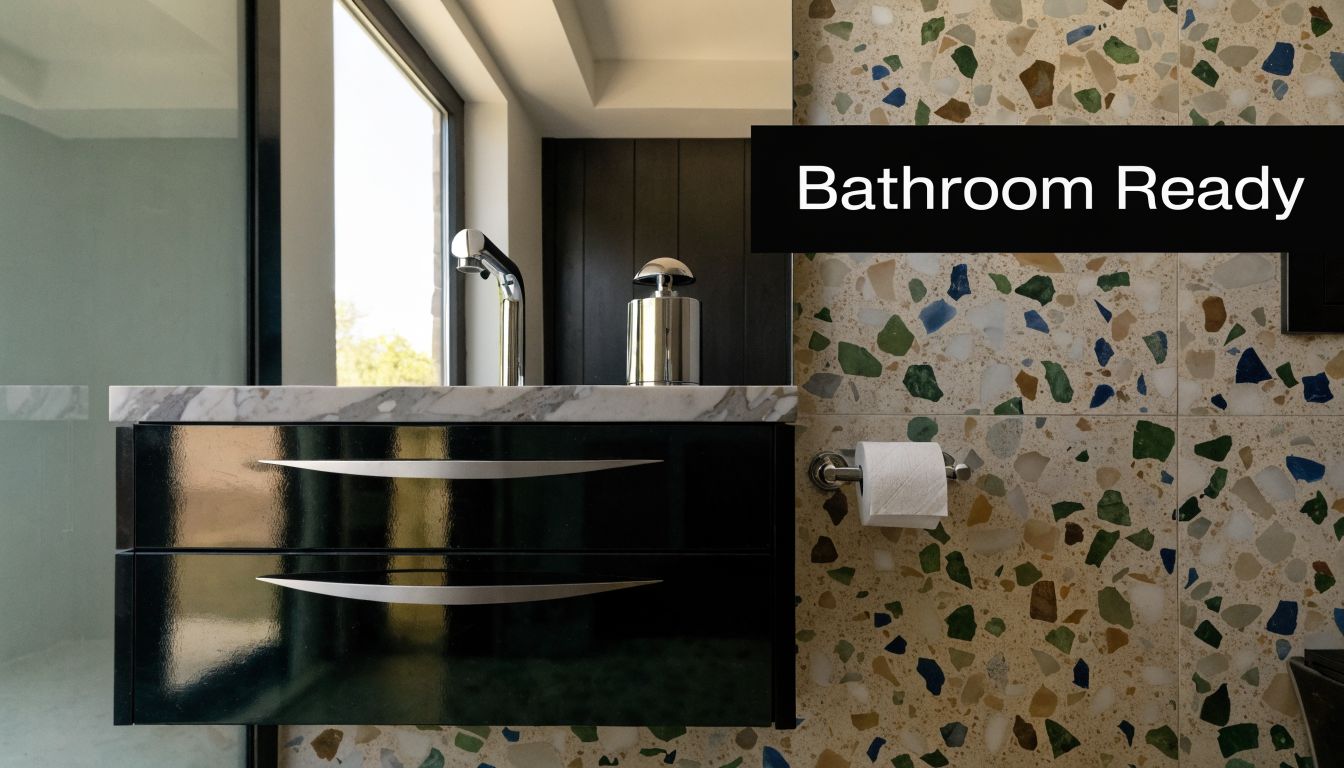
In a well-managed renovation, terrazzo is a strong bathroom choice. It wears well, it has real visual depth, and it suits both contemporary and older Melbourne homes. But it only performs properly when the tile selection, substrate preparation, falls, waterproofing, and movement control are handled like part of the building work, because that is exactly what they are.
Where terrazzo performs well
Terrazzo earns its place in bathrooms that need to last.
It handles regular foot traffic, cleaning, moisture exposure, and the knocks that come with family use. It also gives a room more character than a flat plain tile, without forcing a loud pattern into a small space. In tight ensuites, that balance matters. You get movement and texture, but the room can still feel calm and controlled.
It also works well when the bathroom is being planned as a full renovation rather than a cosmetic update. If comfort is part of the brief, terrazzo can be incorporated with under tile heating in a bathroom renovation, provided the floor build-up, adhesive system, and expansion allowances are set out properly from the start.
Where terrazzo can go wrong
The failures are usually predictable.
The first is structural. Many Melbourne bathrooms sit over older timber floors or mixed substrates that have already moved over time. Cement-based terrazzo and larger-format terrazzo tiles are far less forgiving than clients expect. If the floor has deflection, poor sheet fixing, patchy levelling, or inconsistent screed thickness, the finished surface will show it.
The second is safety. A polished terrazzo sample can look excellent under showroom lighting and still be the wrong floor for a wet area. For bathroom floors, the product has to be checked against the required slip resistance classification, including the practical realities of bare feet, soap residue, and regular water exposure. In Australia, that means looking closely at AS 4586 test information before the tile is approved for use.
The third is maintenance expectation. Some clients want authentic cementitious terrazzo because they like the natural depth and variation. They also want porcelain-level simplicity and a lower install cost. Those goals can conflict. A builder should set that out early, before the tile order is placed and before waterproofing heights and floor transitions are locked in.
The practical decision
Terrazzo suits owners who want a bathroom built for long-term use and are prepared to spend money where it counts. That means stable substrates, compliant waterproofing, correct adhesives, proper falls to waste, and a finish selected for the right location.
If the project budget is tight, the existing floor is marginal, or the bathroom is being refreshed without correcting underlying building issues, terrazzo may not be the smartest choice. In those cases, a more forgiving tile can produce a better result.
Used in the right bathroom, and installed properly, terrazzo is not a risky design move. It is a durable, high-end finish that rewards good building practice.
Designing Your Dream Bathroom with Terrazzo
A good terrazzo bathroom doesn't happen by choosing a random speckled tile from a display wall. It comes from controlling three design decisions properly. Finish, aggregate, and base colour.

Start with the finish
On walls, a smoother and more polished face can work beautifully because it reflects light and lifts the room. On floors, the decision has to be more disciplined. In a wet bathroom, safety and feel underfoot matter more than showroom shine.
A honed or matte finish usually gives the room a more grounded, architectural look anyway. It also hides water spotting better than an overly glossy finish. That matters in family bathrooms where the room gets used hard, not staged for photos.
If you're planning comfort features at the same time, terrazzo also sits well within a broader bathroom build that includes heating and upgraded floor systems. If that's part of your renovation brief, look at under tile heating for bathroom renovations before final tile selections are locked in.
Choose the aggregate and base colour
The room's personality shows up here.
Small aggregate in a close-toned base gives a quieter finish. That suits compact ensuites, bathrooms with strong brassware, or homes where you want the tile to feel expensive without shouting. Larger chip terrazzo is bolder. It's great for a feature wall, vanity splashback, or a powder room where you want more energy.
A straightforward approach:
- Fine chip plus soft grey or warm white base gives a more refined, almost monolithic feel.
- Mid-size marble aggregate adds classic texture without looking busy.
- High-contrast or multicolour chip works best when the rest of the room is restrained.
Don't choose from a tiny sample alone. View the tile beside your vanity finish, tapware colour, shower screen trim, and actual bathroom lighting. Terrazzo changes character a lot depending on the surrounding materials.
Where large format terrazzo-look panels fit
Large-format terrazzo-look slabs are becoming more common in Melbourne bathrooms, especially on walls where clients want fewer grout joints and a cleaner visual plane. A recent Melbourne-focused trend is the use of Kerlite slabs up to 3 x 1.5m, with imports reported to have surged 40% in 2025, and the attraction is obvious because fewer grout lines mean easier cleaning and a more continuous finish. The trade-off is that they need precise substrate preparation and licensed installation in humid Victorian conditions, as noted in this discussion of modern terrazzo-look slab applications.
This short video gives a useful visual reference for the kind of finish clients are often trying to achieve with terrazzo in contemporary bathrooms.
Large format surfaces can look outstanding, but they're less forgiving than standard tile modules. If the walls aren't straight, the corners aren't true, or the substrate hasn't been prepared correctly, the result won't look premium no matter how expensive the slab is.
Getting the Terrazzo Installation Right
A terrazzo bathroom can look first-rate on handover and still fail early if the build-up underneath is wrong. In Melbourne renovations, I see the same causes come up again and again. Poor falls, movement in old timber floors, the wrong finish under wet feet, and waterproofing that was treated as a paperwork item instead of a construction sequence.
Slip resistance comes before shine
Clients often start with the face of the tile. In a bathroom, I start with how it performs when wet.
Terrazzo on bathroom floors needs to suit AS 4586 slip resistance requirements. That usually points to a honed or otherwise slip-rated finish on the floor, especially in shower zones and on the main bathroom path where people step out with wet feet. A polished surface can still work well on walls, vanity cladding, or other low-risk areas, but floor selections need a different standard.
That trade-off matters in real use. A finish that photographs well under showroom lighting can feel risky at 6am on a cold winter morning.
A bathroom floor should feel secure every day, not just look good on install day.
Waterproofing and adhesion decide whether the room lasts
Tiles are the wear surface. They are not the waterproofing system.
In a full bathroom renovation, the sequence matters. Substrate correction comes first, then falls, sheeting, junction treatment, membrane application, and only then tiling. If those steps are out of order, or if products are mixed without checking compatibility, terrazzo will not hide the mistake. It usually highlights it through drummy tiles, cracked grout, stained edges, or moisture showing up in adjoining rooms.
For that reason, I always look closely at:
- Substrate stiffness and deflection, especially in older Victorian and post-war homes with timber floors
- Falls to wastes, so water moves to the drain instead of sitting against walls or glass
- Membrane detailing at corners, hobs, niches, and penetrations
- Adhesive selection and coverage, particularly with heavier terrazzo or low-porosity terrazzo-look porcelain
- Movement joints and perimeter allowances, so the tiled surface has room to behave properly
If you are reviewing a renovation scope, ask who is responsible for waterproofing compliance and what documentation is issued at completion. A proper Victorian waterproofing compliance certificate for wet areas is part of a properly managed build, not an optional extra.
Substrate prep in Melbourne homes
At this stage, many bathroom budgets are often strained.
A lot of Melbourne homes have floors and walls that are out of plane before demolition even starts. Once the old finishes come off, you can find bouncing joists, patched sheet substrates, old screeds, or previous work laid over surfaces that should have been removed. Terrazzo, particularly larger modules and heavier material, wants a stable base. If the floor moves or the walls are not true, the finished room never looks as crisp as the sample board.
In practice, that can mean sistering or correcting joists, resheeting walls, rebuilding shower bases, screeding for proper falls, or using levelling compounds to get walls and floors within tolerance. None of that is decorative work. It is the part that allows the visible finish to sit flat, drain properly, and stay bonded.
Tile thickness matters too, but it needs to be assessed against the product type, substrate, and application rather than treated as a shortcut on price. In a builder-managed renovation, the right question is not “what is the thinnest tile we can use?” It is “what assembly suits this room, this structure, and this waterproofing system?”
The installation standard has to match the tile choice
Terrazzo can be natural cement-based material, resin-based product, or terrazzo-look porcelain. They do not all install the same way.
Cementitious terrazzo is heavier and less forgiving of movement. It also needs good handling, clean cutting, and proper sealing where specified. Porcelain terrazzo-look tiles are usually easier to maintain and more dimensionally consistent, but they still need proper substrate prep, full adhesive support, and accurate set-out if you want the room to read as premium rather than patched together. Large chips, directional patterns, and strong colour variation all need planning before the first tile is fixed.
Set-out is often overlooked. I would rather spend more time resolving grout lines, drains, niches, and threshold transitions on paper than try to solve them with small cuts on the day. That is usually the difference between a bathroom that feels resolved and one that looks close, but not quite right.
Good terrazzo installation is careful work. The finish gets the attention, but the result comes from the prep, the sequence, and the compliance behind it.
Budgeting and Caring for Your Terrazzo Bathroom
A terrazzo bathroom can look expensive for the right reasons, or expensive for the wrong ones. The difference usually comes down to what was allowed for before the first tile was ordered.
Clients often focus on the tile rate per square metre. In a full Melbourne bathroom renovation, that is only one part of the budget. The bigger swings usually come from floor correction in older homes, wall straightening, waterproofing, drainage detailing, and the labour needed to set terrazzo out properly so the room reads clean and intentional.
Where the money actually goes
Terrazzo sits across a wide price range. Cementitious terrazzo, resin-based products, and terrazzo-look porcelain all carry different supply costs, handling requirements, and maintenance demands. The right choice depends on the room, the substrate, and how much ongoing care you are comfortable with.
In practice, budget pressure tends to show up in four places:
- Substrate repairs and preparation for movement, deflection, out-of-level floors, or poor past renovation work.
- Wet-area construction including screeds, shower falls, waterproofing, and compliant junction detailing.
- Tile size, weight, and cutting complexity, especially around linear drains, niches, hobless entries, and tight bathroom footprints.
- Finishing work such as trims, mitres, expansion joints where required, and cleaner transitions at doorways and fixtures.
I often observe poor decisions made. Cheapening the build by reducing prep, rushing set-out, or choosing a product unsuited to the structure rarely saves money once rectification is on the table.
A good quote should break the job into clear parts: demolition, carpentry or builder's rectification work, plumbing, electrical, waterproofing, tiling, glazing, cabinetry, and fittings. If those items are bundled too loosely, it becomes hard to see whether the allowance is realistic or whether costs have been pushed to variations later.
How to look after it properly
Maintenance is straightforward if the material is matched to the bathroom and installed properly.
- Use pH-neutral cleaners on a regular basis. Acidic cleaners can mark or dull some terrazzo surfaces.
- Keep soap scum and mineral build-up under control with routine cleaning, especially in showers and around basins.
- Reseal cement-based terrazzo if the manufacturer calls for it. Maintenance schedules vary by product.
- Repair chips, cracked grout, or failed sealant early so water does not track into the assembly.
Porcelain terrazzo-look tiles are usually the easiest option for busy households. They are consistent, simple to clean, and less demanding over time. Cementitious terrazzo has more depth and character, but it asks for better product selection, more care during installation, and a bit more attention after handover.
That trade-off is worth making for some bathrooms. It is not the right move for every one. A builder-managed renovation should price the material accurately, explain the upkeep clearly, and match the specification to the way the bathroom will be used.
Your Next Steps for a Perfect Terrazzo Bathroom in Melbourne
A Melbourne bathroom can look straight, clean, and ready for tile, then show its real condition the moment demolition starts. I see it often in older homes. Uneven floors, patched sheeting, out-of-square walls, and tired framing all affect whether terrazzo will finish sharply or fight the build the whole way.
Start with the room, not the colour chart. Check the substrate, the shower set-down or floor waste layout, the amount of natural light, and who will use the bathroom every day. A terrazzo tile that looks refined in a showroom can read busy in a compact ensuite, especially under warm downlights or against veined stone and brushed metal finishes.
Get samples in hand. Put them on the floor and against the wall finish. View them morning, afternoon, and at night with the actual lighting switched on. That simple step avoids a lot of second-guessing once the tile order is placed.
Then choose the team who will carry the whole wet-area build. Terrazzo works best when the builder, waterproofer, tiler, plumber, and electrician are working to one plan and one set of tolerances. In a full renovation, that matters more than the tile itself. Falls need to be right, junctions need to be clean, movement needs to be allowed for, and the waterproofing system needs to suit the substrate and layout.
That is why a registered builder is often the right lead on a terrazzo bathroom in Melbourne. Victorian homes regularly need correction before tile goes down, and those adjustments sit across several trades, not just tiling. One party coordinating demolition, rectification, compliance, and finishes usually gives a better result than splitting the job between separate contractors.
Ask for a quote that shows the build sequence clearly, the tile specification, who is responsible for substrate preparation, and how waterproofing and slip resistance will be handled. If those items are vague, the risk usually turns up later as delays, variations, or finishing compromises.
A terrazzo bathroom can look outstanding for years. The projects that stay that way are the ones where the builder gets the structure, the wet-area detailing, and the tile setting right before anyone starts talking about styling.
If you're planning a terrazzo bathroom renovation and want one team to handle the design, waterproofing, substrate prep, tiling, and builder coordination properly, talk to Melbourne Tiling Services P/L. They deliver start-to-finish bathroom renovations across Melbourne and greater Victoria, with registered builder oversight, compliant wet-area systems, and the kind of detail work terrazzo demands.
Recent Comments