

You're probably at the point where the bathroom no longer feels like a room you want to work around. Tiles are dated, grout is stained, the shower might be leaking, and every second contractor seems to promise a clean, fast job without explaining what actually happens below the surface. That's where most renovation stress starts.
A bathroom renovation looks simple from the outside. Pick a tile, choose a vanity, lock in a shower screen. In practice, the finish only lasts when the base is right. Screeding, substrate correction, waterproofing, falls to waste, tile selection, movement control, and trade coordination all have to work together. If one step is rushed, the pretty part on top won't save it.
Table of Contents
- Your Melbourne Bathroom Renovation Starts Here
- What Our Tile Installation Services Truly Include
- Our Step-by-Step Project Process From Design to Delivery
- Transparent Pricing for Your Melbourne Tiling Project
- Common Tiling Problems and Our Expert Solutions
- Seven Critical Questions to Ask Your Tiling Contractor
- The Melbourne Tiling Services Difference
Your Melbourne Bathroom Renovation Starts Here
Most Melbourne homeowners begin with the visible decisions. Wall tile or stone look porcelain. Matte black or brushed nickel. Floating vanity or full-depth joinery. Then the hard part appears. Who's handling demolition, waterproofing, plumbing, electrical, tiling, permits, sequencing, and defect responsibility if something goes wrong months later?
That's the gap between a tile job and a bathroom renovation. One is a trade package. The other is a managed building project.
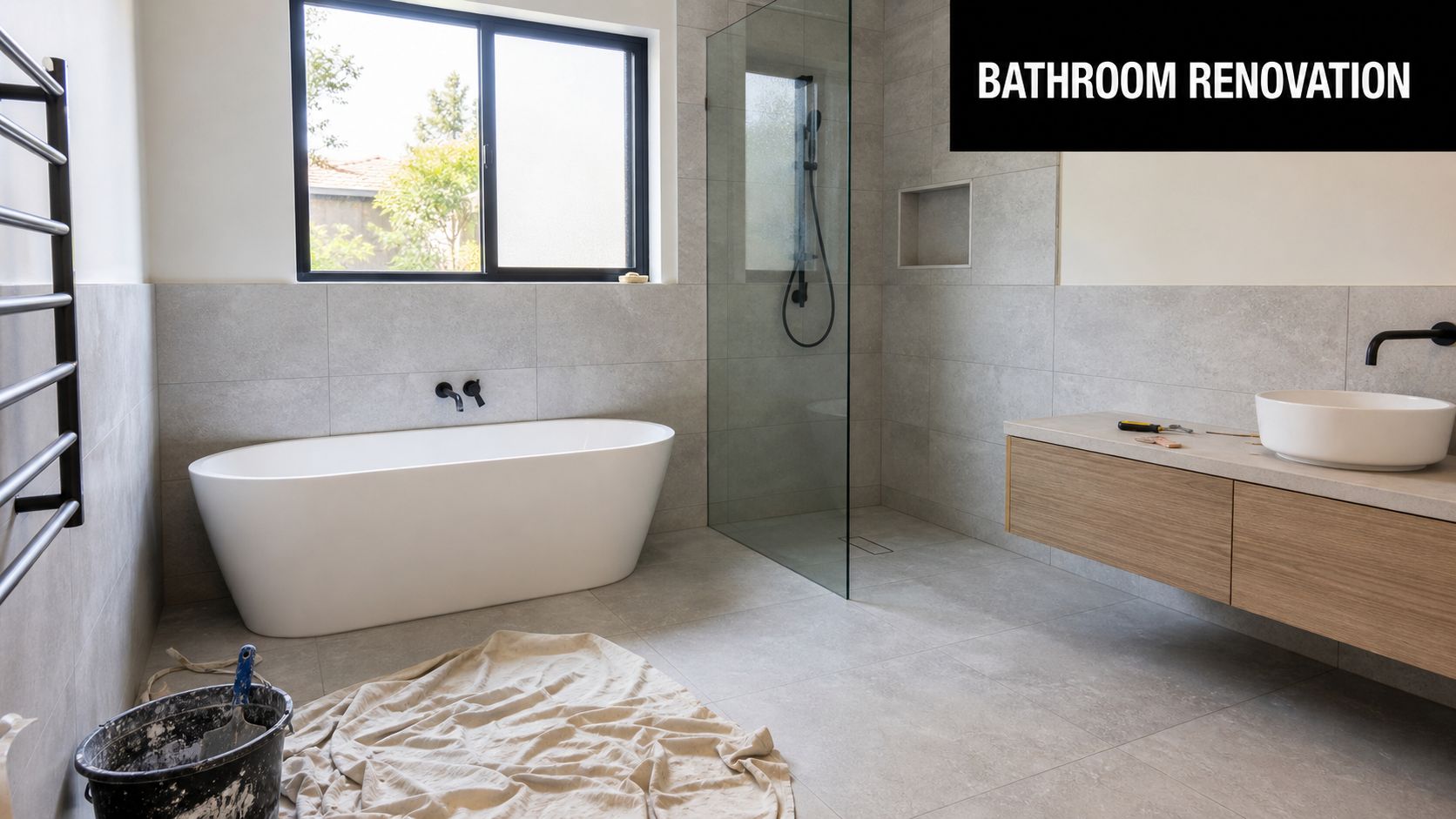
As a registered builder and master tiler in Melbourne, I've seen the same pattern repeatedly. Homeowners get excited by samples and showroom displays, then get stuck trying to compare quotes that don't include the same scope. One contractor prices tiling only. Another allows for demolition but not substrate correction. Someone else says waterproofing is included but doesn't explain the system, the sequencing, or who is accountable for the whole wet area.
A renovation needs one accountable process
The reason this matters is simple. Bathrooms fail in hidden places first. Water tracks into junctions, movement telegraphs through the substrate, and poor falls leave moisture where it shouldn't sit. By the time the surface shows a problem, the underlying cause has usually been there for a while.
Practical rule: If a quote spends more space on tile brands than on preparation and waterproofing, it's missing the part that protects the room.
There's strong demand for qualified contractors in this space. The Tiling & Carpeting Services industry in Australia is projected to reach $8.0 billion in revenue by 2026, with over 20,000 registered businesses, according to IBISWorld's Australian tiling and carpeting services industry report. Demand is not the issue. The challenge is separating surface-level sales talk from proper building practice.
What homeowners usually want
Most clients aren't chasing complexity. They want a bathroom renovation that's organised, clean, compliant, and finished properly.
- Clear scope: They want to know what's included before demolition starts.
- Registered builders: They want one party managing trades and responsibility.
- A durable finish: They want the room to look sharp now and still perform years later.
- Straight answers: They want to understand why a floor needs screeding or why a shower can't just be regrouted and forgotten.
That's the right starting point. A bathroom that lasts is built from the substrate up.
What Our Tile Installation Services Truly Include
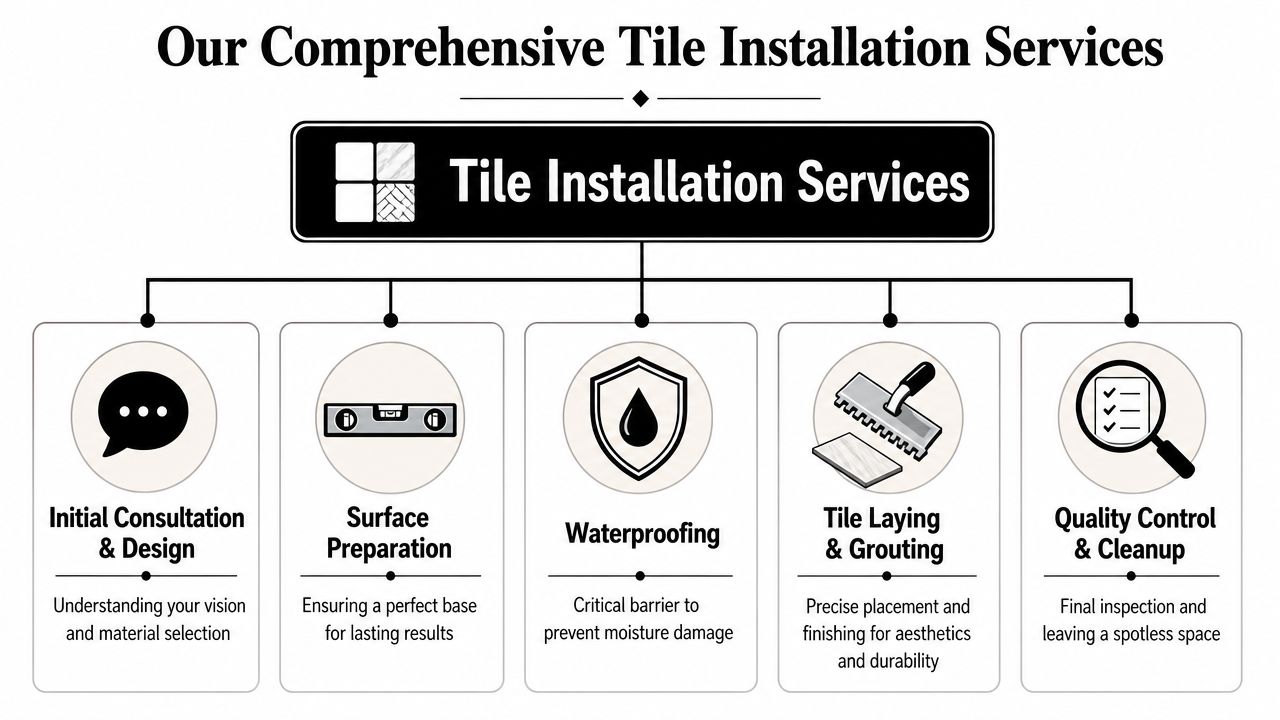
Tile installation services should never mean only laying tiles. In a bathroom, the visible finish is the last stage of a technical build-up. If the room isn't assessed, prepared, waterproofed, and set out correctly, the tile layer is covering risk instead of completing a system.
The work beneath the tile matters most
A proper installation starts with assessment of the substrate. That includes flatness, movement, moisture risk, and the condition of corners, penetrations, and waste locations. In wet areas, waterproofing isn't a cosmetic extra. It's the sealed barrier that protects framing, sheeting, adjoining rooms, and the structure below.
Screeding and self-levelling come before tile adhesive for a reason. Think of them as the calibration stage. They create the plane and falls that the finished floor will follow. If the base is out, the tile won't correct it. It will only reveal it more clearly.
A complete scope commonly includes:
- Demolition and strip-out: Removing failed finishes so the substrate can be inspected properly.
- Substrate preparation: Grinding, patching, screeding, self-levelling, and correcting falls.
- Waterproofing: Treating the wet area as a protective system, not a single product.
- Tile laying and grouting: Setting out, cutting, fixing, spacing, movement allowance, and finishing.
- Final fit-off items: Including details such as frameless shower screens where the layout and levels have already been planned for them.
Good tile work starts long before the first tile is laid. The floor and walls need to be made ready to receive the finish.
Large-format tiles change the installation method
Large-format porcelain, stone, and products such as Kerlite demand tighter control than standard-format tile. You can't treat them like a forgiving surface finish. They telegraph every hump, dip, and twist in the substrate.
For these materials, substrate flatness tolerance cannot exceed 1.5mm per 600mm, as set out in Ardex Australia Technical Bulletin TB001.010 for fixing large format tiles. If that tolerance is missed, you get lippage, visual ridges, awkward reflections, harder cleaning, and a result that never looks settled. That's why experienced installers use laser levels, straight edges, self-levelling compounds, and disciplined set-out.
Material choice also affects the installation method. Different tile bodies, thicknesses, and edge profiles need different handling. If you're comparing finishes, it helps to understand how the tile itself changes the labour and substrate requirements. A practical starting point is reviewing different tiling materials and how they behave in wet areas.
Registered builders manage the whole room, not just the tile
The biggest difference with a registered builder is scope control. Bathrooms involve more than tiling. Plumbing rough-in affects waste position and falls. Electrical work affects wall chases, lighting, and heated accessories. Carpentry and sheeting affect the final line of every wall. Shower screen installation depends on accurate levels and square openings.
That coordination matters because bathroom renovations don't fail one trade at a time. They fail where trades meet.
One practical option in Melbourne is Melbourne Tiling Services P/L, which handles bathroom renovations, screeding, waterproofing, tile installation, and framed or frameless shower screen integration under registered builder management. The value in that model is straightforward. The person responsible for the finish is also responsible for the build-up that supports it.
Our Step-by-Step Project Process From Design to Delivery
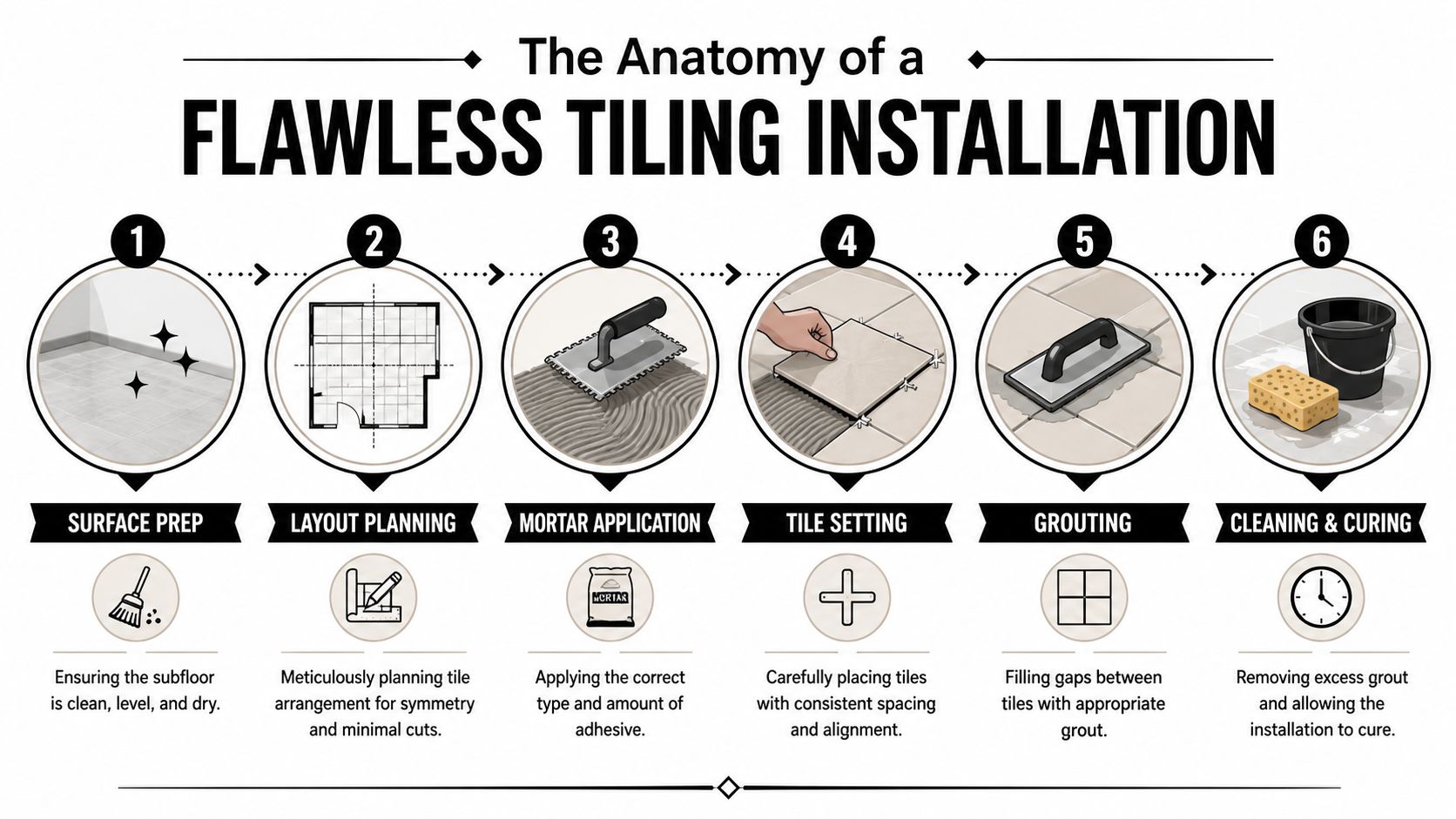
A well-run project should feel predictable. Clients shouldn't be guessing what happens next, who's turning up, or whether the job is ready for the next trade. That's why the process matters as much as the workmanship.
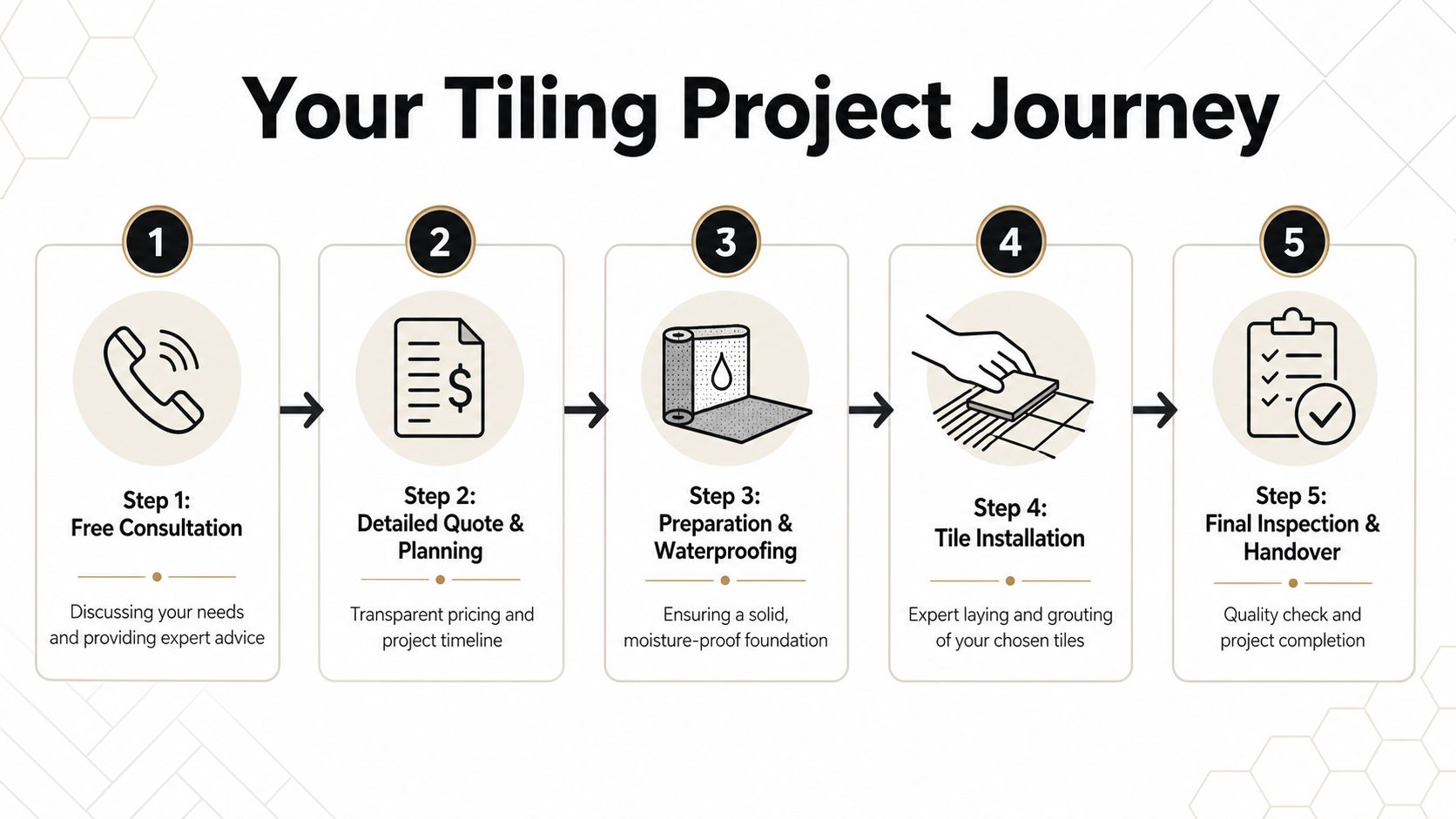
Early in the planning stage, it helps to see the project journey visually.
From first meeting to fixed scope
The first step is a site meeting and discussion about layout, finishes, practical use, and budget range. That's where problems are usually identified early. Existing leaks, movement, poor drainage, low door clearances, awkward plumbing locations, or unrealistic tile choices for the substrate all need to be addressed before a quote becomes meaningful.
Once the room is understood, the project scope is documented properly. For bathroom renovations, 3D drawings are useful because they flush out decisions before site works begin. Niche positions, set-out lines, waste locations, vanity depth, shower screen clearances, and feature tile alignment are far easier to correct on paper than after waterproofing.
Preparation, approvals and coordinated trades
The middle stage is where good builders separate themselves from patch-up operators. Demolition is controlled, the room is stripped back, and the substrate is assessed in real conditions. Then the corrective work starts. Falls are formed, walls are straightened, and wet areas are prepared for membrane application.
If the floor needs correction, proper screeding for tiles becomes part of the build, not an optional extra. That's often the hidden factor that decides whether the finished bathroom looks crisp or troubled.
For some bathroom renovations in Australia, council fees for building permits can range from $500 to $1,000 or more, as noted in Three Birds Renovations' guide to bathroom renovation costs. Registered builders handle that compliance side so the project isn't left drifting between trades and approvals.
This video gives a useful visual sense of how a tiled wet area comes together in practice.
Installation, finishing and handover
Once the substrate and waterproofing are ready, tile installation becomes a precision exercise rather than damage control. Set-out is checked, cuts are planned, and focal lines are established so the room reads cleanly. Here, discipline is paramount. A well-installed bathroom feels calm because the geometry is resolved.
The final stage includes grouting, sealing where required, silicone detailing, fixture installation, and fit-off items such as a frameless shower screen. Then the room is checked as a complete bathroom, not a collection of separate trade tasks.
A reliable handover should cover:
- Scope completion: The installed items match the agreed drawings and selections.
- Finish review: Levels, joints, edges, trim details, and drainage are inspected.
- Practical care advice: You're told what to clean with, what to avoid, and what curing periods still apply.
Transparent Pricing for Your Melbourne Tiling Project
Cost matters because bathroom work combines visible finishes with hidden construction. Two quotes can look close on paper and be completely different in what they allow for. The safest way to assess price is to break it into parts. Materials, labour, preparation, and builder management all shape the final figure.
What drives the final price
Across Australia, the cost to install floor tiles can range from $30 to $150 per square metre, with labour adding another $30 to $120 per m², according to Hipages' guide to floor tile installation costs. That range is broad because not all tile work is equal. A simple floor in a square room is one thing. A bathroom with niches, trims, hob details, large-format tiles, and difficult substrate correction is another.
At whole-room level, a complete bathroom renovation often averages around $26,000, and labour typically makes up 40% to 50% of the total budget, based on Canstar's bathroom renovation cost overview and Hipages' bathroom renovation labour breakdown. That labour component reflects the fact that bathrooms are trade-dense spaces. Even small rooms can take careful sequencing and high-skill work.
Cost rule: Cheap quotes usually hide scope, especially in preparation, waterproofing, and rectification allowance.
Estimated Tiling Renovation Cost Benchmarks in Melbourne 2026
The table below gives budgeting context. These are market benchmarks, not a substitute for a site-specific quote.
| Service / Material | Average Cost Range |
|---|---|
| Floor tile installation | $30 to $150 per m² |
| Tiling labour only | $30 to $120 per m² |
| Ceramic floor tile installation | $40 to $100 per m² |
| Porcelain or natural stone tile installation | $50 to $150 per m² |
| Basic bathroom renovation | $8,000 |
| Average bathroom renovation | Approximately $26,000 |
| Premium bathroom renovation | $35,000+ |
What changes the quote most often?
- Tile type: Ceramic, porcelain, and natural stone don't install the same way.
- Format and layout: Large panels, feature walls, mitred corners, and tight cuts increase labour.
- Preparation load: Screeding, levelling, demolition condition, and substrate repair affect time and materials.
- Project control: Registered builders include trade coordination and compliance responsibility, which protects the client from fragmented scope.
For homeowners trying to budget before locking in selections, a useful next step is a Melbourne bathroom renovation cost guide and calculator. It won't replace a site visit, but it helps you understand where the money is going and why.
Common Tiling Problems and Our Expert Solutions
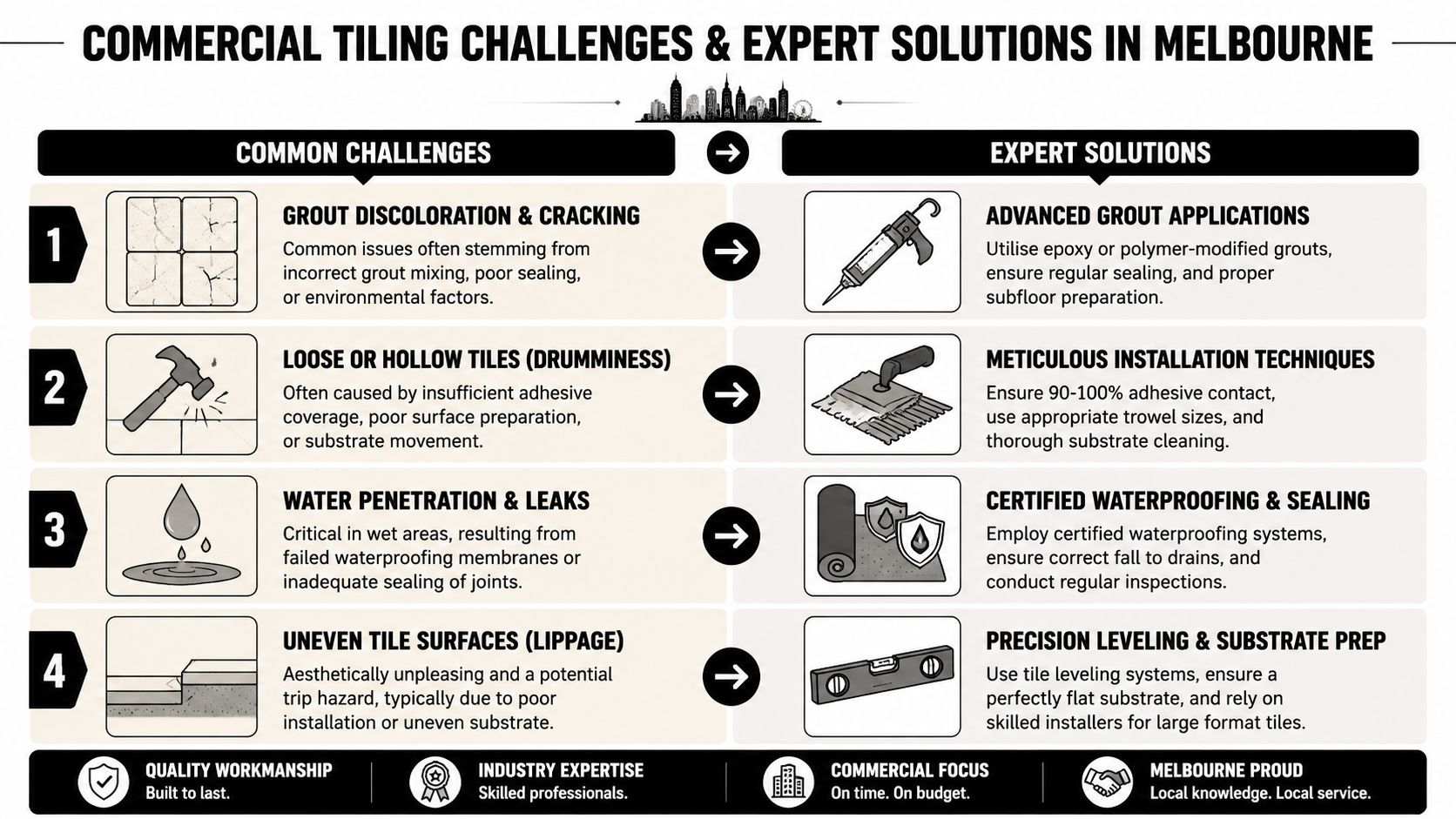
The most expensive tiling problems usually get diagnosed too late. People look at cracked grout, a hollow-sounding tile, or water outside the shower and assume the surface is the problem. Usually it isn't. The tile is just where the failure became visible.
Why patch repairs often fail
A common request is to replace one or two loose tiles, regrout a shower base, or “spot fix” an area that has started leaking. That sounds economical, but it usually avoids the underlying failure point. In wet areas, water doesn't respect the neat outline of a visibly damaged tile.
According to Australian Standard AS 3958.1, spot fixing or patch-installing tiles is non-compliant because it does not provide long-term adhesion and waterproofing integrity, as outlined in this reference to AS 3958.1 guidance on tile installation. If the substrate or membrane has already failed, patching the top layer won't restore the system.
If a shower is leaking, the question isn't which tile to replace. It's where the waterproofing path was broken and what condition the base is in.
The usual root cause is below the surface
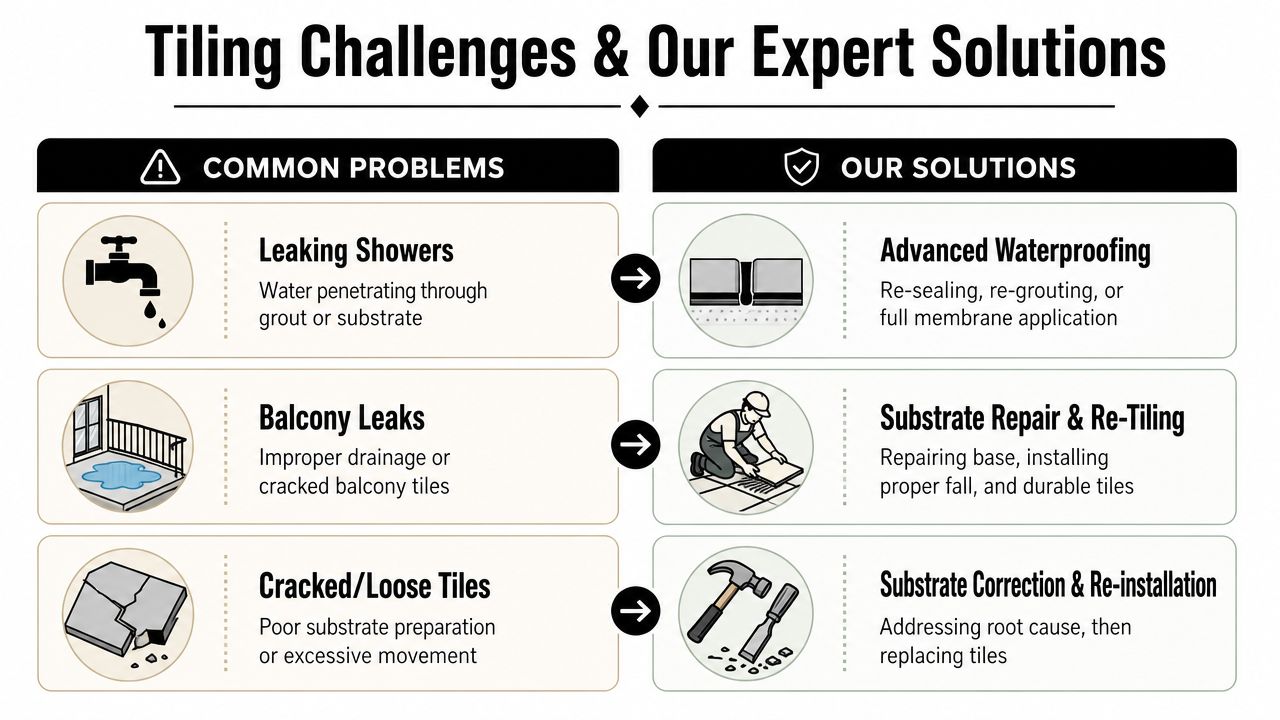
Subfloor instability and unevenness are often neglected in consumer advice, yet they're central to tile performance. The recurring problems are familiar on site:
- Leaking showers: Often tied to membrane failure, poor junction treatment, or movement at penetrations.
- Balcony leaks: Commonly linked to inadequate falls, drainage issues, and water tracking through failed interfaces.
- Cracked or drummy tiles: Usually related to substrate movement, poor bonding coverage, or an uneven base that was never corrected properly.
The right fix starts with diagnosis, not cosmetic repair. In some rooms, rectification means full strip-out, substrate correction, new waterproofing, and complete reinstallation. That sounds heavier than a patch repair because it is. But it's also the only approach that deals with the cause rather than the symptom.
Homeowners often hesitate when they hear that a section must come out completely. That hesitation is understandable. Still, replacing a visible defect while leaving movement, moisture, or poor preparation underneath delays the same failure.
Seven Critical Questions to Ask Your Tiling Contractor
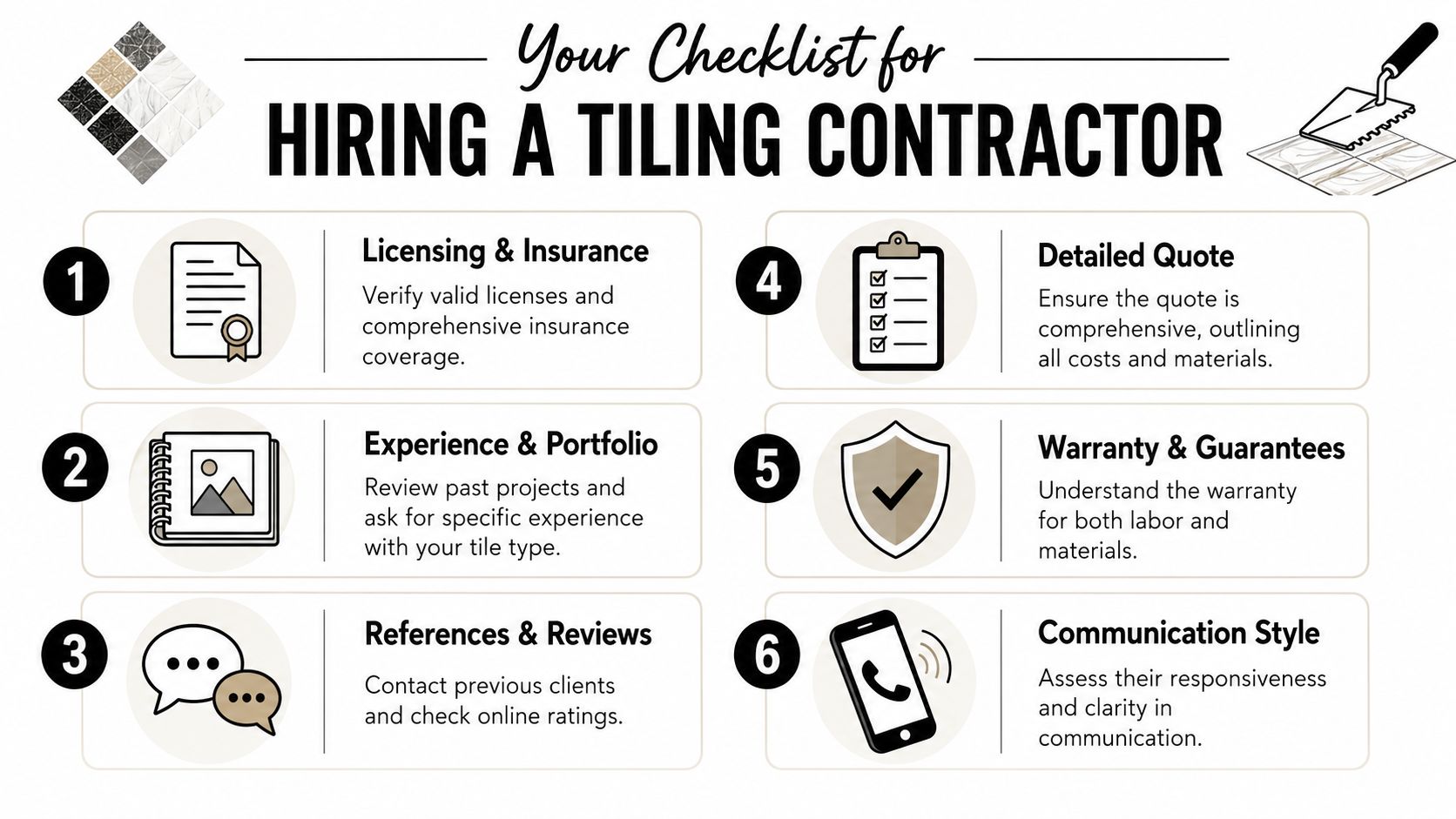
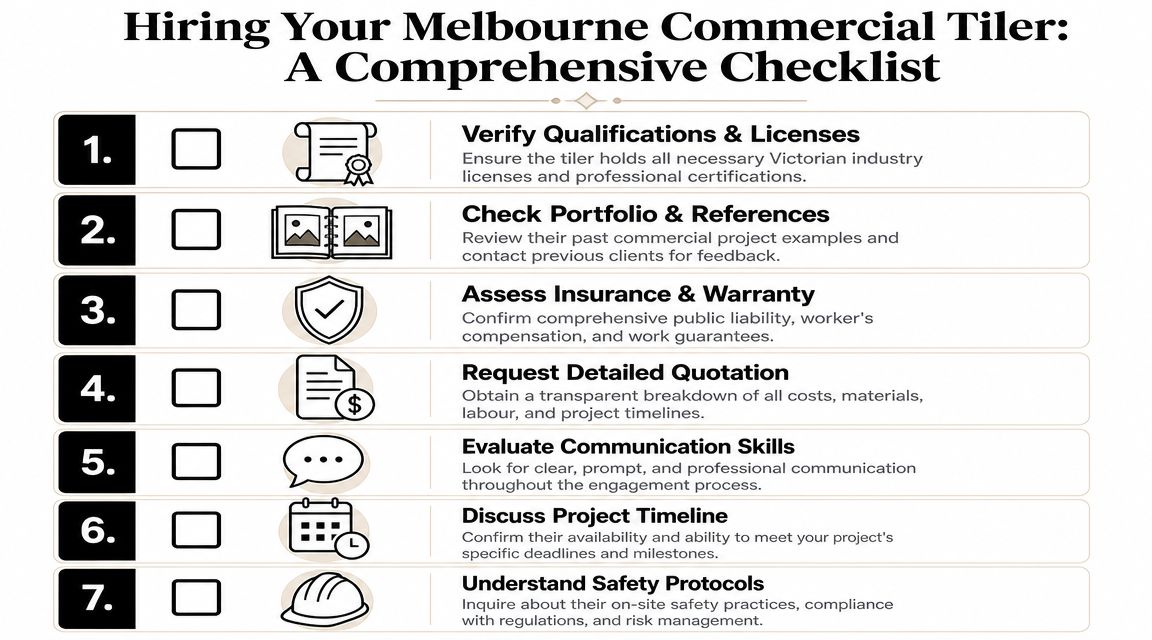
Most bathroom problems can be traced back to one issue at the start. The client didn't know what to ask, and the contractor didn't volunteer the hard details. These questions help expose whether you're dealing with a surface-only tiler or someone who understands the room as a wet-area build.
Are you a registered builder, or only quoting the tiling component?
The answer is critical, as bathroom renovations involve more than tiles. If no one is managing the whole scope, responsibility gets blurred when defects appear.Who handles waterproofing, and what's your wet-area process?
You want a direct answer about sequencing, junctions, penetrations, curing, and how the membrane relates to the rest of the build.What do you do if the subfloor or walls are out of level?
A good contractor will talk about screeding, self-levelling, straightening walls, and checking falls. A weak answer usually jumps straight to adhesive and tiles.How do you prepare for large-format tiles?
This is where experience shows. Large tiles need tighter substrate control, cleaner set-out, and better cutting discipline than small-format work.
Ask for the method, not just the promise. A competent answer includes steps, tools, and who is responsible for each stage.
Who coordinates the plumber, electrician, carpenter, and shower screen installer?
Bathrooms go wrong at interfaces. If trade sequencing is vague, delays and rework usually follow.What is excluded from the quote?
This question saves a lot of grief. Preparation, disposal, tile trims, floor correction, and permit-related items can be left out unless you ask directly.Can you show recent work that matches my type of project?
A contractor may do acceptable basic tiling and still be the wrong fit for a detailed ensuite, a leak rectification, or a large-format bathroom.
The point isn't to interrogate people for sport. It's to protect your project. Good contractors won't be offended by these questions because they already work this way.
The Melbourne Tiling Services Difference
The difference isn't one product or one tile brand. It's the decision to treat a bathroom as a complete building system. That means the job starts with planning, continues through substrate correction and waterproofing, and only then reaches the visible finish.
Registered builders bring structure to that process. Trades are coordinated. Compliance isn't left to chance. Tile installation services sit inside a broader renovation method that protects the room from hidden failures and prevents the usual blame-shifting between separate contractors.
Clients often respond to that clarity more than anything else. A few comments come up again and again: the site stayed organised, the sequencing made sense, and the finished bathroom looked clean because the bones of the room were sorted first. Those aren't flashy claims. They're the signs of disciplined work.
A reliable renovation also feels different during construction. Decisions are documented. Variations are discussed before they become surprises. The room is built with the final result in mind, including details like set-out lines, niches, trims, and frameless shower screen fit.
If you're comparing options, that's the test worth applying. Don't judge the quote by tile samples alone. Judge it by how the contractor handles the parts you won't see once the room is finished.
If you want a clearer path for your bathroom renovation, Melbourne Tiling Services P/L offers practical support from early planning through to completed installation, including quotes, design input, and guidance on preparation, waterproofing, and tile selection.



Recent Comments