

A typical Australian ensuite renovation costs roughly A$14,000 to A$24,000, usually 20% to 30% less than a main bathroom, but compact projects can reach A$30,000 when plumbing moves or premium finishes enter the brief. The room may be small, but waterproofing, drainage, tiling, electrical work, fixtures and compliance still require skilled trades.
Melbourne homeowners often receive quotes that seem impossible to compare. One contractor may be pricing a cosmetic replacement of fixtures, while another is allowing for demolition, new waterproofing, retiling, plumbing alterations and certification. Both quotes can be accurate for their scope, yet neither gives you a useful answer until you separate the work into its actual cost drivers.
That's the purpose of this guide. It treats ensuite renovation cost as a component problem rather than a square-metre problem, then shows where a Melbourne budget is flexible, where it isn't, and when Victorian law requires registered builders.
Table of Contents
- What an Ensuite Renovation Really Costs in 2026
- Matching Scope to Budget from Refresh to Full Remodel
- Where the Money Goes on Trades and Materials
- Why Large-Format Tiles and Waterproofing Cost More
- Sample Ensuite Budgets at Three Price Points
- When Your Ensuite Renovation Legally Needs a Registered Builder
- Your Melbourne Ensuite Price Checklist and Next Steps
What an Ensuite Renovation Really Costs in 2026
The current Australian benchmark for an ensuite sits around A$14,000 to A$24,000, with the smaller 3–5 m² footprint generally making it 20% to 30% cheaper than a main bathroom. The saving comes from less demolition, fewer tiles and fixtures, and shorter trade time. It doesn't eliminate the expensive wet-area work. Once the layout changes, premium waterproofing or high-end finishes are included, the same compact room can move into the A$15,000 to A$30,000 range, as outlined in Australian ensuite renovation cost guidance.
The first step is to identify what you're renovating.
Start with the scope, not the room size
A quote for replacing a vanity and tapware isn't comparable with a quote for stripping the room, altering the shower waste, preparing the substrate, waterproofing and tiling every wall. Ask each contractor to state whether the price includes:
- Strip-out: Removal of existing tiles, fixtures, screens, cabinetry and waste disposal.
- Waterproofing: Preparation, membrane application, detailing around penetrations and compliance documentation.
- Tiling: Tile supply, substrate preparation, cuts, trims, grout and installation.
- Services: Plumbing, electrical work, drainage falls, ventilation and any required carpentry.
- Fixtures: Vanity, basin, toilet, tapware, shower fittings, mirror and screen.
- Compliance: Inspections, certificates, contracts and coordination of licensed trades where required.
This approach exposes the reason a low quote can become expensive. A contractor may have excluded tile supply, assumed the existing waterproofing is serviceable, or allowed for fixtures at a basic level while the owner has selected premium porcelain and a frameless screen.
For another useful comparison of bathroom pricing methodology, review SouthRay Bathroom 2026 pricing alongside your local quotes. It can help you distinguish a broad market guide from a site-specific estimate.
Use a calculator to test the brief
A renovation calculator is useful before you request final prices, particularly when you're still deciding between a standard retile and a full redesign. The Melbourne bathroom renovation calculator can help you organise room dimensions, material choices and upgrades into a clearer starting brief.
Practical rule: If two quotes differ sharply, compare inclusions line by line before assuming one builder is overcharging.
The most reliable budget is itemised. It tells you which costs are fixed by the condition of the room and which are controlled by your selections. That distinction becomes more important once you compare a refresh, a standard remodel and a full redesign.
Matching Scope to Budget from Refresh to Full Remodel
Scope creates the largest price jump in an ensuite. Keeping the toilet, vanity and shower in their existing positions usually limits disruption. Moving a waste, opening walls or changing the shower footprint introduces extra plumbing, building and waterproofing work, even if the room itself hasn't become any larger.
Victoria's broader bathroom renovation guidance places a full project around A$15,000 to A$35,000, with standard work commonly landing around A$20,000 to A$32,000 once demolition, services, waterproofing, tiling and fixtures are included. A separate Melbourne estimate gives a city-wide low-to-high band of A$10,500 to A$21,000. These figures show why a single online average isn't enough for an ensuite, because the scope may range from a surface refresh to a complete wet-area rebuild. The figures are detailed in Victoria bathroom renovation cost guidance.
| Scope tier | What it includes | Indicative cost |
|---|---|---|
| Cosmetic refresh | New tapware, vanity, toilet, mirror, accessories, paint and selected fixture replacements, with the existing layout and sound wet-area finishes retained | Lower end of ensuite pricing, provided no concealed damage or retiling is required |
| Standard remodel | Strip-out, new shower or screen, retiling, waterproofing where required, updated plumbing and electrical work, and replacement fixtures | Commonly within the Australian ensuite benchmark of A$14,000 to A$24,000 |
| Full remodel | Layout changes, moved plumbing, extensive demolition, substrate correction, premium tiles, custom joinery, upgraded screen and detailed compliance work | Can reach the A$15,000 to A$30,000 range or more depending on selections and site constraints |
A cosmetic refresh only works in the right room
A refresh makes sense when the existing tiles are sound, falls drain correctly, the waterproofing has no known failure and the layout functions well. You can change the vanity, basin, tapware, mirror, lighting and shower fittings without disturbing the entire wet area.
It doesn't work as a disguise for movement, cracked grout, loose tiles or recurring leaks. New fittings over a failing substrate may improve the appearance briefly, but they won't correct the underlying problem. If the shower is leaking or the floor doesn't drain properly, price a proper wet-area solution rather than a decorative patch.
The standard remodel is usually the value point
A standard remodel removes the finishes that limit the room, then keeps the plumbing positions broadly where they are. That gives you a new waterproofing system, fresh tilework, updated fixtures and a cleaner result without paying for extensive service relocation.
The price still varies with tile format, wall coverage, screen design and the condition discovered during demolition. A straightforward strip-out and retile is different from rebuilding walls, correcting a floor and moving the shower waste.
Full remodels change the cost category
Layout changes are where many budgets blow out. Moving a toilet or shower can require new pipe runs, altered falls, wall openings, carpentry, additional waterproofing details and more coordination between trades. Premium finishes then add a second layer of cost through specialist handling and installation.
Keeping the layout is one of the most effective ways to control an ensuite budget. It isn't a rule that every home should follow, but it should be a deliberate trade-off rather than an accidental omission.
Where the Money Goes on Trades and Materials
An ensuite remains expensive because its critical work is labour-intensive and regulation-sensitive. The room may have a small floor area, but a plumber still has to connect services, a waterproofer still has to detail penetrations, and a tiler still has to prepare and finish the wet-area surfaces accurately.
Published Australian cost guidance places plumbing at about 20% to 25% of the budget, tile supply and installation at about 20% to 25%, waterproofing at about 5% to 10%, and electrical work at around 10%. These shares explain why reducing floor area doesn't reduce the total in direct proportion. The trade sequence, site access and condition behind the existing finishes often matter more than the room's dimensions.
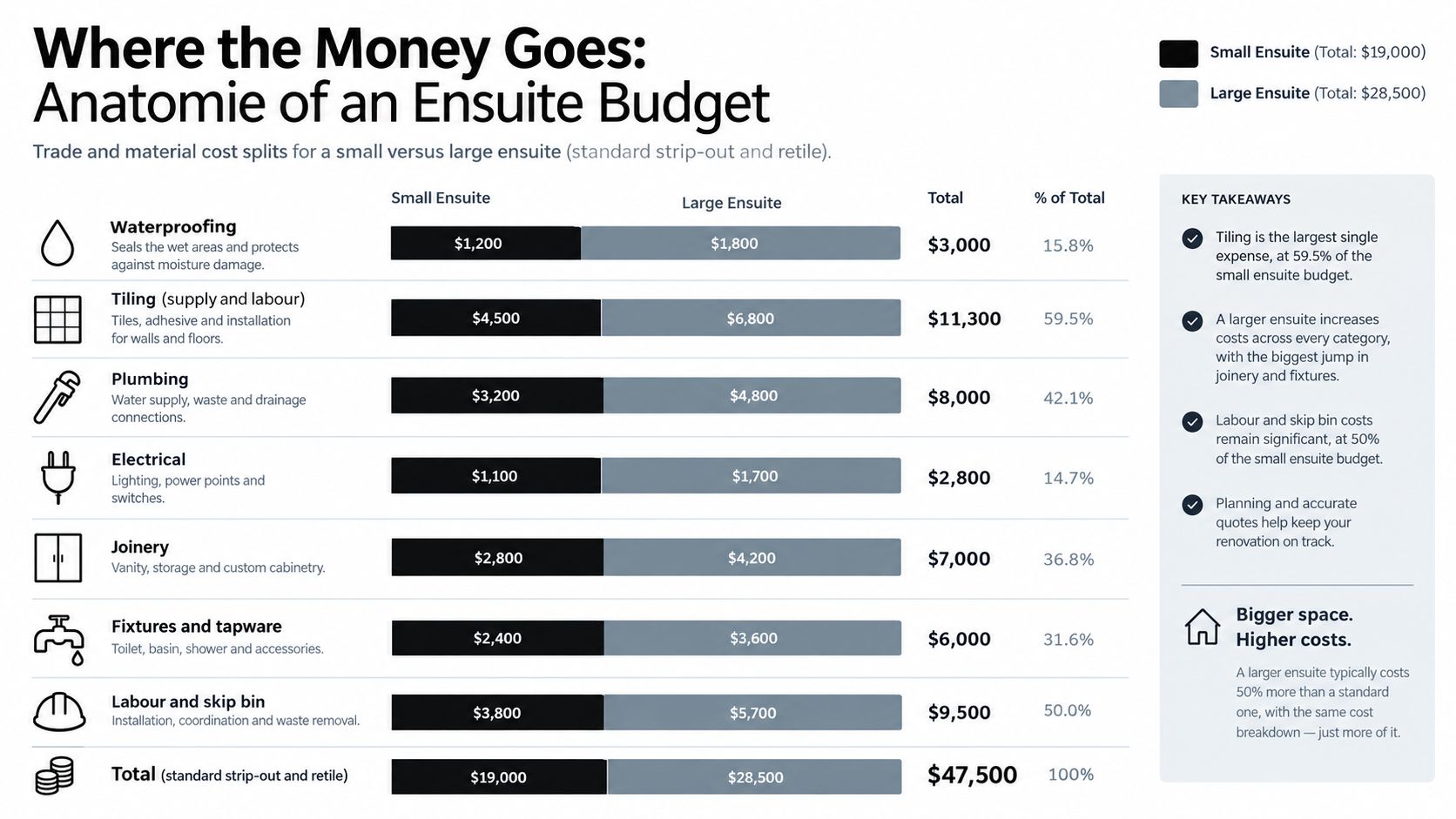
The main cost components
Plumbing becomes costly when fixtures move, pipework needs replacement or the existing drainage doesn't provide the required fall. Keeping the vanity, toilet and shower in their established positions generally reduces disruption, but it doesn't remove the need to inspect connections and waste points.
Tiling includes more than the tile itself. Your allowance needs to cover substrate preparation, layout, cuts, trims, adhesive, grout and installation. A simple ceramic tile pattern is less demanding than detailed niches, mosaics, multiple tile sizes or large-format porcelain.
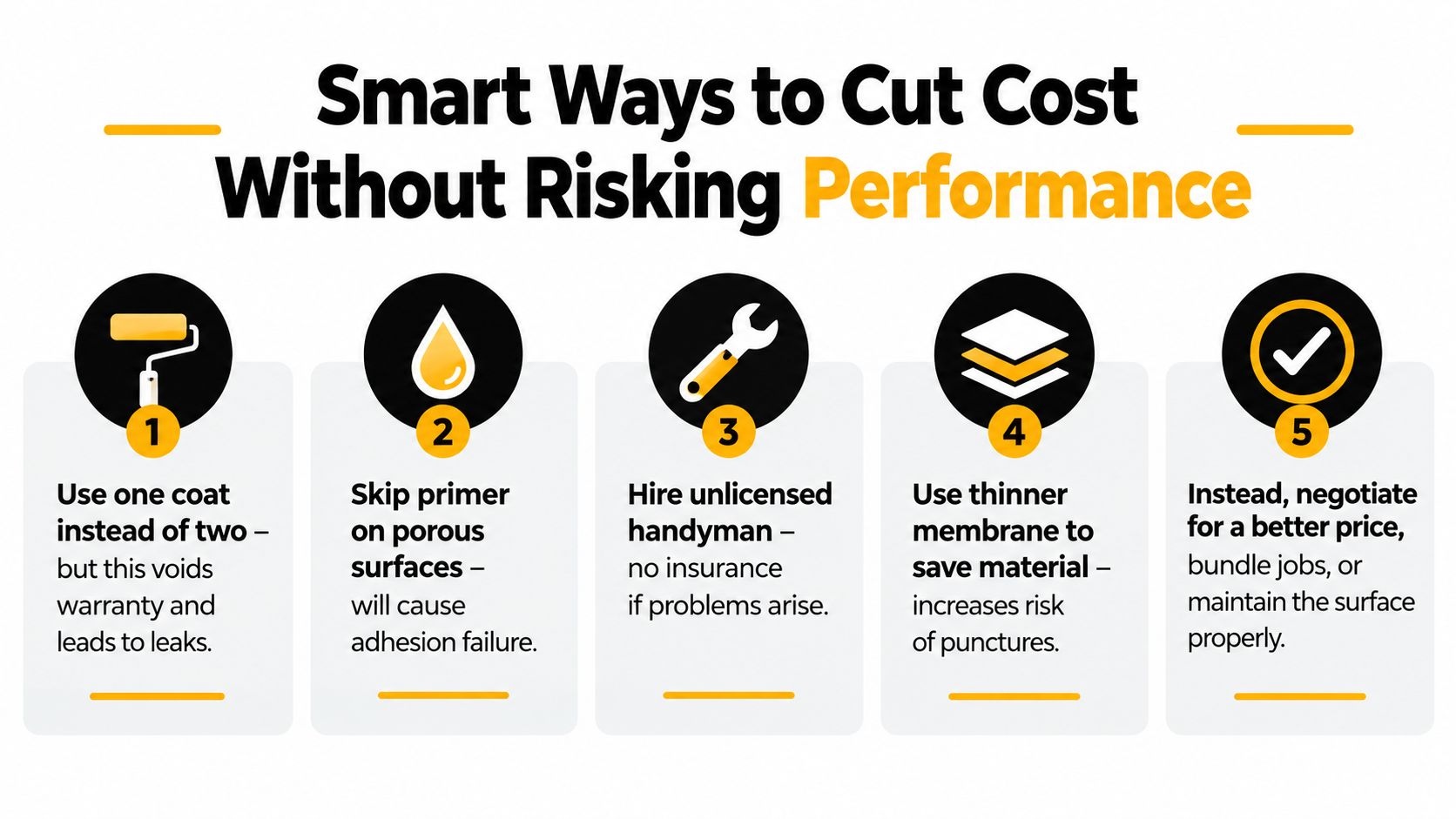
Waterproofing is a smaller share of the overall budget, but it's not a sensible place to economise. The membrane, junction detailing and penetrations protect the structure behind the finished surfaces. A cheap allowance that omits preparation or documentation isn't a genuine saving.
Electrical work covers lighting, exhaust ventilation, switches, power points and compliance. The cost rises when you add feature lighting, relocate points or need work in areas affected by demolition.
Joinery, fixtures, screens and waste disposal then shape the finish level. A stock vanity and standard screen give you more control than custom cabinetry and a frameless glass design, but both still need accurate installation.
Why the national average has moved
The Housing Industry Association's recent figures put the average Australian bathroom renovation at about A$26,000, with a typical range from A$8,000 to A$35,000 or more. Sources citing HIA data say the earlier average was around A$21,000, rising to A$26,000, a 24% increase associated with labour costs, material prices and higher-specification choices, as reported in HIA bathroom renovation cost coverage.
That national bathroom figure isn't an ensuite quote. It is a useful warning against relying on older pricing, especially when comparing a recent Melbourne estimate with a renovation completed several years ago. Labour coordination and finish selections can push a small project into a higher bracket quickly.
Why Large-Format Tiles and Waterproofing Cost More
Waterproofing is like insurance you never see until it fails. Once the tiles, grout and fixtures are installed, the membrane disappears from view, but its preparation and detailing determine whether water stays within the wet area or reaches the framing, floor structure and adjoining rooms.
The economical choice is not a thinner membrane or a rushed application. It is a clear specification, suitable substrate preparation, proper detailing around penetrations and a certificate or documentation trail that shows the work was completed correctly. Cutting that process can create rectification work that costs far more than the original saving.
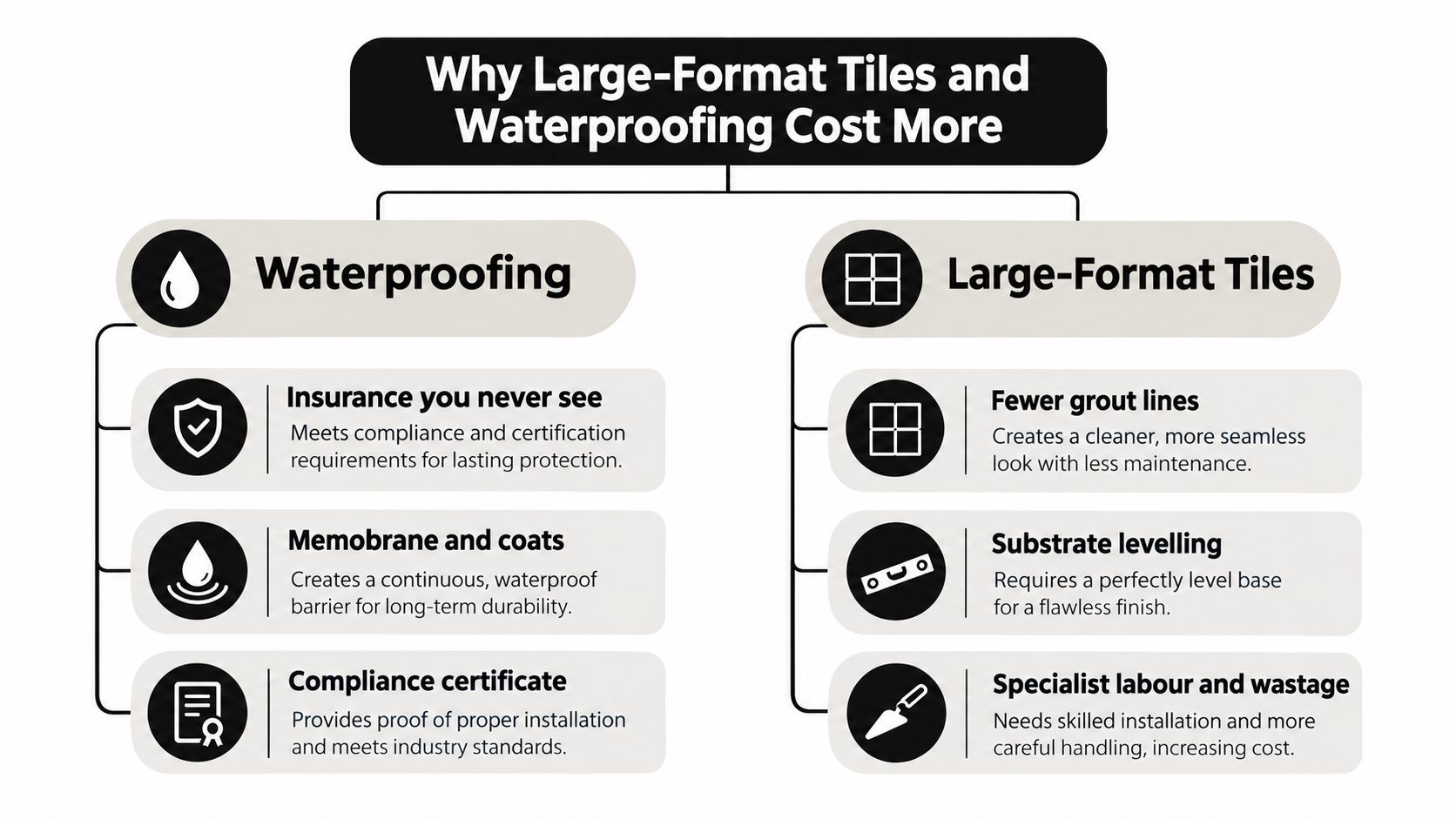
Waterproofing has little room for compromise
A wet-area floor needs appropriate drainage fall, and wall junctions, corners, niches, penetrations and floor wastes need careful treatment. The waterproofer can't just apply a product over a poorly prepared surface and expect the finished tilework to solve the problem.
Premium waterproofing doesn't mean paying for unnecessary features. It means allowing enough time and material for the actual substrate and design, then coordinating the tiler so later work doesn't damage the completed membrane.
Large-format tiles transfer risk to preparation
Large-format porcelain and products such as Kerlite can create a clean appearance with fewer grout lines, but the installation demands greater accuracy. The substrate needs to be flat enough to support the tile, and the installer must manage handling, cuts, adhesive coverage, alignment and movement through the room.
Screeding or self-levelling may be necessary before installation. A tile that looks straight in a sample board can show lippage or uneven joints when the substrate isn't prepared properly. Large pieces can also create more expensive wastage if a cut is wrong or access is difficult.
The large-format tile installation cost guide is useful when you're comparing standard ceramic, porcelain and Kerlite options, because the product price is only one part of the installation allowance.
Spend on the structure, then choose the finish
Recent Australian renovation commentary identifies scope, site constraints and finish level as stronger sources of price variation than size alone. Cosmetic work can often be upgraded economically, but moving plumbing or selecting premium large-format materials changes the labour and preparation requirements, as explained in Australian bathroom renovation cost commentary.
Save on colour changes, accessories and replaceable styling items before you save on waterproofing, drainage fall or substrate preparation.
Sample Ensuite Budgets at Three Price Points
A useful budget conversation starts with three different rooms, not three different tile colours. The first room needs a visual update, the second needs a complete wet-area renewal while retaining the layout, and the third needs the services and finishes redesigned.
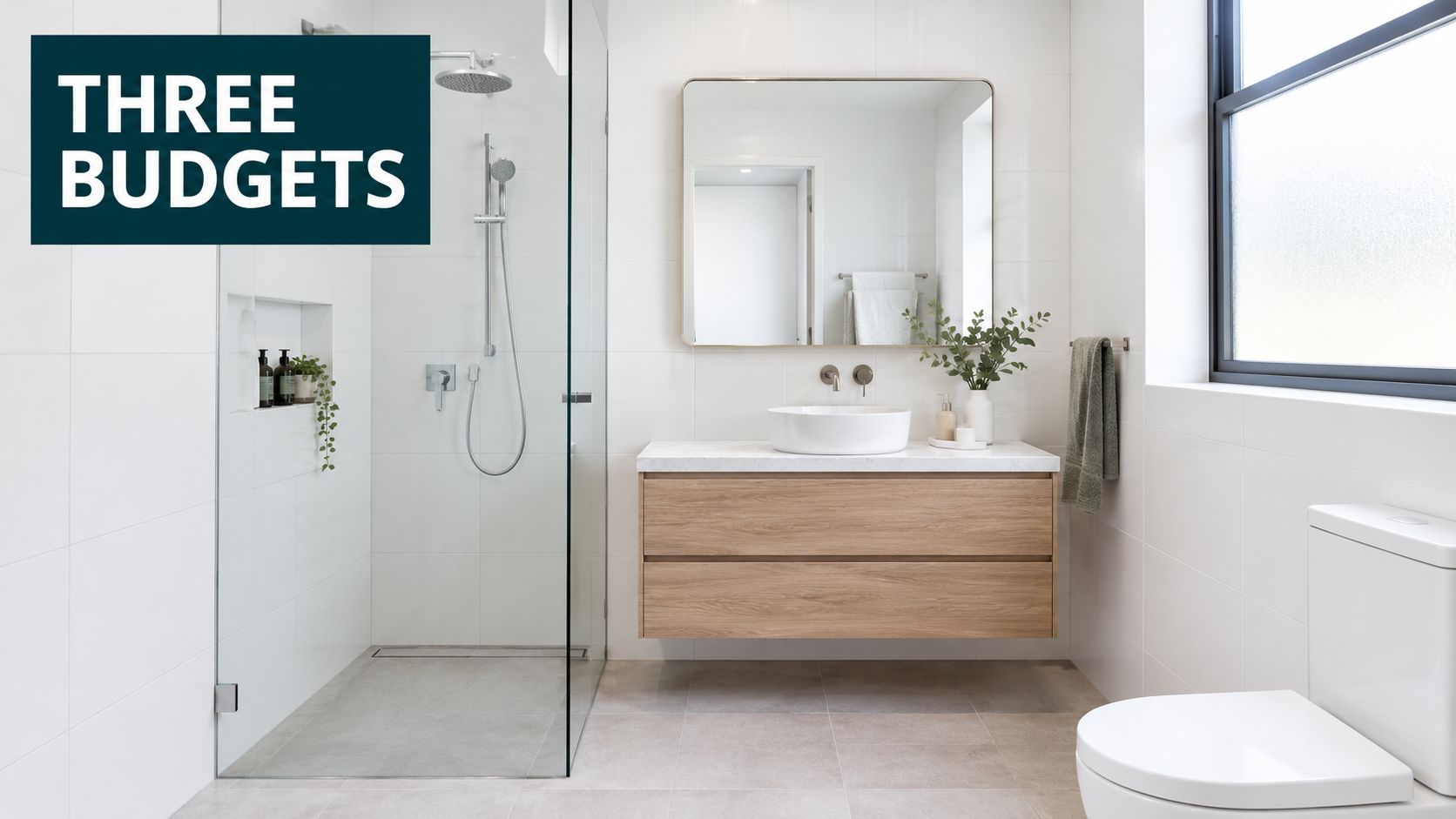
The tight refresh
The owner keeps the shower, vanity and toilet positions. The tiles and waterproofing are sound, so the work focuses on a new vanity, basin, tapware, mirror, paint, lighting and selected shower fittings.
This is the only scenario where a compact ensuite can remain near the lower end of the market without compromising the wet-area system. The risk is hidden condition. If demolition reveals movement, water damage or failed waterproofing, the project is no longer a cosmetic refresh and the quote needs to change before work continues.
The standard strip-out and retile
The existing finishes are removed, the layout stays broadly unchanged, and the room receives new waterproofing, floor and wall tiles, shower fittings, vanity, toilet, lighting and screen. A basic version of this scope is often discussed around a median of approximately A$10,000 by Melbourne renovation providers, but the final figure depends on inclusions, substrate condition and fixture choices.
Standard ceramic or mid-range porcelain provides more predictable handling than premium large-format sheets. The owner can still create a strong result by selecting one feature tile, using a practical vanity and avoiding unnecessary plumbing changes.
A standard project also needs a real allowance for strip-out and disposal. A quote that omits those items may look attractive but won't describe the cost of delivering a finished room.
After the room's scope has been established, the decision points become easier to see in a visual example.
The premium remodel
The premium scenario moves the shower or vanity, corrects the floor, uses large-format porcelain or Kerlite, adds custom joinery, and installs a frameless shower screen. Each choice adds work beyond the product price. Relocated plumbing needs coordination, large tiles need better substrate preparation, and custom glass requires accurate finished dimensions.
The owner can reduce the risk of runaway cost by choosing which element matters most. Keep the layout and spend on the tile, or retain a standard tile and invest in joinery. Doing everything at the highest specification is the fastest route into the upper end of the A$15,000 to A$30,000 compact-project range.
When Your Ensuite Renovation Legally Needs a Registered Builder
A common mistake is treating an ensuite as too small to need formal building oversight. In Victoria, the value and nature of the work matter more than the room label. A builder or tradesperson must be registered with the Building and Plumbing Commission for work worth more than A$10,000, with exceptions for some single-trade work such as tiling, plumbing, painting, electrical, glazing, plastering or insulating. Victorian consumer guidance also warns that an owner can't obtain Home Warranty insurance if the builder isn't properly registered. Check the Victorian guidance on builders and tradespeople before signing a major domestic building contract.
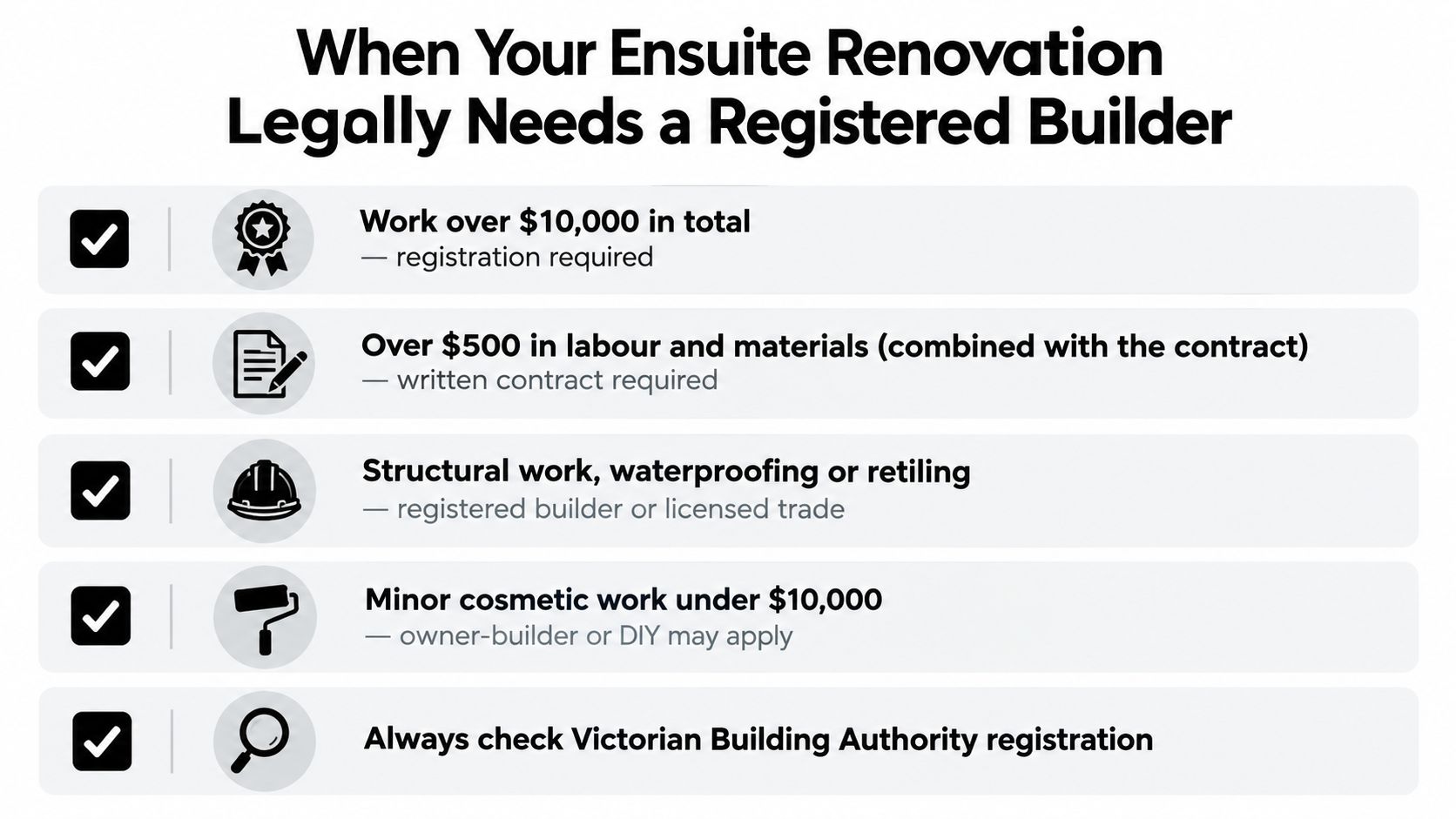
Why two or more trades changes the arrangement
An ensuite remodel commonly involves demolition, carpentry, plumbing, electrical work, waterproofing and tiling. Once the project combines several trades and passes the relevant value threshold, you need an accountable structure, not just a collection of separate verbal arrangements.
A registered builder can coordinate the sequence, engage the relevant licensed trades and manage responsibility for the completed work. That coordination matters because waterproofing must be completed before tiling, rough-in services must be set before walls are closed, and screens and fixtures depend on finished levels being accurate.
A Melbourne building source also identifies bathrooms, laundries and kitchens as major construction works when the project exceeds A$10,000 and involves two or more trades, with registered builders responsible for managing that work. Its registered builder renovation guidance provides additional context for homeowners comparing a single contractor with separate trade bookings.
Verify before you sign
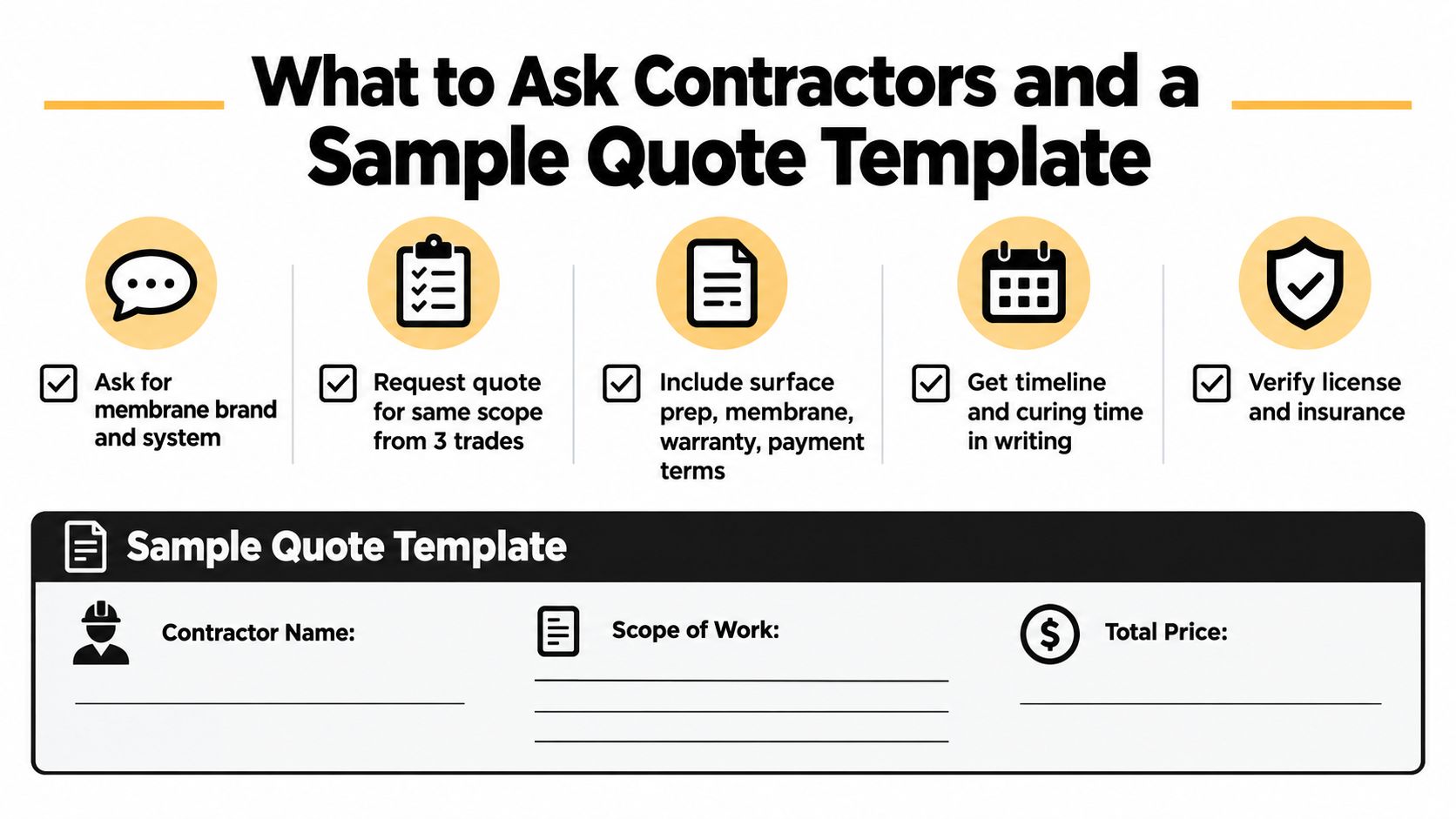
Ask for the builder's registration details and confirm them with the relevant Victorian authority. Don't rely only on a business name, a vehicle sign or a social media profile. The contract should also state the scope, price, payment arrangements, inclusions, exclusions and responsibility for certificates.
Pay particular attention to waterproofing documentation. A Victorian waterproofing compliance certificate resource can help you understand what paperwork to request and why it belongs in the handover file.
Registration doesn't make every quote competitive, but it gives you a clearer legal and contractual framework for a multi-trade renovation.
Some minor single-trade work may fall within an exception, but homeowners shouldn't use that exception to split a complete renovation into informal pieces to avoid proper oversight. If the project includes a new wet area, retiling, services and fixtures, obtain advice based on the full scope.
Your Melbourne Ensuite Price Checklist and Next Steps
Before accepting a quote, write down the decisions that control the price:
- Choose the scope tier. Confirm whether you're refreshing fixtures, completing a standard strip-out and retile, or changing the layout.
- Keep or move the plumbing. Price both options if you're unsure, then compare the gain in function with the extra coordination.
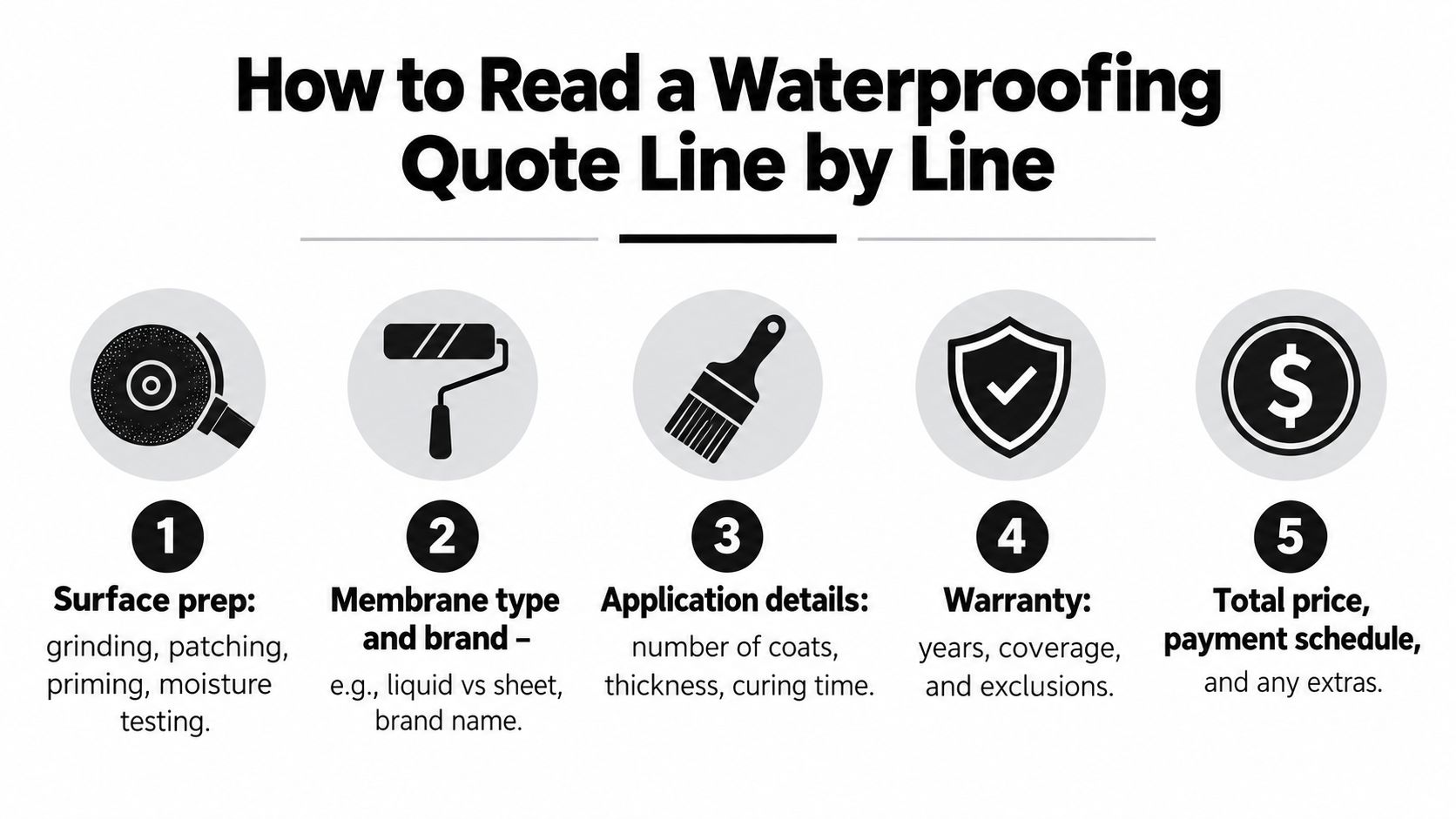
- Request an itemised quote. Separate strip-out, waterproofing, tiling, fixtures, services, waste disposal and compliance.
- Confirm the finish level. Name the actual tile, vanity, tapware, screen and lighting selections rather than relying on “standard” or “premium”.
- Check registration. If the full domestic building work is above A$10,000, confirm whether a registered builder is required and verify the registration before signing.
- Ask about the handover file. Include waterproofing records, certificates, product information and final documentation.
Use a calculator to pressure-test your brief before requesting final prices. A tool that accepts room size, materials, fixture selections and upgrades gives you a more useful starting point than a generic online average, while a site inspection remains essential for checking falls, substrate condition, access and concealed services.
A successful Melbourne ensuite isn't defined by the most expensive tile. It comes from a clear scope, honest component pricing, sound waterproofing and a finish level that suits the home's use.
Melbourne Tiling Services P/L offers start-to-finish ensuite renovations, waterproofing, screeding, self-levelling, premium porcelain and Kerlite tiling, frameless shower screens, free quotes and 3D drawings across Melbourne and greater Victoria. Visit Melbourne Tiling Services P/L to discuss your scope, test the budget with a renovation calculator and request a transparent quote.
Recent Comments